

Portfolio construction..5 min read
The lower number is your profile
A real risk profile scores willingness and capacity separately out of 50 and takes the lower one, which is how a self declared daredevil with an eight month horizon ends up conservative.
By Tanmay Kurtkoti, founder of QC Alpha and builder of RupeeCase
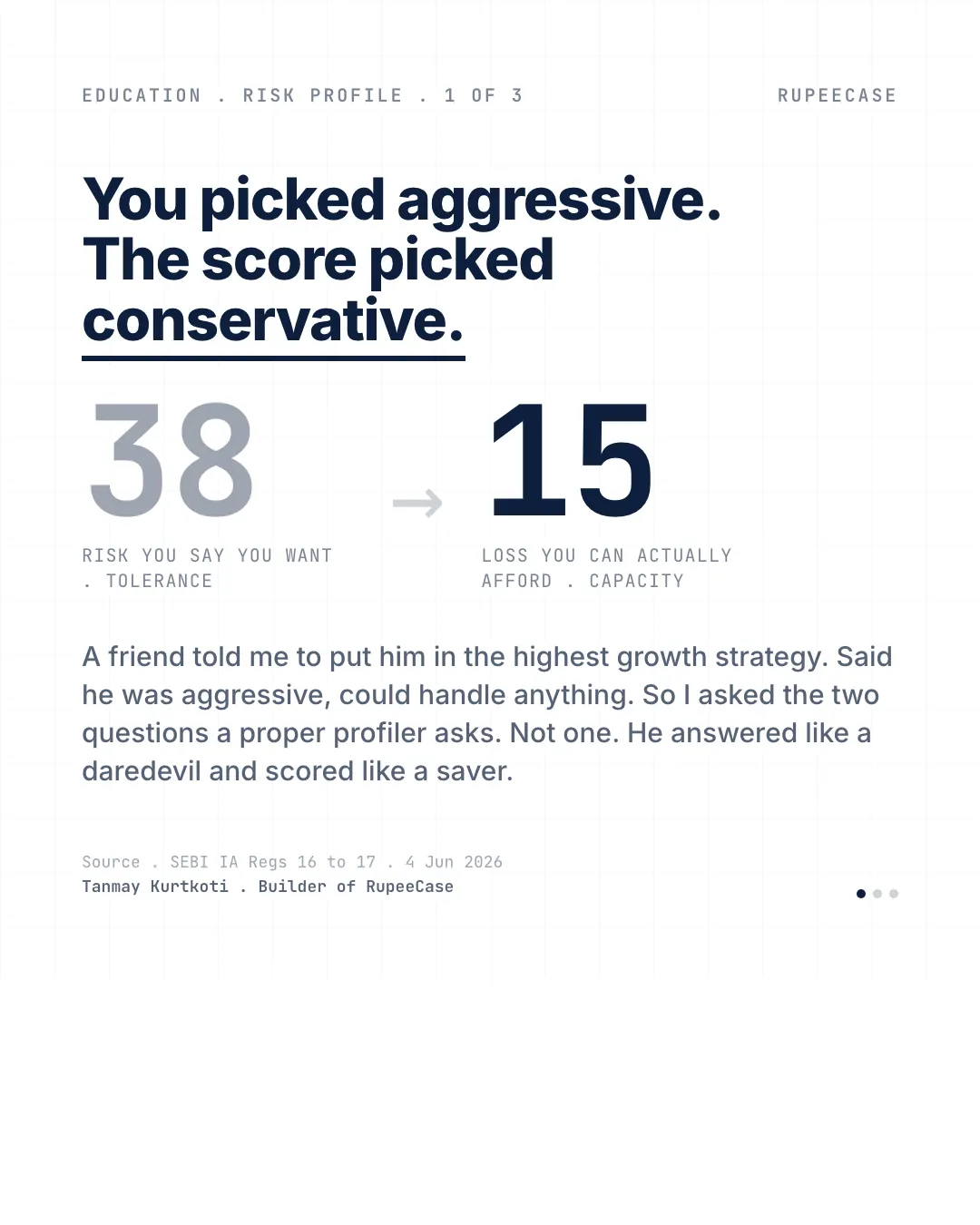
A friend texted me last week to put him in the highest growth strategy on the shelf. Said he was aggressive. Could handle anything.
I did not argue. I asked him the two questions a real risk profiler asks. Not one.
Here is the thing almost every five question quiz gets wrong. It asks how much risk you want, prints "Moderate," and sends you on your way. One axis. A feeling, dressed up as an assessment.
A proper profile asks two separate things. How much risk are you willing to take, which is temperament, how you behave when the screen is deep red. And how much loss can you actually absorb, which is math. Your horizon. Your emergency fund. Your debt. Whether this money has a job in the next three years. The first is tolerance. The second is capacity. They are different numbers, and they are rarely close.
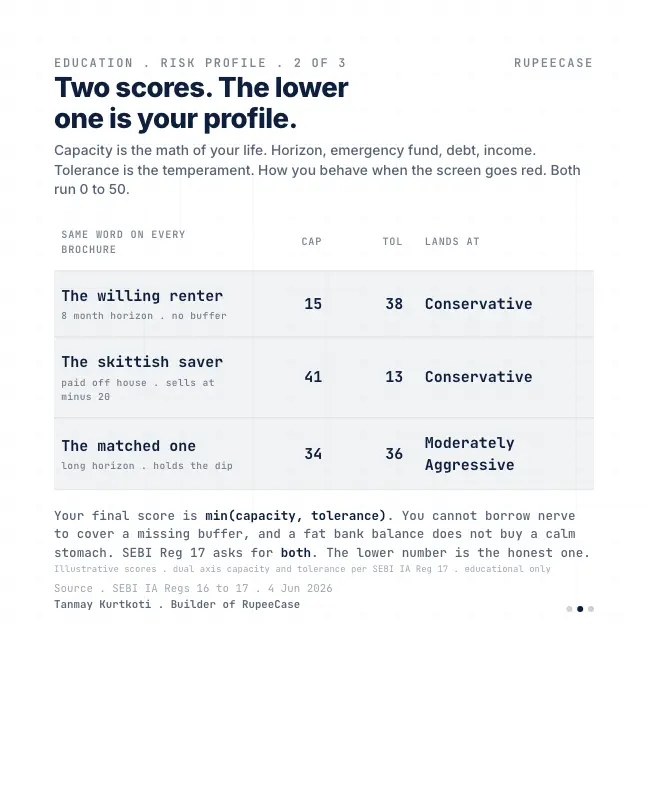
So you score both, each out of 50, and your profile is the lower of the two.
My friend answered the scenario questions like a daredevil. Scored high on tolerance. Then the capacity side came in. Eight month horizon, no real buffer, the deposit half borrowed. His capacity was a quarter of his tolerance. The honest profile is the lower one. He came in wanting aggressive and walked out genuinely conservative, and he was relieved, because nobody had ever shown him the gap.
It cuts the other way too. The fifty year old with a paid off house and a fat buffer who sells everything at minus 20. Loads of capacity. Almost no tolerance. Same conservative answer, opposite reason.
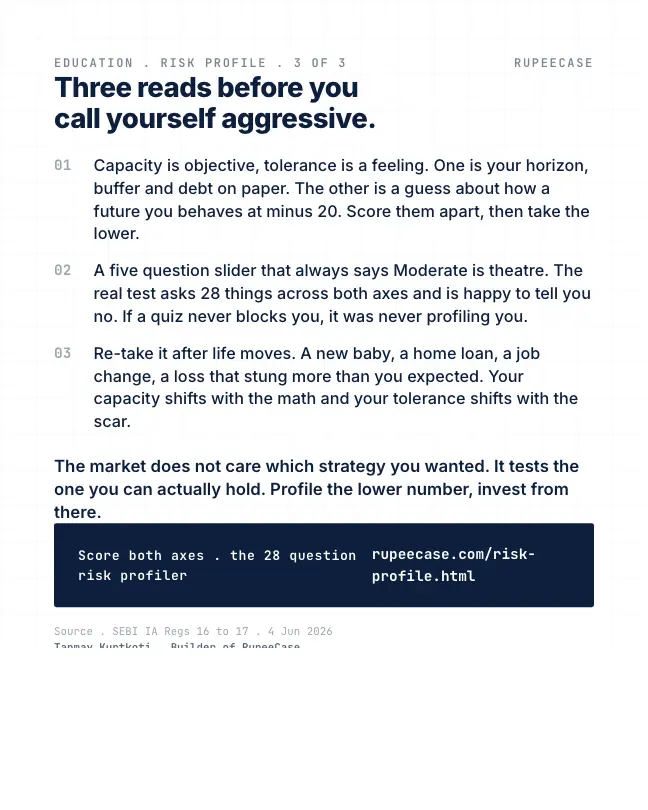
SEBI's adviser rules ask for both for exactly this reason. You cannot borrow nerve to cover a missing buffer, and a healthy bank balance does not buy a calm stomach. If a quiz never tells you no, it was never profiling you.
Score both axes. Take the lower. Invest from there:
The third line is the trap. Average the two and the friend looks like a middle of the road investor at 27.5. Neither of his real numbers is anywhere near that. The average describes a person who does not exist.
Why an eight month horizon caps everything
Capacity is mostly about time. An equity fall needs time to recover, and the recovery time is not something you get to choose. NSE closing data from the last two years shows how long that can be, even for broad indices. Each wait below starts at the index's record close, after falls of 15.8 percent for the Nifty 50, 21.1 for the Midcap 150 and 26.1 for the Smallcap 250.
Nifty 50 back above its Sep 2024 record
NSE closes, 26 Sep 2024 to 2 Jan 2026
Nifty Midcap 150 back above its Sep 2024 record
NSE closes, 24 Sep 2024 to 2 Jan 2026
Nifty Smallcap 250 still below its Sep 2024 record
NSE closes, 23 Sep 2024 to 12 Oct 2026
Put the friend's eight month horizon next to those numbers. Even the Nifty 50 took about 15 months, nearly twice that, to climb back above its record. His tolerance said he could watch a 30 percent fall without blinking. His calendar said the money had to be whole in eight months. Only one of those is negotiable, and it is not the calendar.
Two people, the same answer
Tolerance high, capacity low
- Eight month horizon, money already promised
- No emergency fund, part of the deposit borrowed
- A fall at the wrong time forces a sale
Capacity high, tolerance low
- Paid off home, a long horizon, a large buffer
- Sells everything at minus 20, every time
- A fall at any time triggers a sale
Both end up cautious, and for both that is the profile they can actually live with. The difference is what can change. Capacity can grow: a buffer can be built, debt paid down, a goal date moved. Tolerance changes slowly, if at all, and mostly through experience of sitting through a fall with a plan.
Building capacity first
The quickest lever on capacity is the emergency fund. Six months of expenses held outside the market means a job loss or a medical bill does not force a sale at the bottom. On monthly expenses of Rs 60,000, that is Rs 3,60,000. Until it exists, every rupee in equity is also, quietly, your emergency fund.
- Build the bufferSix months of expenses outside the market, so no bill forces a sale.
- Clear expensive debtA loan at a high rate is a guaranteed cost that no portfolio reliably beats.
- Date every goalMoney needed within three years has little capacity for an equity fall.
- Then read your toleranceOnly now does nerve decide where you sit, inside the room capacity leaves.
SEBI's Investment Advisers Regulations write the same idea into the rule book. The risk profiling regulation asks an adviser to assess a client's capacity for absorbing loss, and to update the assessment periodically, because capacity changes with life.
The free Learn module on risk management covers drawdown limits and how to size risk to a plan. The emergency fund calculator sizes the buffer from your own expenses. For the feeling side of the same coin, read the calm day contract.
Questions readers ask
What is the difference between risk tolerance and risk capacity?
Tolerance is how much loss you can watch without selling, a matter of temperament. Capacity is how much loss your finances can absorb, set by horizon, buffer, income and debt. A sound profile scores both and uses the lower.
Can I invest aggressively if I have a high risk tolerance?
Only if your capacity is also high. With a short horizon or no emergency fund, a fall can force a sale whatever your nerve. On NSE data, even the Nifty 50 took 463 days to close above its Sep 2024 record again after a 15.8 percent fall.
Does SEBI require risk profiling?
Yes, for registered investment advisers. The Investment Advisers Regulations require an adviser to profile each client's risk, including the capacity for absorbing loss, and to update that assessment periodically.
The cards
3 cards. Swipe, or tap to open.
Reading path
Stop 6 of 10 on Start here
Related
- The calm day contractThe same investor scored Moderately Aggressive on a quiet day and Conservative three weeks into a wobble, so fill the profile on a boring day and treat it as a contract.Portfolio construction . . 5 min
- The conservative starter is a drawdown number, not a nameMost investors tick the box for a 40 percent drawdown and panic at 15 to 20, which is why the first SIP should be sized to the worst window you would keep adding into.Portfolio construction . . 5 min
- A risk profile has an expiry dateTwo years from a college goal, a 35 percent crash leaves a 90 percent equity saver Rs 10 lakh short while one who glided to 25 percent equity lands funded.Portfolio construction . . 6 min
Educational content only. Figures are illustrative and computed on historical or representative data for teaching purposes, not investment advice. Past performance does not guarantee future returns. Sourced from NSE, BSE, SEBI, AMFI and RBI public data.