

Costs: MF, PMS, RupeeCase..6 min read
Direct vs regular: the finder's fee you pay forever
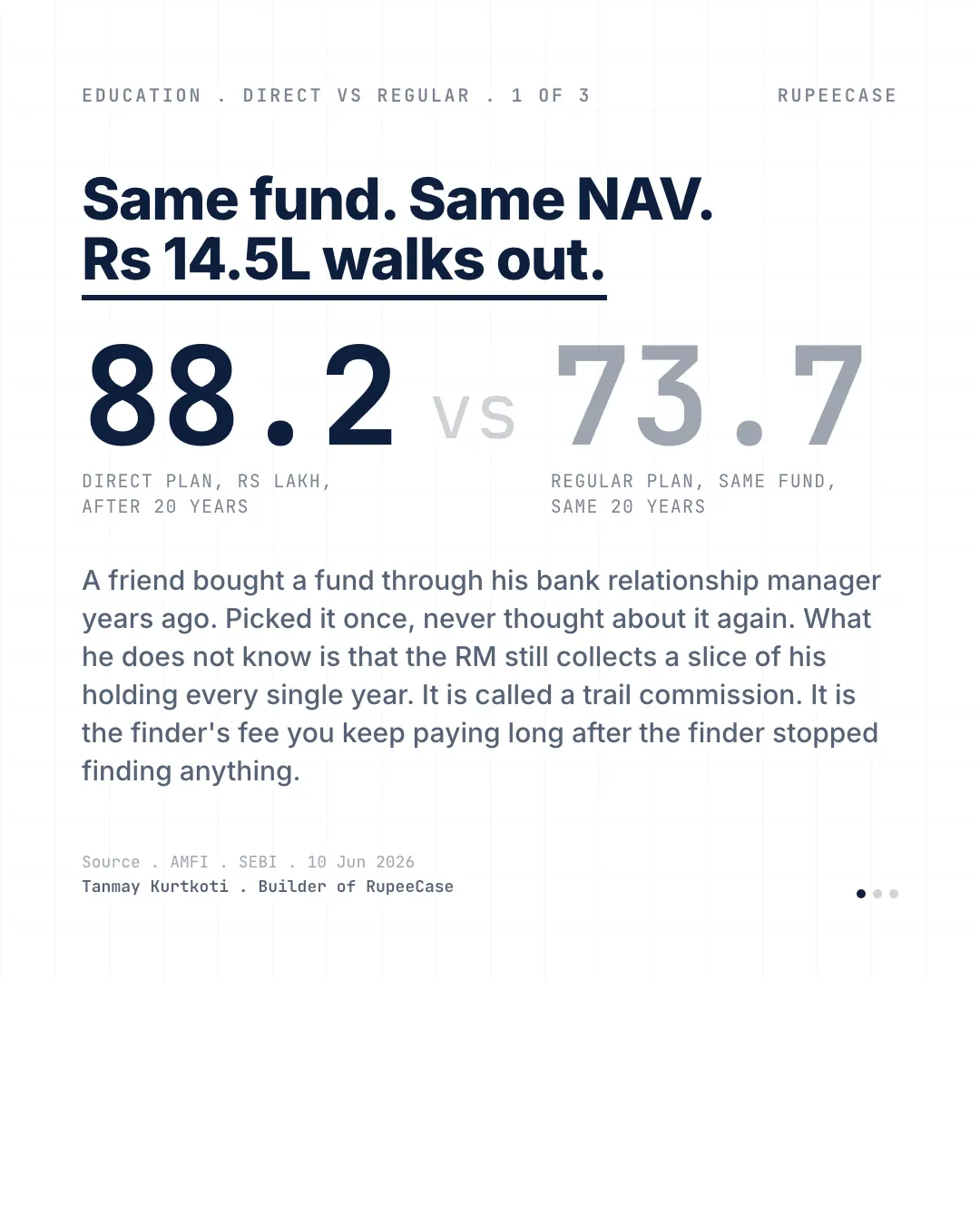
A one point trail commission on Rs 10 lakh over twenty years costs Rs 14.5 lakh, almost one and a half times the original cheque, for a fund sold once.
By Tanmay Kurtkoti, founder of QC Alpha and builder of RupeeCase
A friend has held the same equity fund for years. He bought it through his bank relationship manager, picked it once, and never thought about it again. He thinks his only cost is the market having a bad year now and then.
What he does not know is that the RM still takes a slice of his holding. Every single year. For doing nothing since the sale.
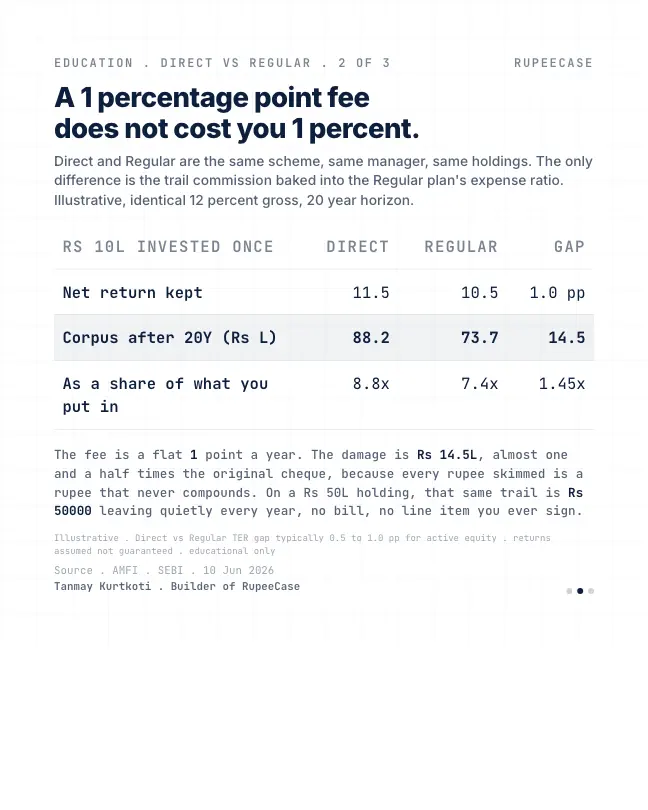
It is called a trail commission, and here is the part most people miss. Direct and Regular plans are the same scheme. Same manager, same stocks, same NAV, same everything. The only difference is that the Regular plan's expense ratio carries the trail commission paid to whoever sold it to you. For an active equity fund that gap is usually about one percentage point a year.
One point sounds like rounding error. So I ran it.
Rs 10 lakh, twenty years, identical 12 percent gross return on both. The Direct plan keeps 11.5 percent and grows to about Rs 88.2 lakh. The Regular plan keeps 10.5 and grows to about Rs 73.7 lakh. That one point of fee did not cost one percent of the money. It cost Rs 14.5 lakh, almost one and a half times the original cheque.
Here is why the damage is so much bigger than the fee. A fee is not a one-time cost, it is a compounding leak. Every rupee skimmed this year is a rupee that never grows in any of the years after. On a Rs 50 lakh holding, a one percent trail is Rs 50,000 walking out the door annually. No bill arrives. No line item you ever sign.
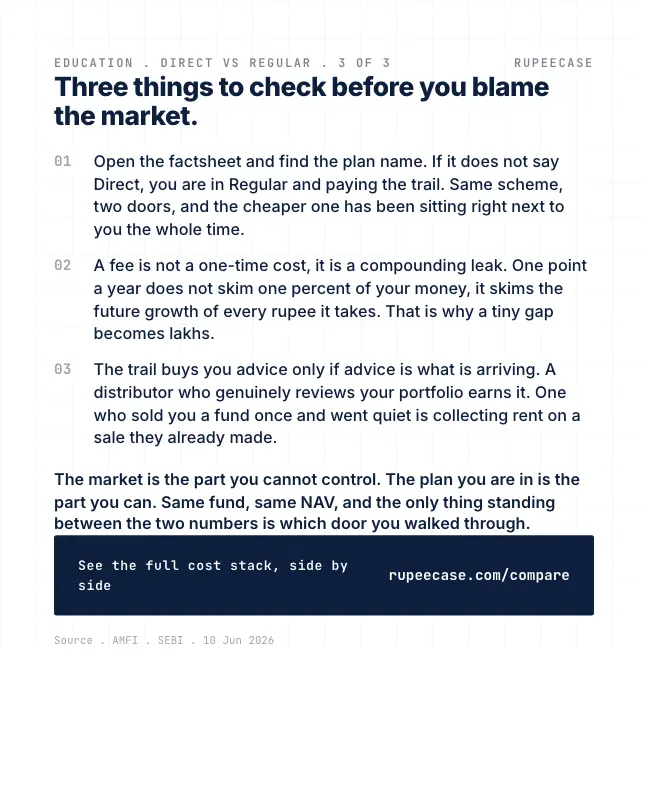
None of this means a distributor is a villain. The trail is fair payment if real advice is actually arriving, someone reviewing your portfolio, rebalancing, talking you out of panic selling. The leak is the case where a fund was sold once and the person went quiet, and the commission keeps coming anyway.
The market is the part you cannot control. The plan you are sitting in is the part you can. Open the factsheet. If it does not say Direct, you already know which door you walked through.
Where the Rs 14.5 lakh actually goes
The Rs 14.5 lakh gap in the opening has two parts, and splitting them shows why one point does so much damage. Start with the regular plan growing at 10.5 percent a year. Each year the trail takes about one percent of whatever the holding is worth that year. Add those yearly slices over twenty years and the commission itself comes to about Rs 6.7 lakh.
The rest, about Rs 7.8 lakh, was never paid to anyone. It is the growth those Rs 6.7 lakh would have earned had they stayed invested. That is the compounding leak: the fee is taken once, and its absence is felt every year after.
trail commission paid over 20 years
Worked example, Rs 10 lakh, 1% a year
growth those rupees never earned
Worked example, 11.5% against 10.5%
total gap, direct against regular
Worked example, Rs 88.2 L against Rs 73.7 L
The same leak on a monthly SIP
Most people do not hold a lump sum. They run a SIP from salary. The leak works the same way, a little smaller because the early rupees are few. Rs 10,000 a month for twenty years is Rs 24 lakh put in. At 11.5 percent a year it grows to about Rs 86.6 lakh in the direct plan. At 10.5 percent, the regular plan, about Rs 76.8 lakh. A gap of about Rs 9.8 lakh on Rs 24 lakh of savings.
How direct plans came to exist
None of this was a choice for Indian investors until 2013. Before that, every scheme had one expense structure and the commission was in it whether or not anyone advised you.
- SEBI orders a separate direct plan
Lower expense ratio, separate NAV, no commission paid from it.
- Direct plans go live
Every scheme offers both plans on the same portfolio.
- Commission shown in rupees
The half yearly CAS lists the gross commission paid on your money, scheme by scheme.
- Fee caps rebuilt
The base expense ratio excludes statutory levies; the TER shows each part.
So the information the friend in the opening was missing has been on his own statement since 2016. The half yearly Consolidated Account Statement, for the periods ending September and March, shows the commission his relationship manager's firm received against his holding. It also shows the average expense ratio of his plan. If the plan name has no "Direct" in it, there will be a rupee figure in that column.
Checking whether the trail is earning its keep
The opening says the trail is fair when advice is arriving. That is a test you can run, because advice leaves traces.
- Read the CASFind the rupee commission against each regular plan scheme.
- List the contactReviews, rebalancing calls, a conversation during the last fall. Anything in the last year?
- Price itCompare the commission with what that service would cost you directly.
- Count the switch costA move to direct is a redemption: tax on gains and any exit load.
The last step matters. Moving from the regular plan to the direct plan of the same scheme counts as selling and buying. Equity fund units held more than 12 months are taxed at 12.5 percent on gains above Rs 1.25 lakh a year; inside 12 months, at 20 percent, plus any exit load. Units already past a year carry the smallest switching bill, and fresh SIP instalments carry none at all.
The free Learn module on mutual fund structure and hidden costs has a direct against regular calculator, a myth check on NAV and a quiz. The fee drag calculator runs any fee over any horizon. Related posts: IDCW against Growth and pull your CAS before you buy a seventh fund.
Questions readers ask
What is the difference between a direct and a regular mutual fund plan?
Both hold the same portfolio with the same manager. The regular plan's expense ratio includes a commission paid to the distributor who sold it; the direct plan, available since 1 Jan 2013, pays none and has a separate, higher NAV over time. For active equity funds the gap is often about one percentage point a year.
How much does a regular plan cost over 20 years?
On Rs 10 lakh with a one point yearly difference, 11.5 against 10.5 percent, the direct plan ends near Rs 88.2 lakh and the regular near Rs 73.7 lakh. On a Rs 10,000 monthly SIP over the same twenty years, the gap is about Rs 9.8 lakh.
Can I switch from regular to direct without paying tax?
No. A switch between plans is a redemption followed by a purchase, so capital gains tax applies and an exit load may too. Gains on equity fund units held more than 12 months are taxed at 12.5 percent above Rs 1.25 lakh a year.
The cards
3 cards. Swipe, or tap to open.
Explore next
Learn it properly, then see it applied.
- StrategyAllcap strategyNifty Total Market, 50 stocks, every 2 weeks
- CalculatorSIP calculatorFree, with the formula and a worked example
- Free module 6.3Mutual Funds, Structure, Types and Hidden Costs8 min read
- CalculatorFee drag over 20 yearsFree, with the formula and a worked example
- Blog topicCosts: MF, PMS, RupeeCase notes25 notes
Reading path
Stop 7 of 10 on Start here
Related
- The tax you pay for someone else's tradesA PMS realises gains in your name every year while a fund defers to exit, and on the same 14 percent gross over ten years the structure alone keeps five to twelve lakh more invested.Costs: MF, PMS, RupeeCase . . 6 min
- IDCW vs Growth: the dividend that is your own moneyA fund payout drops the NAV by the same amount and is taxed at slab, so Rs 10 lakh over twenty years ends near Rs 96 lakh in Growth and Rs 69 lakh on the IDCW path.Costs: MF, PMS, RupeeCase . . 6 min
- Pull your CAS before you buy a seventh fundOne consolidated account statement showed six funds with 62 percent of the money in the same twelve stocks, Rs 12,800 a year of fees and Rs 72,000 of forgotten debt.Costs: MF, PMS, RupeeCase . . 6 min
Educational content only. Figures are illustrative and computed on historical or representative data for teaching purposes, not investment advice. Past performance does not guarantee future returns. Sourced from NSE, BSE, SEBI, AMFI and RBI public data.