RupeeCase | Systematic Quantitative Investing Terminal by QC AlphaRupeeCase | Systematic Quantitative Investing Terminal by QC Alpha
Start free
Looking up at Phiroze Jeejeebhoy Towers on Dalal Street, Mumbai

Honest comparison

Where RupeeCase fits.

A quantitative index in your own demat, next to a PMS, an AIF, a mutual fund and your own stock picks: fees, minimum ticket, lock in, transparency and tax.

  • Under ₹50 lakhwhere a PMS cannot start
  • Your dematyou own the stocks
  • Published ruleswritten in advance
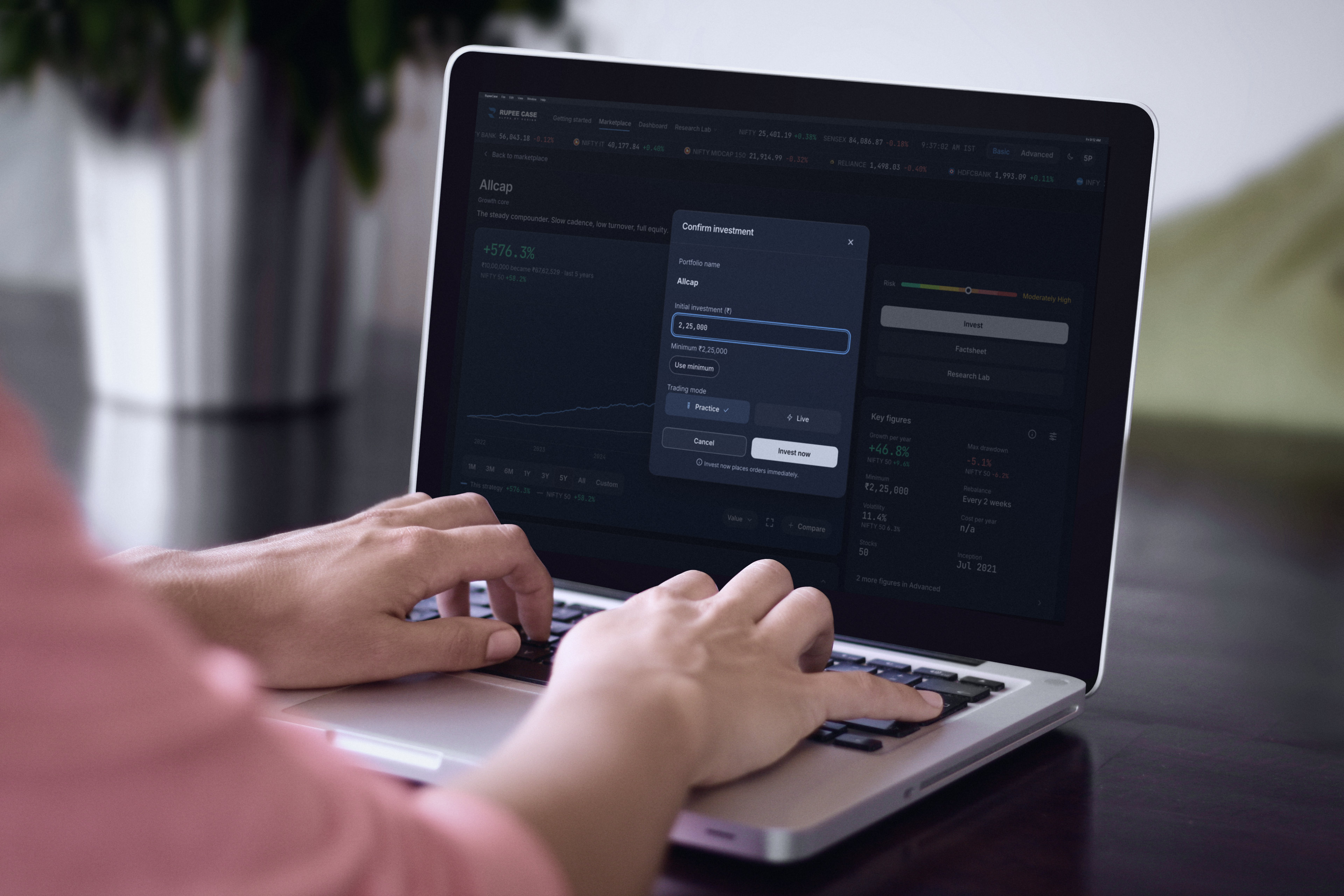
Hands typing on a laptop with a RupeeCase strategy chart on screen

01Ownership

Stocks,
not units.

A fund gives you units. A RupeeCase strategy puts the stocks in your own demat, through your own broker.

  • Exitstop rebalancing, keep the stocks
  • Lock innone, no exit load

02Side by side

Five ways to invest.
Every row.

RupeeCase against
FeatureRupeeCasePMSAIF, typicalMutual fund, activeDirect stocks
Recurring fee0.2% of traded value per rebalance, charged only when trades execute. No AUM fee.2% AUM + 20% performance over hurdleAbout 2% + 20% of profits, typical for Category III1.5 to 2.25% TER for active equity, deducted from NAVBrokerage per trade only
Minimum ticketPublished per strategy₹50,00,000 (SEBI mandate)₹1,00,00,000 (SEBI mandate)₹500 (SIP) or ₹5,000 (lump sum)Price of one share
Who holds your stocksYou, in your own dematPMSThe fund; you hold unitsAMC / RTA (units, not stocks)You, in your own demat
Lock inNoneUsually 1 year + 2% exit loadSet by the schemeELSS 3 years, others noneNone
Transparency of holdingsFull, at every rebalance, datedMonthly or quarterly statementPeriodic investor reportsMonthly portfolio disclosureFull (you picked them)
MethodologyPublished rules, reproducible by any userProprietary, not disclosedThe manager's strategyFund factsheet, high level onlyYour own
RebalancingSystematic, on each strategy's published cadence, announced in advanceManager discretionManager discretionManager discretionYour discretion
Tax treatmentSTCG 20% / LTCG 12.5% above ₹1,25,000 a year, on your own stocks, standard equity rulesTaxed on each realised trade by manager, complex P&LSet by AIF category and schemeSTCG 20% / LTCG 12.5% above ₹1,25,000 a year, on redemption only, compounding insideSTCG 20% / LTCG 12.5% above ₹1,25,000 a year, on each stock you sell
Exit processStop rebalancing, keep the stocks, no transferRedeem, wait for settlement, exit load possibleAs the scheme allowsRedeem, 1 to 3 day settlement, exit load possibleSell when you want
Regulatory statusAlgo vendor platform, RA application pending via QC Alpha ResearchSEBI registered PMSSEBI registered AIFSEBI registered AMCNo intermediary
Investment decisionRupeeCase places the orders the published rule generates, in your own broker accountManager decides for youManager decides for youManager decides for youYou decide everything
Suits you ifYou want transparent systematic strategies and own demat execution at sub PMS ticketsYou have 50L+ and want an outsourced discretionary managerYou have 1 Cr+ and want a pooled, manager run strategyYou want hands off SIP based wealth buildingYou have time, conviction, and a process

Typical industry rates as of April 2026, not specific to any PMS manager, AIF or AMC. AIF figures are typical for Category III; schemes differ. Your actual fees depend on your broker, the specific product and your tax bracket.

03When RupeeCase wins

The mid ticket,
systematic allocator.

Less than the ₹50,00,000 a PMS demands, rule based execution, and the stocks stay yours. A PMS may be more than you need, a fund gives you units not stocks, and self picking takes time.

04When it is not

Go elsewhere,
honestly.

Daily liquidity with no process: liquid funds. Pure SIP automation for 30 years with no attention: index funds. A dedicated manager with 50L+: a PMS. We are not trying to be all things.

05Head to head

Allcap against
nine funds.

RupeeCase AllcapModel, back testedvsFundFund, as published
Read the full comparison

Every pair in full: Allcap vs Nifty BeES, UTI Nifty 50, Mirae Large Cap, Axis Bluechip, HDFC Top 100, ICICI Bluechip, Kotak Emerging, SBI Midcap and a smallcase momentum basket.

Allcap: model, back tested, rolling 5 year metrics, as of 17 Jul 2026; not a promise of future returns. Funds and ETFs: publicly available data as of 13 Jul 2026, rounded from AMC factsheets. Not investment advice.

Recorded, sample data

06In the product

Lay any index
over the curve.

Open Compare on a strategy chart, pick an index, and it draws on the same model history. The product, recorded on sample data.

07Strategy vs strategy

Any two,
side by side.

Read the full pair comparison

Key insight

0.78% a year.

A 1.8% fund TER is charged on the whole portfolio every year and compounds against you. RupeeCase charges 0.2% of what traded: at a four week cadence and 30% turnover that is about 0.78% of portfolio value a year. Slower or lighter costs less.

08Questions

Indices, PMS,
AIFs and funds.

What is a quantitative index?

A quantitative index picks and weights its stocks by fixed rules written in advance, such as momentum or quality, instead of by company size. An algorithm applies the rules and rebalances on a set schedule, so nobody decides by feel.

When is a RupeeCase strategy a good fit?

It fits if you want rules published in advance, want to own the stocks in your own demat, and have less than the ₹50,00,000 a PMS requires. A PMS suits an outsourced discretionary manager at 50 lakh or more. A mutual fund suits hands off SIP building.

How do the fees compare?

RupeeCase charges 0.2% of traded value per rebalance, only when trades execute, with no AUM fee. A typical PMS charges 2% of AUM plus 20% over a hurdle; a typical Category III AIF about 2% plus 20% of profits. An active mutual fund charges a 1.5 to 2.25% TER from NAV. These are typical industry rates, not any one manager's.

Who holds my stocks?

With RupeeCase, you do, in your own demat account. A PMS manager runs the portfolio for you under a mandate, while a mutual fund or an AIF gives you units, not stocks. With direct stocks you also hold them yourself.

When is RupeeCase not the right choice?

If you need daily liquidity with no process, use liquid funds. If you want pure SIP automation for a 30 year horizon with no attention, use index funds. If you want a dedicated manager to choose everything for you with 50 lakh or more, use a PMS.

Own the stocks.
Read the rules first.

Figures are typical industry rates as of April 2026, not specific to any PMS manager, AIF or AMC. RupeeCase makes no performance claim against any specific competitor. Model returns are back tested and not a promise of future returns. Read the Disclaimers.