

Portfolio construction..5 min read
Your biggest asset is not in your portfolio
A 30 year old's future paycheques can be 15 to 20 times the brokerage account, so a portfolio should diversify away from the job, not toward it.
By Tanmay Kurtkoti, founder of QC Alpha and builder of RupeeCase
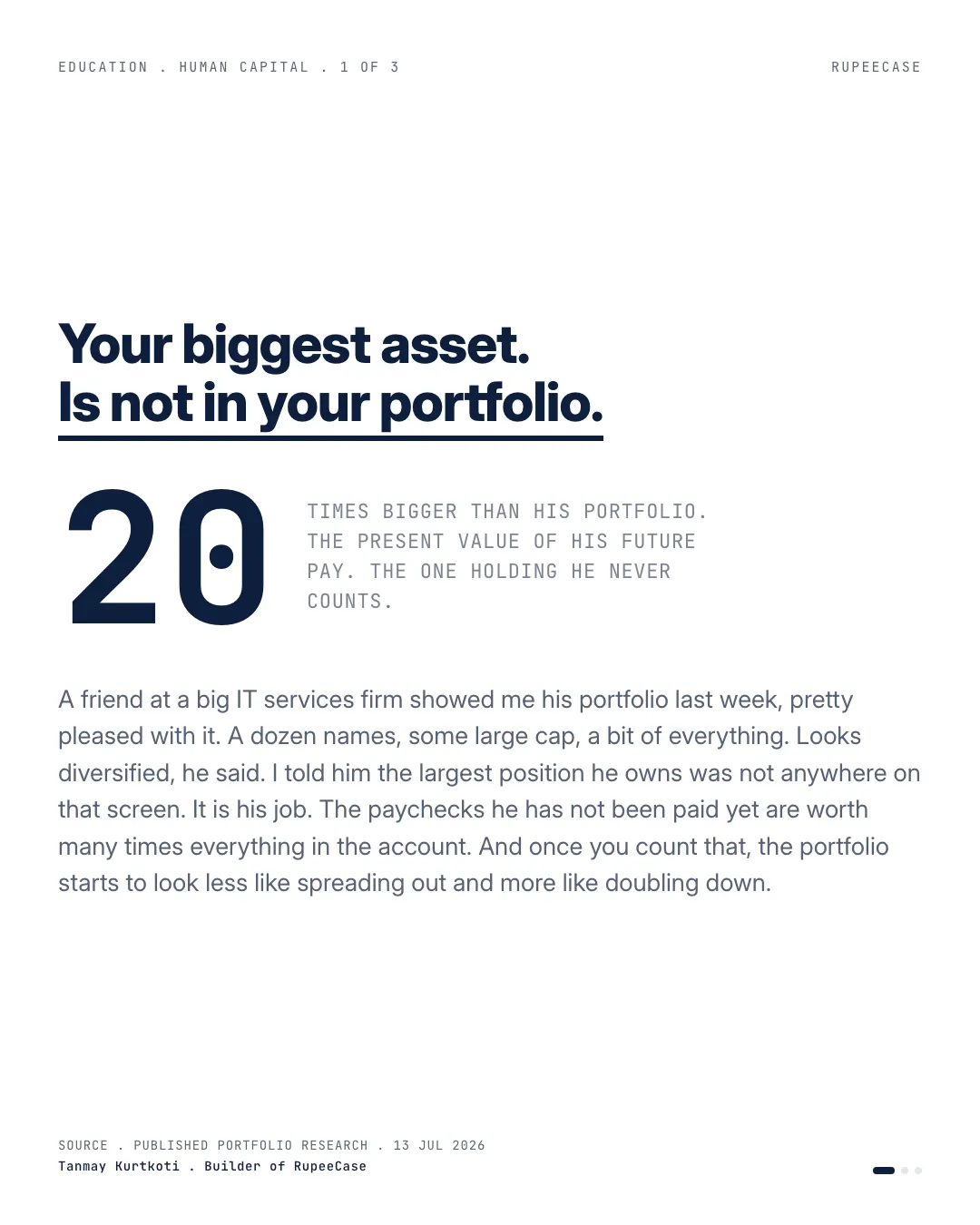
A friend at a big IT services firm showed me his portfolio last week, pretty pleased with it. A dozen names, some large cap, a bit of everything. "Looks diversified," he said.
I told him the largest position he owns was not anywhere on that screen. It is his job.
Your future paychecks have a present value, the same way a bond does. Run the numbers on a 30 year old earning a decent salary and everything he will be paid over the rest of his career can sit at a few crore. Often 15 to 20 times whatever is in the brokerage account. Early on, your job is 80 to 90 percent of your net worth. The portfolio is the small half.
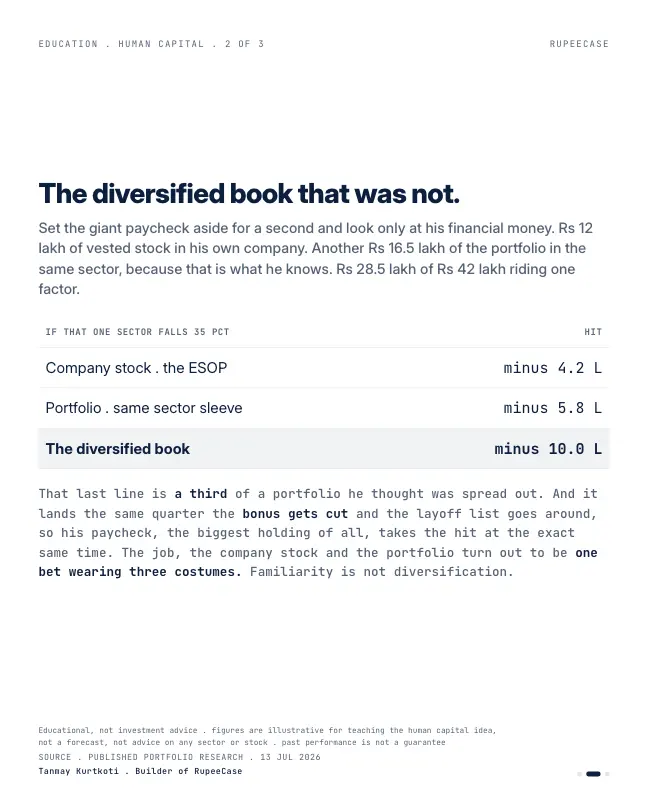
Here is where it gets uncomfortable. His "diversified" equity book held about Rs 12 lakh of his own company's ESOPs, and more than half the rest sat in the same sector he draws a salary from, because that is what he understands best. So if that one sector derates 35 percent, he loses close to Rs 10 lakh, a third of the portfolio, in the same quarter the bonus gets cut and the layoff list goes around. The job, the company stock, and the "spread out" portfolio turn out to be the same bet wearing three costumes.
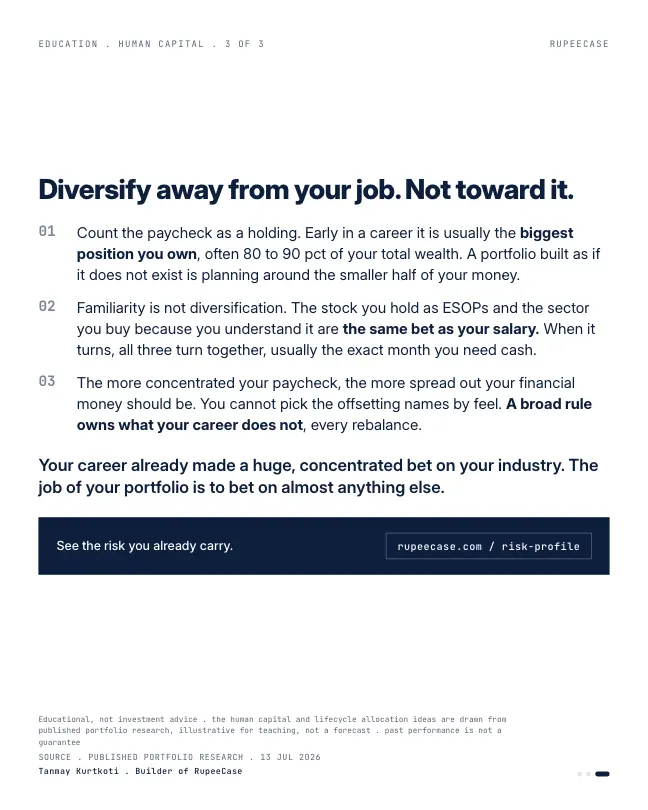
The lifecycle finance researchers say it cleanly: your financial capital should hedge your human capital, not amplify it. In plain terms, diversify away from your job, not toward it. Familiarity feels like an edge. In a portfolio it is just the same risk twice.
You cannot pick the offsetting names by feel. A broad, rules based basket owns what your career does not, quietly, every rebalance.
Your career already made a huge, concentrated bet on your industry. The job of your portfolio is to bet on almost anything else
Pricing your paycheques like a bond
A salary that grows each year is a stream of future payments, and a stream of payments has a present value. Discount each year's pay back to today and add them up. For a pay stream growing at g and discounted at d over n years, the sum is the salary times (1 minus ((1 + g) / (1 + d)) to the power n), divided by (d minus g).
Take a 30 year old earning Rs 15 lakh a year, with pay growing 7 percent a year, discounted at 8 percent, over 30 working years. The ratio 1.07 / 1.08 is 0.9907. Raised to the 30th power it is 0.756. One minus that, divided by 0.01, is 24.4. So the career is worth about 24.4 years of today's salary: roughly Rs 3.65 crore.
On these inputs the career is about 18 times a Rs 20 lakh portfolio. The exact number depends heavily on the discount rate, and a riskier job deserves a higher one. The shape does not change: for most people in their thirties, the portfolio is a small boat tied to a large ship.
What one sector did in one year
The risk in the opening is not hypothetical. Over the year from 30 Sep 2025 to 30 Sep 2026, NSE sector indices spread widely. The Nifty IT index fell 17.68 percent while the Nifty 50 fell 8.09 percent, by NSE closing data. An IT employee whose portfolio leaned into IT took more than twice the index's fall, in the same year the sector's own news was weakest.
- Nifty Metal27.12%
- Nifty Pharma23.23%
- Nifty 50-8.09%
- Nifty IT-17.68%
- Nifty FMCG-18.65%
NSE index closes, price return, 30 Sep 2025 to 30 Sep 2026 (NSE bhavcopy). Dividends not included.
None of this says IT will lag again. Sectors take turns, and the next year may look the other way round. The point is that the employee's job and the IT index tend to have their bad years together, so holding more of that sector stacks the risk instead of spreading it.
Two portfolios for the same engineer
Rs 12 lakh in ESOPs, half the rest in the same sector
- A 35% sector fall costs close to Rs 10 lakh
- It lands in the year bonuses are cut
- Salary, stock and portfolio fall together
A broad basket that underweights the employer's sector
- The same sector fall touches a small slice
- Other sectors carry the portfolio that year
- The career is the sector bet; the portfolio is not
MythInvesting in the industry you know best is the safest choice.
FactKnowing an industry does not stop it falling. If you also earn your living there, the same fall hits your income and your savings at once.
Employer stock deserves its own line. ESOPs vest on a schedule and often come with a tax bill at exercise, so many employees end up holding more than they would ever buy. A simple rule, decided in advance, of selling down vested shares beyond a set weight keeps one name from becoming the portfolio.
The free Learn module on position sizing covers caps per name and per sector and how to size a holding from the loss you can take, with a quiz and a certificate. The retirement calculator helps you see how much of your plan rests on future earnings. For the same idea applied to one stock, read the single stock skew.
Questions readers ask
What is human capital in personal finance?
It is the present value of all the income you expect to earn from work. For a 30 year old earning Rs 15 lakh a year, with assumed 7 percent pay growth and an 8 percent discount rate, it comes to about Rs 3.65 crore, usually far more than the investment portfolio.
Should I invest in the company I work for?
That is a personal choice, but it concentrates risk: if the company or its sector has a bad year, both your income and your savings can fall together. Many investors cap employer stock at a small share of the portfolio and sell vested shares above that cap.
How should my job affect my asset allocation?
A stable income behaves a little like a bond and can support more equity in the portfolio; an income tied to one sector argues for holding less of that sector. The aim is for the portfolio to own what the career does not.
The cards
3 cards. Swipe, or tap to open.
Related
- The risk you get paid forAbout 80 percent of a single stock's volatility is company specific and unrewarded, and an equal weight basket sheds it from 40 percent at one name to about 19 at thirty.Portfolio construction . . 5 min
- Single stock skew: own the haystackBessembinder found 57 percent of US stocks since 1926 did worse than a Treasury bill and four percent of names created all the net wealth.Portfolio construction . . 6 min
- Twenty funds, one betAt the 0.85 correlation Indian diversified equity funds show against each other, twenty funds buy 1.17 effective bets against 1.14 for five.Portfolio construction . . 11 min
Educational content only. Figures are illustrative and computed on historical or representative data for teaching purposes, not investment advice. Past performance does not guarantee future returns. Sourced from NSE, BSE, SEBI, AMFI and RBI public data.