

Portfolio construction..5 min read
One profile, many goals
Pointing one Moderate label at a two year flat deposit and a 25 year retirement pot loses at both ends; the deposit falls short and the far pot ends Rs 24.18 lakh lower.
By Tanmay Kurtkoti, founder of QC Alpha and builder of RupeeCase
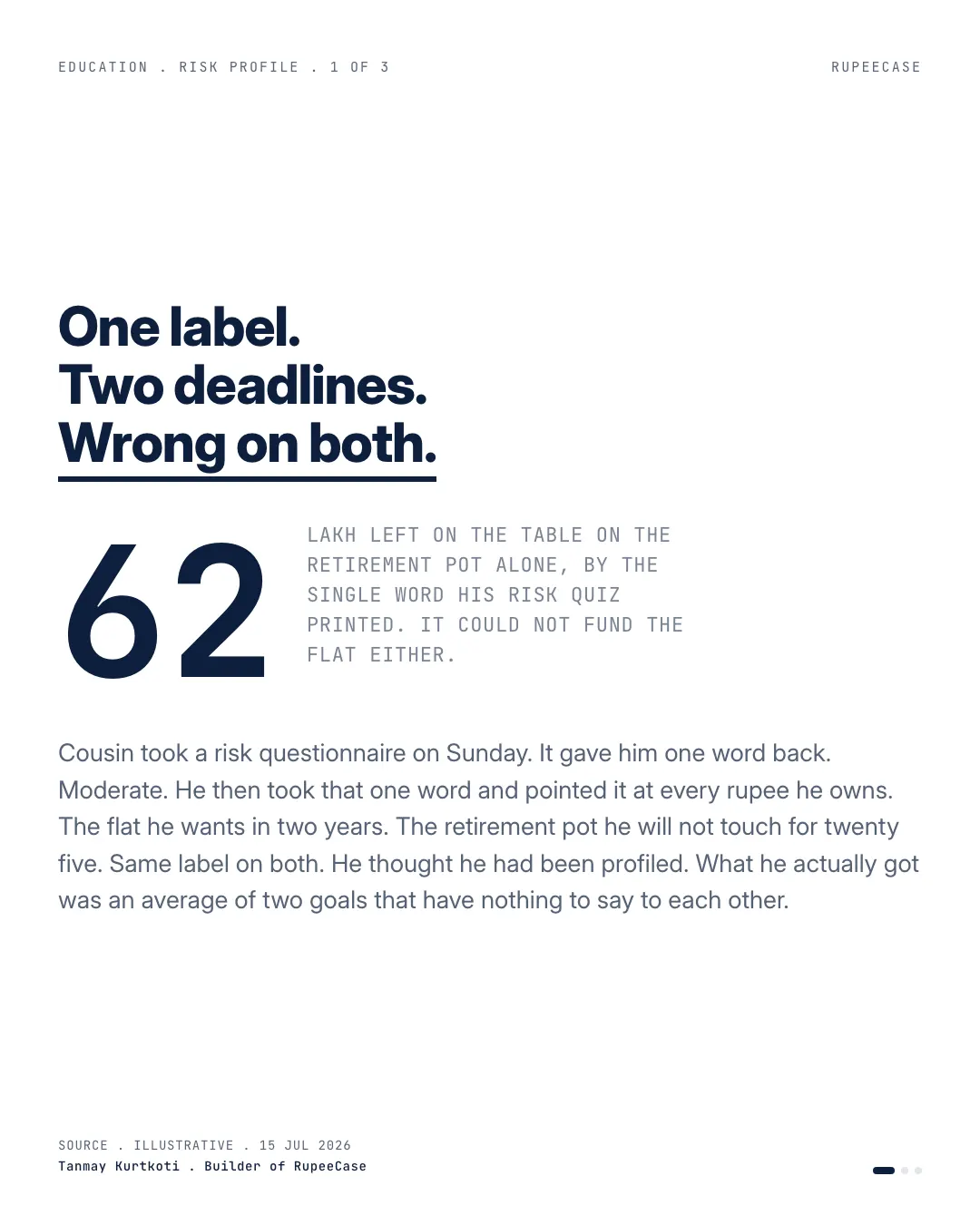
Cousin took a risk questionnaire on Sunday afternoon. It thought about him for a moment and gave one word back. Moderate.
He was pleased. Then he took that one word and pointed it at every rupee he owns.
Which is where it fell apart. Because he has two goals, not one. A flat he wants to put a deposit on in two years. A retirement pot he will not touch for twenty five. The quiz never asked about either. It asked about him, printed a label, and let him do the rest.
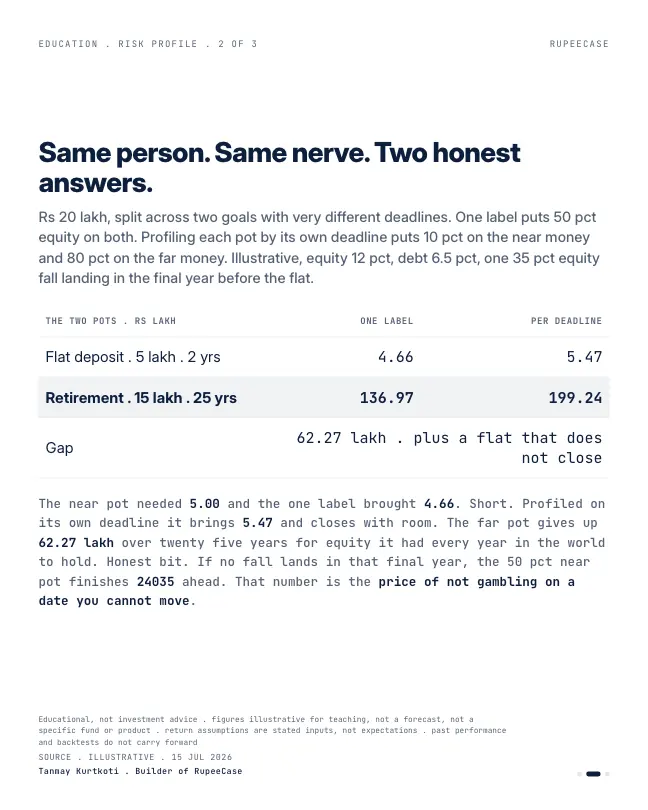
So I ran it. Rs 5 lakh for the flat, Rs 15 lakh for retirement, illustrative numbers, equity at 12 and debt at 6.5.
Under the one label, 50 pct equity on both pots. A 35 pct equity fall lands in the year before he needs the deposit and the flat money finishes at 4.66 lakh against a 5.00 lakh goal. Short. Meanwhile the retirement pot takes the same fall in year two and, rebalanced once a year, crawls to 107.51 lakh after twenty five years.
Profile each pot by its own deadline instead. Near money at 10 pct equity finishes 5.47 and closes on the flat with room. Far money at 80 pct sits through the same fall and still finishes 131.69 lakh. Same person. Same nerve. Rs 24.18 lakh more on the far pot, and a deposit that actually happens.
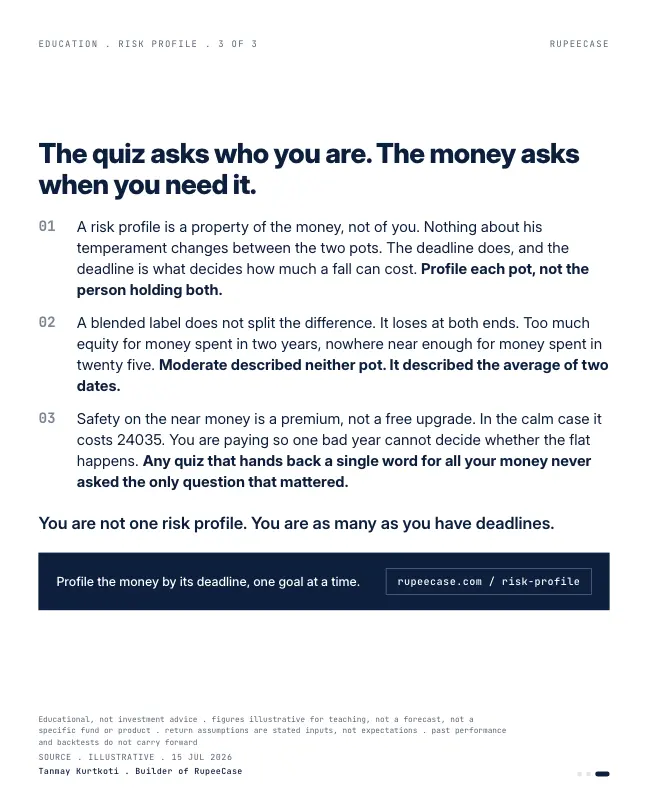
Here is the part nobody tells you. A blended label does not split the difference. It loses at both ends. Too much equity for money with a date on it, nowhere near enough for money without one.
Honest version, because it cuts both ways. If no fall lands in that final year, the 50 pct near pot finishes 24,035 ahead. That number is not a mistake. It is the premium for refusing to gamble on a date you cannot move. Worth paying.
You are not one risk profile. You are as many as you have deadlines. The quiz asks who you are. Your money only ever asks when you need it
The near pot, line by line
The flat money is the one that can fail, so here is its arithmetic in full. Rs 5 lakh, two years, no rebalancing. Equity earns 12 percent in the first year and then falls 35 percent in the second. Debt earns 6.5 percent in both.
At 50 percent equity: the equity half is 2,50,000 x 1.12 x 0.65 = Rs 1,82,000. The debt half is 2,50,000 x 1.065 x 1.065 = Rs 2,83,556. Total Rs 4,65,556, short of the deposit by about Rs 34,000.
At 10 percent equity: equity is 50,000 x 1.12 x 0.65 = Rs 36,400 and debt is 4,50,000 x 1.065 squared = Rs 5,10,401. Total Rs 5,46,801, about Rs 47,000 above the goal.
Set the final year return to 12 and the 50 percent pot ends at about Rs 5,97,000, roughly Rs 24,000 ahead of the 10 percent pot. That is the premium the opening describes: the price of a deposit that happens whatever the market does in that one year.
A 35 percent fall in a year is not rare
A one year fall of that size can sound like a stress test. Indian markets have produced falls in that range recently, inside a few months. Between its record close on 23 Sep 2024 and 3 Mar 2025 the fall was 26.1 percent for the Nifty Smallcap 250. The Nifty 50, the calmest broad index, fell 14.5 percent between 31 Dec 2025 and 30 Mar 2026, by NSE closing data.
Nifty Smallcap 250 fall from its record in about five months
NSE closes, 23 Sep 2024 to 3 Mar 2025
Nifty 50 fall in one quarter
NSE closes, 31 Dec 2025 to 30 Mar 2026
Money due in two years cannot wait for a recovery that takes longer than that, and the Smallcap 250 was still below its Sep 2024 record on 12 Oct 2026, more than two years on. Money due in 25 years can wait for several.
Equity by deadline
The RupeeCase asset allocation calculator caps equity by horizon for exactly this reason. Its rules hold equity to at most 20 percent for money needed within 3 years, 40 percent within 5 and 60 percent within 7. Beyond that the split is set by the fall you can sit through, up to 90 percent.
- Under 3 years20%
- 3 to 5 years40%
- 5 to 7 years60%
- 7 years or more90%
Maximum equity share by horizon in the RupeeCase asset allocation calculator rules, as published 12 Oct 2026. Teaching numbers, not a recommendation.
One label per pot
- List every goal with a dateFlat deposit in 2 years, school fees in 9, retirement in 25.
- Give each goal its own potSeparate folios or at least separate lines on one sheet.
- Cap equity by the dateThe flat pot sits under the 20% ceiling; retirement uses your full profile.
- Glide as dates approachMove a pot down a band each time its deadline crosses a threshold.
The free Learn module on building systems that protect you from yourself covers rules like these, set in advance so a bad month cannot rewrite them, with a quiz at the end. The asset allocation calculator applies the horizon caps to your own numbers. For the three questions behind each pot's setting, read capacity, tolerance, need.
Questions readers ask
Should I have a different risk profile for each goal?
It usually makes sense to set a separate equity share for each goal, because the deadline changes how much loss the money can absorb. Money needed in two years has little time to recover from a fall; money needed in 25 years has plenty.
How much equity for a goal two years away?
Many planning rules keep it low. The RupeeCase asset allocation calculator caps equity at 20 percent for money needed within three years. In the worked example, a 50 percent equity pot hit by a 35 percent fall in the final year ended about Rs 34,000 short of a Rs 5 lakh goal.
What is goal based investing?
It is sizing the risk of each pot of money by when that money is needed, rather than applying one risk level to everything you own. Each goal gets its own mix and its own glide path as the date approaches.
The cards
3 cards. Swipe, or tap to open.
Explore next
Learn it properly, then see it applied.
- GuideHow to invest for your child's education: the cost, the monthly amount and the glide pathThe future cost, the monthly amount at different returns, and the glide path out of equity.
- Free module 4.1Modern Portfolio Theory, What Actually Matters11 min read
- StrategyAllcap strategyNifty Total Market, 50 stocks, every 2 weeks
- CalculatorFIRE calculatorFree, with the formula and a worked example
Related
- Capacity, tolerance, need: the three risksA questionnaire scored one risk and pointed at 90 percent equity; capacity eight years from retirement and a need of about 9 percent a year both pointed near 60.Portfolio construction . . 4 min
- Who sells first: a household's real risk levelA shared portfolio is held by consensus and sold by veto, so the account's risk level is the lower partner's tolerance, not the average.Portfolio construction . . 4 min
- A risk profile has an expiry dateTwo years from a college goal, a 35 percent crash leaves a 90 percent equity saver Rs 10 lakh short while one who glided to 25 percent equity lands funded.Portfolio construction . . 6 min
Educational content only. Figures are illustrative and computed on historical or representative data for teaching purposes, not investment advice. Past performance does not guarantee future returns. Sourced from NSE, BSE, SEBI, AMFI and RBI public data.