

You have picked your stocks with a systematic signal. Now the quieter question: how much goes into each one? It gets a fraction of the attention stock selection gets, and it decides a large part of how the ride feels. The same 10 stocks, sized two different ways, can give you two very different drawdowns.
I learned to respect sizing early. A good signal with careless sizing still hurts you, because one or two names end up carrying the whole portfolio's risk. There are four main ways systematic equity portfolios size positions. Each assumes something different about what you know, and more importantly, about what you do not know.
- Capital availablePortfolio value after any cash you keep aside.
- Pick a weighting ruleEqual weight, inverse volatility, market cap or Kelly.
- Apply capsSingle stock, sector and liquidity limits.
- Round to whole sharesIndian cash equity trades in whole shares, so weights drift from target.
- ExecuteThrough your own broker, into your own demat.
A 10 stock equal weight portfolio with a 10% single stock cap means a 40% fall in any one name costs the portfolio about 4% before anything else moves. Step 3 is the step most discretionary investors skip.
The four approaches
- Needs no inputs beyond the stock list
- Tilts towards smaller companies compared with market cap weighting, which adds a size exposure
- Strong academic evidence that it often matches or beats optimised weights out of sample
- A very volatile stock gets the same capital as a calm one, so it carries more of the risk
- Fixes the risk concentration problem of equal weight
- Has often improved risk adjusted returns over equal weight in published studies
- Needs a volatility estimate per stock at every rebalance, so more turnover
- Can pile into defensive, low volatility sectors unless capped
- Low turnover: weights move with prices, so little trading is needed
- Concentrates money in the largest few names
- Underweights smaller companies that may score better on your factor
- For a factor strategy it brings back the size bias the factor was meant to avoid
- Optimal for long run growth only if your inputs are right
- Needs a win rate and payoff estimate per position, which is very hard in equities
- Full Kelly produces large swings and deep drawdowns in practice
- Most useful as a ceiling: never bet more than Kelly says
Worked example: equal vs inverse volatility
Say your signal selects five stocks with these annual volatilities. The volatilities are illustrative, of the size you see across Indian large and mid caps, and I assume every pair has a correlation of 0.4.
| Stock | Vol | Equal wt | Risk share | Inv vol wt | Risk share |
|---|---|---|---|---|---|
| A | 22% | 20% | 13.3% | 24.8% | 20% |
| B | 35% | 20% | 23.4% | 15.6% | 20% |
| C | 48% | 20% | 35.2% | 11.4% | 20% |
| D | 26% | 20% | 16.2% | 21.0% | 20% |
| E | 20% | 20% | 11.9% | 27.3% | 20% |
| Portfolio volatility | 22.1% | 19.7% | |||
A is a steady large cap, B a lender, C a cyclical, D an IT services name, E a consumer staple. Computed with the full covariance formula from Module 4.1; illustrative volatilities, correlation 0.4 between every pair.
Look at stock C. It holds 20% of the capital and drives 35% of the risk under equal weight. Inverse volatility cuts it to 11.4% of the capital and every stock ends up carrying the same 20% of the risk. Portfolio volatility drops from 22.1% to 19.7% with the same five stocks.
Now the rupees. On ₹5 lakh, equal weight puts ₹1 lakh in each name. If stock C falls 40% in a bad quarter, you lose ₹40,000 from it alone. Under inverse volatility you hold ₹57,000 of C and the same fall costs about ₹22,800.
The practical trade off: inverse volatility gives a smoother ride but adds work and turnover at every rebalance. When you hold 20 or more stocks of similar volatility, the difference narrows and equal weight is usually good enough. For concentrated portfolios of 10 to 15 names, or ones that mix jumpy growth stocks with steady compounders, inverse volatility changes the ride noticeably.
Kelly in rupees, and why I stop at half
Suppose a setup wins 55% of the time and the average win is 1.2 times the average loss. Kelly says f* = (0.55 × 1.2 − 0.45) / 1.2 = 17.5% of capital per bet. On ₹10 lakh that is ₹1.75 lakh on a single idea.
Now suppose your real win rate is 50%, not 55%, a tiny estimation error. True Kelly drops to 8.3%. Betting 17.5% when the right answer is 8.3% is betting more than double Kelly, and at double Kelly your expected long run growth falls to about zero while the swings get much larger. Half Kelly, 8.75% here, keeps you near the right answer across a range of errors. That is why every practitioner I respect uses a fraction of Kelly or none at all.
Position sizing constraints
Whatever the weighting rule, a few hard limits stop extreme concentration:
- Maximum single stock weight. Typically 10 to 15% in a 20 stock portfolio, 5 to 8% in a 30 stock one. No single stock should decide your year.
- Maximum sector weight. Typically 25 to 35%. A momentum signal can otherwise put half the money into one sector in a strong run.
- Minimum position size. Typically 1 to 2% of the portfolio. Smaller positions cost more in friction than they add in information.
- Liquidity. Keep any order to a small fraction of the stock's average daily traded value, often 5 to 10% at most, so your own trade does not move the price.
- Most concentrated, 5 names20%
- Energy Basket, 10 names10%
- Focused Largecap 205%
- Large Midcap, 40 names2.5%
- Allcap, 50 names2%
Equal weight per stock = 100% / holdings, from the RupeeCase strategy lineup, as of 27 Apr 2026. Weights drift with prices between rebalances.
Whole shares and minimum capital
Indian cash equity trades in whole shares. That makes small portfolios lumpy. With ₹2 lakh across 20 stocks, each target is ₹10,000. A stock at ₹7,800 gives you one share, ₹7,800, or 3.9% instead of 5%. A stock at ₹13,000 cannot be bought at all without overshooting to 6.5%.
This is why systematic products state a minimum capital. On RupeeCase the minimum shown on each strategy is roughly one share of every holding at recent prices, and the strategies cap the share price of stocks they admit, for example under ₹5,000 for Allcap. More capital buys more shares of each name and tracks the equal weights more closely.
Common mistake: sizing by conviction
The common mistake is letting conviction set the size. The stock you have read the most about gets 25%, the ones you are unsure of get 3%. Conviction feels like information. Most of the time it is familiarity. And the size of a position usually grows after a stock has run, which means you are largest exactly when the risk is highest.
The second mistake is averaging down without a rule. Buying more of a falling stock turns a 5% position into 12% without any decision about whether 12% is acceptable. A systematic rule makes both decisions for you, in advance, when you are calm.
MythEqual weight means each stock carries equal risk.
FactEqual capital is not equal risk. In the example above a stock with 20% of the money drove 35% of the risk because it moved more than twice as much as the calmest name.
How this shows up in RupeeCase
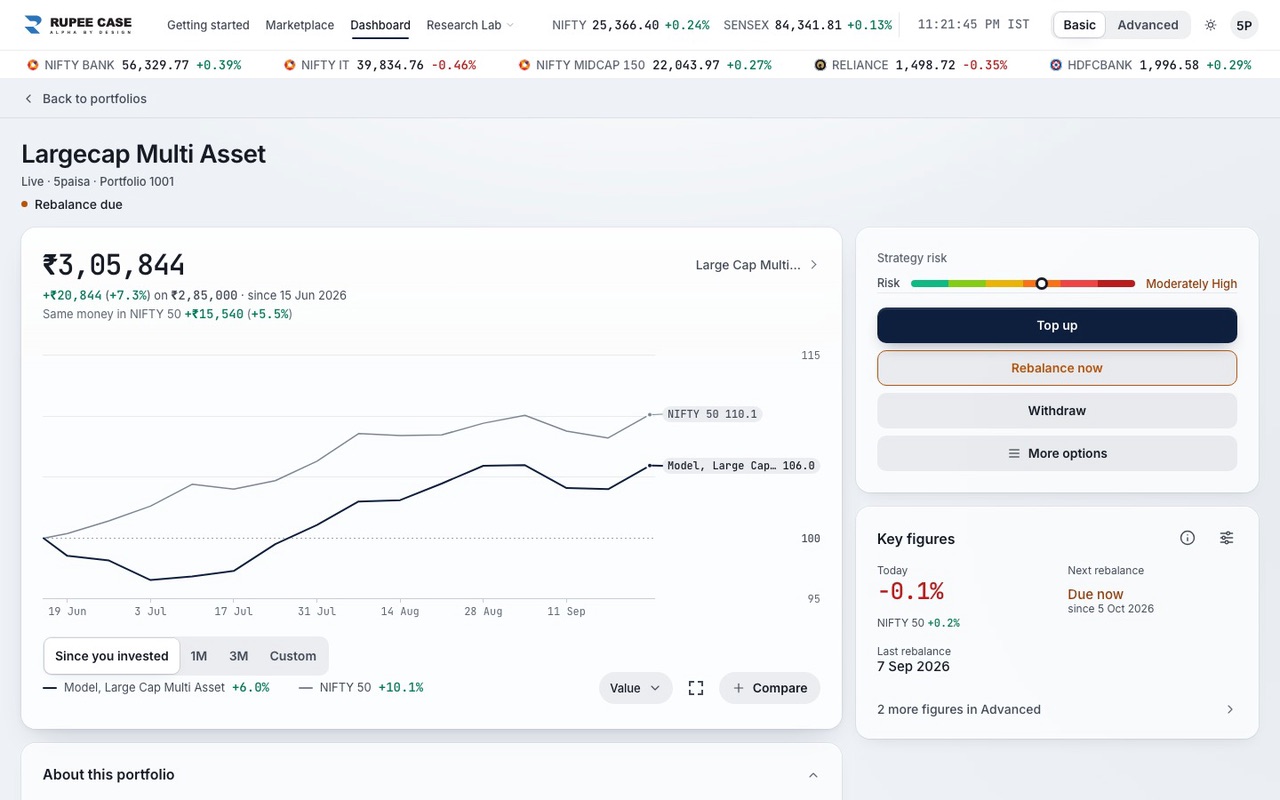
Every RupeeCase strategy holds its names equal weighted at each rebalance: Allcap holds 50 names at about 2% each, Focused Largecap 20 holds 20 at about 5%. The weights then drift with prices until the next rebalance resets them. The factsheet on each strategy page lists the current holdings with their weights on the rebalance day, and the minimum capital shown is roughly one share of every holding. Compare concentration across strategies on the compare page, and find a risk band that fits you with the risk profile.
Questions readers ask
Is equal weight better than market cap weight?
Neither is better in every period. Equal weight gives smaller companies more room and rebalances more often, which has helped when smaller companies did well and hurt when the largest names led. Market cap weight is cheaper to hold. The NSE publishes both a Nifty 50 and a Nifty 50 Equal Weight index, so you can compare them over any window.
How much of my portfolio should one stock be?
There is no single right number, but most systematic investors keep single names between 2% and 10%. The question to ask is what a 50% fall in that stock would do to your total portfolio, and whether you could hold through it.
Why do my actual weights differ from the target weights?
Two reasons. Whole share rounding means small portfolios cannot hit exact targets, and prices move every day after the rebalance. Both are normal; the next rebalance brings the weights back towards target.