

Company numbers..5 min read
Off balance sheet debt: the notes are the balance sheet
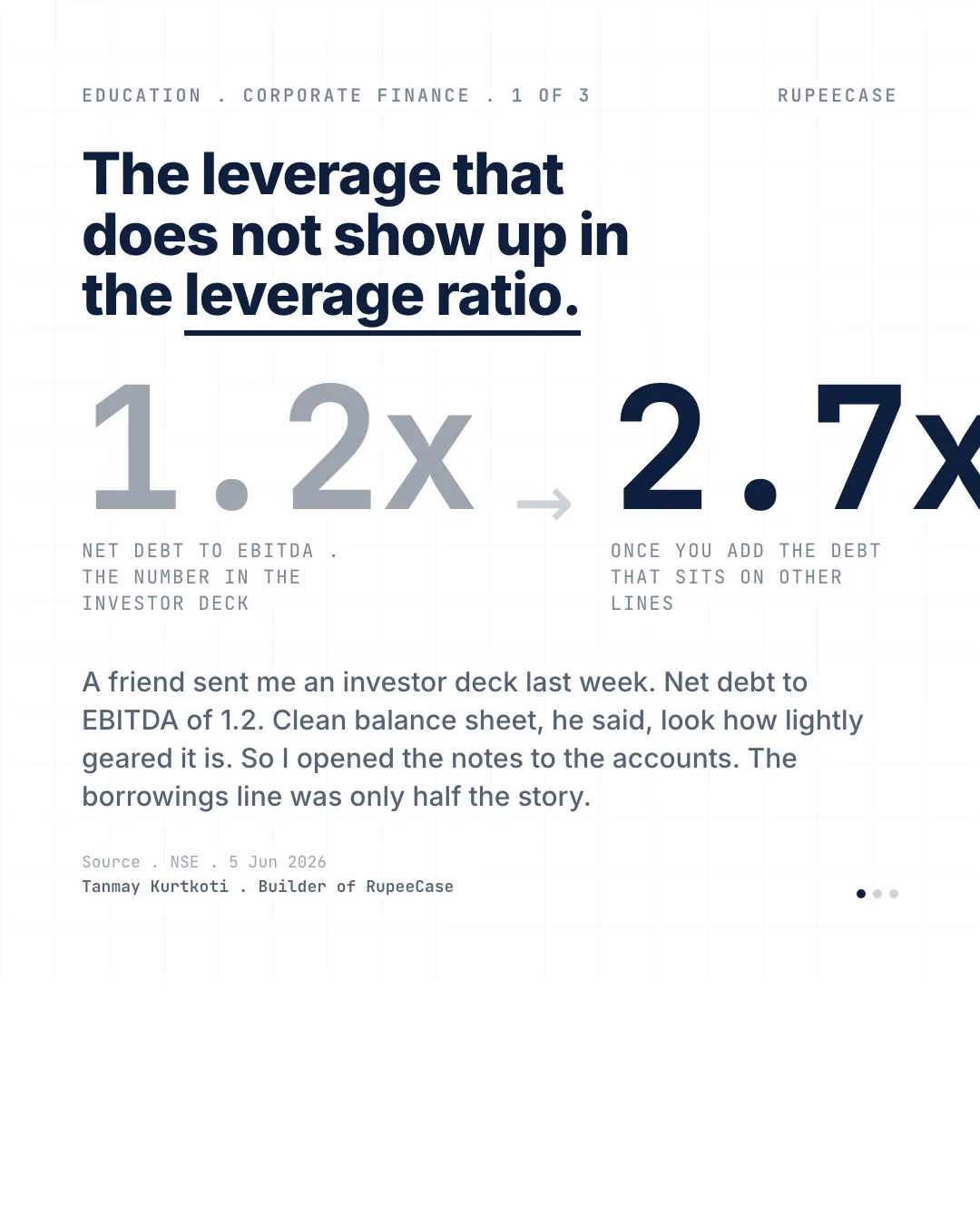
Reported net debt of 1.2 times EBITDA becomes 2.7 times once lease liabilities and supply chain financing are counted, before the contingent liabilities in the notes.
By Tanmay Kurtkoti, founder of QC Alpha and builder of RupeeCase
A friend sent me an investor deck last week. Net debt to EBITDA of 1.2. Lightly geared, he said. Clean balance sheet. Why would you worry about this one.
So I opened the notes to the accounts. The borrowings line he was reading off turned out to be about half the company's actual claims on cash.
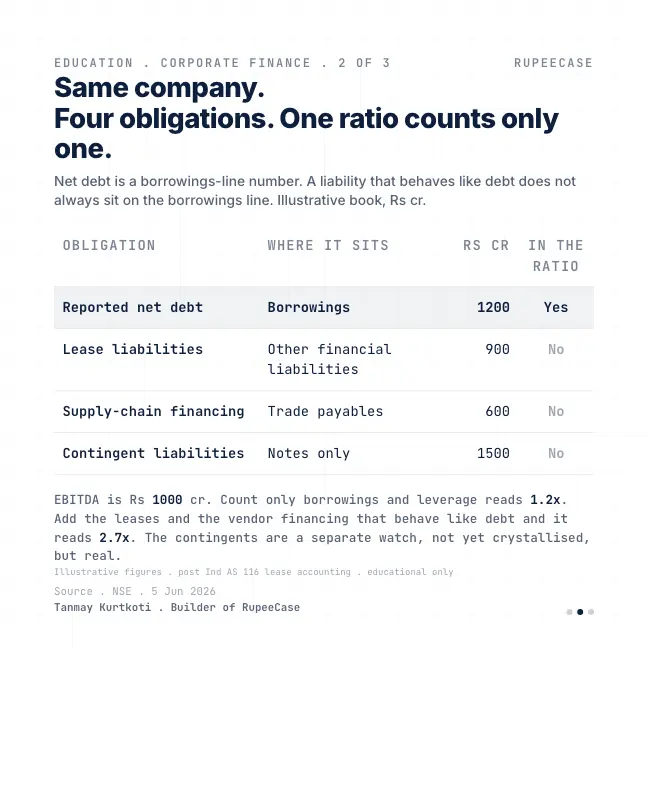
Here is the thing about a net-debt number. It counts borrowings. Just borrowings. But a business carries obligations that behave exactly like debt and do not sit on the borrowings line. Lease liabilities get parked under other financial liabilities. Supply-chain financing, where a bank pays the company's suppliers and the company repays the bank later, gets tucked into trade payables and looks like ordinary working capital. Guarantees and disputed tax claims live in the notes as contingent liabilities, off the face of the balance sheet entirely.
Every one of those is a fixed claim on the same cash flow. A schedule. A counterparty who gets paid before the equity holder sees a rupee. Different line, same economics.
Run the illustrative numbers. Reported net debt 1200 crore on EBITDA of 1000, so 1.2 times. Add lease liabilities of 900 and supply-chain financing of 600, both behaving like debt, and you are at 2700 crore. That is 2.7 times. Same company, same quarter, more than double the gearing once you stop reading only the line that was put in front of you. And the 1500 crore of contingent liabilities in the notes is not even in that figure yet.
None of this is hidden, to be clear. It is all disclosed, sitting in the notes a few pages back. It is just not in the one ratio the deck leads with.
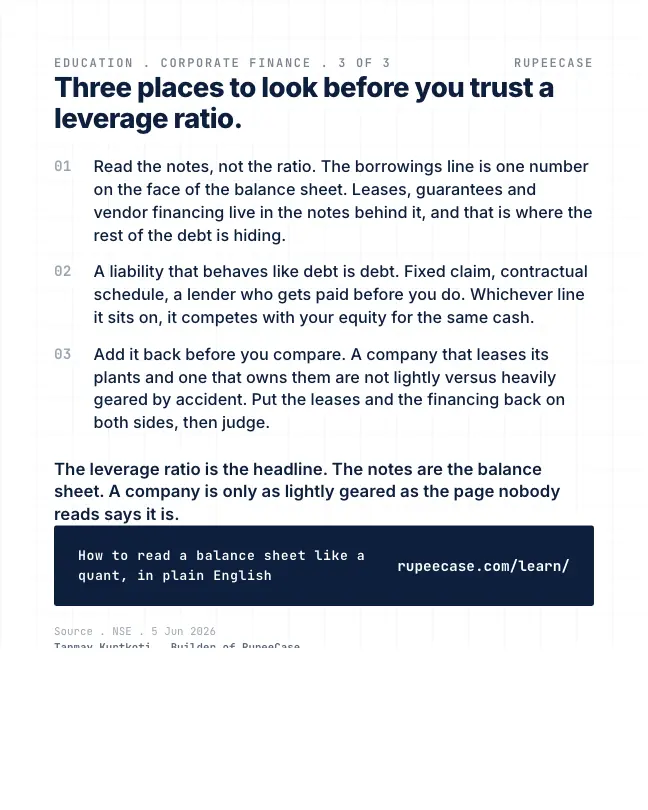
The discipline is simple. Read the notes, not just the ratio. Treat a liability that behaves like debt as debt. And add it back on both companies before you call one lightly geared and the other heavy, because a business that leases its plants and one that owns them are not different by accident.
The leverage ratio is the headline. The notes are the balance sheet.
From 1.2 times to 2.7 times, line by line
Here is the same company drawn as a stack. Each bar is a claim that gets paid before shareholders do. Only the first one made it into the deck.
- Net borrowings (in the deck)1,200
- Lease liabilities900
- Supply chain financing600
- Debt like claims, total2,700
- Contingent, not counted1,500
Rs crore, against EBITDA of Rs 1,000 crore. Worked example from the opening, not a company.
The contingent liabilities are a different kind of claim. A guarantee for a group company or a disputed tax demand may never be paid. But some of it often is. A simple way to stress it is to assume a share of it lands. If one third of the Rs 1,500 crore crystallises, that is Rs 500 crore more, and the ratio goes from 2.7 to 3.2 times.
Why leases belong in the debt figure
Since 1 April 2019, Indian companies on Ind AS follow Ind AS 116, which the Ministry of Corporate Affairs notified on 30 March 2019. A company that leases a plant, a store or an aircraft now records a lease liability, the present value of the payments it has committed to, and a matching right of use asset. The rent no longer runs through operating expenses. It shows up as depreciation on the asset and interest on the liability.
That has a side effect on the ratio. Because rent is no longer an operating cost, EBITDA is higher than it would have been before 2019. So the EBITDA in the deck already gives the company credit for leasing. If you take that higher EBITDA and leave the lease liability out of debt, you have counted the benefit and skipped the obligation. Either add the leases to debt, as above, or take the lease payments back out of EBITDA and leave the leases out. Mixing the two is the error.
Borrowings Rs 2,100 crore
- Borrowed to buy the plants
- No lease liability
- Net debt to EBITDA: 2.1x
Borrowings Rs 1,200 crore
- Rents the same plants
- Lease liability Rs 900 crore
- Deck says 1.2x, true figure 2.1x
Where each claim sits in the annual report
Supply chain financing is the hardest of the three to spot, because it looks like a supplier being patient. A useful test is payable days. If trade payables jump from 60 days to 120 days in a year while suppliers are known to want cash in 60, someone is funding the gap, and that someone is usually a lender.
- Borrowings noteLong term and short term borrowings, less cash and investments. This is the deck's net debt.
- Leases noteLease liabilities, current and non current, often shown under other financial liabilities.
- Trade payables noteLook for supplier finance or acceptances, and compare payable days with the past three years.
- Contingent liabilities noteGuarantees given, claims not acknowledged as debt, and disputed tax demands, with the amounts.
All four notes sit in the annual report filed on NSE and BSE, and the same four checks work on every company you compare. The free Learn module on leverage, debt and financial risk works through net debt, coverage and these add backs with a quiz at the end. The post on promoter pledging covers a different claim that never appears on the company's balance sheet at all: debt the owner has taken against his shares.
Questions readers ask
Are lease liabilities counted as debt?
Under Ind AS 116, since 1 April 2019, lease liabilities are on the balance sheet but usually outside the borrowings line, so many net debt figures leave them out. Because the same standard lifts EBITDA, the consistent approach is to add lease liabilities to debt when you use reported EBITDA.
What is supply chain financing and why does it matter?
A lender pays the company's suppliers on time and the company repays the lender later, so the company keeps the cash longer. It is often shown inside trade payables, so it looks like working capital rather than borrowing. A sharp rise in payable days is the usual clue.
Should contingent liabilities be added to debt?
Not in full, because many are never paid. A practical approach is to read what they are, guarantees, tax disputes or legal claims, and stress the ratio by assuming a share lands. If a modest share would push leverage past a level you are uncomfortable with, the headline ratio is not telling the full story.
The cards
3 cards. Swipe, or tap to open.
Reading path
Stop 5 of 8 on Reading a company
Related
- Promoter pledging: the page nobody readsA stock down 40 percent in two sessions on no news is usually a pledge unwinding, as a 30 percent fall takes lender cover from 2.0x to 1.4x and triggers forced selling.Company numbers . . 6 min
- Goodwill impairment: the day the future said noPaying Rs 1,000 crore for Rs 400 crore of real assets parks Rs 600 crore of optimism as an asset, and the write down only catches the books up to cash that left years earlier.Company numbers . . 5 min
- Goodwill: the asset that exists because they overpaidA Rs 400 crore goodwill write down can turn a 500 crore profit year into 100 without a rupee of cash moving, as Tata Steel's Corus impairment showed.Company numbers . . 5 min
Educational content only. Figures are illustrative and computed on historical or representative data for teaching purposes, not investment advice. Past performance does not guarantee future returns. Sourced from NSE, BSE, SEBI, AMFI and RBI public data.