

Company numbers..5 min read
Goodwill impairment: the day the future said no
Paying Rs 1,000 crore for Rs 400 crore of real assets parks Rs 600 crore of optimism as an asset, and the write down only catches the books up to cash that left years earlier.
By Tanmay Kurtkoti, founder of QC Alpha and builder of RupeeCase
Reading through an acquisition last week and the number that stopped me was not the price. It was what happened to the price afterward.
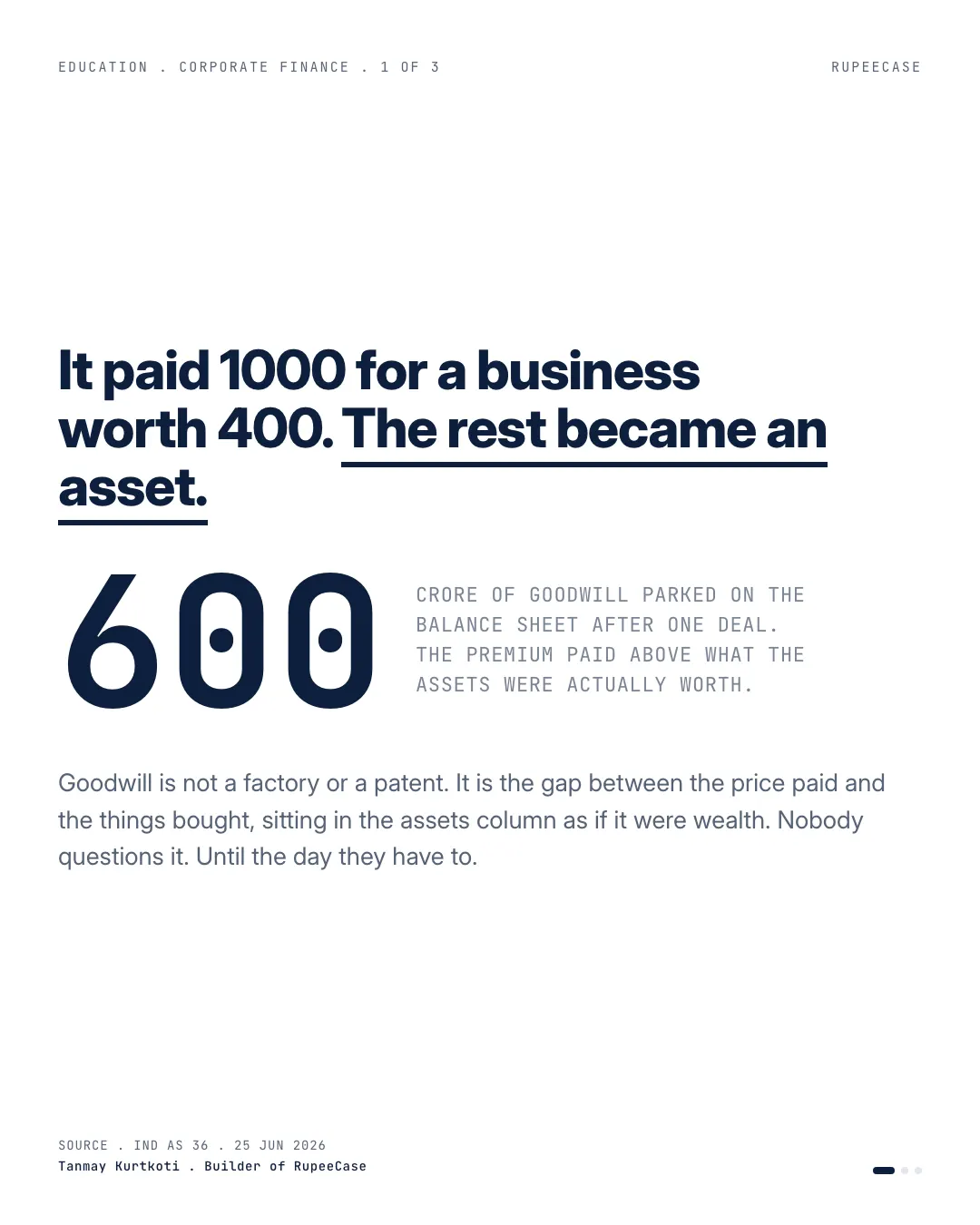
A company paid 1000 crore for a business. The assets it actually bought, the real ones you could point at, were worth about 400. So where did the other 600 go? Onto the balance sheet. As an asset. Called goodwill.
That is all goodwill is. The premium. The gap between what you paid and what you bought. It does not run a factory or hold a patent or throw off a rupee of cash on its own. It is a record of optimism, sitting in the assets column as if it were wealth.
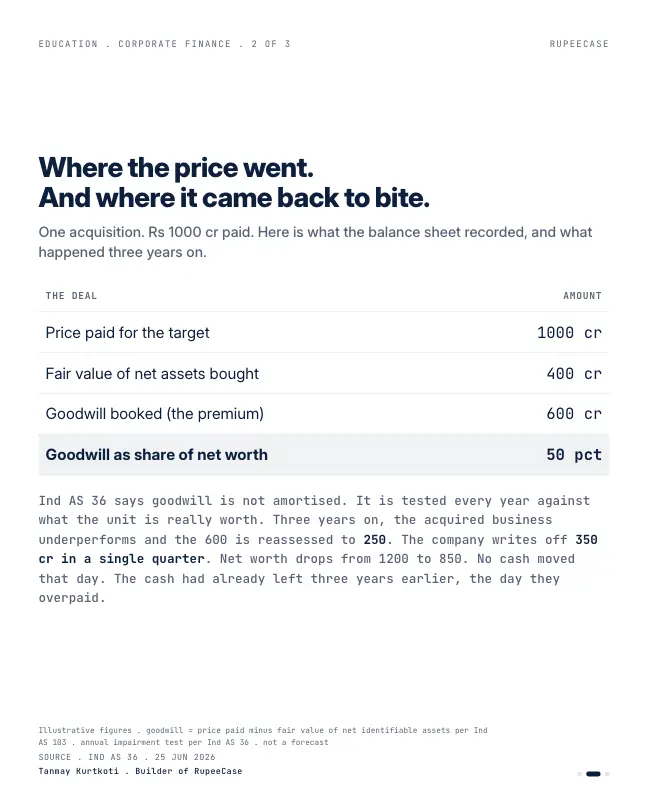
Most of the time nobody questions it. Then the acquired business underperforms, and the company has to test that goodwill against what the unit is really worth now. In this case 600 became 250. They wrote off 350 in a single quarter. Profit for the quarter, gone.
And here is the line every headline reaches for: it is non-cash, just an accounting entry. Do not let that one slide. The cash was very real. It just left three years earlier, the day they overpaid. The impairment is only the books finally catching up to a decision already made.
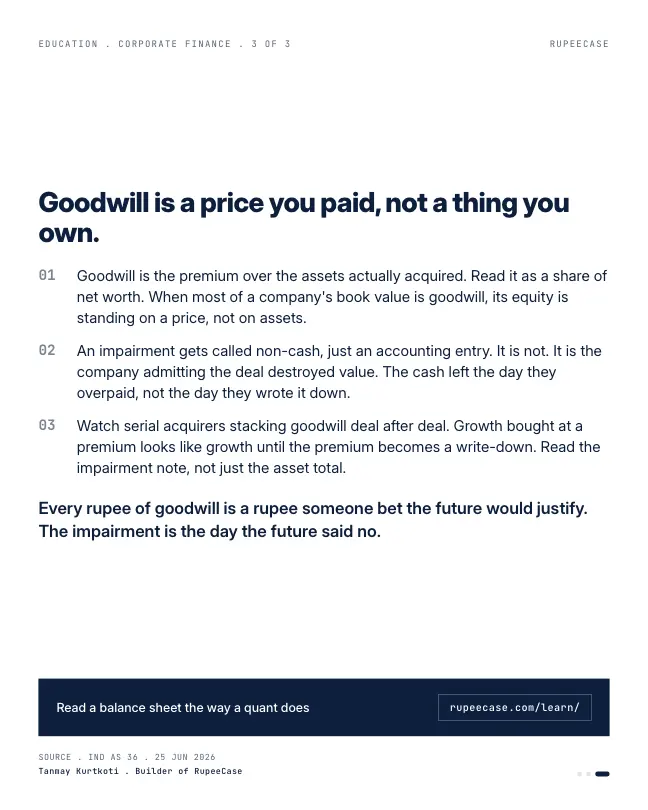
So when you read a company's balance sheet, find the goodwill line and read it as a share of net worth. If most of the book value is a price someone once paid, the equity is standing on hope, not on assets. A serial acquirer stacking goodwill deal after deal is building tomorrow's write-down in plain sight.
Every rupee of goodwill is a rupee someone bet the future would justify. The impairment is the day the future said no.
What the Rs 1,000 crore bought
Under Ind AS 103, when a company buys a business it records the target's identifiable assets and liabilities at fair value. Plant, receivables, brands and customer contracts that can be valued separately all count. Whatever is left of the price after that is goodwill. In the opening's deal, 60 percent of the price is goodwill.
- Identifiable net assets400
- Goodwill600
Rs crore, Rs 1,000 crore paid. Worked example from the opening, not a company.
Goodwill is not amortised under Ind AS. It stays on the balance sheet at cost until a test says it is worth less. Ind AS 36 requires that test at least once a year for every unit carrying goodwill. That is why write downs arrive in one large lump instead of a little each year.
How 600 became 250
The test compares what the acquired unit is carried at with what it can recover, which is the higher of its fair value less costs to sell and its value in use, the present value of the cash it is expected to generate. Here is a simple version.
When the buyer paid Rs 1,000 crore, it expected the unit to earn about Rs 100 crore a year, a 10 percent return on the price. Three years later the unit earns Rs 65 crore a year. At a 10 percent discount rate, a steady Rs 65 crore a year is worth Rs 650 crore. The unit is carried at Rs 400 crore of assets plus Rs 600 crore of goodwill, Rs 1,000 crore in all. The gap is Rs 350 crore. It comes off goodwill first, leaving Rs 250 crore.
The discount rate and the forecast are management's estimates. A small change moves the answer a lot. At 9 percent instead of 10, the same Rs 65 crore is worth about Rs 722 crore and the write down shrinks to Rs 278 crore. That is one reason write downs tend to arrive late: there is room to be hopeful for a few years.
Net worth and tangible net worth
Say the buyer has Rs 1,500 crore of net worth before the write down, Rs 600 crore of it goodwill. Goodwill is 40 percent of the book value. After the Rs 350 crore impairment, net worth is Rs 1,150 crore and goodwill is 22 percent of it.
Now strip goodwill out entirely. Tangible net worth was Rs 900 crore before and is Rs 900 crore after. The write down did not touch it. That is the useful way to read it: the impairment removed something that tangible book value never counted in the first place.
- Net worth, before1,500
- Net worth, after1,150
- Tangible net worth, before900
- Tangible net worth, after900
Rs crore, before and after a Rs 350 crore goodwill impairment. Worked example, not a company.
There is a quieter effect too. With a smaller equity base, next year's ROE looks better on the same profit. Rs 150 crore of profit on Rs 1,500 crore is 10 percent. On Rs 1,150 crore it is 13 percent. Nothing improved. The denominator shrank.
MythAn impairment is non cash, so it does not matter to shareholders.
FactThe cash left when the deal was paid for. The impairment is the accounts admitting that Rs 350 crore of that payment will not come back as earnings.
Where to find it in an annual report
Goodwill sits on the face of the balance sheet as its own line under non current assets. The notes give the movement for the year, which unit it belongs to, and the assumptions used in the test: growth rate, discount rate and forecast period. Read those three assumptions against what the unit actually delivered. If the forecast growth is well above anything the unit has managed so far, the next write down is already in view. The free Learn module on reading annual reports shows where these notes sit and what else to read next to them. The posts on off balance sheet debt and promoter pledging cover two other numbers that live in the pages most readers skip.
Questions readers ask
What is goodwill on a balance sheet?
It is the part of an acquisition price above the fair value of the identifiable assets and liabilities acquired. In the worked example, Rs 1,000 crore was paid for Rs 400 crore of identifiable net assets, so Rs 600 crore was recorded as goodwill.
Is goodwill amortised in India?
Not under Ind AS, which most listed companies follow. Goodwill stays at cost and is tested for impairment at least once a year under Ind AS 36, so reductions come as occasional write downs rather than a yearly charge.
Why does a goodwill impairment matter if it is non cash?
Because the cash was spent when the acquisition was paid for. The impairment says the acquired business will not earn enough to justify that price. It also lowers net worth, which can flatter ROE in later years on the same profit.
The cards
3 cards. Swipe, or tap to open.
Related
- Promoter pledging: the page nobody readsA stock down 40 percent in two sessions on no news is usually a pledge unwinding, as a 30 percent fall takes lender cover from 2.0x to 1.4x and triggers forced selling.Company numbers . . 6 min
- Off balance sheet debt: the notes are the balance sheetReported net debt of 1.2 times EBITDA becomes 2.7 times once lease liabilities and supply chain financing are counted, before the contingent liabilities in the notes.Company numbers . . 5 min
- Goodwill: the asset that exists because they overpaidA Rs 400 crore goodwill write down can turn a 500 crore profit year into 100 without a rupee of cash moving, as Tata Steel's Corus impairment showed.Company numbers . . 5 min
Educational content only. Figures are illustrative and computed on historical or representative data for teaching purposes, not investment advice. Past performance does not guarantee future returns. Sourced from NSE, BSE, SEBI, AMFI and RBI public data.