


Company numbers..5 min read
Five lines below the headline
A land sale, a deferred tax write back and a stretched depreciation life turned 3.8 percent profit growth into a 25 percent headline, and receivable days cracked first.
By Tanmay Kurtkoti, founder of QC Alpha and builder of RupeeCase
A midcap's Q4 press release landed in a group chat I am on yesterday evening. Profit up 25 pct. By the time the chat finished congratulating itself, the stock had gapped up.
I did the boring thing. Opened the actual results filing and read five lines below the headline.
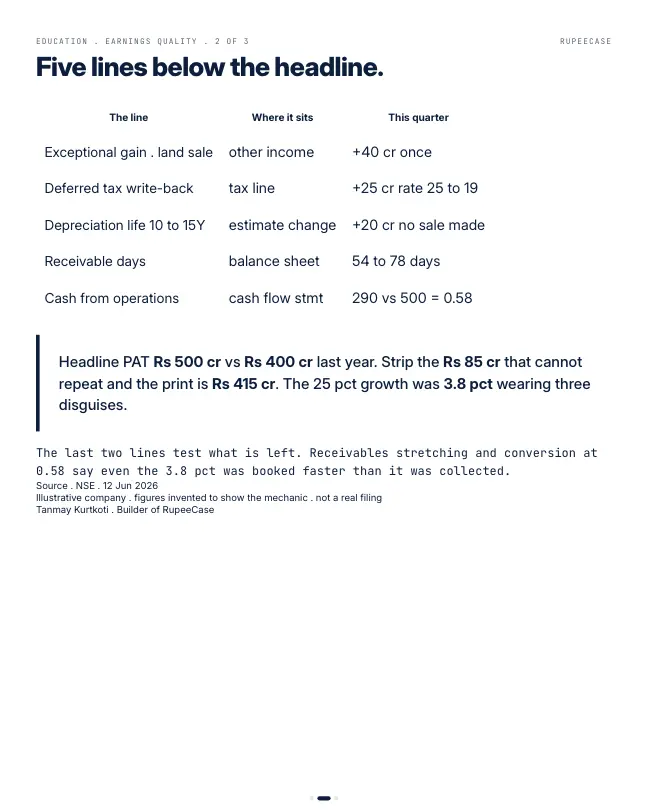
Line one, other income: a Rs 40 cr gain on a land sale. Happens once. Line two, the tax line: a Rs 25 cr deferred tax write-back, effective rate down from 25 to 19 pct. Line three, depreciation: useful life of the plant stretched from 10 to 15 years, which quietly added Rs 20 cr to profit without a single extra unit sold.
Strip those three. The headline Rs 500 cr becomes Rs 415 cr against last year's Rs 400 cr. The 25 pct growth is 3.8 pct.
Lines four and five test what is left. Receivable days went from 54 to 78, so a chunk of the quarter's sales are still promises. Cash from operations came in at Rs 290 cr against Rs 500 cr of reported profit. Conversion of 0.58. Even the 3.8 was booked faster than it was collected.
(The company here is illustrative. The five lines are not. They sit in every results filing in the same places.)
Three rules from my desk. The headline is chosen and the notes are mandatory, so read the filing, not the quote. A line that cannot repeat is not growth, strip it before you compare years. Receivable days crack before earnings do. Days first, conversion second, headline last.
A press release is written to be quoted. A filing is written to be checked. Quote nothing you have not checked.
Two documents, same evening
Every listed company files its results with NSE and BSE under the SEBI listing rules. The press release is optional and written by the company. The filing is the statement of profit and loss with its notes, in a format the rules fix. The same quarter, two very different reads.
Profit up 25 percent
- Record profit of Rs 500 crore
- Strong operating performance
- No mention of the land sale
Repeatable profit up 3.75 percent
- Rs 40 crore land sale in other income
- Rs 25 crore deferred tax write back
- Rs 20 crore from a longer plant life
Lines one to three: strip what cannot repeat
Do the arithmetic once and it sticks. Reported profit Rs 500 crore. Take out the Rs 40 crore land sale, because the company cannot sell the same land next year. Take out the Rs 25 crore tax write back, because the tax rate will not keep falling by 6 points. Take out the Rs 20 crore that came from the change in useful life, because it is an accounting choice, not a better business. Rs 500 crore less Rs 85 crore is Rs 415 crore. Against Rs 400 crore last year, growth is Rs 15 crore, or 3.75 percent, which the opening rounds to 3.8.
- Reported profit500
- Land sale gain-40
- Tax write back-25
- Longer plant life-20
- Repeatable profit415
- Last year400
Rs crore. Worked example, not a company.
Line three is the quiet one, so here is where the Rs 20 crore comes from. Say the plant cost Rs 600 crore. Spread over 10 years, depreciation is Rs 60 crore a year. Spread over 15 years, it is Rs 40 crore. Nothing about the plant changed on the day of the decision. The cost just moved into later years. Ind AS allows a company to revise a useful life when its estimate changes, and the change has to be disclosed, which is why it sits in the notes and never in the press release.
Lines four and five: test what is left
Receivable days is trade receivables divided by sales, times the days in the period. It tells you how long customers take to pay. Run it on a business with Rs 4,000 crore of yearly sales. At 54 days, receivables are about Rs 592 crore. At 78 days, about Rs 855 crore. The extra 24 days means roughly Rs 263 crore of sales the company has booked and not collected.
That is why line five agrees with line four. Cash from operations of Rs 290 crore on Rs 500 crore of profit is a conversion of 0.58. Even against the cleaned Rs 415 crore, it is only 0.70. The money that did not arrive is sitting in those 24 extra days. The post on cash against profit walks the bridge from profit to cash one line at a time.
Where each line sits in the filing
Other income is its own line near the top of the statement of profit and loss; a large jump usually has a footnote. The tax line shows current and deferred tax separately. A change in useful life is disclosed in the notes on accounting estimates. Receivables are on the balance sheet, and cash from operations is in the cash flow statement, both filed with the half year and full year results. Five places, about ten minutes.
The free Learn module on revenue quality and earnings quality puts these checks in order with the auditor's notes as a sixth stop, and ends with a quiz. The companion post on other income takes line one apart on its own.
Questions readers ask
How do I calculate receivable days?
Divide trade receivables by sales and multiply by 365 for a full year, or by the number of days in the period. With Rs 4,000 crore of yearly sales and Rs 855 crore of receivables, receivable days are about 78. Compare the figure with the same company's past years, because normal levels differ a lot between industries.
What is a one off item in company results?
It is income or expense that will not recur in the normal course of business, such as a gain on selling land, a tax write back or an insurance claim. Companies sometimes label these exceptional items, but they can also sit inside other income or the tax line. Strip them before comparing one year's profit with the next.
Why does a change in depreciation life increase profit?
Depreciation spreads the cost of an asset over its useful life. A longer life means a smaller charge each year, so profit rises even though nothing about the business changed. The total cost is the same; it is pushed into later years.
The cards
3 cards. Swipe, or tap to open.

Reading path
Stop 4 of 8 on Reading a company
Related
- EPS grew, cash did notEarnings per share rising from 10 to 17 while free cash flow sits at 9 drops the conversion ratio from 0.90 to 0.53, and three quarters of that is a trend, not timing.Company numbers . . 5 min
- The business that grows on its suppliers' moneyA 135 day cash conversion cycle needs Rs 37 crore to fund Rs 100 crore of extra sales, while a minus 35 day cycle is handed about Rs 10 crore for the same growth.Company numbers . . 5 min
- Other income: you are buying the factory, not the FDReported profit rose from 170 to 200 while core business profit fell from 120 to 110, because other income's share of pre tax profit climbed from 29 to 45 percent.Company numbers . . 5 min
Educational content only. Figures are illustrative and computed on historical or representative data for teaching purposes, not investment advice. Past performance does not guarantee future returns. Sourced from NSE, BSE, SEBI, AMFI and RBI public data.