

Company numbers..5 min read
Goodwill: the asset that exists because they overpaid
A Rs 400 crore goodwill write down can turn a 500 crore profit year into 100 without a rupee of cash moving, as Tata Steel's Corus impairment showed.
By Tanmay Kurtkoti, founder of QC Alpha and builder of RupeeCase
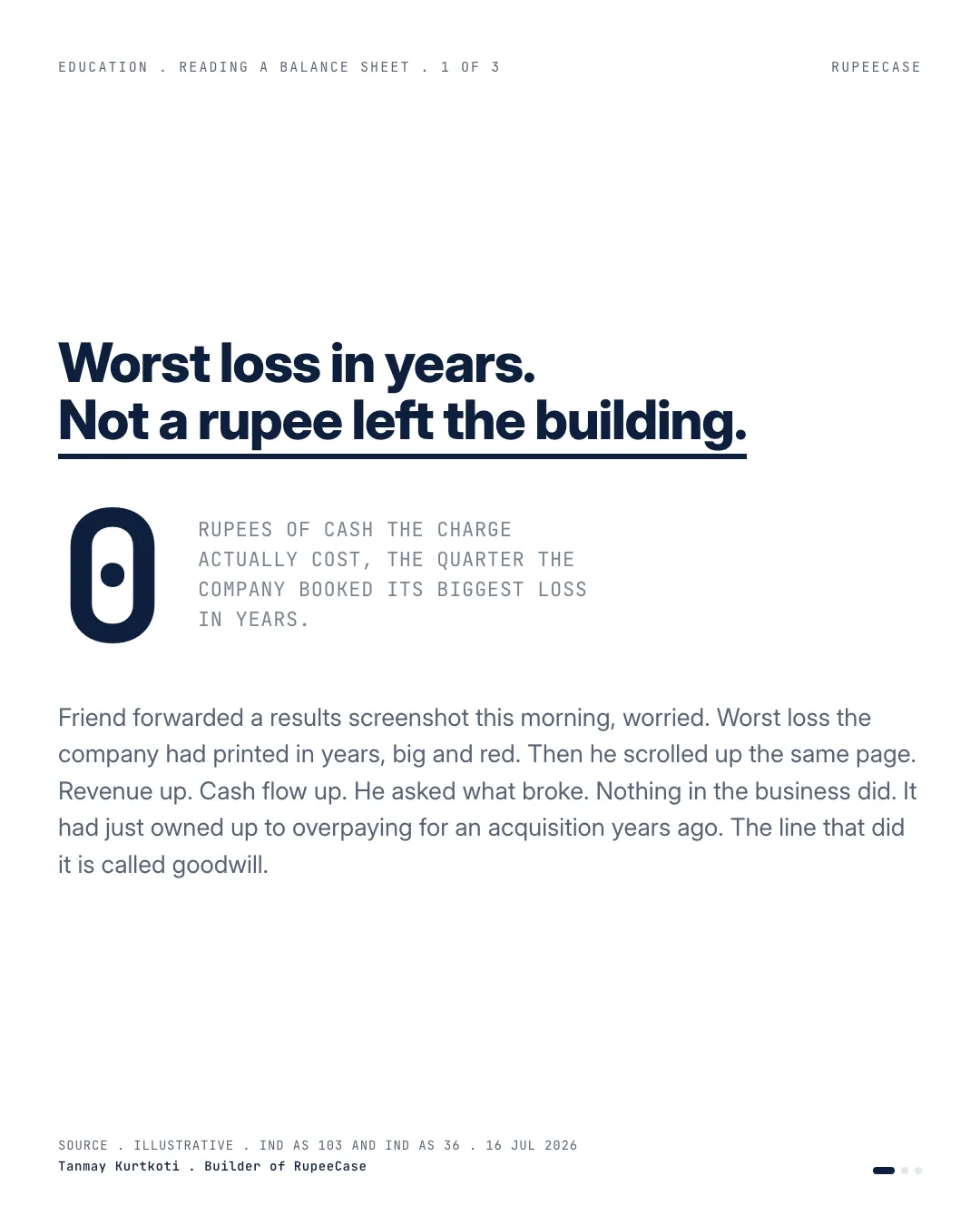
A friend forwarded me a results screenshot this morning, half worried. The company had just posted its worst loss in years, big and red. Then he scrolled up the same statement. Revenue was up. Operating cash flow was up. He asked the obvious thing. What broke.
Nothing in the business. It had written down goodwill.
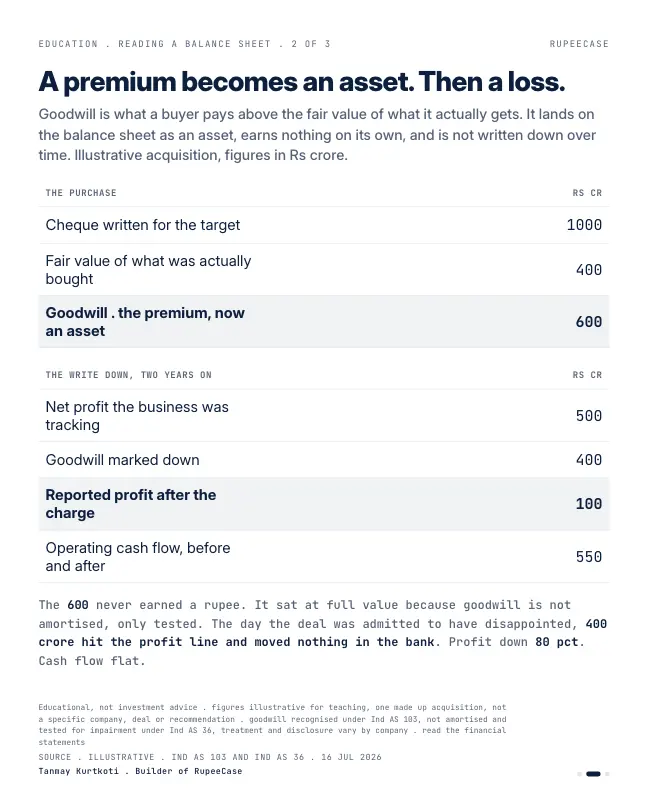
Here is the part most people never get told. When a company buys another for more than the fair value of what it is actually getting, the extra does not disappear. It gets parked on the balance sheet as an asset called goodwill. Pay Rs 1,000 crore for a business whose net assets are worth 400, and 600 crore of pure premium sits on the books. It earns nothing on its own. And under the accounting rules it is not written down a little each year. It sits at full value, tested once a year, until the day management admits the deal did not deliver.
That day, the whole shortfall hits the profit line at once. Say they mark down 400 crore. A year that was tracking 500 crore of profit reports 100. Eighty percent of the year, gone in a single line. And here is the twist that scares people out of good businesses. Not a rupee of cash moved. It is a non cash charge, so operating cash flow does not flinch. Tata Steel took an impairment near 1.6 billion dollars on its old Corus acquisition. The reported loss was enormous. The cash did not change.
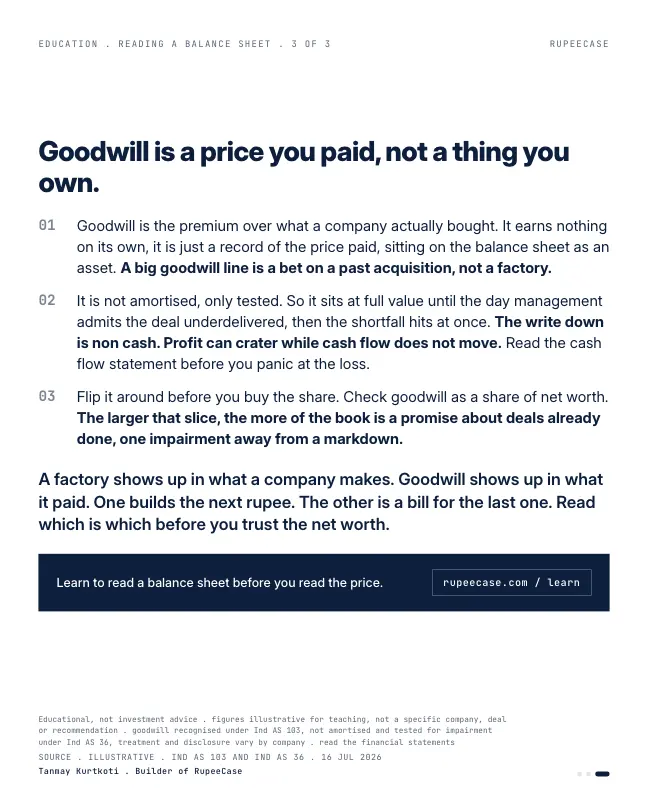
So two habits. When you see a shock loss, read the cash flow statement before you react. And before you trust a company's net worth, check how much of it is goodwill. The bigger that slice, the more of the book is a bet on deals already done, sitting one impairment away from a markdown.
A factory shows up in what a company makes. Goodwill shows up in what it paid.
How Rs 1,000 crore splits on the day of the deal
Take the opening's deal and give it names. Company A buys all of Company B for Rs 1,000 crore in cash. On the day it closes, Company A's accountants value everything Company B owns, plant, stock, receivables, brands they can identify and price, and subtract everything it owes. Say that comes to Rs 400 crore. The other Rs 600 crore has no asset behind it. It is the price of the hope: synergies, growth, a market position. Ind AS 103 books it as goodwill.
Under Indian accounting rules that Rs 600 crore is not amortised. Ind AS 36 asks the company to test it for impairment at least once a year: estimate the cash Company B will generate, discount it, and compare the result with what sits on the books. As long as the forecast holds up, nothing happens. That is why goodwill can sit untouched for years and then fall in one quarter.
The year of the write down
Now Company B misses its plan for two years running. The test says it is worth Rs 400 crore less than its carrying value, so Rs 400 crore of goodwill goes. Here is the year in rupees.
The cash flow statement tells the other half. Cash from operations starts from profit and adds back every expense that was not paid in cash. The Rs 400 crore write down is added straight back. If the business generated Rs 520 crore of operating cash last year and Rs 560 crore this year, it still shows Rs 560 crore. The shock is in the profit and loss and the balance sheet, not in the bank account.
- Profit, a normal year500
- Profit, write down year100
- Operating cash, last year520
- Operating cash, this year560
Rs crore. Worked example, not a company.
Two details make the write down sharper than it looks. Ind AS 36 does not let a company reverse a goodwill impairment later, even if Company B recovers, so the markdown is permanent. And it does not soften the tax bill: goodwill has not been a depreciable asset for income tax since the Finance Act, 2021, so the Rs 400 crore charge comes with no tax saving.
What the write down really tells you
The cash did not move this year. It moved years ago, on the day Company A paid Rs 1,000 crore for Rs 400 crore of assets. The impairment is the accounts catching up with a capital allocation decision. That is why I read it less as news about this year and more as a grade on management's past deals.
Check the slice before the write down arrives. Say Company A has a net worth of Rs 2,000 crore and Rs 600 crore of it is goodwill. Then 30 percent of its book value is the premium on deals already done. Its tangible net worth, the book minus goodwill and other intangibles, is Rs 1,400 crore. A price to book ratio quoted on Rs 2,000 crore looks lower than it would on Rs 1,400 crore.
of Company A's Rs 2,000 crore net worth is goodwill
Worked example
tangible net worth once goodwill is set aside
Worked example
The free Learn module on capital allocation shows how to judge acquisitions, buybacks and reinvestment by the return they earn, with a quiz at the end. The companion post on goodwill impairment reads the note in the annual report where the test is disclosed, and two sets of books explains why goodwill appears in the consolidated statement and not the standalone one.
Questions readers ask
What is goodwill on a balance sheet?
It is the part of an acquisition price that is above the fair value of the net assets bought. If a company pays Rs 1,000 crore for a business with Rs 400 crore of net assets, Rs 600 crore is recorded as goodwill. It stays on the balance sheet until an impairment test shows the acquired business is worth less.
Does a goodwill impairment affect cash flow?
No. It is a non cash charge, so it reduces reported profit and net worth but is added back in cash from operations. The cash left the company when the acquisition was paid for, often years earlier.
Can a goodwill write down be reversed?
Not under Ind AS 36. Impairment on other assets can be reversed if their value recovers, but an impairment of goodwill is permanent, so a recovery in the acquired business does not bring the written off amount back.
The cards
3 cards. Swipe, or tap to open.
Reading path
Stop 7 of 8 on Reading a company
Related
- One company, two sets of booksA parent's standalone profit of Rs 45 crore, consolidated Rs 140 crore and attributable Rs 100 crore give P/Es of 33, 11 and 15 on the same market value.Company numbers . . 5 min
- Goodwill impairment: the day the future said noPaying Rs 1,000 crore for Rs 400 crore of real assets parks Rs 600 crore of optimism as an asset, and the write down only catches the books up to cash that left years earlier.Company numbers . . 5 min
- Promoter pledging: the page nobody readsA stock down 40 percent in two sessions on no news is usually a pledge unwinding, as a 30 percent fall takes lender cover from 2.0x to 1.4x and triggers forced selling.Company numbers . . 6 min
Educational content only. Figures are illustrative and computed on historical or representative data for teaching purposes, not investment advice. Past performance does not guarantee future returns. Sourced from NSE, BSE, SEBI, AMFI and RBI public data.