

Company numbers..5 min read
Operating leverage: the amplifier nobody prices in
Two firms with Rs 200 crore of operating profit on Rs 1,000 crore of sales fall 40 and 20 percent on the same 10 percent revenue drop, depending only on where the costs sit.
By Tanmay Kurtkoti, founder of QC Alpha and builder of RupeeCase
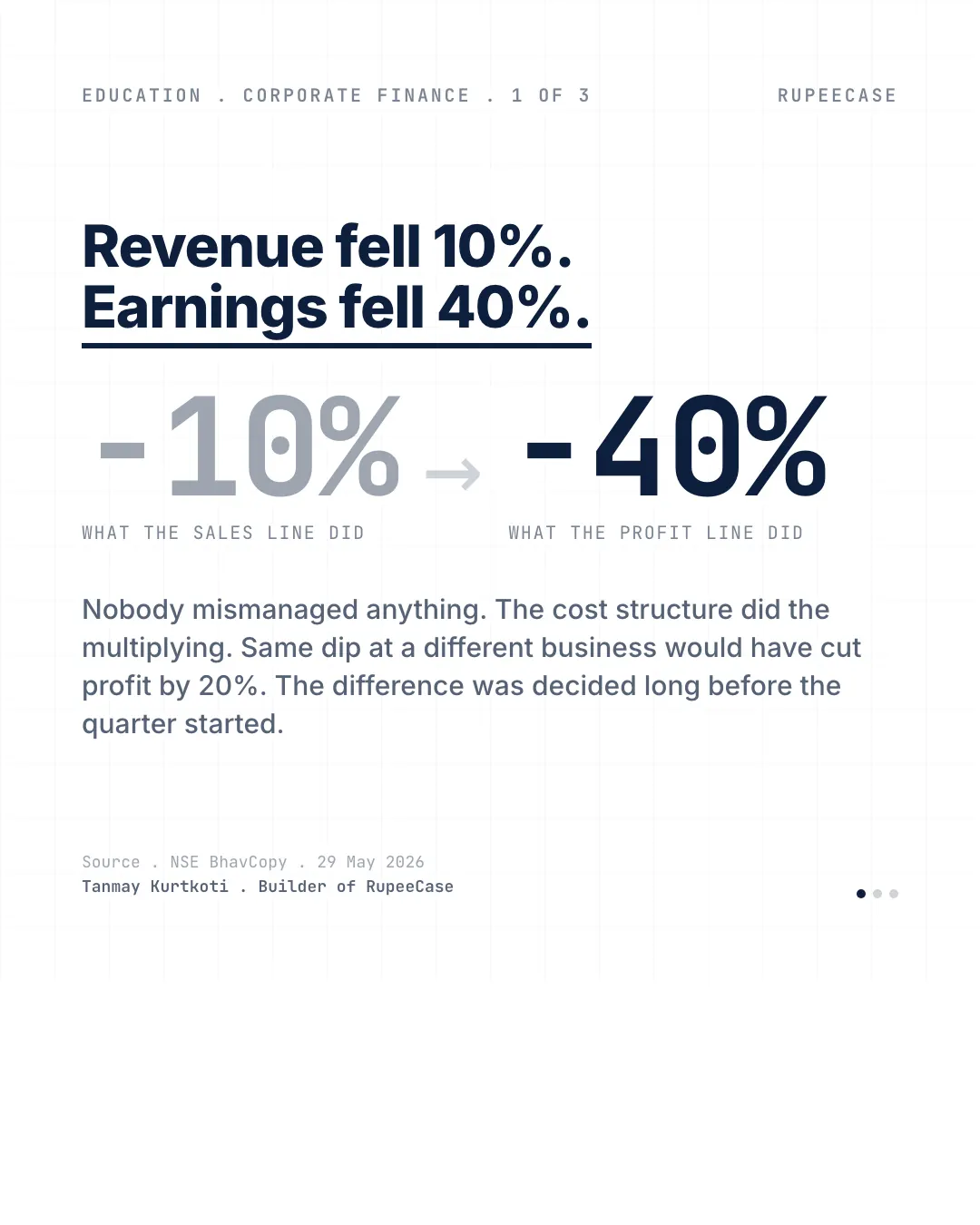
A midcap industrial reported last week. Sales down 10%. Operating profit down 40%. The first reaction in every group I am in was the same. Someone must have messed up the quarter.
Nobody messed up the quarter. The cost structure did exactly what cost structures do.
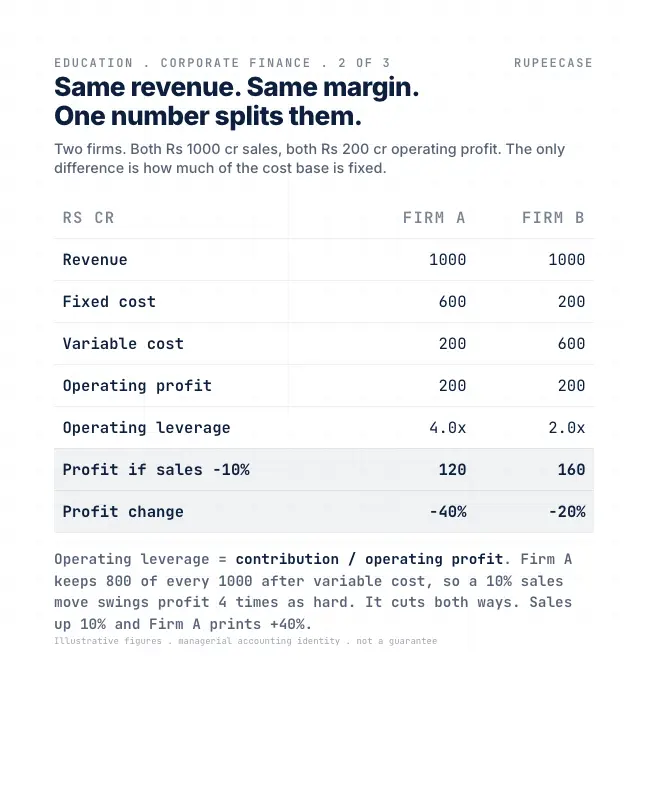
Here is the thing most people never check before they buy a business. Two companies can look identical on the headline and behave nothing alike when the cycle turns. Picture two firms. Both do Rs 1,000 cr of sales. Both earn Rs 200 cr of operating profit. Same margin, same top line, same bottom line.
Now look one line down. Firm A carries Rs 600 cr of fixed cost and Rs 200 cr of variable. Firm B is the mirror image, Rs 200 cr fixed and Rs 600 cr variable. After variable cost, Firm A keeps Rs 800 of every Rs 1,000. Firm B keeps Rs 400.
That ratio has a name. Operating leverage, which is just contribution divided by operating profit. Firm A reads 4.0x. Firm B reads 2.0x. So when sales fall 10%, Firm A's profit falls 40% and Firm B's falls 20%. Same shock, double the pain, and the only thing that changed was where the costs sat.
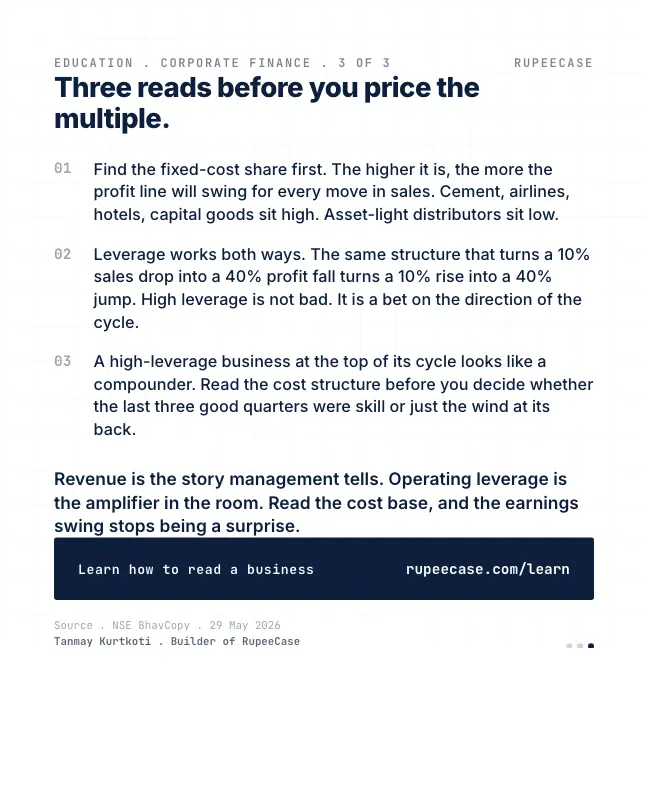
It cuts the other way too. On a 10% better quarter Firm A prints a 40% jump and looks like a runaway compounder. That is the trap. A high fixed-cost business at the top of its cycle, cement, airlines, hotels, capital goods, wears the same clothes as a genuine compounder. The leverage is doing the flattering.
The honest version is simple. Revenue is the story management tells. Operating leverage is the amplifier in the room. Find the fixed-cost share before you price the multiple, and the earnings swing stops being a surprise.
Walk the 10 percent fall line by line
Redo it on paper. Firm A's sales fall 10 percent, from Rs 1,000 crore to Rs 900 crore. Variable cost is 20 percent of sales, so it falls with them, from Rs 200 crore to Rs 180 crore. Fixed cost stays at Rs 600 crore: the plant, the salaried staff, the rent and the depreciation do not care what was sold this quarter. Rs 900 crore less Rs 180 crore less Rs 600 crore is Rs 120 crore of operating profit. Down from Rs 200 crore. That is the 40 percent.
Firm B on the same fall: Rs 900 crore of sales, variable cost at 60 percent is Rs 540 crore, fixed cost Rs 200 crore. Operating profit is Rs 160 crore, down 20 percent. Firm B gave back Rs 60 crore of variable cost when sales fell. Firm A gave back only Rs 20 crore.
The swing gets wider as the fall gets deeper
Operating leverage is not a fixed number. It rises as profit shrinks, because the same fixed cost sits on top of a smaller cushion. At a 20 percent fall in sales, Firm A's operating profit drops to Rs 40 crore, down 80 percent. Firm B drops to Rs 120 crore, down 40 percent.
- A, sales down 20%-80%
- B, sales down 20%-40%
- A, sales down 10%-40%
- B, sales down 10%-20%
- A, sales up 10%+40%
- B, sales up 10%+20%
Change in operating profit. Both firms start at Rs 1,000 crore of sales and Rs 200 crore of operating profit. Worked example, not a company.
There is a second way to read the same structure: the break even point. Firm A keeps 80 paise of every rupee of sales after variable cost, so it needs Rs 600 crore divided by 0.8, or Rs 750 crore of sales, just to cover its fixed cost. That is a 25 percent fall from today. Firm B keeps 40 paise, so it needs Rs 200 crore divided by 0.4, which is Rs 500 crore. It can lose half its sales before operating profit hits zero.
Stack debt on top and the amplifier doubles
Operating leverage lives above the operating profit line. Debt adds a second amplifier below it, because interest is a fixed cost too. Give Firm A an interest bill of Rs 100 crore. Profit before tax is Rs 100 crore. Financial leverage, operating profit divided by profit before tax, is 2.0x. Multiply the two: 4.0 times 2.0 is a combined leverage of 8.0x.
Now the 10 percent fall in sales takes operating profit to Rs 120 crore and profit before tax to Rs 20 crore. Down 80 percent, from a 10 percent fall in sales. Nothing went wrong in the business. The structure did it. The post on interest coverage runs the debt side of this in detail, and the free Learn module on leverage, debt and financial risk covers both amplifiers with a quiz at the end.
MythProfit up 40 percent on sales up 10 percent means the business has turned into a compounder.
FactWith operating leverage of 4x, a 10 percent rise in sales lifts profit 40 percent by arithmetic alone. The same arithmetic takes 40 percent off when sales fall 10 percent.
Finding the fixed cost share in a filing
Companies do not print a fixed cost line. You estimate it from the expense lines that Schedule III requires on the statement of profit and loss.
- Mostly variableCost of materials consumed, purchases of stock in trade, freight. These move with volume.
- Mostly fixedEmployee benefits expense and depreciation. They move with headcount and plant, not with this quarter's orders.
- MixedOther expenses, which hold power, rent and repairs. Treat about half as fixed if the notes give no split.
- Test itCompare the change in operating profit with the change in sales over the last eight quarters. The ratio is the operating leverage the market actually saw.
That last step is the one I trust most. Accounting labels are approximate. The way profit actually moved against sales across a few quarters is the business telling you its own cost structure.
Questions readers ask
What is the degree of operating leverage?
It is the percentage change in operating profit for a 1 percent change in sales, and at a given level of sales it equals contribution divided by operating profit. A reading of 4x means a 10 percent move in sales moves operating profit about 40 percent in the same direction.
Which Indian sectors have high operating leverage?
Businesses with large plant, salaried staff or lease commitments that do not scale down with volume, such as cement, airlines, hotels and capital goods, which the opening names. Their profits rise faster than sales in an upturn and fall faster in a downturn.
Is high operating leverage bad?
Not by itself. It makes profit more sensitive to sales in both directions. It becomes dangerous when it is paired with debt, because interest adds a second fixed cost, or when a high fixed cost business is valued on profits earned at the top of its cycle.
The cards
3 cards. Swipe, or tap to open.
Related
- Interest coverage: the number under the profitTwo companies with the same operating profit cover their interest 5 times and 1.5 times, and a 40 percent bad year leaves one at 3x and the other below 1.Company numbers . . 6 min
- Off balance sheet debt: the notes are the balance sheetReported net debt of 1.2 times EBITDA becomes 2.7 times once lease liabilities and supply chain financing are counted, before the contingent liabilities in the notes.Company numbers . . 5 min
- EPS grew, cash did notEarnings per share rising from 10 to 17 while free cash flow sits at 9 drops the conversion ratio from 0.90 to 0.53, and three quarters of that is a trend, not timing.Company numbers . . 5 min
Educational content only. Figures are illustrative and computed on historical or representative data for teaching purposes, not investment advice. Past performance does not guarantee future returns. Sourced from NSE, BSE, SEBI, AMFI and RBI public data.