

Costs: MF, PMS, RupeeCase..6 min read
Pull your CAS before you buy a seventh fund
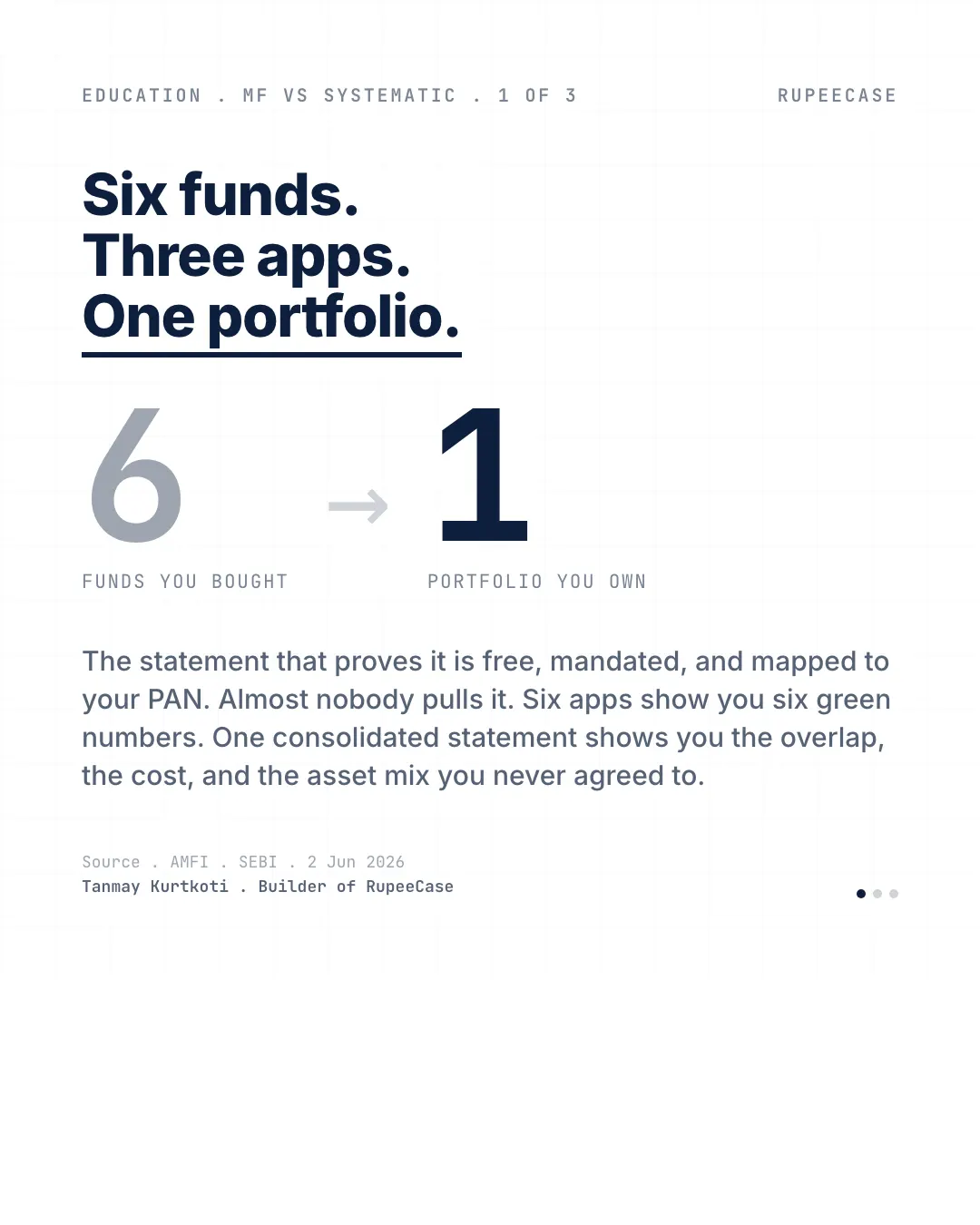
One consolidated account statement showed six funds with 62 percent of the money in the same twelve stocks, Rs 12,800 a year of fees and Rs 72,000 of forgotten debt.
By Tanmay Kurtkoti, founder of QC Alpha and builder of RupeeCase
A friend told me last week he was well diversified. Six funds, three different apps, everything green. I asked him to do one thing before he bought a seventh. Pull his CAS.
He had never heard of it. That is the part that gets me every time, because the Consolidated Account Statement is free, it is mandated, and it shows every mutual fund folio sitting on your PAN in one place. The reason nobody pulls it is that no single app wants to. Each platform shows you its own slice and its own green number. The CAS shows you the whole book, and the whole book usually tells a different story.
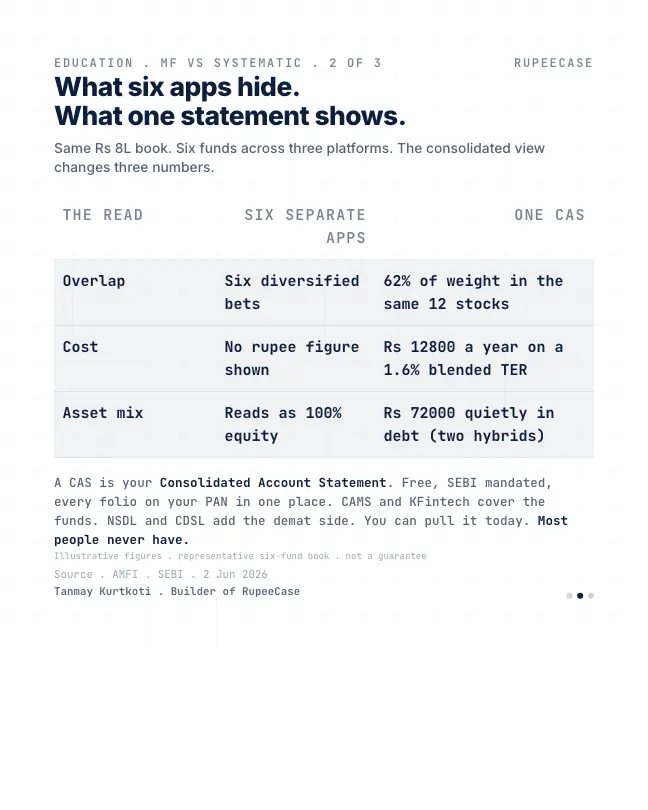
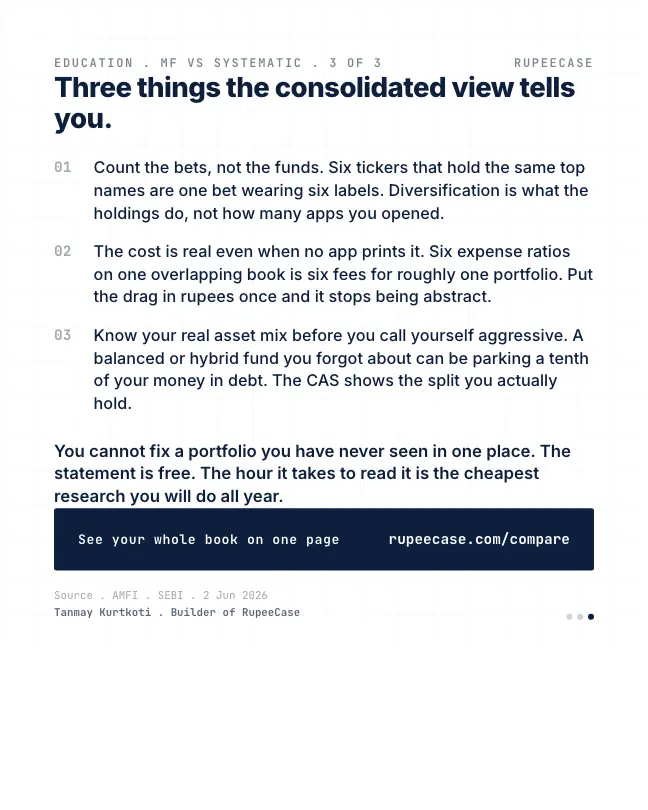
His did. Start with the overlap. Six funds, but once you lined up the holdings, about 62% of the money sat in the same twelve stocks. The big private banks, the same two energy names, the usual index heavyweights. Six funds, one bet, five extra labels.
Then the cost. None of his apps printed a rupee figure anywhere. His blended expense ratio was around 1.6%, which on a Rs 8L book is roughly Rs 12,800 a year. Six expense ratios stacked on what was really one portfolio. Put a number on a drag and it stops being abstract.
Last one surprised him most. He called himself fully aggressive, all equity. Two of the six were hybrid funds he had forgotten were hybrid, and between them they were parking about Rs 72,000 in debt. His real mix was not the one in his head.
Nothing here was hidden. It was all on one statement he could have pulled any morning, for free, in twenty minutes. The cheapest research you will do all year is reading the book you already own.
What the CAS is, and how to pull it
The Consolidated Account Statement is one statement for everything held against your PAN: transactions across every mutual fund, plus the securities in your demat accounts. SEBI's investor site describes it in those terms, and the condition for getting it is simple: your PAN has to be updated with your depository participant or broker. Folios without a PAN on record drop out of the consolidation.
- Check the PANEvery folio and demat account needs the same PAN on record.
- Get the statementThe depositories build it on your PAN and send it to your registered contact details.
- List every schemeName, plan, units, value. Note which say Direct and which say Regular.
- Read the half yearly linesAverage expense ratio and the commission paid on your money, in rupees.
- Add up the bookOne total, one asset mix, one cost. The number no single app shows.
That fourth step is the one most people do not know exists. SEBI's circular of 20 Sep 2016 requires the half yearly CAS, for the periods ending September and March, to show for each scheme the average total expense ratio of your plan and the gross commission paid to your distributor against your investment, in rupees. My friend's "no app printed a rupee figure" problem is solved on that page.
Rebuilding his book on paper
Here is the friend's book rebuilt as a worked example, so the arithmetic is visible. Rs 8 lakh across six funds.
- Fund 1, flexicap, regular plan: Rs 2,00,000 at a 1.8 percent expense ratio, Rs 3,600 a year.
- Fund 2, large cap: Rs 1,50,000 at 1.7 percent, Rs 2,550.
- Fund 3, large and mid cap: Rs 1,50,000 at 1.5 percent, Rs 2,250.
- Fund 4, focused: Rs 1,00,000 at 1.6 percent, Rs 1,600.
- Fund 5, balanced hybrid: Rs 1,00,000 at 1.4 percent, Rs 1,400.
- Fund 6, aggressive hybrid: Rs 1,00,000 at 1.4 percent, Rs 1,400.
The six lines add to Rs 12,800 a year, a blended 1.6 percent. Now the mix. A balanced hybrid holds 40 to 60 percent in debt under SEBI's categories; call it half, Rs 50,000. An aggressive hybrid holds 20 to 35 percent; call it 22 percent, Rs 22,000. Together, Rs 72,000 in debt.
- Equity, Rs 7,28,00091%
- Debt, Rs 72,0009%
Worked example: Rs 8 lakh in six funds, debt inside two hybrid funds. Category ranges from SEBI circular of 26 Feb 2026.
Nine percent debt is not a problem in itself. The problem is not knowing it is there, because then you cannot decide whether you want it.
Measuring overlap the way SEBI does
The 62 percent figure in the opening needs a method, and since February SEBI has published one. Its categorisation circular of 26 Feb 2026 measures the overlap between two schemes at the level of each stock: for every stock both hold, take the smaller of the two weights, then add those up. Stocks only one fund holds count for nothing.
With these weights, two funds with different names are 41 percent the same book. The SEBI rule that uses this method applies to sectoral and thematic schemes against a fund house's other equity schemes, and it leaves out large cap schemes. Nothing in it looks across six funds from four houses sitting in one PAN. That check is yours, and the CAS plus the portfolio each fund publishes is all it needs.
What six labels hide
Diversification is about how many different bets you hold, not how many fund names. Two funds that hold the same twelve stocks move together, so the second one adds an expense ratio without adding a different outcome. Modern portfolio theory puts a number on this: the risk of a mix depends on how closely its parts move together, and two near copies move almost as one.
The free Learn module on modern portfolio theory shows why correlated holdings do not cut risk, with a quiz and a certificate, and the expense ratio calculator turns each fund's fee into rupees. Two related reads: SEBI's overlap cap and the overlap you own and star ratings are the rear view mirror.
Questions readers ask
How do I get a consolidated account statement for all my mutual funds?
Make sure every folio and demat account carries your PAN, because the consolidated statement is built on PAN and sent by the depositories. SEBI's investor site lists updating the PAN with your depository participant or broker as the step that gets you a CAS.
How do I check overlap between two mutual funds?
List both funds' holdings with weights from their monthly portfolios. For each stock both hold, take the smaller weight, and add these up. That is the method in SEBI's circular of 26 Feb 2026, and a result above 50 percent means more than half of one fund is the other.
Does the CAS show how much commission I pay?
Yes, in the half yearly statements for periods ending September and March. Since 1 Oct 2016 they show, for each scheme, the gross commission the fund paid your distributor against your investment, in rupees, and the average expense ratio of your plan.
The cards
3 cards. Swipe, or tap to open.
Related
- Star ratings are the rear view mirrorOnly about one in four top quartile funds is still there a few years later, which is what a coin flip sorted into four buckets would deliver.Costs: MF, PMS, RupeeCase . . 5 min
- The NAV mythRs 10,000 in a Rs 10 NAV fund and in a Rs 500 NAV fund with the same portfolio are worth the same Rs 11,000 after a 10 percent rise, because NAV is not a price.Costs: MF, PMS, RupeeCase . . 5 min
- The fund that got too big to beat the indexA six percent conviction position is Rs 30 crore in a Rs 500 crore fund and Rs 2,400 crore at Rs 40,000 crore, which no midcap can absorb, so the fund drifts into the index.Costs: MF, PMS, RupeeCase . . 5 min
Educational content only. Figures are illustrative and computed on historical or representative data for teaching purposes, not investment advice. Past performance does not guarantee future returns. Sourced from NSE, BSE, SEBI, AMFI and RBI public data.