

Costs: MF, PMS, RupeeCase..5 min read
SEBI's overlap cap and the overlap you own
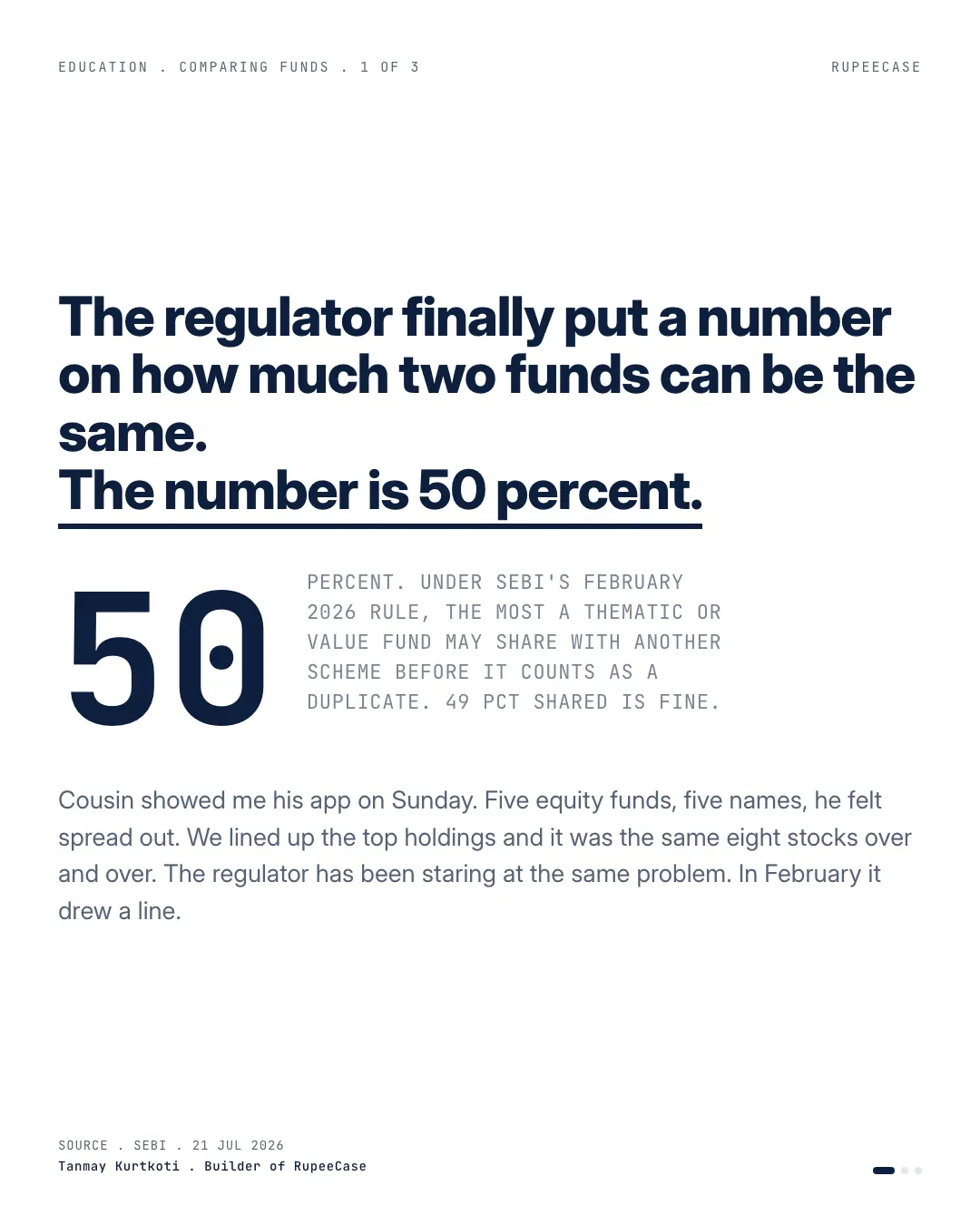
SEBI's February rule treats two schemes as duplicates above 50 percent overlap but carves out large caps, which is exactly where two plain funds share 60 to 80 percent.
By Tanmay Kurtkoti, founder of QC Alpha and builder of RupeeCase
Cousin showed me his app on Sunday. Five equity funds, five different names, and he felt spread out.
We lined up the top holdings. Same eight stocks, over and over.
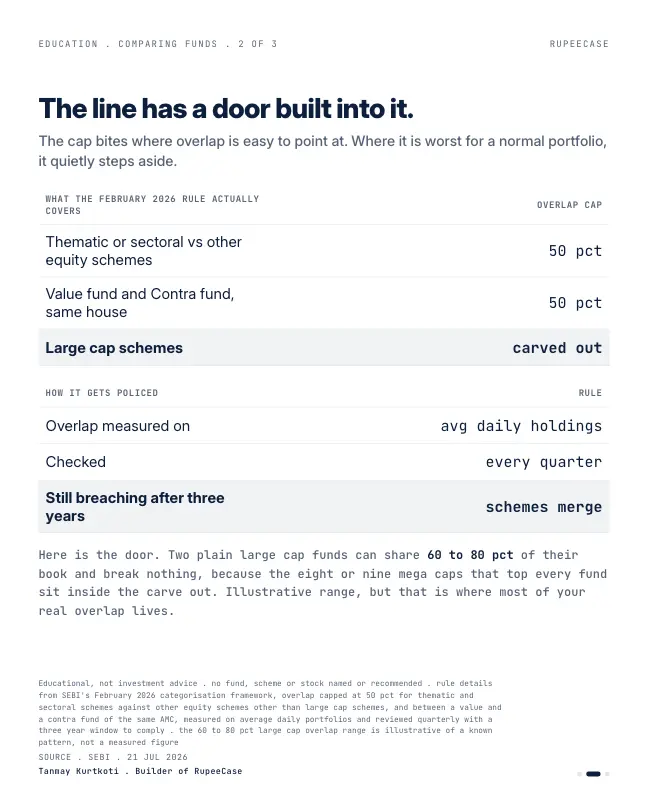
Turns out the regulator has been looking at the same thing. In February SEBI put an actual number on how much two funds are allowed to be the same. A thematic or value fund can now share no more than 50 pct of its portfolio with another scheme before it is treated as a duplicate. Value fund and contra fund from the same house, same 50 pct ceiling. Measured on average daily holdings, checked every quarter, and a scheme still breaching after three years gets merged away.
Read the number again. 49 pct of the same stocks, and the rulebook still counts them as two different funds. A cap set that high is not the regulator being strict. It is the regulator admitting that heavy overlap is normal.
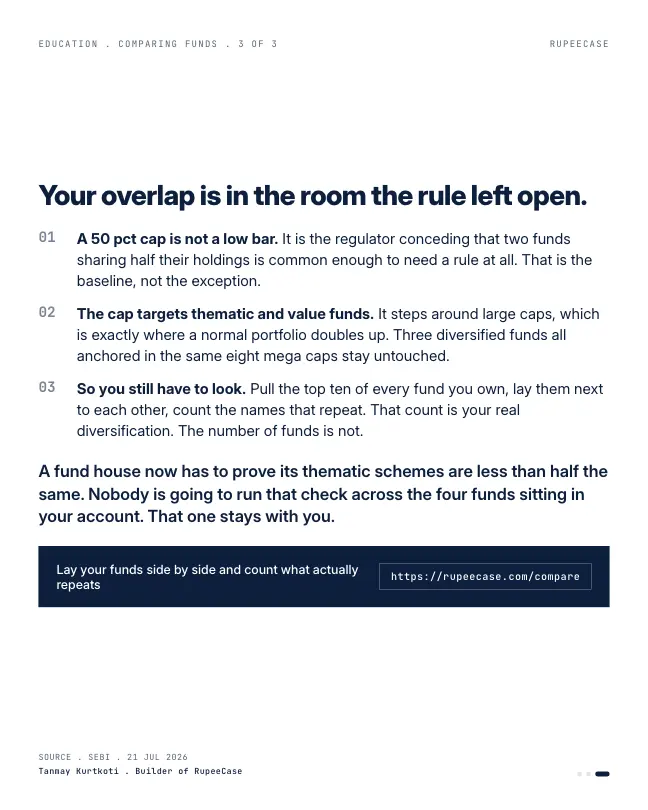
Here is the part that matters for your account. Large caps are carved out of the rule. And large caps are exactly where a normal portfolio doubles up. The eight or nine mega caps that top almost every diversified fund sit right inside that carve out, so two plain large cap funds can share 60 to 80 pct of their book and break nothing.
So the overlap the rule fixes is not the overlap you own. A fund house now has to prove its thematic schemes are less than half the same. Nobody is going to run that check across the four funds sitting in your account.
That one stays with you. Pull the top ten holdings of every fund you hold, lay them side by side, and count the names that repeat. That count is your real diversification. The number of funds was never it
How SEBI measures the overlap
The rule is in SEBI's categorisation circular of 26 Feb 2026, and the method is precise enough to redo by hand. For two schemes, take every stock both of them hold. For each, take the smaller of the two weights. Add those up. That sum is the overlap. A stock held by only one scheme adds nothing.
- Every dayOverlap computed stock by stock, the lower weight of each common holding.
- Every quarterThe average of the daily figures is tested against 50 percent.
- Every monthFund houses publish category wise overlap levels on their websites.
- Three yearsExisting sectoral and thematic schemes must comply, or be merged.
Two schemes are named in the circular. A fund house may now run both a value fund and a contra fund, as long as the two overlap by no more than 50 percent. And a sectoral or thematic scheme may overlap no more than 50 percent with the house's other equity schemes, large cap schemes excepted. Themes themselves have to come from a list AMFI publishes with SEBI, updated every six months.
The glide path, in numbers
Existing schemes do not have to fix it at once. The circular suggests a glide path: bring down 35 percent of the excess overlap in the first year, another 35 percent in the second and the last 30 percent in the third. Here is what that means for a thematic scheme that overlaps a sibling by 65 percent today.
Three years from 26 Feb 2026 is Feb 2029. A scheme that still breaches then is merged into another. So the rule's first effect on your account may be a merger notice, not a change in what you own today.
Why large caps had to be left out
The carve out for large caps is not a loophole. It is arithmetic. Large cap funds have to hold at least 80 percent in the 100 largest companies, and those companies are concentrated at the top. On NSE's factsheet of 30 Sep 2026, the ten largest stocks of the Nifty 50 made up 52.27 percent of the index, and the single largest 10.38 percent.
of the Nifty 50 in its ten largest stocks
NSE Indices factsheet, 30 Sep 2026
in the single largest stock
NSE Indices factsheet, 30 Sep 2026
overlap limit for thematic and sectoral schemes
SEBI circular, 26 Feb 2026
Two large cap funds that each hold those ten stocks at index weight overlap by 52.27 percent from those ten names alone, before a single other stock is counted. A 50 percent rule could not apply to large caps without forcing every large cap fund to avoid the largest companies in the market.
Counting your own overlap
The rule fixes overlap inside one fund house's shelf. Your account usually spans several houses, and nothing in the rule looks across them. That is the check left to you, and it takes the same method SEBI uses. My own habit is cruder and quicker: list the top ten of every fund, count the names that repeat, and only then do the weights for the funds that share the most.
MythSEBI now stops funds from holding the same stocks.
FactIt caps overlap at 50 percent only for thematic, sectoral, value and contra schemes inside one fund house. Large cap funds and your own mix of houses are outside it.
Why care at all? Because diversification is about how differently your holdings move, not how many fund names you hold. Five funds that share most of their stocks rise and fall together. The free Learn module on modern portfolio theory shows why correlated holdings barely reduce risk, with a quiz, and the asset allocation calculator builds a mix from your own weights. For the full overlap calculation on two funds, read pull your CAS before you buy a seventh fund; for what merger rules do to records, funds that vanished.
Questions readers ask
What is SEBI's portfolio overlap rule for mutual funds?
Under SEBI's circular of 26 Feb 2026, a sectoral or thematic scheme may not overlap more than 50 percent with the same fund house's other equity schemes, except large cap schemes, and a value fund and contra fund from one house may not overlap more than 50 percent. Overlap is the average of daily figures over each quarter.
What happens to a thematic fund that breaches the overlap limit?
Existing schemes have three years from 26 Feb 2026 to comply, with a suggested glide path of cutting 35, 35 and 30 percent of the excess in successive years. A scheme still breaching after three years must be merged with another scheme.
Why are large cap funds excluded from the overlap rule?
Because large cap funds must hold mostly the 100 largest companies, and the top of the market is concentrated. The ten largest Nifty 50 stocks were 52.27 percent of the index on 30 Sep 2026, so two index like large cap funds overlap by more than half before any other stock is counted.
The cards
3 cards. Swipe, or tap to open.
Explore next
Learn it properly, then see it applied.
- Free module 6.3Mutual Funds, Structure, Types and Hidden Costs8 min read
- StrategyAllcap strategyNifty Total Market, 50 stocks, every 2 weeks
- Free module 4.1Modern Portfolio Theory, What Actually Matters11 min read
- CalculatorAsset allocation by risk profileFree, with the formula and a worked example
- Blog topicCosts: MF, PMS, RupeeCase notes25 notes
Related
- Funds that vanishedAbout one in four Indian large cap funds disappeared over ten years, and the category average you see is the average of the survivors.Costs: MF, PMS, RupeeCase . . 5 min
- The cost of switching fundsHopping out of a fund inside a year on a Rs 11.5 lakh pot costs about Rs 41,500 in tax and exit load, so the new fund must out earn the old by 3.6 percent before it earns a rupee.Costs: MF, PMS, RupeeCase . . 5 min
- The base rate of beating the marketSPIVA India shows 73 of 100 active large cap funds and 82 of 100 mid and small cap funds trailed their benchmark over the ten years to June 2025.Costs: MF, PMS, RupeeCase . . 5 min
Educational content only. Figures are illustrative and computed on historical or representative data for teaching purposes, not investment advice. Past performance does not guarantee future returns. Sourced from NSE, BSE, SEBI, AMFI and RBI public data.