

Costs: MF, PMS, RupeeCase..5 min read
The fund that got too big to beat the index
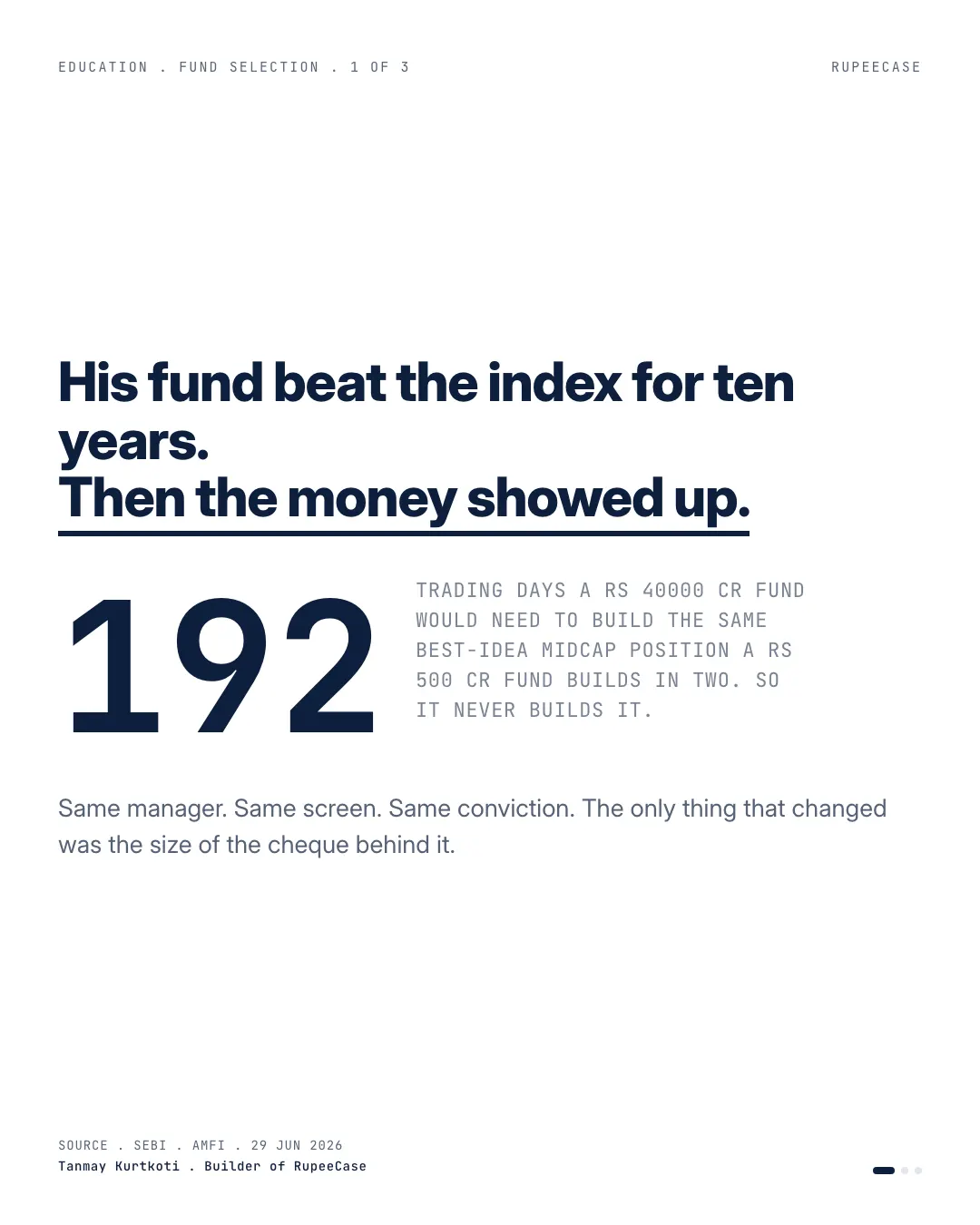
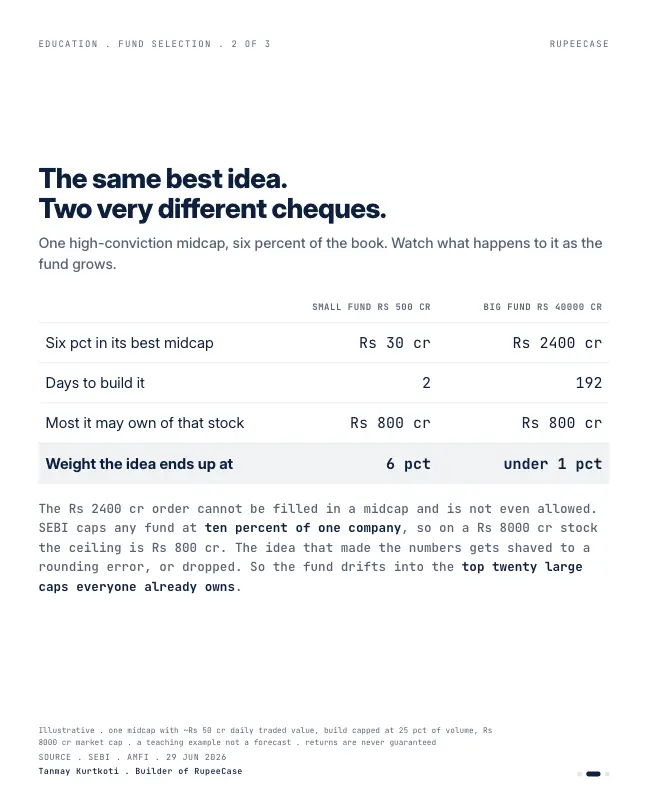
A six percent conviction position is Rs 30 crore in a Rs 500 crore fund and Rs 2,400 crore at Rs 40,000 crore, which no midcap can absorb, so the fund drifts into the index.
By Tanmay Kurtkoti, founder of QC Alpha and builder of RupeeCase
A friend forwarded me his mutual fund's factsheet last week, a little deflated.
For about ten years this thing beat its index by roughly four points a year. Properly good. Then he pointed at the last three years on the same chart. Flat. Dead in line with the benchmark. Same manager the whole time, same process, same star rating on every app. He wanted to know what broke.
I asked him one question. How big is the fund now.
Here is the part the factsheet never prints. When that fund was small, say Rs 500 crore, its highest conviction midcap idea could sit at six percent of the book. That is a Rs 30 crore position. A manager builds that in a couple of days and it actually moves the fund's number.
The good years pulled money in. It now runs around Rs 40,000 crore. That same six percent conviction is a Rs 2,400 crore order. You cannot fill that in a midcap without becoming the price yourself, and you would need months of the stock's entire traded volume to get there. SEBI caps any fund at ten percent of a single company on top of that, so on a Rs 8,000 crore midcap the absolute ceiling is Rs 800 crore. The idea that made his numbers gets shaved down to a rounding error, or dropped.
So the fund does the only thing it can. It drifts into the top twenty large caps everyone already owns and quietly becomes the index it used to beat, while still charging an active fee.
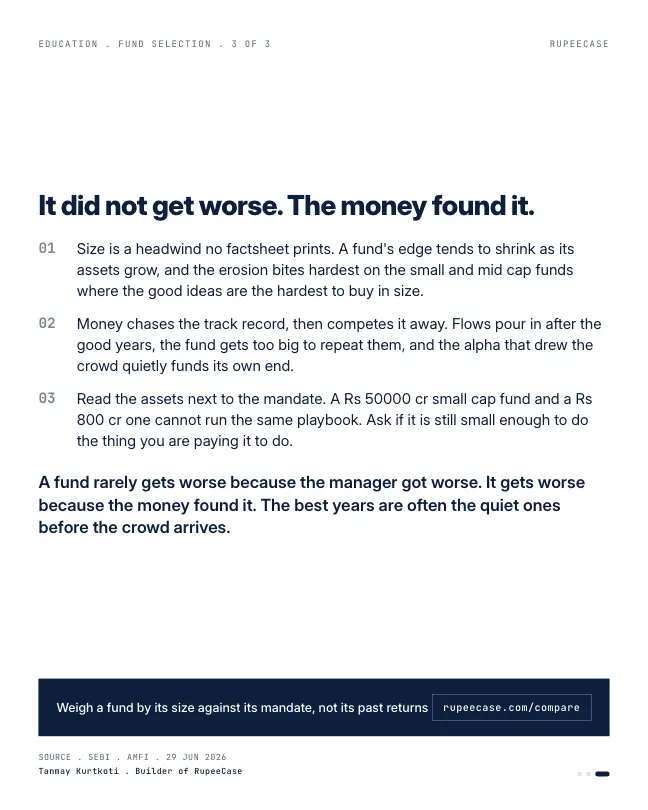
None of this is the manager getting worse. The money found the track record and competed it away. The academics call it diseconomies of scale, and it bites hardest exactly where the good ideas are hardest to buy in size.
Before you read a fund's returns, read its assets next to its mandate. Ask whether it is still small enough to do the thing you are paying it to do
How long it takes to buy one idea
The opening says a Rs 2,400 crore order in a midcap would need months of the stock's traded volume. Here is that arithmetic in steps, so you can redo it with any fund.
Take Company A, a midcap worth Rs 8,000 crore, whose shares trade about Rs 40 crore a day on NSE and BSE. That turnover is an assumption for the worked example, not a named company. A fund that does not want to move the price usually limits itself to a slice of each day's volume; say 20 percent, or Rs 8 crore a day.
- Fund of Rs 500 crore, 6 percent position: Rs 30 crore. At Rs 8 crore a day, about 4 trading days.
- Fund of Rs 5,000 crore: Rs 300 crore. About 38 trading days, close to two months.
- Fund of Rs 20,000 crore: Rs 1,200 crore. About 150 trading days, seven months.
- Fund of Rs 40,000 crore: Rs 2,400 crore. About 300 trading days, more than a year, and three times the regulatory ceiling.
- Rs 500 crore fund4 days
- Rs 5,000 crore fund38 days
- Rs 20,000 crore fund150 days
- Rs 40,000 crore fund300 days
Trading days to build a 6% position in a Rs 8,000 crore midcap trading Rs 40 crore a day, buying 20% of daily volume. Worked example with assumed turnover.
And while the fund buys for a year, its steady demand shows up in the price. The stock moves against the fund before the position is built. That is market impact, and it is a cost that never appears as a fee.
The ceiling SEBI puts on top
There is also a hard limit. SEBI's mutual fund rules say a mutual fund, across all its schemes together, may not own more than 10 percent of any company's paid up capital carrying voting rights. On Company A that is Rs 800 crore at market value, shared by every scheme of the same fund house. A Rs 40,000 crore fund that wants 6 percent in Company A is asking for three times what the rule allows.
At Rs 40,000 crore, even the full legal ceiling is only 2 percent of the fund. That is the rounding error in the opening. To keep a 6 percent conviction position, the fund would need a company worth Rs 24,000 crore or more, which moves it out of midcaps and toward the large caps everyone owns.
Where midcap ends, by NSE's definition
The squeeze is sharpest exactly where the good ideas are. NSE's Nifty Midcap 150 holds the companies ranked 101 to 250 by full market value, the same band SEBI uses to define a midcap for fund categories. On NSE's factsheet of 30 Sep 2026, the single largest stock in the index was just 2.07 percent of it.
companies in the Nifty Midcap 150, ranked 101 to 250
NSE Indices factsheet, 30 Sep 2026
weight of its largest stock
NSE Indices factsheet, 30 Sep 2026
most of one company a mutual fund may own, all schemes together
SEBI MF Regulations, Seventh Schedule
The path from beating the index to being it
- Small and nimbleTop ideas at full size. The record is built here.
- Money arrivesThe record pulls in flows. Assets grow tenfold.
- Ideas shrinkSmall names capped by volume and the 10 percent rule.
- Drift to sizeNew money goes where it can be absorbed: the largest stocks.
- The index, with a feeReturns converge on the benchmark.
None of this needs a worse manager. It needs only success. The free Learn module on capacity, when your strategy meets scale works through market impact and capacity limits for systematic portfolios too, with a quiz, because the same arithmetic applies to any rule that buys small companies. The position size calculator sizes any position against your own limits. Related: star ratings are the rear view mirror and the base rate of beating the market.
Questions readers ask
Why do large mutual funds struggle to beat the index?
Size makes small ideas hard to buy. A 6 percent position in a Rs 40,000 crore fund is Rs 2,400 crore, which can take a year of a midcap's trading to build, and SEBI caps a fund house at 10 percent of any company. So large funds drift toward the biggest stocks, which are the index.
What is the SEBI limit on how much of a company a mutual fund can own?
Under the Seventh Schedule of SEBI's mutual fund rules, a mutual fund across all its schemes may not own more than 10 percent of a company's paid up capital carrying voting rights. In a Rs 8,000 crore company, that is Rs 800 crore at market value.
Is a bigger mutual fund always worse?
Not always. A large cap or index fund can absorb a lot of money because its stocks trade in large volumes. The problem bites hardest in mid and small cap funds, where each company is small and trades less, so the same rupees are a bigger share of the market.
The cards
3 cards. Swipe, or tap to open.
Explore next
Learn it properly, then see it applied.
Related
- The NAV mythRs 10,000 in a Rs 10 NAV fund and in a Rs 500 NAV fund with the same portfolio are worth the same Rs 11,000 after a 10 percent rise, because NAV is not a price.Costs: MF, PMS, RupeeCase . . 5 min
- Star ratings are the rear view mirrorOnly about one in four top quartile funds is still there a few years later, which is what a coin flip sorted into four buckets would deliver.Costs: MF, PMS, RupeeCase . . 5 min
- Pull your CAS before you buy a seventh fundOne consolidated account statement showed six funds with 62 percent of the money in the same twelve stocks, Rs 12,800 a year of fees and Rs 72,000 of forgotten debt.Costs: MF, PMS, RupeeCase . . 6 min
Educational content only. Figures are illustrative and computed on historical or representative data for teaching purposes, not investment advice. Past performance does not guarantee future returns. Sourced from NSE, BSE, SEBI, AMFI and RBI public data.