

Costs: MF, PMS, RupeeCase..5 min read
Hybrid: one word, three products
Universe hybrid, SEBI asset class hybrid and multi asset hybrid carry worst windows from 5 to 27 percent under the same label, so read the asset mix, not the adjective.
By Tanmay Kurtkoti, founder of QC Alpha and builder of RupeeCase
Saturday morning. Friend's message lands with a question that sounds simple. "Picked a hybrid fund. Safer than pure equity, right?"
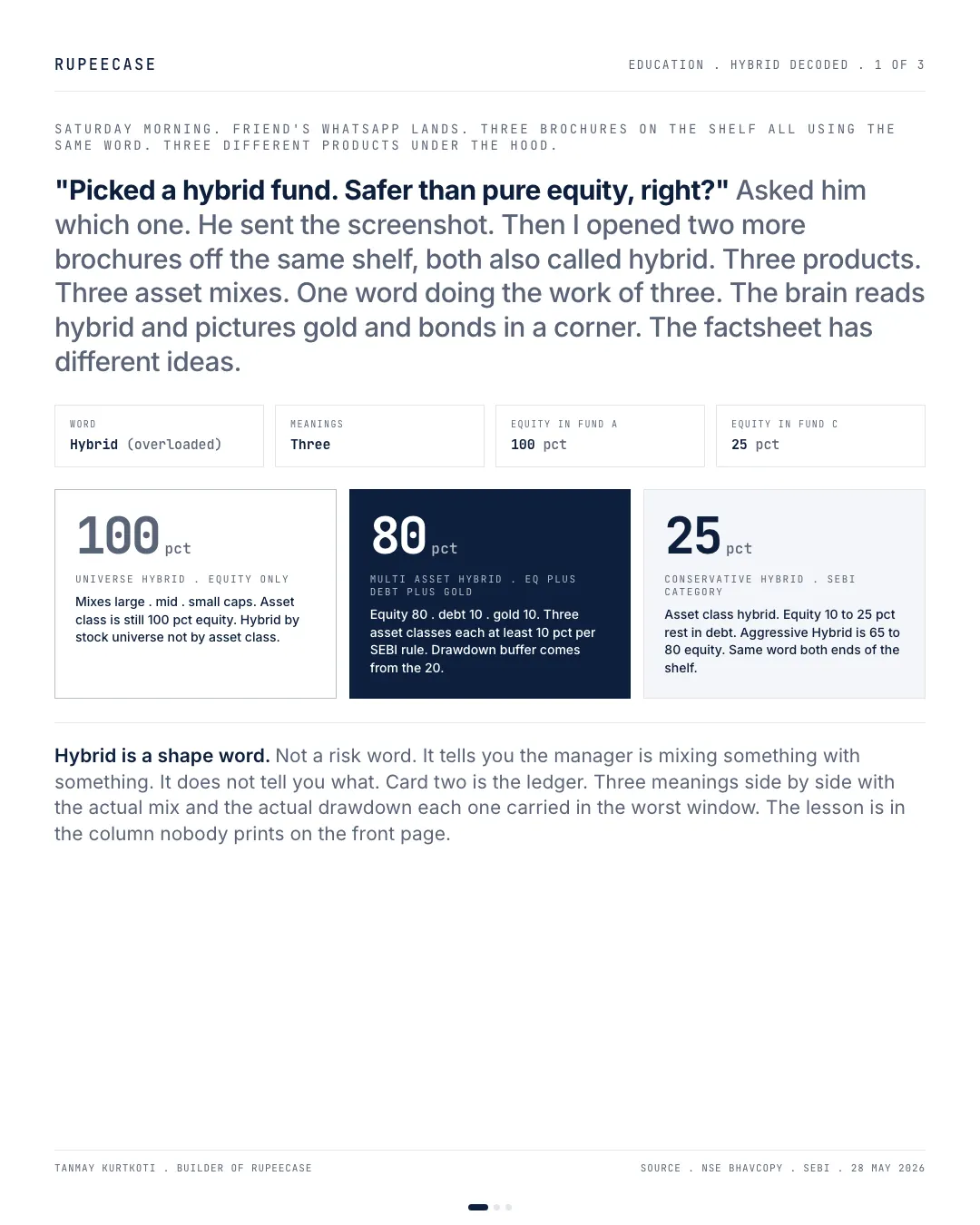
Asked him which one. He sent the screenshot. Then I opened two more brochures off the same shelf, both also called hybrid. Three different asset mixes. One word doing the work of three.
The brain reads hybrid and pictures gold and bonds in a corner. The factsheet has different ideas.
Three meanings of the same word, all live on the Indian shelf right now.
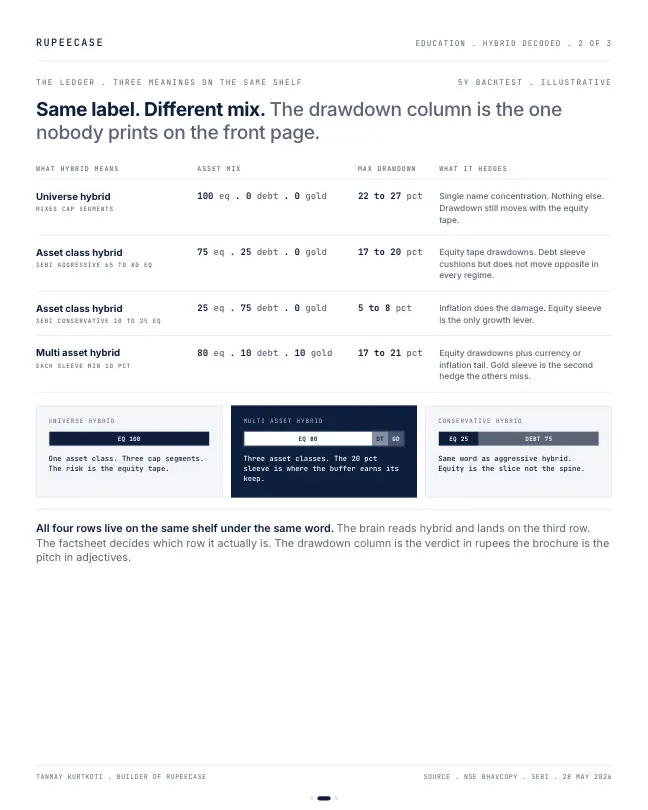
The first kind is universe hybrid. The fund is 100 pct equity. The mix is across cap segments . large plus mid plus smallcap in one basket. The asset class is still pure equity. The drawdown in a bad five year window sits at 22 to 27 pct on illustrative numbers, the same shape as any other equity book.
The second kind is asset class hybrid. SEBI's category rules carve this into sub-buckets. Aggressive Hybrid runs 65 to 80 pct equity, the rest in debt. Conservative Hybrid runs 10 to 25 pct equity. Same word at both ends of the shelf. A Conservative Hybrid prints a 5 to 8 pct worst window. An Aggressive Hybrid prints 17 to 20. Three times the hole under the same label.
The third kind is multi asset hybrid. Three asset classes . equity plus debt plus gold . each sleeve at least 10 pct per the SEBI Multi Asset Allocation rule. Illustrative 80 10 10 carries a 17 to 21 pct drawdown in the same window. The 20 pct sleeve is where the buffer earns its keep.
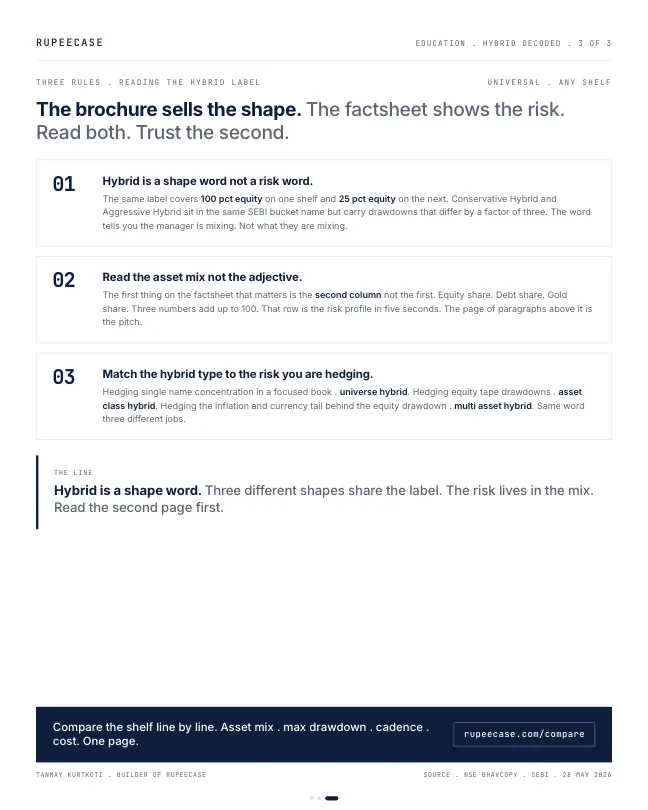
Three rules. Hybrid is a shape word not a risk word. Read the asset mix not the adjective. Match the type of hybrid to the drawdown you are actually hedging.
The brochure sells the shape. The factsheet shows the risk. Read both. Trust the second
The SEBI hybrid shelf, range by range
The asset class meaning is the one SEBI writes down, so start there. SEBI's categorisation circular of 26 Feb 2026, which updates the 2017 framework, lists seven hybrid categories. Four of them are defined by how much equity they must hold.
The other three are defined differently. Dynamic Asset Allocation moves between equity and debt as the fund decides. Arbitrage holds at least 65 percent in equity, but hedged, so it behaves like a short term debt fund. Multi Asset Allocation must invest in at least three asset classes with at least 10 percent in each. That last rule is where the 80, 10, 10 shape in the opening comes from.
One bad equity year across the shelf
The cleanest way to see the difference is to push one bad year through each mix. Say equity falls 20 percent in a year, debt earns 3 percent and gold rises 5 percent. These are round numbers for the worked example, not a forecast.
- Universe hybrid, 100 percent equity: minus 20 percent.
- Multi asset at 80, 10, 10: minus 16 from equity, plus 0.3 from debt, plus 0.5 from gold. About minus 15.2 percent.
- Aggressive hybrid at 75 percent equity and 25 percent debt: minus 15 plus 0.75. About minus 14.3 percent.
- Balanced hybrid at 50 and 50: minus 10 plus 1.5. About minus 8.5 percent.
- Conservative hybrid at 20 percent equity: minus 4 plus 2.4. About minus 1.6 percent.
On Rs 10 lakh that is a range from a Rs 2 lakh hole to a Rs 16,000 one, and every one of those funds can call itself hybrid. Change the weights and the moves below to test your own mix.
The same shapes on the RupeeCase shelf
Our own lineup has all three meanings in it, on one equity engine. Allcap is pure equity across caps, a universe hybrid. TotalMarket Hybrid puts 20 percent in debt. Allcap Multi Asset holds 10 percent debt and 10 percent gold. The headline returns are close; the holes are not far apart either, and that is the honest lesson.
- Allcap, all equity-22.72%
- TotalMarket Hybrid-21.82%
- Allcap Multi Asset-21.32%
Maximum drawdown. Model, back tested, as of 27 Apr 2026. RupeeCase lineup.json.
CAGR runs 44.70, 39.53 and 40.47 percent for the three, and Sharpe 1.68, 1.77 and 1.81 (Model, back tested, as of 27 Apr 2026). The cushion bought a little more return per unit of risk. It did not buy a shallow hole, because the 80 percent that is still equity decides most of the fall. A 20 percent sleeve is a shock absorber on a high risk engine, not a conservative fund.
Hybrid also changes the tax
There is a fourth way the word misleads, and it shows up at exit. Tax follows the equity share, not the label. A fund with at least 65 percent in equity is taxed like shares: 20 percent on gains inside 12 months, 12.5 percent above Rs 1.25 lakh a year after that. A fund with more than 65 percent in debt, which is where a conservative hybrid sits, counts as a specified fund if bought on or after 1 Apr 2023, and its gains are taxed at your slab rate however long you hold. The funds in between, such as a balanced hybrid, fall in a third bucket with a 24 month holding period.
So three rules become four. Read the asset mix, read the drawdown, match it to the hole you are hedging, and read the tax line before you call it the safer choice. The free Learn module on mutual fund structure and categories lays out every SEBI category with a quiz, and the asset allocation calculator builds a mix from your own numbers. The multicap against flexicap post does the same label check on the equity shelf.
Questions readers ask
Are hybrid mutual funds safer than equity funds?
It depends on which hybrid. SEBI's categories run from conservative hybrids with 10 to 25 percent equity to aggressive hybrids with 65 to 80 percent. In a year when equity falls 20 percent, a 20 percent equity mix might lose under 2 percent while a 75 percent equity mix loses about 14.
What is a multi asset allocation fund?
A SEBI category that must invest in at least three asset classes, with at least 10 percent in each, usually equity, debt and gold. An 80, 10, 10 mix is allowed, so a multi asset fund can still carry most of the risk of an equity fund.
How is a conservative hybrid fund taxed?
If it holds more than 65 percent in debt, units bought on or after 1 Apr 2023 are taxed at your income slab rate on gains, whatever the holding period. Aggressive hybrids with at least 65 percent equity are taxed like equity funds instead.
The cards
3 cards. Swipe, or tap to open.
Explore next
Learn it properly, then see it applied.
- StrategyAllcap strategyNifty Total Market, 50 stocks, every 2 weeks
- CalculatorSIP calculatorFree, with the formula and a worked example
- Free module 6.3Mutual Funds, Structure, Types and Hidden Costs8 min read
- CalculatorAsset allocation by risk profileFree, with the formula and a worked example
- Blog topicCosts: MF, PMS, RupeeCase notes25 notes
Related
- Multicap vs flexicap: the same shelf, opposite mandatesA multicap must keep at least 25 percent each in large, mid and small caps while a flexicap can hold no small caps at all, which is why fund houses converted in 2020.Costs: MF, PMS, RupeeCase . . 5 min
- The diversifier that concentratesFinancial services is 37.7 percent of the Nifty 50, so a sector fund that must hold 80 percent financials pushes a 30 percent sleeve past half the book in one sector.Costs: MF, PMS, RupeeCase . . 10 min
- Recipe versus paragraph: reading a methodology pageUniverse, entry rule, weight method and cadence decide whether a strategy is a process or a paragraph, and a conviction weighted PMS brochure answers none of them.Costs: MF, PMS, RupeeCase . . 6 min
Educational content only. Figures are illustrative and computed on historical or representative data for teaching purposes, not investment advice. Past performance does not guarantee future returns. Sourced from NSE, BSE, SEBI, AMFI and RBI public data.