

Costs: MF, PMS, RupeeCase..5 min read
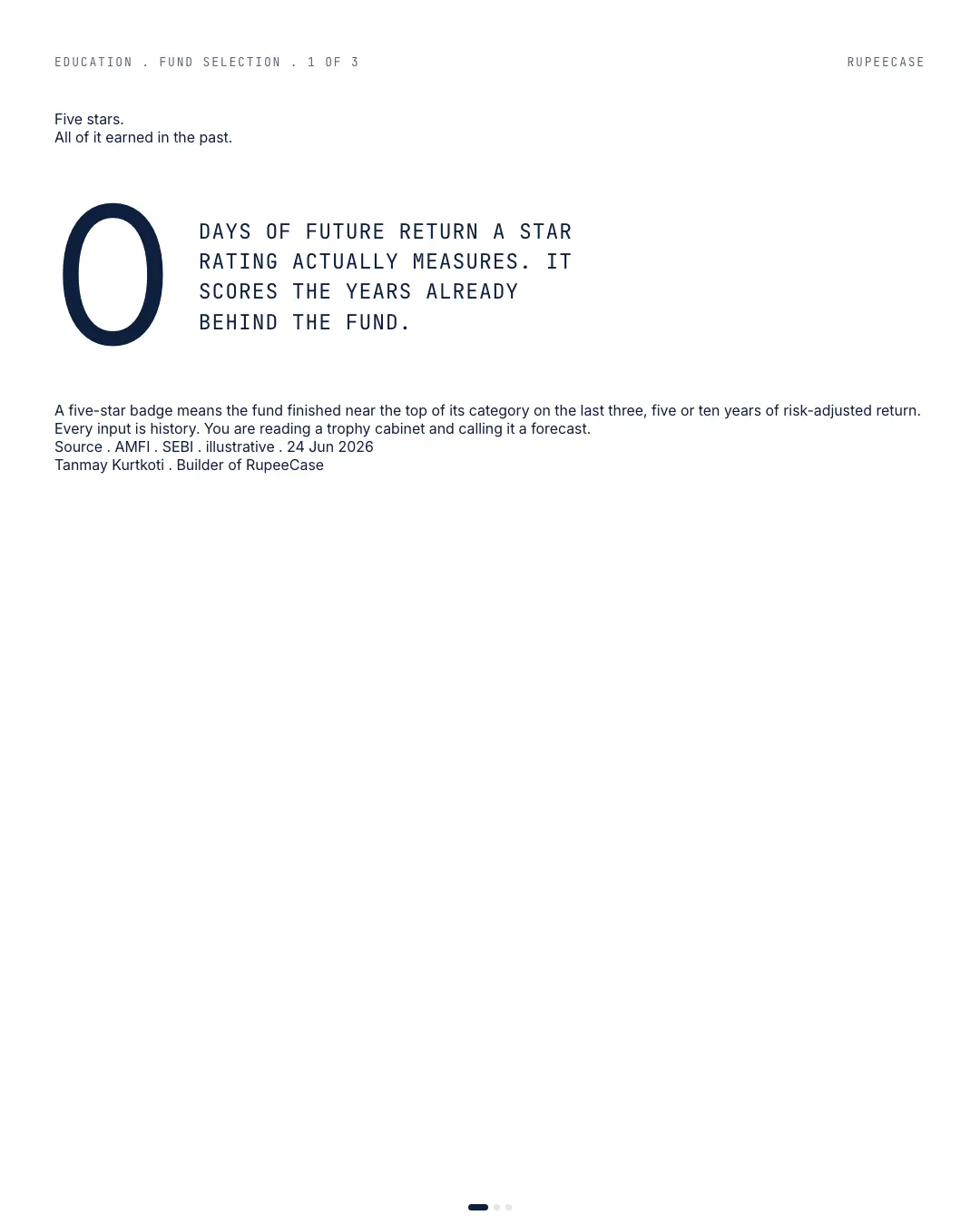
Star ratings are the rear view mirror
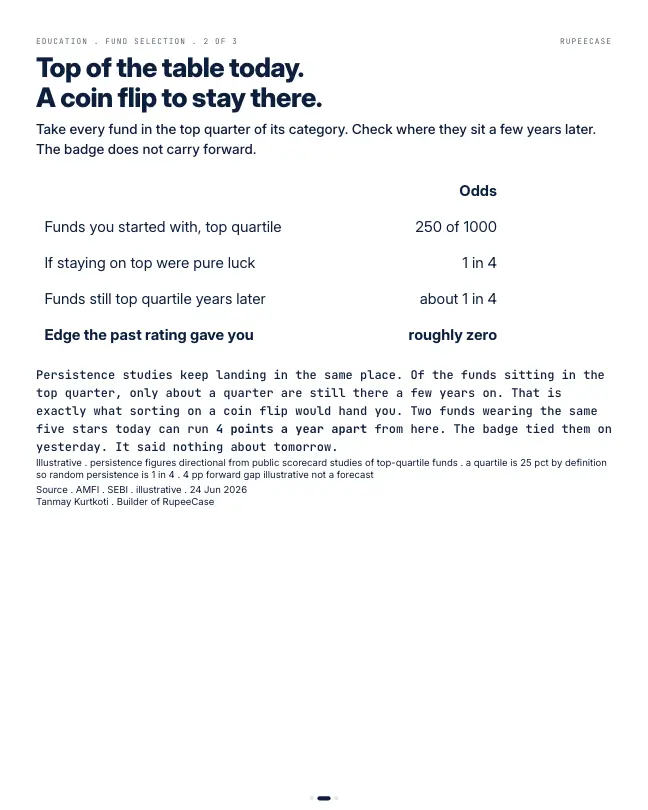
Only about one in four top quartile funds is still there a few years later, which is what a coin flip sorted into four buckets would deliver.
By Tanmay Kurtkoti, founder of QC Alpha and builder of RupeeCase
A friend sent me a screenshot on Saturday. A five-star fund, finger hovering over the buy button, asking if it was the one. I asked him what part of those five stars happens after today.
He went quiet, because the answer is none of it.
A star rating is built entirely on the past. Three, five, sometimes ten years of risk-adjusted return, ranked against the fund's category. Every input is history. It is a beautifully kept trophy cabinet, and people keep reading it as a forecast. Knowing which fund won the last race tells you almost nothing about the one you are about to enter.
The part nobody puts on the brochure is what happens to those winners. Take all the funds sitting in the top quarter of their category and come back a few years later. Only about one in four is still there. A quarter is 25 percent by definition, so a coin flip sorted into four buckets would hand you the same answer. The badge, on the evidence, carries roughly zero edge into the future.
Which is why two funds wearing the same five stars today can drift four points a year apart from here. On Rs 10L over seven years, that is the gap between 20.76L and 26.60L. Same rating yesterday. Completely different tomorrow. And tomorrow is the only stretch your money actually lives through.
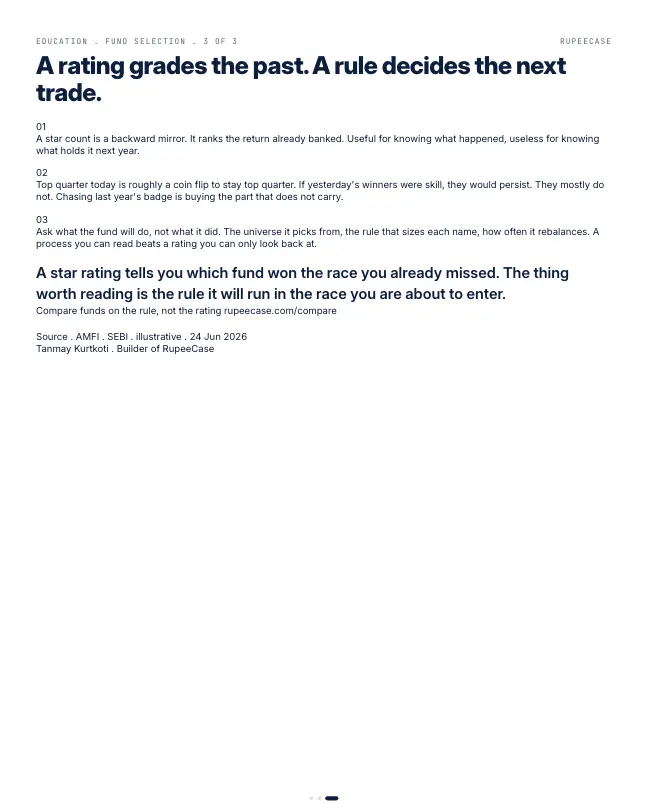
I am not saying ignore the past. I am saying stop mistaking it for the plan. A rating grades what already happened. A rule decides the next trade. Before the stars, I want to know the universe a fund picks from, how it sizes each position, and how often it rebalances, because a process I can read forward beats a badge I can only look at backward.
Pick the rule. The stars are just the rear-view mirror
I ran the same test on our own shelf
It is easy to say ratings do not persist about other people's funds. So I ran the test on the RupeeCase lineup. Seventeen model strategies have full calendar years from 2022 to 2025. Rank them by return each year, take the top four, and see where they land the next year.
| Strategy | 2022 | 2023 | 2024 | 2025 |
|---|---|---|---|---|
| Energy Basket | 18.2 | 108.4 | 16.0 | -14.7 |
| Smallcap | 27.8 | 112.7 | 55.3 | -8.7 |
| Midcap Smallcap | 26.9 | 98.5 | 86.0 | -8.6 |
| Allcap | 28.8 | 98.9 | 76.5 | -4.2 |
| Large Midcap | 45.2 | 66.9 | 44.6 | 7.5 |
| Nifty 50 Equal Weight | 9.2 | 34.1 | 17.9 | 11.6 |
Calendar year returns, six of seventeen strategies. Model, back tested, from RupeeCase nav files, lineup as of 27 Apr 2026.
The pattern is plain once it sits in one table. Energy Basket was second of seventeen in 2023, up 108.4 percent, and last in 2024. The four leaders of 2024 finished eighth, ninth, thirteenth and fifteenth in 2025. Nifty 50 Equal Weight, the simplest card on the shelf, was last in 2023 and first in 2025. None of these strategies changed its rules between those years. The market changed which rule it rewarded.
That is what a star rating cannot see. It ranks the outcome of a rule against a market that has already happened. The next market may favour a different shape: smaller companies one year, large and steady ones the next.
Same stars today, different money tomorrow
The opening's numbers are worth redoing, because the size of the gap surprises people. Rs 10 lakh for seven years. One fund earns 11 percent a year from here, the other 15 percent. Both wore the same rating on the day you looked.
A Rs 5.84 lakh gap, more than half the starting amount, between two funds a rating could not tell apart. The rating was accurate about the past. It simply had nothing to say about the next seven years.
Why the brain trusts the badge
There is a name for the pull the friend felt: recency bias. We give the latest evidence far more weight than it deserves, and a five star badge is the latest evidence condensed into a picture. It also anchors: once you have seen the stars, every later fact is read against them.
MythA top rated fund is more likely to stay top rated.
FactThe opening's numbers put it near one in four, about what chance gives. On our own shelf, none of 2024's top four stayed in the top four in 2025.
So what do you read instead? Things that carry forward, because they describe what the fund will do rather than what it did.
- UniverseWhich stocks it is allowed to buy. This decides which markets it will do well in.
- SizingHow much each position can be. This decides how deep a bad year can go.
- CadenceHow often it trades. This decides its cost and tax line.
- Worst yearThe drawdown it has already shown. Not a limit, but a lower bound on the pain.
How I use the past, honestly
I am not saying past returns are useless. They tell you how a rule behaved in markets you can name: what it did in a small cap rally, what it did in a correction. That is useful. What they cannot tell you is which of those markets comes next.
So when I look at the table above, I do not read it as a ranking. I read it as a description. Smallcap is a card that can double in a year and fall in the next. Nifty 50 Equal Weight is a card that rarely leads and rarely trails by much. Both are true, and neither tells me what 2027 looks like.
The free Learn module on cognitive biases, overconfidence, anchoring and recency shows how these pulls work in Indian markets, with a quiz, and the CAGR calculator turns any two values into a yearly rate. Related: the fund that got too big to beat the index and pull your CAS before you buy a seventh fund.
Questions readers ask
Do mutual fund star ratings predict future returns?
Ratings are built only from past risk adjusted returns. The evidence the opening cites puts the share of top quarter funds still in the top quarter a few years later near one in four, about what chance gives. On RupeeCase's own model lineup, none of the four best strategies of 2024 stayed in the top four in 2025.
What is recency bias in investing?
It is the habit of giving the most recent results far more weight than they deserve. A fund that led last year feels safer than one that lagged, even when both follow rules that the next market may reward in the opposite order.
What should I check instead of ratings?
Things that describe what a fund will do: the universe it can buy from, how large each position can grow, how often it trades and what it has cost, and its worst drawdown so far. These carry forward; a rating describes only what already happened.
The cards
3 cards. Swipe, or tap to open.
Explore next
Learn it properly, then see it applied.
Related
- The NAV mythRs 10,000 in a Rs 10 NAV fund and in a Rs 500 NAV fund with the same portfolio are worth the same Rs 11,000 after a 10 percent rise, because NAV is not a price.Costs: MF, PMS, RupeeCase . . 5 min
- The fund that got too big to beat the indexA six percent conviction position is Rs 30 crore in a Rs 500 crore fund and Rs 2,400 crore at Rs 40,000 crore, which no midcap can absorb, so the fund drifts into the index.Costs: MF, PMS, RupeeCase . . 5 min
- Pull your CAS before you buy a seventh fundOne consolidated account statement showed six funds with 62 percent of the money in the same twelve stocks, Rs 12,800 a year of fees and Rs 72,000 of forgotten debt.Costs: MF, PMS, RupeeCase . . 6 min
Educational content only. Figures are illustrative and computed on historical or representative data for teaching purposes, not investment advice. Past performance does not guarantee future returns. Sourced from NSE, BSE, SEBI, AMFI and RBI public data.