

Costs: MF, PMS, RupeeCase..5 min read
The NAV myth
Rs 10,000 in a Rs 10 NAV fund and in a Rs 500 NAV fund with the same portfolio are worth the same Rs 11,000 after a 10 percent rise, because NAV is not a price.
By Tanmay Kurtkoti, founder of QC Alpha and builder of RupeeCase
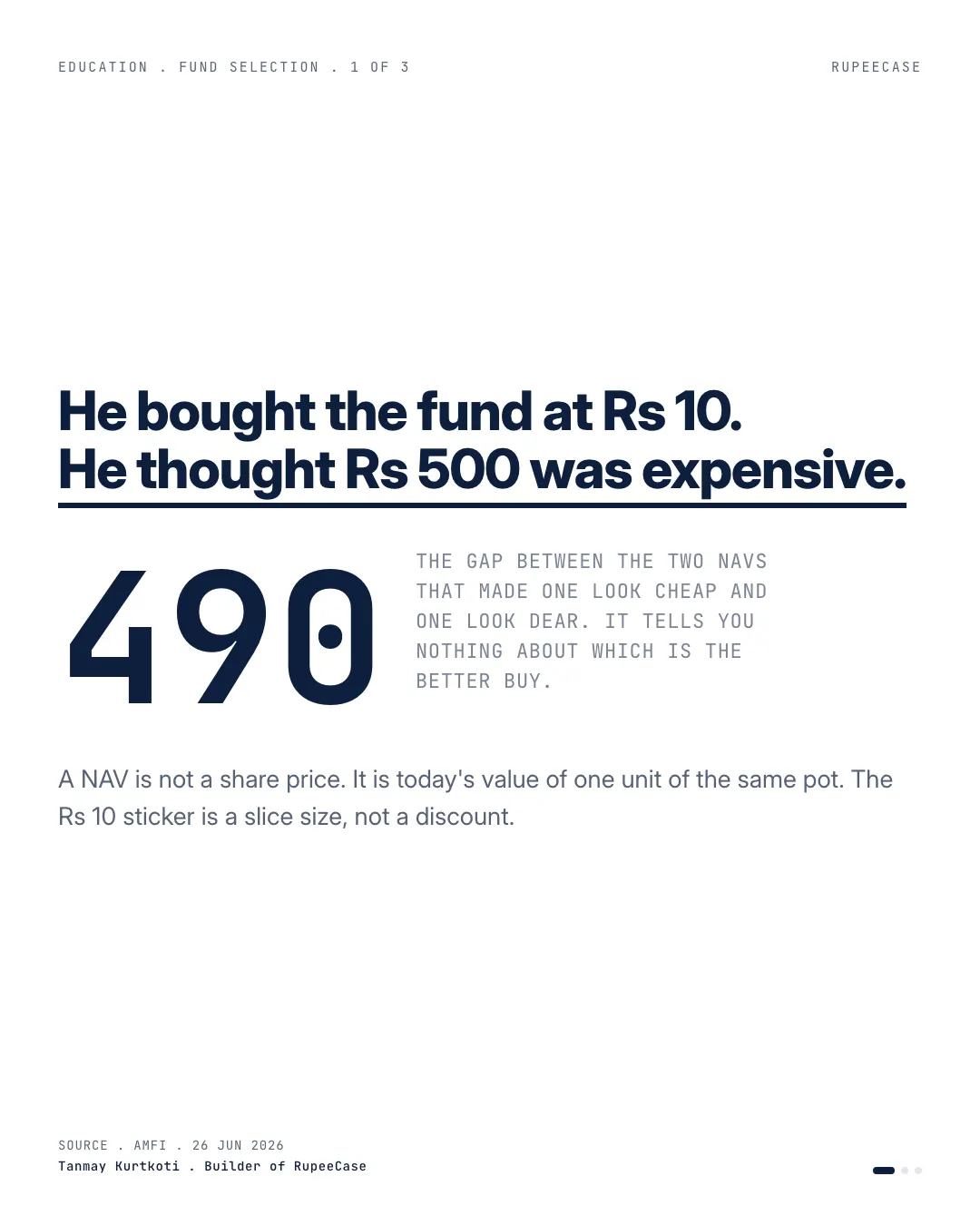
A friend showed me two funds last week and asked which was the better buy. One had a NAV of Rs 10. The other Rs 480. He was leaning hard toward the Rs 10 one. It felt cheap. More room to run.
I asked him what he thought the Rs 10 was actually the price of.
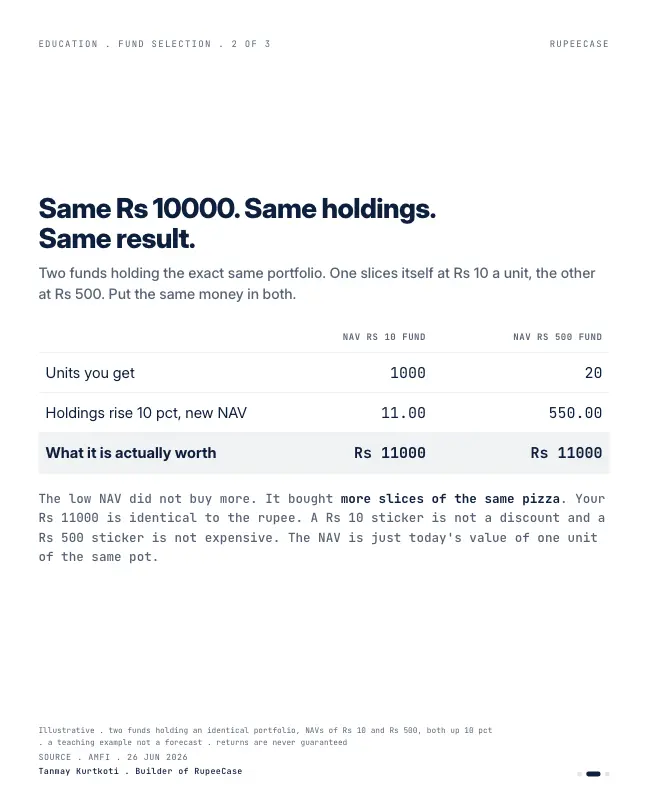
Here is the math that settled it. Put Rs 10,000 into the Rs 10 fund and you get 1000 units. Put the same Rs 10,000 into the Rs 500 fund and you get 20 units. Now say both funds hold the exact same portfolio and it rises 10 pct. The first is worth Rs 11,000. The second is worth Rs 11,000. To the rupee.
A NAV is not a share price. It is today's value of one unit of the pot. A low NAV does not buy you more, it slices the same money into more units. You own the same rupees of the same holdings either way. Rs 10 is not a discount. Rs 500 is not expensive.
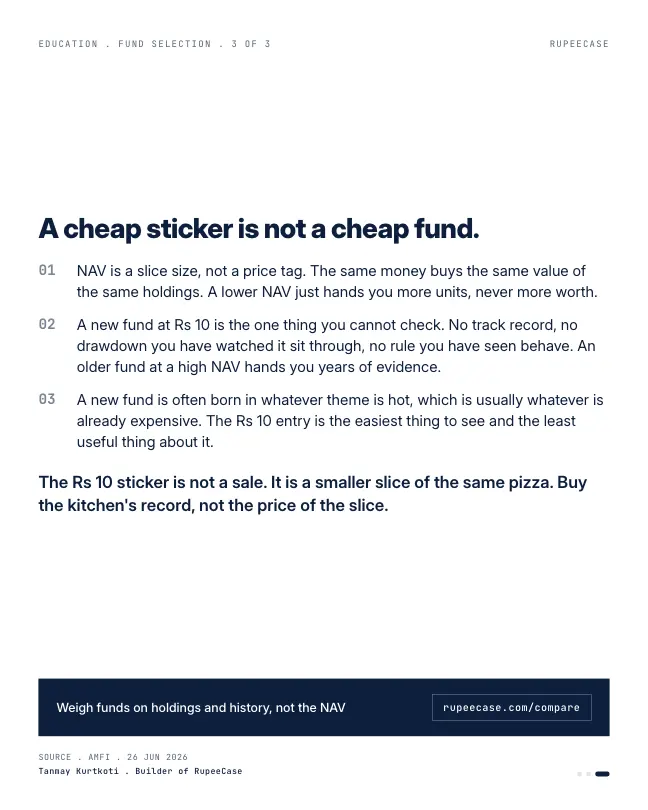
And the cheap sticker hides the thing that actually matters. A new fund priced at Rs 10 has no track record. No drawdown you have watched it sit through. No rule you have seen behave through a bad year. An older fund at a high NAV is not dearer, it has simply been compounding long enough to hand you years of evidence. That evidence is the part worth paying attention to.
The Rs 10 sticker is the easiest thing to see and the least useful. Buy the kitchen's record, not the price of the slice.
What a NAV actually is
The friend's instinct comes from stocks, where people (wrongly, even there) read a low share price as cheap. A fund unit is simpler than a share. There is no order book, no buyer on the other side, no premium for popularity. The fund takes everything it owns at the day's closing prices, adds cash and income due, subtracts what it owes, including the expenses it has accrued, and divides by the number of units outstanding. That is the NAV. It is a division, struck once a day, and every investor who comes in or goes out that day does so at the same number.
MythA Rs 10 NAV fund has more room to run than a Rs 500 NAV fund.
FactBoth move by the percentage change in what they hold. Rs 10 to Rs 11 and Rs 500 to Rs 550 are the same 10 percent, and the same Rs 1,000 on Rs 10,000.
Since a unit is just a slice, the number of slices tells you nothing about the size of the pie. Picture the same Rs 10,000 cut two ways.
Change the numbers yourself. Put in any two NAVs; the end values match as long as the portfolio return is the same.
How the day's NAV is struck
The mechanics also explain why nobody can buy a unit at a "low" moment within the day. SEBI's rule since 1 Feb 2021 (circular of 31 Dec 2020, as explained by AMFI) is that a purchase gets the NAV of the day on which your money is realised in the fund's account before the cut-off, 3 pm for most schemes, whatever the amount. Money that arrives later gets a later day's NAV.
- Market closesEvery holding is valued at the day's closing price.
- Net it offAdd cash and income due; subtract liabilities and the day's accrued expenses.
- DivideNet assets divided by units outstanding is the NAV.
- Price the day's ordersMoney realised before the cut-off gets that NAV; later money gets the next one.
Two everyday events move a NAV without changing your wealth. A payout under an income distribution option lowers the NAV by the amount paid out, because that money has left the pot and landed in your bank account. And a fund's expenses come out daily before the NAV is struck, which is the one place the NAV does tell you about cost: quietly, by growing slower.
What to compare instead
If the NAV is the least useful number on a fund page, here is what I look at, in the order I look at it. What the fund holds, and how much of that I already own elsewhere. How it behaved through a bad stretch, with the worst fall written down. And what it costs every year, because that is the only difference between two funds that is certain to compound against you.
That last one is worth seeing in rupees. Two funds earn the same 12 percent a year before costs on Rs 10 lakh for 20 years. One charges 0.5 percent a year, the other 1.5 percent.
- Expense ratio 0.5%Rs 88.2 L
- Expense ratio 1.5%Rs 73.7 L
Rs 10 lakh, 12% a year before costs, 20 years, net return compounded. Worked example, not a fund.
Neither fund's NAV would have told you that. A NAV of Rs 10 or Rs 500 on day one changes nothing in this sum; the fee changes Rs 14.5 lakh of it. The free expense ratio calculator runs the same comparison with your own figures.
The free Learn module on mutual funds covers how a fund is structured, how the NAV is calculated and what the expense ratio includes, with a short quiz at the end. Two posts go further on the same habit of reading past the front page: why a star rating is a rear view mirror, and why fund size can bloat a strategy that worked when it was small.
Questions readers ask
Is a mutual fund with a low NAV cheaper to buy?
No. NAV is the value of one unit of the fund's portfolio, so a low NAV only means you get more units for the same money. Rs 10,000 in a Rs 10 NAV fund and in a Rs 500 NAV fund holding the same portfolio are both worth Rs 11,000 after a 10 percent rise.
Why do new fund offers start at a NAV of Rs 10?
A new fund has no portfolio history yet, so its first units are issued at a round starting value, commonly Rs 10. After launch the NAV moves only with the value of what the fund holds, which is why a new fund's Rs 10 says nothing about value and an old fund's high NAV says only that it has compounded for longer.
Which NAV do I get when I invest in a mutual fund?
Since 1 Feb 2021, under SEBI's rule as explained by AMFI, you get the NAV of the day on which your money reaches the fund's account before the cut-off time, 3 pm for most schemes. If the money arrives after the cut-off, the next business day's NAV applies.
The cards
3 cards. Swipe, or tap to open.
Explore next
Learn it properly, then see it applied.
- StrategyAllcap strategyNifty Total Market, 50 stocks, every 2 weeks
- CalculatorSIP calculatorFree, with the formula and a worked example
- Free module 6.3Mutual Funds, Structure, Types and Hidden Costs8 min read
- CalculatorExpense ratio impactFree, with the formula and a worked example
- Blog topicCosts: MF, PMS, RupeeCase notes25 notes
Related
- Star ratings are the rear view mirrorOnly about one in four top quartile funds is still there a few years later, which is what a coin flip sorted into four buckets would deliver.Costs: MF, PMS, RupeeCase . . 5 min
- The fund that got too big to beat the indexA six percent conviction position is Rs 30 crore in a Rs 500 crore fund and Rs 2,400 crore at Rs 40,000 crore, which no midcap can absorb, so the fund drifts into the index.Costs: MF, PMS, RupeeCase . . 5 min
- Pull your CAS before you buy a seventh fundOne consolidated account statement showed six funds with 62 percent of the money in the same twelve stocks, Rs 12,800 a year of fees and Rs 72,000 of forgotten debt.Costs: MF, PMS, RupeeCase . . 6 min
Educational content only. Figures are illustrative and computed on historical or representative data for teaching purposes, not investment advice. Past performance does not guarantee future returns. Sourced from NSE, BSE, SEBI, AMFI and RBI public data.