

You have built a portfolio with a systematic signal and sized each position. Then the market moves, and the portfolio you own is no longer the portfolio you designed. Winners grow into bigger weights, losers shrink, and the signal that picked the names goes stale. Rebalancing is how you bring the portfolio back to the rule. It is also where returns quietly leak, through costs and tax, if you do it carelessly.
I think of rebalancing as a design decision, not a chore. Rebalance too rarely and the signal you paid for has decayed. Rebalance too often and you pay STT, charges and short term capital gains tax on trades that add little. The right cadence sits between those two leaks, and it is different for different strategies.
Equity weight of a 60% Nifty 50, 40% debt portfolio started in October 2024: left alone it fell to 54.9% by October 2026 as the index fell; rebalanced each October it was reset to 60%.
Equity weight, %, month end. Nifty 50 price index from NSE daily closes; debt assumed to earn 7% a year. Computed by RupeeCase, Oct 2024 to 9 Oct 2026.
Two reasons to rebalance
People use one word for two different jobs. Keep them apart and the rest of this gets easier.
- Weight drift. The names stay the same, but their weights move with prices. A 60/40 equity and debt mix becomes 65/35 after a strong year. An equal weight portfolio becomes a winners heavy portfolio. Rebalancing trims the winners and tops up the laggards to restore the targets.
- Signal refresh. The names themselves change. A momentum rule re-ranks the universe; stocks that fell out of the top get sold and new leaders get bought. This is where most of the trading in a factor strategy comes from.
An index fund on the Nifty 50 does almost only the first kind: NSE reviews the index constituents twice a year, so names change rarely. A momentum strategy does mostly the second kind, and that is why its cadence matters so much more.
The four approaches
- No judgement needed, so no temptation to skip
- Trades even when nothing much has changed
- The cadence itself becomes the main design choice
- Trades only when it matters, so lower costs
- Needs monitoring, and the band size is one more parameter to tune
- Works best for asset allocation, less well for a factor signal
- Fewer small, pointless trades
- Still a fixed routine, so easy to stick to
- Cuts turnover in factor strategies a lot
- The buffer width needs testing out of sample
- Calendar dateThe rule runs on its fixed day.
- Re-rank the universeLatest prices, latest scores.
- Names in, names outLeavers sold, entrants bought.
- Reset weightsBack to equal weight.
- Approve and executeOrders through your broker, stocks in your demat.
My rebalance flow for a RupeeCase index. Steps 2 and 3 are the signal refresh; step 4 is the drift correction.
Worked example: a 60/40 portfolio in rupees
You start the year with ₹10 lakh: ₹6 lakh in a Nifty index fund, ₹4 lakh in a debt fund. Equity returns 30% and debt 7% over the year.
| Start | After one year | Weight now | Target | Trade | |
|---|---|---|---|---|---|
| Equity | ₹6,00,000 | ₹7,80,000 | 64.6% | 60% | Sell ₹55,200 |
| Debt | ₹4,00,000 | ₹4,28,000 | 35.4% | 40% | Buy ₹55,200 |
| Total | ₹10,00,000 | ₹12,08,000 | 100% | 100% |
The trade is small, 4.6% of the portfolio, and its job is risk control. Without it the drift compounds. After a few strong years a 60/40 investor is quietly 75/25, and finds out in the next correction. The tax angle matters too: if the equity units sold were held more than 12 months, the gain is long term and taxed at 12.5% above the ₹1.25 lakh yearly exemption. Inside 12 months it is short term at 20%. These are the rates for listed equity since 23 July 2024 (incometax.gov.in).
What the published record shows
RupeeCase publishes every model rebalance of every strategy, so you can see cadence and turnover in real data instead of theory.
| Strategy | Holds | Cadence | Rebalances in the record | Names changed per rebalance, average |
|---|---|---|---|---|
| Midcap | 20 | Every 2 weeks | 132, 14 May 2021 to 11 May 2026 | About 3 of 20 |
| Energy Basket | 10 | Every week | 262, 14 May 2021 to 11 May 2026 | About 1 of 10 |
| Nifty 50 Equal Weight | 50 | Every 4 weeks | 65, 6 Aug 2021 to 3 Jul 2026 | Almost none; mostly weight resets |
Computed from the model, back tested rebalance record on the RupeeCase rebalance pages. Not actual client trades. Names are not recommendations.
Look at the contrast. The equal weight Nifty 50 strategy barely changes names; its rebalances are almost pure drift correction. The Midcap strategy swaps about three of its twenty names every fortnight, which is signal refresh, and that is where the momentum return comes from and where the costs come from.
- Midcap, every 2 weeks15.5%
- Large Midcap, every 2 weeks15.0%
- Smallcap, every 2 weeks13.9%
- Energy Basket, every week9.5%
- Nifty 50 Equal Weight, 4 weeks0.3%
Average share of names replaced at each rebalance, computed from the published rebalance record, May 2021 to May or Jul 2026. Model, back tested. Not actual client trades.
The cost of cadence
Here is rough arithmetic for a strategy that, like Midcap, replaces about 15% of its names every two weeks. Each rebalance sells about 15% of the portfolio and buys about 15%, so roughly 30% of the portfolio trades.
- Fee. At RupeeCase's 0.2% of traded value, that is about 0.06% of the portfolio per rebalance, or about 1.6% over 26 rebalances a year.
- STT. Delivery trades pay 0.1% on the buy and 0.1% on the sell, so about 0.03% per rebalance, roughly 0.8% a year.
- Impact and spreads. Small on liquid names, larger on small caps. Not in the numbers above.
- Tax. Positions held for weeks produce short term gains at 20%.
So a fortnightly momentum strategy carries a few percent a year of friction before tax. That is fine if the signal refresh earns more than it costs, and it is the reason a weekly or daily version of the same rule usually does worse after costs, not better. Quality and low volatility signals change slowly and suit monthly or quarterly cadences. Momentum decays faster and suits two to four weeks. The published RupeeCase model returns are after brokerage, STT, exchange charges and GST, as each factsheet states, so the cadence cost is already inside those figures.
Tax aware rebalancing
In a taxable account, the order of trades matters. A few habits help:
- Use new money first. Monthly SIP or fresh capital can go into the underweight side, which rebalances without selling anything.
- Sell the long term lots first. When you must trim, sell units held over 12 months at 12.5% rather than recent units at 20%.
- Use the exemption. The first ₹1.25 lakh of long term gains on listed equity each financial year is tax free. Booking gains up to it each year is sometimes called gain harvesting; Module 11.3 covers it.
- Accept short term tax in fast strategies. A fortnightly momentum strategy cannot avoid short term gains. Judge it on its after tax return, not its gross.
MythRebalancing more often always keeps a strategy sharper.
FactPast the signal's natural pace, extra rebalances mostly add STT, charges and short term tax. Weekly or daily versions of a monthly signal usually do worse after costs.
Common mistake: skipping the rebalance that feels wrong
The mistake that costs the most is not the wrong cadence. It is skipping the rebalance that feels uncomfortable. After a fall, rebalancing means buying more of what just hurt you. After a rally, it means selling what is working. Both feel wrong, both are the rule doing its job, and investors skip exactly those two.
The second mistake is the opposite: rebalancing on every headline. Each extra trade pays STT and charges, and in a taxable account often 20% tax. If a rule says every four weeks, the right number of extra rebalances in between is zero.
How this shows up in RupeeCase
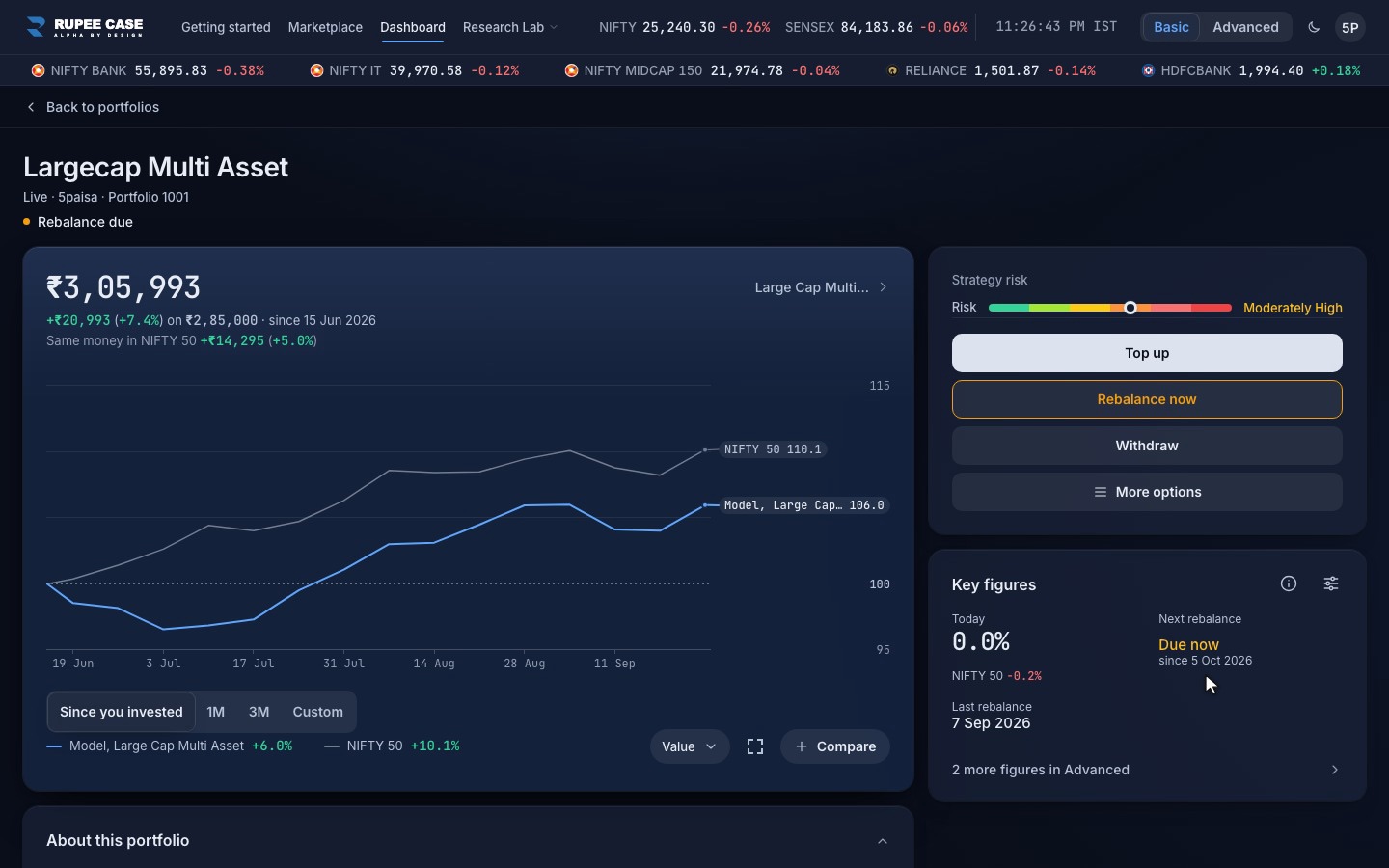
Every RupeeCase strategy rebalances on a fixed calendar: weekly for the two sector baskets, every 2 weeks for most strategies, every 3 weeks for some, every 4 weeks for the large cap ones. On each date the model re-ranks its universe, publishes the names in and out, and resets the weights to equal. You approve the orders, they go through your own broker, and the stocks stay in your demat. The fee is 0.2% of traded value, charged only when a rebalance trades. Every past rebalance is on the strategy page and the rebalance record, and the fee calculator shows what fees cost over the years.
Questions readers ask
How often should a long term investor rebalance?
For a simple equity and debt mix, once a year or when a weight drifts more than about 5 points from target is enough for most people. Factor strategies need more frequent rebalancing because their signal changes faster.
Does rebalancing improve returns?
Its main job is risk control: it keeps the portfolio at the risk you chose. In a factor strategy it also refreshes the signal, which is where the factor return comes from. Whether it adds return after costs depends on the cadence and the turnover.
Is every rebalance taxable?
Every sale in a taxable account can create a capital gain or loss. Buying with new money does not. Losses booked in a rebalance can be set off against gains under the income tax rules, which is one reason to keep good records of every trade.