

Portfolio construction..4 min read
Who sells first: a household's real risk level
A shared portfolio is held by consensus and sold by veto, so the account's risk level is the lower partner's tolerance, not the average.
By Tanmay Kurtkoti, founder of QC Alpha and builder of RupeeCase
My cousin and his wife took the same risk questionnaire last year.
He came out aggressive. She came out cautious. So they did the reasonable thing, split the difference, picked one moderate portfolio, and considered it settled.
Then a rough month arrived. And the quiz result stopped mattering, because I watched which of them reached for the sell button.
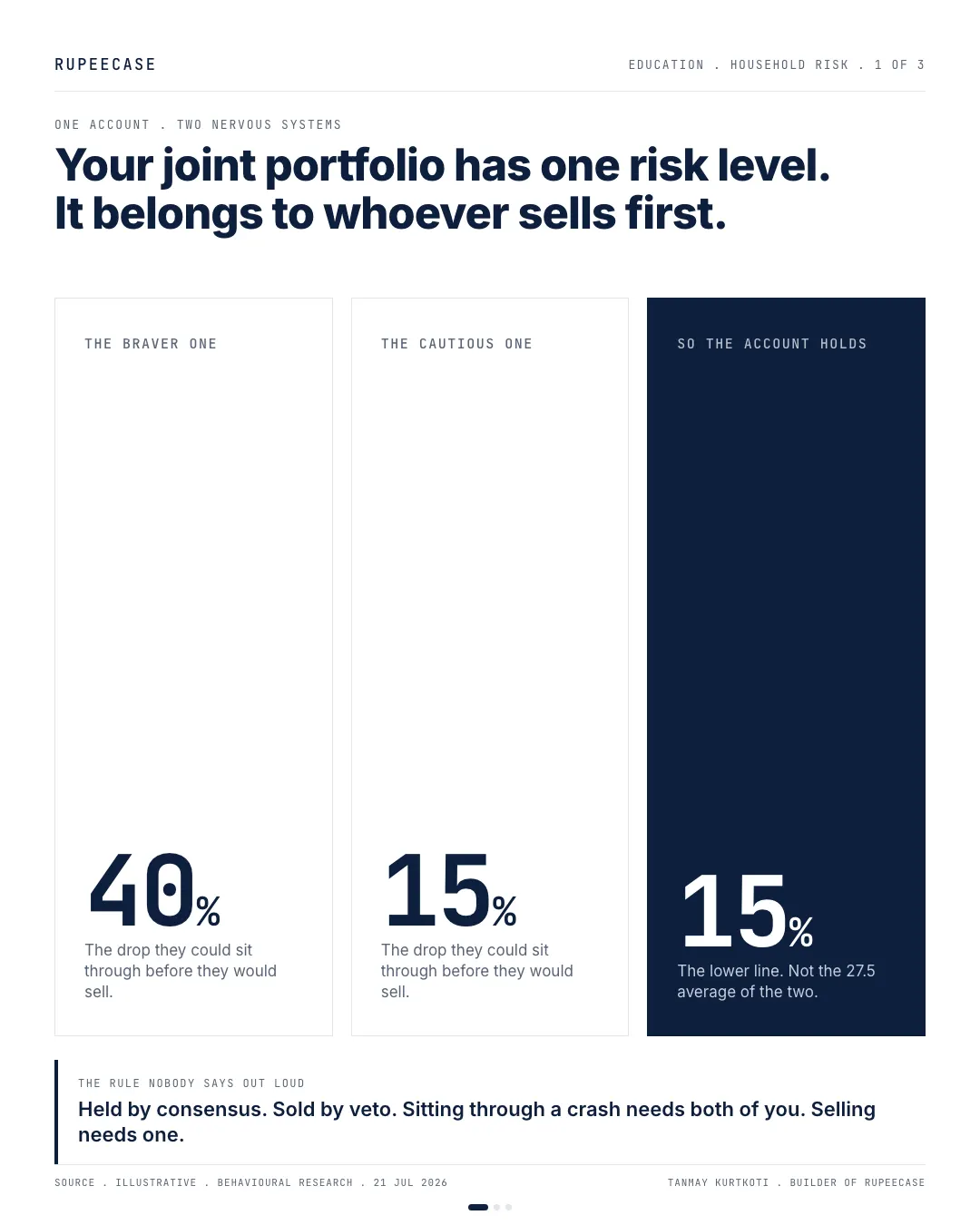
Here is the thing nobody tells couples about risk profiling. A shared portfolio is held by consensus and sold by veto. Sitting through a drawdown needs both of you to hold. Selling needs only one of you to break. Which means the account's real risk level is not the average of your two tolerances. It is the lower one.
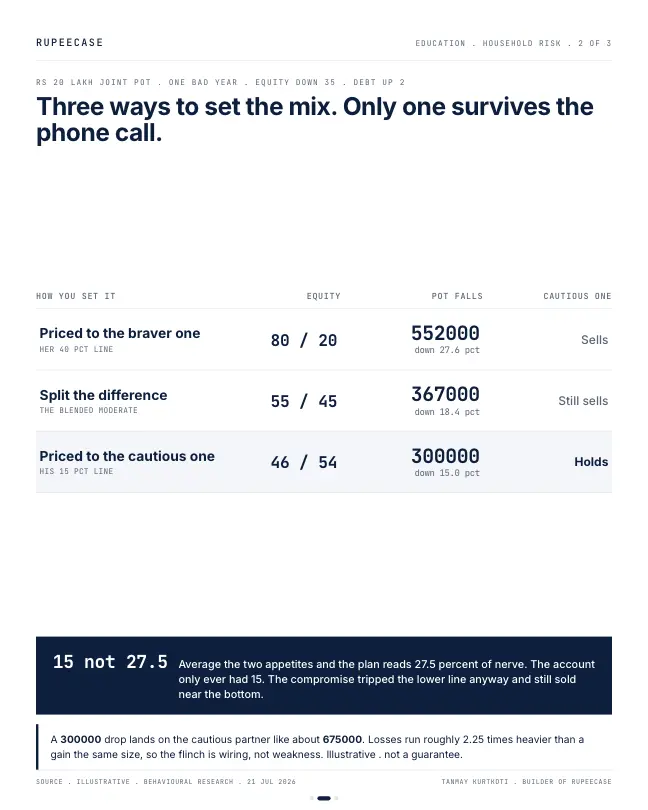
Put numbers on it. Say she can sit through a 40 percent fall and he taps out at 15. Build to her nerve, and a bad year lifts Rs 5,52,000 off a Rs 20 lakh pot. He is out before the bottom, and the loss is now real for both of you.
The trap is thinking the compromise fixes this. It does not. A blended 55/45 portfolio still falls Rs 3,67,000 in the same year, still trips his line, still sells at the worst possible moment. You averaged two appetites and landed on a mix neither of you will hold.
And his flinch is not weakness. A Rs 3,00,000 drop lands on the more loss-averse partner like roughly Rs 6,75,000. Losses run about 2.25 times heavier than gains. That is wiring, not a character flaw.
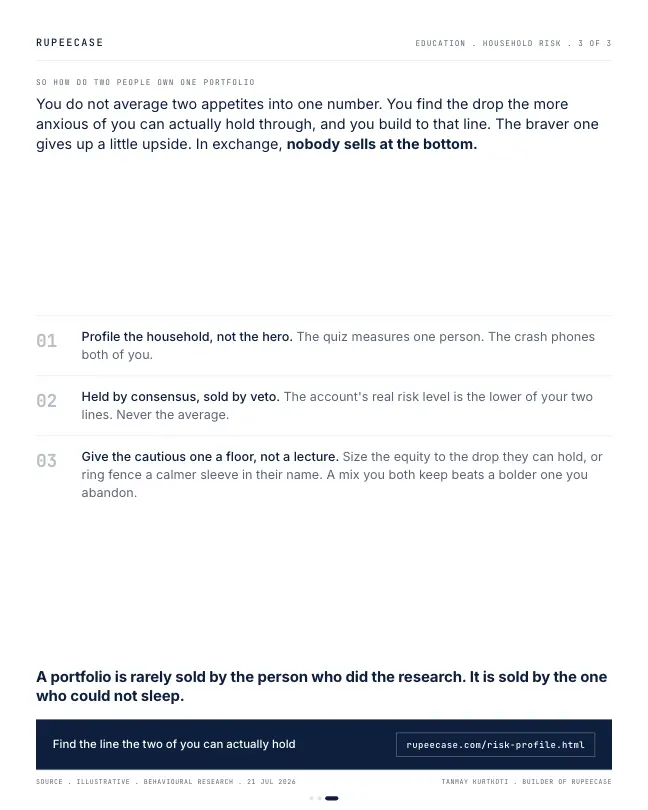
So profile the household, not the hero. Size the equity to the drop the calmer partner can actually hold, or ring fence a quieter sleeve in their name. A mix you both keep beats a bolder one you abandon at the bottom.
A portfolio is rarely sold by the person who did the research. It is sold by the one who could not sleep.
Where the opening's numbers come from
Both rupee figures in the opening fall out of one bad year: equity down 35 percent, debt up 2 percent. Built to her nerve at 80 percent equity, the pot falls 0.80 x 35 minus 0.20 x 2 = 27.6 percent, which is Rs 5,52,000 on Rs 20 lakh. The 55/45 compromise falls 0.55 x 35 minus 0.45 x 2 = 18.35 percent, Rs 3,67,000. His line is 15 percent. Both mixes cross it.
The last line is the useful one. With a 35 percent equity fall and his 15 percent line, the most equity the household can carry and still hold is about 46 percent. Above that, the plan depends on the bad year being kinder than the one assumed.
A real quarter, at three household mixes
The opening's bad year is an illustration. The quarter from 31 Dec 2025 to 30 Mar 2026 was real. The Nifty 50 fell 14.54 percent and the Nifty Composite G-sec Index fell 1.44 percent, by NSE closing data. Here is what three household mixes did in those three months.
- 80/20, built to her nerve-11.92%
- 55/45, the compromise-8.65%
- 46/54, built to his line-7.47%
Quarter 31 Dec 2025 to 30 Mar 2026. NSE closes: Nifty 50 26,129.60 to 22,331.40; Nifty Composite G-sec Index 3,052.91 to 3,009.05. RupeeCase calculation, price only.
On Rs 20 lakh, the 80/20 mix lost about Rs 2,38,000 in one quarter, almost 12 percent, against a line of 15. One more bad month would have crossed it. A quarter is short; the opening's year is the fuller test. The direction is the same: the further the mix sits from the cautious partner's line, the less bad news it takes to trigger the sale.
Profiling the household
- Each partner takes the profile aloneSeparate answers, on a calm day, without discussing them first.
- Find the lower lineThe household can hold only what the more cautious partner can hold.
- Size the shared pot to that lineWork backwards from a bad year to the highest equity share that stays inside it.
- Give the bolder partner a separate sleeveA smaller pot in one name, sized so its worst fall does not touch the shared plan.
The second option in the opening, a ring fenced sleeve, often works better than either partner expects. The cautious partner gets a shared pot that will not frighten them. The bolder partner gets room to hold more equity, in a pot whose losses do not land on the shared plan.
The free Learn module on loss aversion and prospect theory explains why losses weigh about twice as much as gains and how pre set rules counter it, with a quiz and a certificate. The drawdown recovery calculator shows the climb back from any fall. For the same idea on one person's goals, read one profile, many goals.
Questions readers ask
How should couples set a joint risk profile?
Profile each partner separately, then size the shared portfolio to the more cautious partner's limit, because a joint portfolio is usually sold when either partner panics. A bolder partner can hold extra equity in a separate, smaller pot.
What is loss aversion?
It is the finding that a loss feels heavier than a gain of the same size, by about 2.25 times in the original research. A Rs 3 lakh fall can feel like a Rs 6.75 lakh hit, which is why people sell at the bottom.
Is a 50/50 compromise portfolio a good idea for a couple?
Averaging two risk levels can still leave the mix above the cautious partner's limit. In the worked example, a 55/45 mix falls 18.35 percent in a bad year, beyond a 15 percent line, so it would still be sold.
The cards
3 cards. Swipe, or tap to open.
Explore next
Learn it properly, then see it applied.
- GuideHow much equity should you hold at your age? The rule of thumb, and what to use insteadThe 100 minus age rule, and four equity and debt mixes tested on NSE data since 2015.
- Free module 4.1Modern Portfolio Theory, What Actually Matters11 min read
- StrategyAllcap strategyNifty Total Market, 50 stocks, every 2 weeks
- CalculatorLump sum vs SIPFree, with the formula and a worked example
Related
- One profile, many goalsPointing one Moderate label at a two year flat deposit and a 25 year retirement pot loses at both ends; the deposit falls short and the far pot ends Rs 24.18 lakh lower.Portfolio construction . . 5 min
- Capacity, tolerance, need: the three risksA questionnaire scored one risk and pointed at 90 percent equity; capacity eight years from retirement and a need of about 9 percent a year both pointed near 60.Portfolio construction . . 4 min
- A risk profile has an expiry dateTwo years from a college goal, a 35 percent crash leaves a 90 percent equity saver Rs 10 lakh short while one who glided to 25 percent equity lands funded.Portfolio construction . . 6 min
Educational content only. Figures are illustrative and computed on historical or representative data for teaching purposes, not investment advice. Past performance does not guarantee future returns. Sourced from NSE, BSE, SEBI, AMFI and RBI public data.