

Company numbers..11 min read
The buyback illusion
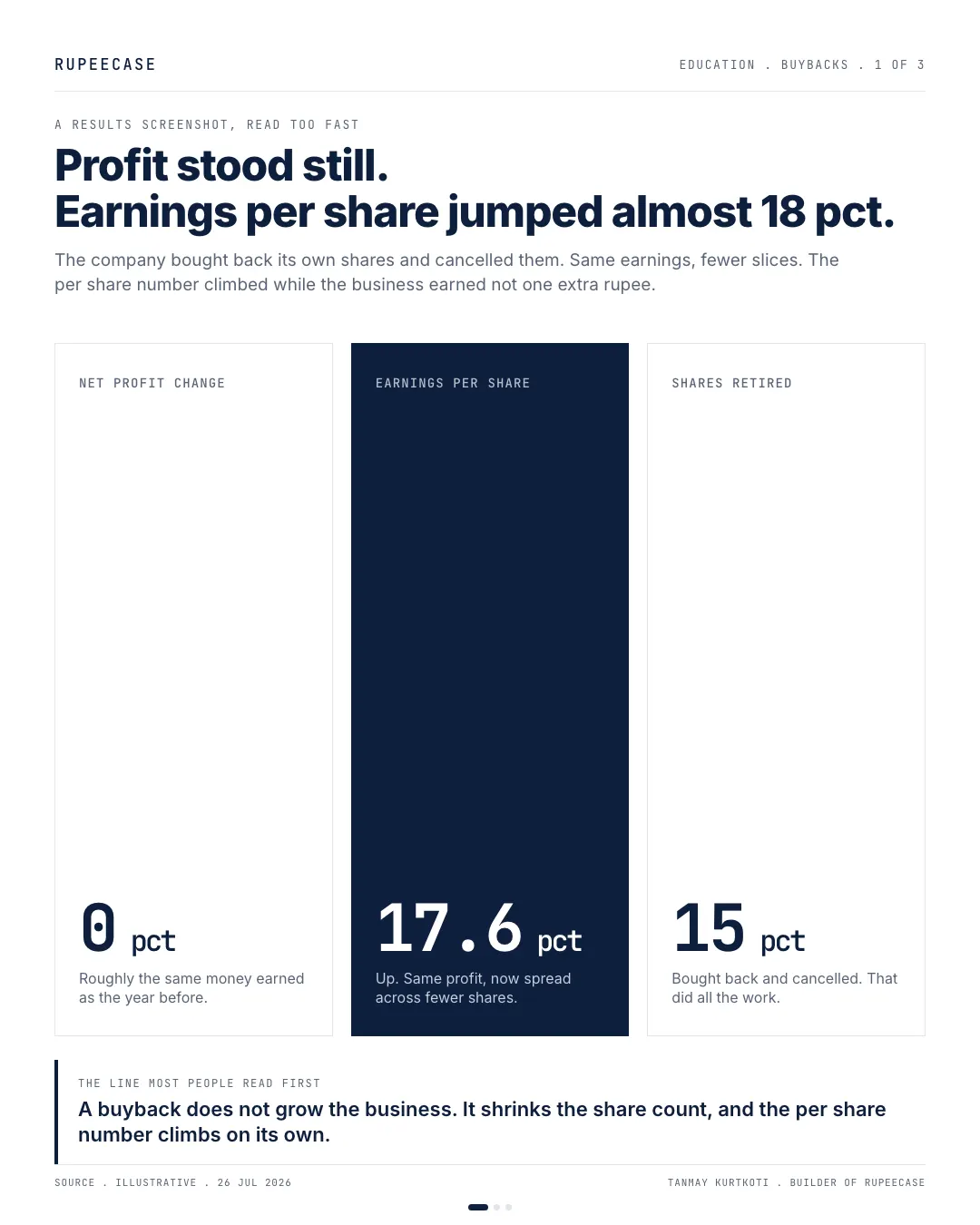
Retiring 15 percent of shares lifts EPS almost 18 percent on flat profit, and since October 2024 buyback proceeds are taxed as a deemed dividend at slab.
By Tanmay Kurtkoti, founder of QC Alpha and builder of RupeeCase
Saturday morning, second coffee, and a cousin drops a screenshot into the family group with two words sitting on top of it. "Finally compounding." It is a results slide from a company he has held for two years, and the line he has circled reads earnings per share up seventeen point six percent. He is not wrong to be pleased. A number with the words per share in it went up by almost a fifth, and every app he owns has taught him that is the number that matters.
I asked him to scroll up two lines, to the one that says net profit.
Net profit had barely moved. Same business, roughly the same money earned, give or take a rounding error. The per share number had jumped almost eighteen percent while the profit behind it stood nearly still. He looked at it for a second and asked the obvious thing. How does earnings per share go up when earnings did not.
Here is the quietest sleight of hand in company reporting. The company had bought back a slab of its own shares and cancelled them. Same earnings, fewer slices, so each slice is now a bigger piece. Nothing about the business improved. The denominator just got smaller.
A buyback does not make a company earn more. It makes the same earnings land on fewer shares, and most people read that as growth.
A buyback shrinks the slices. It does not bake a bigger cake.
So I pulled the line under the headline
Earnings per share is one of the most quoted numbers in investing and one of the least understood, because it is a fraction and people only look at the top of it. Profit on top, share count on the bottom. Move either one and the number moves. Grow the profit and you have earned the increase. Shrink the share count and you have manufactured it.
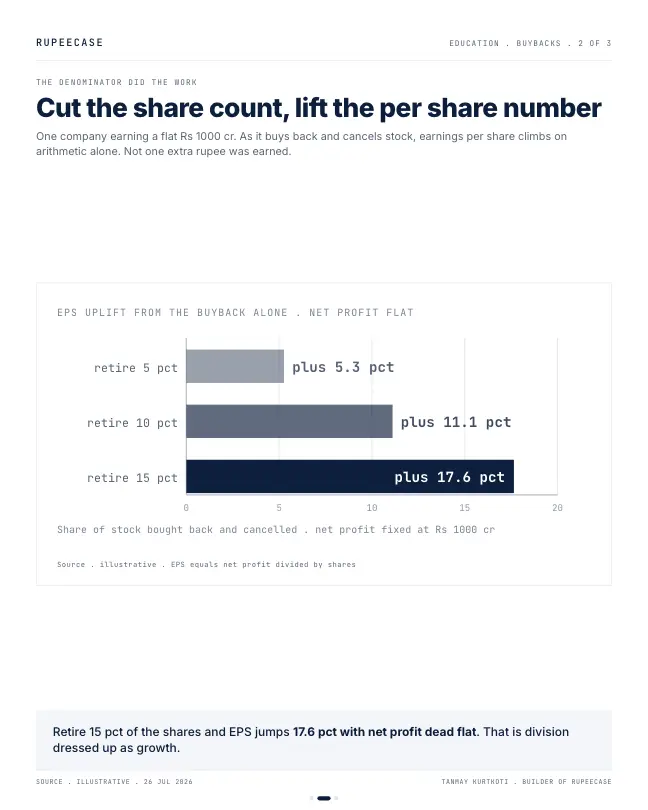
Take a company earning a flat one thousand crore, with a hundred crore shares outstanding. That is ten rupees of earnings per share. Now it buys back and cancels shares, and watch what the same one thousand crore does as the slice count falls.
Retire five percent of the shares and earnings per share rises about five percent. Retire fifteen and it jumps almost eighteen, on a business that earned not one extra rupee. The bar you are looking at is not growth. It is division. And the further right it runs, the more a flat company looks like a compounding one on the only line most people bother to read.
The number that grew was the denominator
The maths is not hard, which is exactly why it works on people. Retire a slice x of the shares and earnings per share gets multiplied by one over one minus x. Cut ten percent, divide by point nine, and you get an eleven percent lift that nobody in the building earned. It fell out of the arithmetic.
Real results usually mix both effects, which is why the headline needs splitting. Put in the profit growth and the share count cut, and the calculator separates what the business earned from what the arithmetic added.
| Shares bought back | Shares left, crore | Net profit, Rs cr | Earnings per share, Rs | Vs base |
|---|---|---|---|---|
| none | 100 | 1000 | 10.00 | base |
| 5 pct | 95 | 1000 | 10.53 | plus 5.3 pct |
| 10 pct | 90 | 1000 | 11.11 | plus 11.1 pct |
| 15 pct | 85 | 1000 | 11.76 | plus 17.6 pct |
Every row in that table is the same company earning the same money. Only the share count moved. The most famous version of this is not Indian. One large US technology company spent more than six hundred billion dollars buying back its own stock between 2012 and 2024 and dropped its share count from about twenty six and a half billion shares to about fifteen point four, roughly forty two percent fewer. Every remaining share now owns a bigger piece of the same company, which flatters per share growth even in years the business itself was flat. If you want the plain version of how earnings per share is built before we go on, we keep one in the Learn hub.
A buyback is not free money, it is your money
Now the part that sounds like heresy the first time you hear it. A buyback is not the company giving you something. It is the company handing back cash that was already yours.
The money a company spends buying its own shares comes off its own balance sheet, and that balance sheet belongs to the shareholders. So a buyback returns capital, exactly like a dividend, just routed through the market instead of your bank account. Whether it does you any good comes down to one thing. The price it paid. Buy back shares that are genuinely cheap and the holders who stay are better off, because the company retired ownership on the cheap. Buy back shares that are dear and it flips, the leavers get paid a rich price and the stayers quietly fund it. Same action, opposite outcomes, and the press release never tells you which one you are standing in. Reading the actual profit line under the headline is the whole reason the per stock factsheets exist.
Then in October 2024 the tax quietly flipped
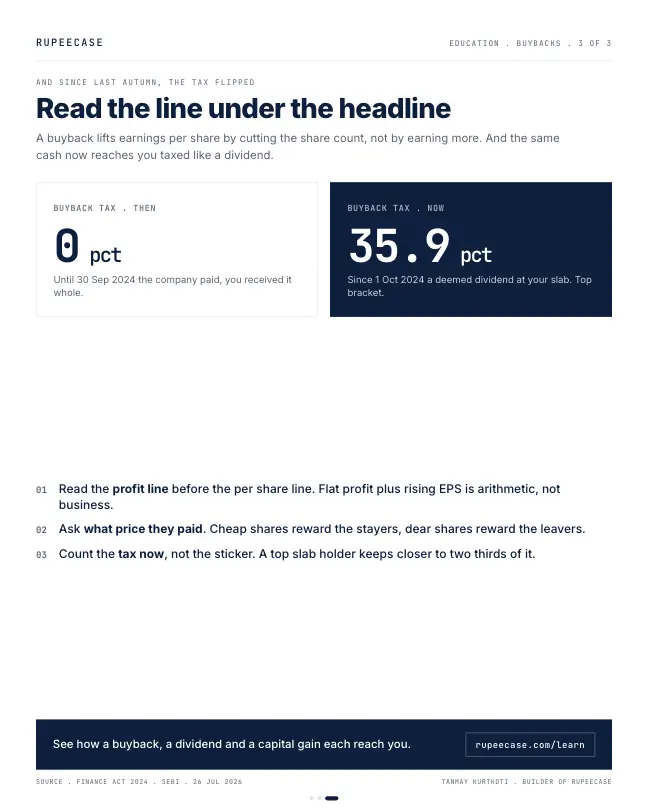
For years a buyback in India was the tax smart way to hand cash back. The company paid a buyback tax, about twenty three percent all in, and the shareholder received the money completely free of tax. Promoters liked it, funds liked it, and for a top slab investor it beat a dividend, which lands as ordinary income.
That ended on the first of October 2024. The old company level buyback tax is gone. In its place, the entire amount you receive in a buyback is treated as a deemed dividend and taxed in your hands at your slab rate, with no credit for what you paid for the shares in the first place. For someone in the top bracket that was an effective 35.88 percent. It did not last. From 1 April 2026 a buyback is taxed as a capital gain instead, only on what you receive over your cost, and promoters pay a higher effective rate.
- Buyback tax extended to listed companies
The company pays about 23 percent all in on the amount distributed. The shareholder receives the money tax free.
- Taxed as a dividend, in your hands
The whole amount received is taxed at your slab rate, with no deduction for cost. The cost becomes a capital loss.
- Taxed as a capital gain
Only what you receive over your cost is taxed, at 12.5 or 20 percent by holding period. Promoters pay an effective 22 percent (domestic companies) or 30 percent (others).
Run one hundred thousand rupees of buyback through both worlds. Before, a top slab investor kept the whole lakh. After, the same investor keeps about sixty four thousand, and the cost of the shares they tendered turns into a capital loss they then had to find gains to use. The buyback did not change. The route the money takes to reach you did, and it now walks through a tollgate it used to skip. If you want to see how differently a rupee reaches you as a dividend, a buyback, or a plain capital gain, put them next to each other in the compare view.
There are three worlds now, not two. Take the same Rs 1,00,000 tendered by a top slab holder whose shares cost Rs 60,000 and were held more than a year.
The calendar trick in the next section shows how much companies cared about these rules. The free Learn module on capital allocation covers when a buyback is a good use of cash and when it is not, and the share dilution note runs the same fraction the other way.
The tell was in the calendar, not the value
Here is the part I keep coming back to. If a buyback is really about scooping up your own cheap shares, the timing should follow the price. It followed the tax instead.
In the three weeks after the July 2024 budget announced the change, fifteen listed companies rushed out buyback plans. In the whole seven months before that, there had been eighteen. Close to a year of buybacks got crammed into a scramble to beat a tax date, which tells you what a lot of them were actually about. Not a cool headed judgment that the shares were a bargain. A window closing. When the reason a company hands back cash is a deadline on a calendar, the odds that it is also buying at a genuinely good price are not high.
The honest part, where a buyback actually helps
I do not want to leave this as buybacks bad, because that is lazy and it is wrong.
A buyback done well is a fine thing. When a company throws off more cash than it can sensibly reinvest, handing it back beats letting it itch a hole in the balance sheet and get spent on some empire building acquisition nobody asked for. Bought at a sensible price, a buyback quietly concentrates every loyal holder's stake in a business they already wanted more of. It is more flexible than a dividend, which the market punishes a company for ever cutting once it has started. And a rising per share number, when it sits on top of a rising profit, is the real thing and worth paying up for. The mistake is not the buyback. The mistake is reading the per share line as growth without checking whether the profit line grew too. The company that grew its earnings and the company that merely shrank its share count can print the exact same headline, and only one of them actually got better. I cannot tell you from a single slide which one you are holding. I can tell you the two lines it takes to find out.
Three ways to read a buyback
Read the profit line before the per share line. If earnings per share is up and net profit is flat, the growth is arithmetic, not business.
Ask what price they paid. A buyback of cheap shares rewards the holders who stay, a buyback of dear shares rewards the ones who leave, and the company is doing one of those two. Find out which.
Count the tax, not the sticker. From October 2024 to March 2026 a buyback reached you as slab taxed income, so a top slab holder kept closer to two thirds of it. Since April 2026 it is taxed as a capital gain on your profit over cost. The old free lunch is still off the menu.
The per share number is the easiest line in the entire report to move without moving the business. Read the one sitting underneath it first. That is the one nobody can fake with a fraction.
Questions readers ask
How is a share buyback taxed in India in 2026?
From 1 Apr 2026, a shareholder who tenders shares in a buyback pays capital gains tax only on the amount received over the cost, at 12.5 percent for holdings over 12 months or 20 percent otherwise. Between 1 Oct 2024 and 31 Mar 2026 the whole amount was taxed at slab rates as a dividend. Promoters pay an effective 22 or 30 percent.
Does a buyback increase earnings per share?
Yes, mechanically: cancelling 10 percent of the shares lifts EPS by about 11.1 percent even if profit is flat. That lift is arithmetic, not business growth, so the net profit line is the one to compare.
The cards
3 cards. Swipe, or tap to open.
Explore next
Learn it properly, then see it applied.
- Free module 1.4Reading Financial Statements11 min read
- StrategyAllcap strategyNifty Total Market, 50 stocks, every 2 weeks
- Free module 9.3Capital Allocation, The Most Important Skill11 min read
- CalculatorLTCG and STCG on equityFree, with the formula and a worked example
- Blog topicCompany numbers notes24 notes
Reading path
Stop 8 of 8 on Reading a company
Related
- The stock split that changed nothingA 1:1 split turned 1,000 shares at Rs 200 into 2,000 at Rs 100, left the P/E and the ownership fraction untouched, and the volume bump faded within 90 days.Company numbers . . 10 min
- Bonus shares: the same pizza, more slicesA 1:1 bonus doubled the share count and halved the price, left Rs 80,000 worth Rs 80,000, and started a fresh holding period clock on the new shares.Company numbers . . 6 min
- Why EPS growth lags net profit growthNet profit up 40 percent and share count up 25 percent is EPS up 12 percent, so read the per share line, track the count and use diluted EPS.Company numbers . . 5 min
Educational content only. Figures are illustrative and computed on historical or representative data for teaching purposes, not investment advice. Past performance does not guarantee future returns. Sourced from NSE, BSE, SEBI, AMFI and RBI public data.