


Portfolio construction..4 min read
Home bias is rationed in India
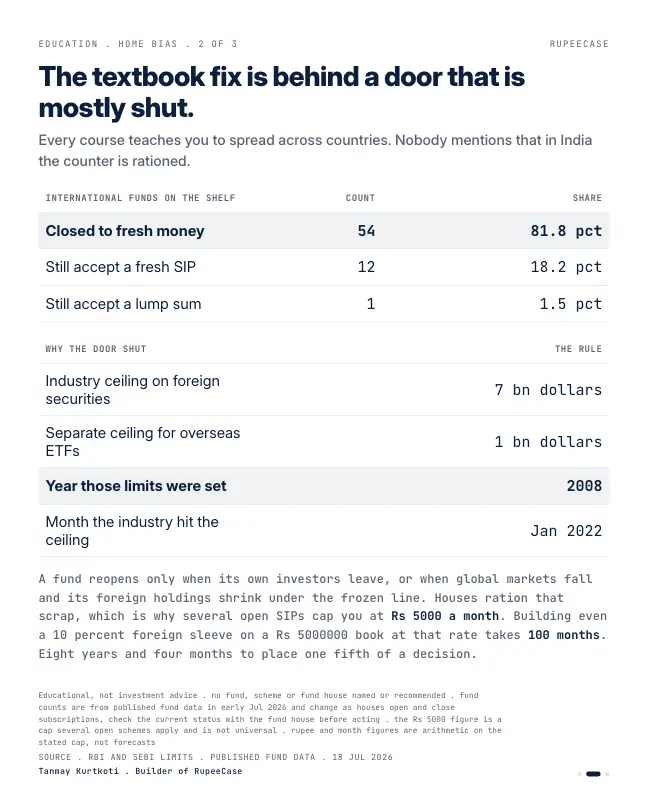
54 of 66 international funds were closed to fresh money under a 7 billion dollar industry cap set in 2008, so one country concentration is often found rather than chosen.
By Tanmay Kurtkoti, founder of QC Alpha and builder of RupeeCase
Friend showed me his portfolio yesterday. Eight funds. Large cap, mid cap, small cap, a little gold on the side. He was proud of it, and rightly.
So I asked how many countries were in it.
Long pause. One. Every rupee he owns is a bet on the same economy that pays his salary, prices his house and signs his bonus cheque.
That is home bias, and every textbook has the same fix. Own some of the rest of the world. Here is what the textbooks skip: in India that counter is rationed.
Of the 66 international funds on the shelf, 54 will not accept fresh money today. Twelve still take a SIP. One takes a lump sum. Not one of those closures is a verdict on the fund behind it.
The reason is a ceiling. Indian mutual funds may hold 7 billion dollars in foreign securities between all of them, plus 1 billion for overseas ETFs. Those numbers were set in 2008 and have not moved since. The industry crossed the line in January 2022 and every house has been frozen at whatever room it held that February. A fund reopens only when its own investors leave, or when global markets fall far enough to shrink what it holds.
So the doors still open ration you. Several cap a fresh SIP at Rs 5,000 a month. A 10 percent sleeve on a 50 lakh book works out to 100 months of that. Eight years to place one fifth of a decision.
Honest version: I am not telling you to fix this, because mostly you cannot. And home bias is not automatically a mistake. Your rent and your liabilities are in rupees. There is a real case for owning rupee assets.
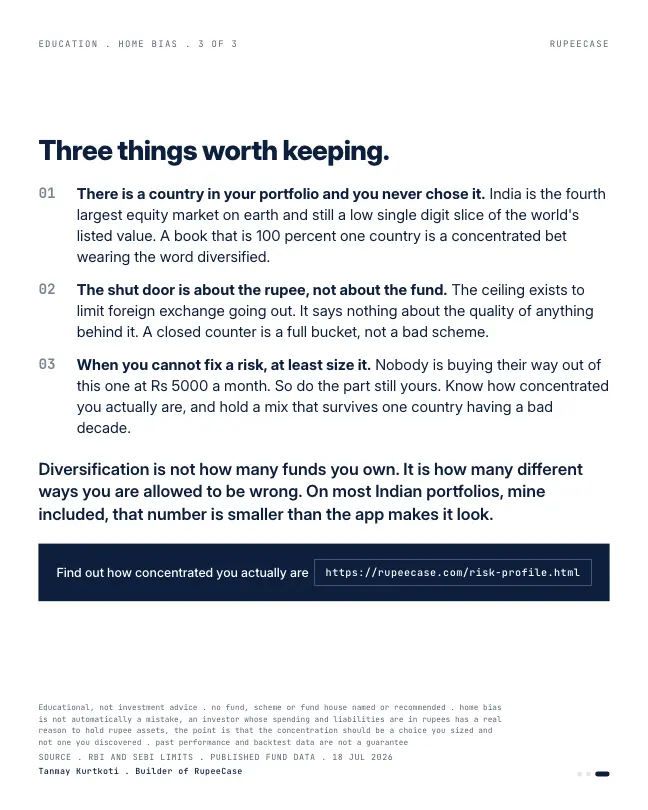
But there is a difference between a concentration you chose and one you found out about. Diversification is not how many funds you own. It is how many different ways you are allowed to be wrong. On most Indian portfolios, mine included, that number is smaller than the app makes it look
The limits, in one place
The ceiling in the opening is written into SEBI's rules for mutual funds. The current Master Circular for Mutual Funds, dated 27 Jun 2024, sets an industry wide limit of 7 billion US dollars for overseas investment, with no more than 1 billion for any one fund house. Overseas ETFs have a separate industry limit of 1 billion dollars, with up to 300 million per fund house.
Overseas limit for all mutual funds together
SEBI Master Circular for Mutual Funds, 27 Jun 2024
Cap for any one fund house within that limit
SEBI Master Circular for Mutual Funds, 27 Jun 2024
Separate industry limit for overseas ETFs
SEBI Master Circular for Mutual Funds, 27 Jun 2024
Seven billion dollars sounds large until you set it against the size of the industry and the number of investors who might want a slice. Once the industry reached the line, the only room for new money is the room existing investors leave behind.
How the door closed
- The 7 billion dollar ceiling is set
The industry wide overseas limit for mutual funds reaches the level it holds today.
- The industry reaches the ceiling
Fund houses stop taking fresh money into overseas schemes beyond the room each one held.
- Overseas ETF subscriptions paused
Following a SEBI letter of 19 Mar 2024, schemes stop fresh subscriptions meant for overseas ETFs from 1 Apr 2024.
- The limits are restated
The SEBI Master Circular of 27 Jun 2024 carries the same 7 billion and 1 billion dollar limits forward.
There is a second route outside mutual funds. Under the RBI's Liberalised Remittance Scheme, a resident individual may send up to 2,50,000 US dollars abroad in a financial year for permitted purposes, which include buying overseas shares. It comes with its own paperwork, tax reporting and currency costs, and it is not a fund. It does exist, and it is not rationed by the industry ceiling.
How long a capped SIP takes
The arithmetic in the opening is worth running on your own numbers, because the answer surprises most people.
And the target keeps moving. If the rest of the Rs 50 lakh grows while the overseas sleeve fills Rs 5,000 at a time, the 10 percent target keeps rising ahead of it.
MythA closed international fund has done something wrong.
FactMost closures follow the industry ceiling. A fund reopens when its own investors redeem or its overseas holdings shrink, not because of a verdict on it.
The free Learn module on gold, commodities and international investing covers the routes Indian investors use to hold assets outside India, their limits and their tax treatment, with a quiz at the end. For the size of the one country bet, read the one country bet.
Questions readers ask
Why are international mutual funds not accepting new investments in India?
Because the mutual fund industry reached its overall overseas limit of 7 billion US dollars, set by SEBI. Each fund house can only take fresh money up to the room it has left, so many international schemes have paused or capped new subscriptions.
What is the SEBI limit on overseas investment by mutual funds?
The SEBI Master Circular of 27 Jun 2024 sets 7 billion US dollars for the industry as a whole and up to 1 billion per fund house, plus a separate 1 billion dollar industry limit for overseas ETFs with up to 300 million per fund house.
Is home bias a mistake for Indian investors?
Not automatically. Your income, rent and future spending are in rupees, which is a real reason to hold mostly rupee assets. The risk is holding 100 percent in one country without having chosen it.
The cards
3 cards. Swipe, or tap to open.
Related
- The one country betJapan was 45 percent of world equity in 1989 and took 34 years to regain its high; India is about 2.9 percent and most Indian portfolios sit near 100 percent India.Portfolio construction . . 4 min
- One profile, many goalsPointing one Moderate label at a two year flat deposit and a 25 year retirement pot loses at both ends; the deposit falls short and the far pot ends Rs 24.18 lakh lower.Portfolio construction . . 5 min
- Who sells first: a household's real risk levelA shared portfolio is held by consensus and sold by veto, so the account's risk level is the lower partner's tolerance, not the average.Portfolio construction . . 4 min
Educational content only. Figures are illustrative and computed on historical or representative data for teaching purposes, not investment advice. Past performance does not guarantee future returns. Sourced from NSE, BSE, SEBI, AMFI and RBI public data.