

Personal finance and tax..5 min read
Emergency fund first, risk profile second
Two people with Rs 12 lakh hit by a Rs 2 lakh bill in a 30 percent fall end Rs 85,714 apart, because one sold equity at the trough and one paid from cash.
By Tanmay Kurtkoti, founder of QC Alpha and builder of RupeeCase
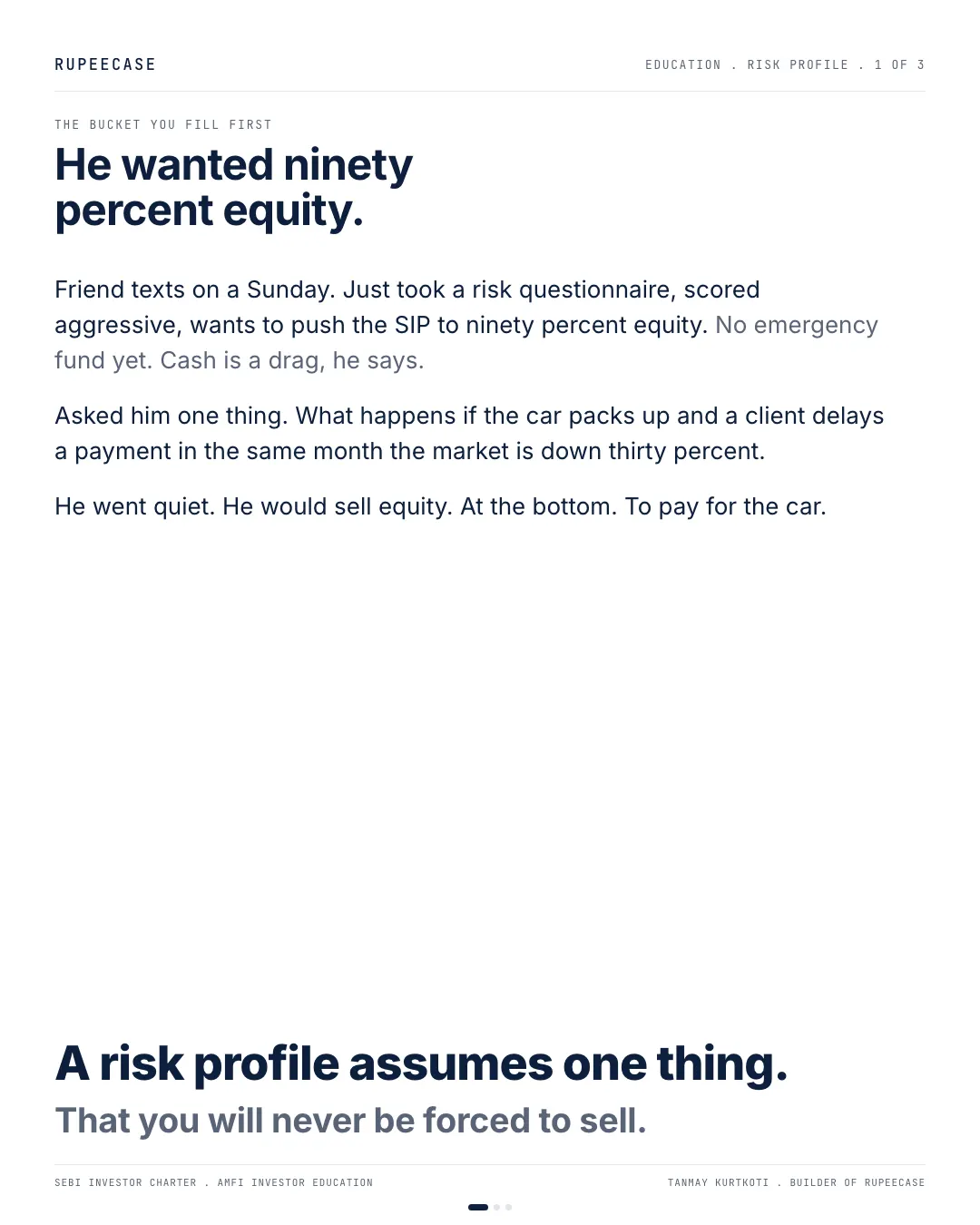
A friend texted me on Sunday. He had just taken a risk questionnaire, scored aggressive, and wanted to push his SIP to ninety percent equity. No emergency fund yet. Cash is a drag, he said.
I asked him one question. What happens if the car packs up and a client delays a payment in the same month the market is down thirty percent.
He went quiet. Because he knew. He would sell equity. At the bottom. To pay for the car.
Here is the part the questionnaire never tells you. Every risk profile silently assumes one thing. That you will never be forced to sell. Score yourself aggressive all you like. The moment a real bill collides with a falling market and you have no cash, the market decides when you sell, not you.
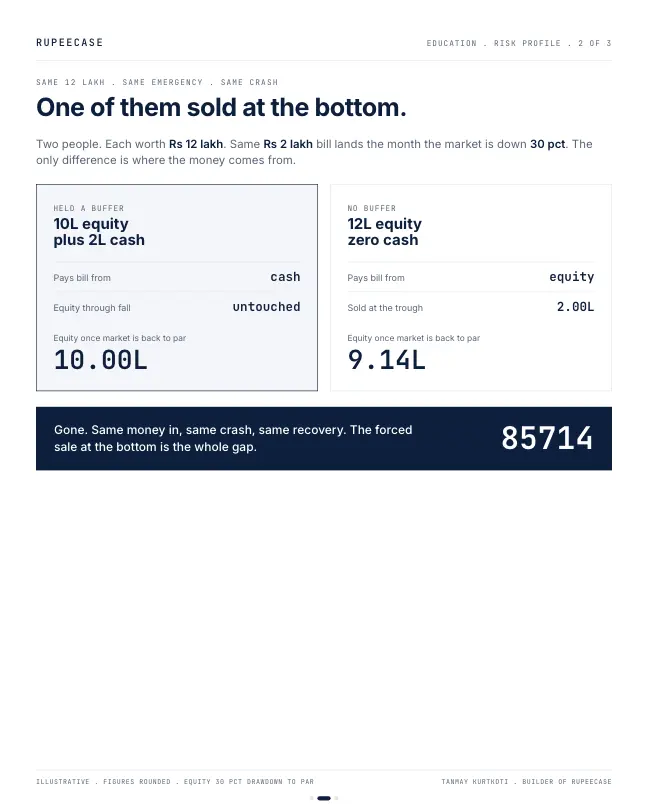
So I ran the numbers on two people. Each worth twelve lakh. Each hit with the same two lakh expense the month the market is down thirty percent. The only difference is where the money comes from.
The one with a cash buffer pays the bill from cash. Equity stays invested, rides the fall, comes back to ten lakh once the market is at par. The one with no buffer sells two lakh of equity at the trough. By the time the market is merely back to where it started, he is sitting on nine point one four lakh. Same money in. Same crash. Same recovery. Rs 85,714 gone, purely because he had to sell at the worst possible moment.
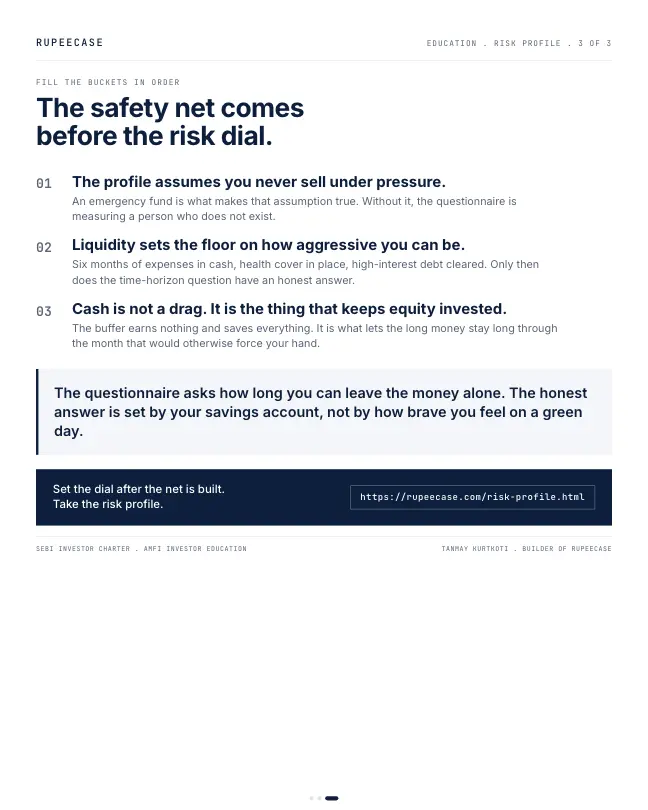
That gap is not a return problem. It is a liquidity problem. Six months of expenses in cash, health cover in place, high-interest debt cleared. Only then does the time-horizon question have an honest answer.
The questionnaire asks how long you can leave the money alone. The honest answer is set by your savings account, not by how brave you feel on a green day:
Where the Rs 85,714 comes from
The arithmetic is short, and worth doing once by hand. The person without a buffer has Rs 12 lakh in equity. A 30 percent fall takes it to Rs 8.4 lakh. He sells Rs 2 lakh to pay the bill, leaving Rs 6.4 lakh. When the market climbs back to its starting level, every rupee left grows by 1 divided by 0.7, so Rs 6.4 lakh becomes about Rs 9,14,286.
The person with a buffer had Rs 10 lakh in equity and Rs 2 lakh in cash. The bill takes the cash. The Rs 10 lakh falls to Rs 7 lakh and comes back to Rs 10 lakh. The difference is Rs 85,714, and it has a one line formula: the bill times the fall divided by one minus the fall. The forced seller sold Rs 2 lakh of shares that were worth Rs 2,85,714 at the starting price.
The cost grows faster than the fall. At a 10 percent fall the same Rs 2 lakh sale costs about Rs 22,222. At 40 percent it costs about Rs 1,33,333.
- Sold in a 10% fallRs 22,222
- Sold in a 20% fallRs 50,000
- Sold in a 30% fallRs 85,714
- Sold in a 40% fallRs 1,33,333
Worked example: Rs 2 lakh bill paid by selling equity, cost measured when the market returns to its starting level.
This year had such a month
The collision in the opening is not rare. On NSE's closes the Nifty 50 fell from 26,328.55 on 2 Jan 2026 to 22,331.40 on 30 Mar 2026, 15.2 percent, with March alone down 11.3 percent. A Rs 2 lakh bill paid by selling an index fund at the 30 Mar close used shares that were worth about Rs 2,35,800 at the Jan level. And as of 9 Oct 2026, with the index at 22,520.45, the market had not returned to its Jan level, so the forced seller was still waiting for the recovery the example assumes.
Liquidity comes before the questionnaire
The opening's order is the useful part. Before any risk score means anything, three things need to be in place, because each of them is a way a bill can force a sale.
- Cash for six monthsReal monthly spending, held where it can be reached in a day or two.
- Health coverA hospital bill is the most common large surprise; cover keeps it off the portfolio.
- No high interest debtCard balances cost more than any portfolio reliably earns.
- Then the risk profileNow the answer to "how long can you leave it" is true.
MythCash in an emergency fund is a drag on returns, so an aggressive investor can skip it.
FactWithout it, a Rs 2 lakh bill in a 30 percent fall costs about Rs 85,714 in forced selling, more than many years of the return the cash gave up.
The emergency fund calculator sizes the buffer from your real spending, and the companion post on where to keep it covers the vehicle. Our risk profile asks about the buffer before it asks about drawdowns, for exactly this reason. The free Learn module on risk management for systematic portfolios treats liquidity as the first risk control.
Questions readers ask
Why do I need an emergency fund before investing in equity?
Because a bill that arrives during a market fall otherwise has to be paid by selling shares at a low price. In the worked example, a Rs 2 lakh bill paid from equity in a 30 percent fall costs about Rs 85,714 once the market recovers, against nothing when it is paid from cash.
How much does it cost to sell investments in a market crash?
Measured at the point the market returns to its old level, the cost is the amount sold times the fall divided by one minus the fall. Selling Rs 2 lakh costs about Rs 22,222 in a 10 percent fall, Rs 50,000 in a 20 percent fall and Rs 85,714 in a 30 percent fall.
What should come before a risk profile?
An emergency fund of about six months of real expenses, health cover and no high interest debt. Each removes a reason to be forced to sell, which every risk score quietly assumes will not happen.
The cards
3 cards. Swipe, or tap to open.
Explore next
Learn it properly, then see it applied.
- GuideHow to invest your first salary: an order of steps that worksEmergency fund, insurance, EPF, tax regime, then a first SIP, worked on a real budget.
- Free module 11.1Equity Taxation After July 2024: The New Rules10 min read
- StrategyAllcap strategyNifty Total Market, 50 stocks, every 2 weeks
- CalculatorDrawdown and recoveryFree, with the formula and a worked example
Reading path
Stop 3 of 8 on Before you pick a card
Related
- Emergency fund: six months is the rule, the vehicle leaksSix months of expenses in a savings account at 3 percent loses to inflation, while a three tier split of savings, sweep FD and liquid fund earns 5.58 percent with the same liquidity.Personal finance and tax . . 5 min
- The first crore is the slowestA flat Rs 10,000 SIP at 12 percent takes about 20 years to the first crore, 5 more to the second and 3 to the third, with 72 percent of the final pot arriving in the last decade.Personal finance and tax . . 5 min
- The lever you control beats the one you chaseTwo extra points of return over 25 years adds Rs 82 lakh to a Rs 10,000 SIP; stepping the same SIP up 10 percent a year adds Rs 2.35 crore.Personal finance and tax . . 4 min
Educational content only. Figures are illustrative and computed on historical or representative data for teaching purposes, not investment advice. Past performance does not guarantee future returns. Sourced from NSE, BSE, SEBI, AMFI and RBI public data.