

Personal finance and tax..4 min read
The lever you control beats the one you chase
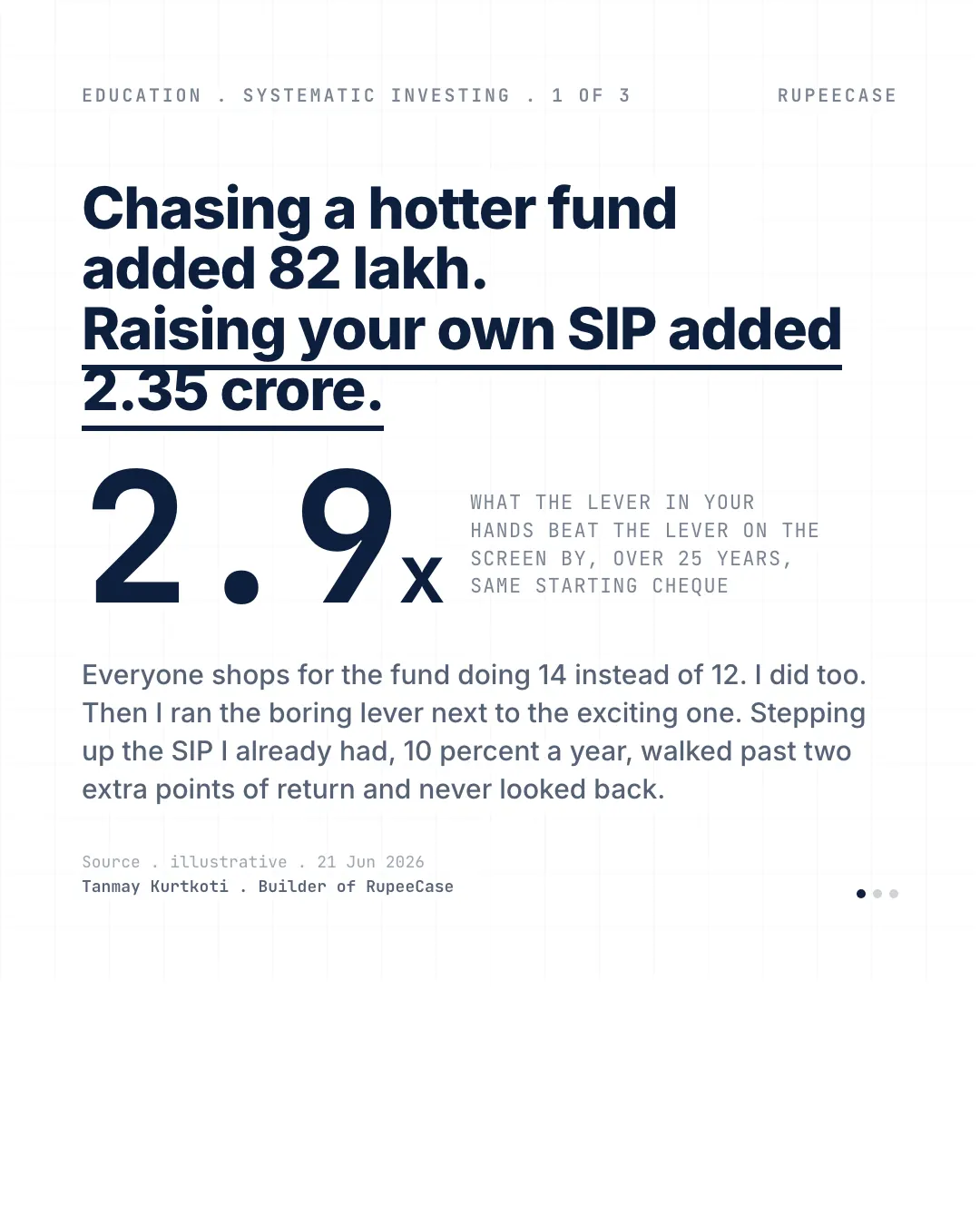
Two extra points of return over 25 years adds Rs 82 lakh to a Rs 10,000 SIP; stepping the same SIP up 10 percent a year adds Rs 2.35 crore.
By Tanmay Kurtkoti, founder of QC Alpha and builder of RupeeCase
Everyone shops for the fund doing 14 instead of 12. I did too, for years. Then one evening I put the boring lever next to the exciting one, and the exciting one lost.
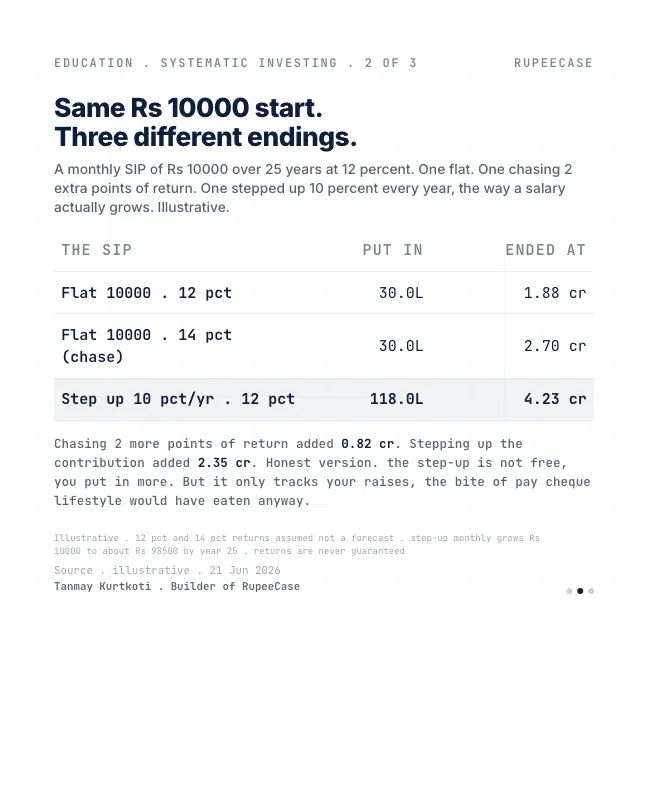
Same Rs 10,000 monthly SIP. 25 years. I ran three versions.
Flat at 12 percent ends at about 1.88 crore. Now chase the harder thing, squeeze two more points out of the fund, get it to 14 percent. That ends at 2.70 crore. Two extra points of return, sustained for a quarter century, bought you 82 lakh.
Now leave the return at 12 and pull the other lever instead. Start the same 10,000, step it up 10 percent every year the way a salary actually grows. That ends at 4.23 crore. The contribution lever added 2.35 crore. Almost three times what chasing return managed.
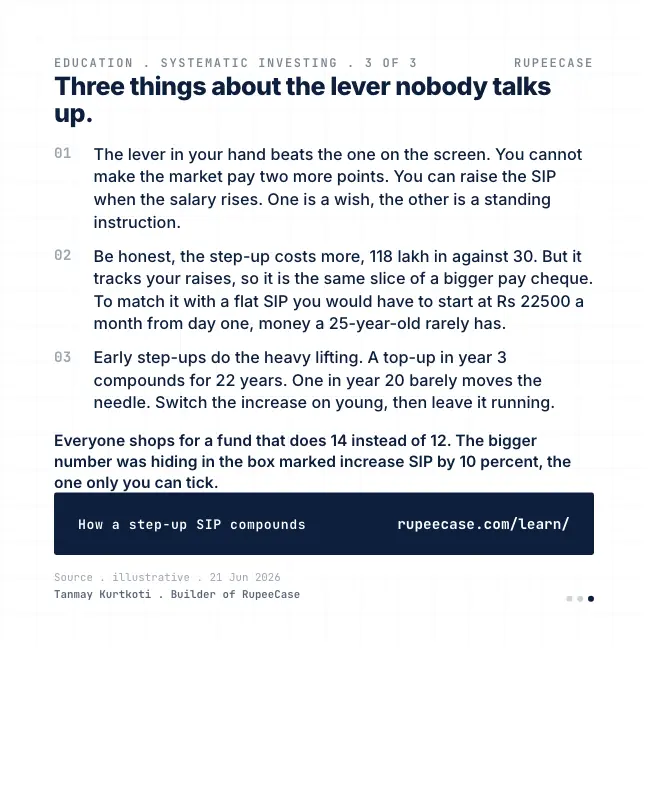
Here is the honest part, because the brochure version skips it. The step-up is not free. You put in 118 lakh over the years against 30 for the flat SIP. But the increases only ride your raises, so it is the same slice of a bigger pay cheque, the slice lifestyle creep quietly eats if you do not move it into the SIP first.
And timing inside the plan matters more than people think. A top-up in year three compounds for 22 years. One in year twenty barely moves the needle. Switch the increase on young, then leave it running.
To match that step-up with a flat SIP you would have to start at Rs 22,500 a month from day one, money a 25-year-old rarely has. What the 25-year-old does have is the box marked increase SIP by 10 percent. The one nobody talks up, the one only you can tick.
The bigger number was never in the fund. It was in the contribution
The three versions, checked
I reran the opening's three SIPs with 1 percent a month for 12 percent (and 14 divided by 12 for 14 percent), each instalment paid at the end of the month. They reproduce: Rs 1.88 crore flat, Rs 2.70 crore at 14 percent, and Rs 4.23 crore with a 10 percent yearly step up.
- Flat Rs 10,000 at 12%Rs 1.88 Cr
- Flat Rs 10,000 at 14%Rs 2.70 Cr
- 10% step up at 12%Rs 4.23 Cr
Worked example, 25 years, monthly compounding, instalments at month end. Before tax and costs.
The two levers are not equally available. Two extra points of return a year for 25 years is something very few funds deliver, and nobody can choose it in advance. A 10 percent yearly increase in the SIP is a setting in the mandate.
Run your own step up
A flat SIP shrinks every year
There is a second reason the step up matters, and it has nothing to do with growth. A flat Rs 10,000 SIP buys less every year. All India CPI inflation was 4.82 percent in Aug 2026, on MOSPI's figures. At that rate, Rs 10,000 in 25 years has the purchasing power of about Rs 3,080 today. A SIP that never rises is a SIP that quietly falls.
all India CPI inflation, Aug 2026
MOSPI, 14 Sep 2026
what Rs 10,000 a month is worth in 25 years, in today's money
Worked example at 4.82% a year
step up that roughly keeps the SIP level in real terms
Worked example
So a step up near the inflation rate is not saving more. It is standing still. Anything above it is the real increase. The opening's 10 percent sits about five points above recent inflation, which is roughly what a salary that grows ahead of prices allows.
Early increases do most of the work
The opening's timing point is the reason to switch the step up on early. An extra Rs 1,000 a month added in year three gets 22 years of compounding. The same Rs 1,000 added in year twenty gets five.
MythI will increase the SIP later, when I earn more. It works out the same.
FactAt 12 percent, Rs 1,000 a month added in year 3 and kept for 22 years is worth about Rs 12.8 lakh. Added in year 20 and kept for five, about Rs 82,000. The rupee is the same; the years are not.
The step up SIP calculator shows the effect for any increase and period. The free Learn module on inflation and its investment impact explains real returns and why a goal's rupee figure has to grow with prices. The post on lifestyle creep covers the behaviour side: deciding the step up before the raise lands.
Questions readers ask
What is a step up SIP?
It is a SIP whose monthly amount rises by a fixed percentage or amount once a year. A Rs 10,000 SIP stepped up 10 percent a year for 25 years at 12 percent ends near Rs 4.23 crore, against Rs 1.88 crore for the same SIP kept flat.
How much should I step up my SIP every year?
A step up close to inflation, about 5 percent with CPI at 4.82 percent in Aug 2026, keeps the SIP level in real terms. Anything above that is a real increase, and many people tie it to their yearly raise.
Is a higher return or a higher SIP amount more important?
In the worked example, two extra points of return for 25 years added Rs 82 lakh, while a 10 percent yearly step up added Rs 2.35 crore. The return cannot be chosen in advance; the contribution can.
The cards
3 cards. Swipe, or tap to open.
Explore next
Learn it properly, then see it applied.
Related
- Lifestyle creep: the raise that never reaches the portfolioBanking half of every increment lifts a savings rate from 20 to 35 percent without a felt cut and ends Rs 21.5 lakh ahead over a decade on the same income and returns.Personal finance and tax . . 5 min
- The flat SIP shrinksRs 10,000 a month buys about Rs 7,473 of 2021 purchasing power after five years at 6 percent inflation, and a 10 percent annual step up doubles the twenty year corpus.Personal finance and tax . . 8 min
- The first crore is the slowestA flat Rs 10,000 SIP at 12 percent takes about 20 years to the first crore, 5 more to the second and 3 to the third, with 72 percent of the final pot arriving in the last decade.Personal finance and tax . . 5 min
Educational content only. Figures are illustrative and computed on historical or representative data for teaching purposes, not investment advice. Past performance does not guarantee future returns. Sourced from NSE, BSE, SEBI, AMFI and RBI public data.