

Personal finance and tax..5 min read
Emergency fund: six months is the rule, the vehicle leaks
Six months of expenses in a savings account at 3 percent loses to inflation, while a three tier split of savings, sweep FD and liquid fund earns 5.58 percent with the same liquidity.
By Tanmay Kurtkoti, founder of QC Alpha and builder of RupeeCase
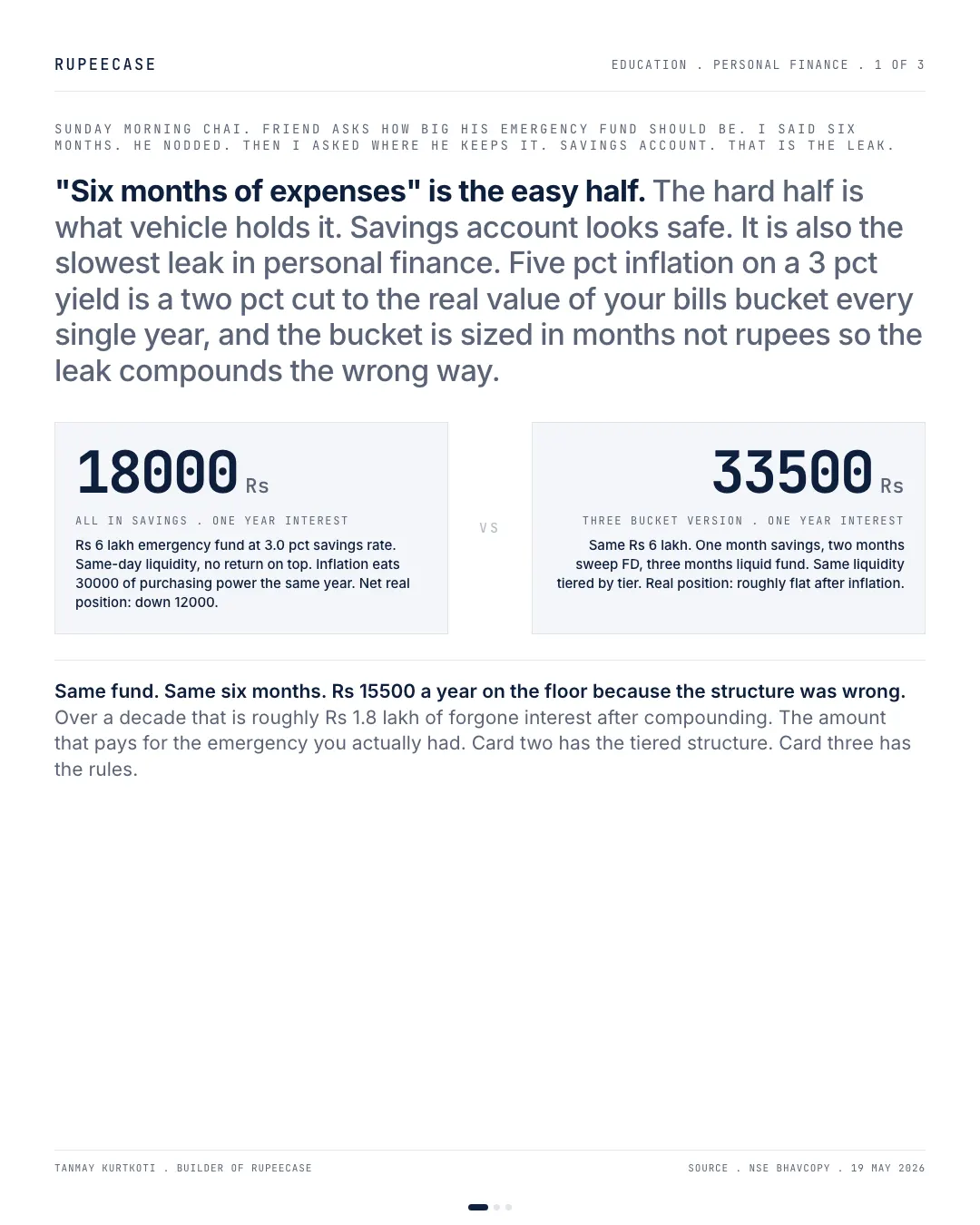
Sunday chai with a friend. He asks how big his emergency fund should be. I said six months of expenses. He nodded. Then I asked where he keeps it. Savings account.
That is the leak.
The size rule is the easy half. Most people get to six months on their own. The vehicle is what nobody explains, and it is where the structure of the bucket either compounds quietly or bleeds quietly. Six months in a savings account at 3 pct nominal loses to 5 pct inflation every year. The fund looks safe. The purchasing power of the rupees inside it is being shaved.
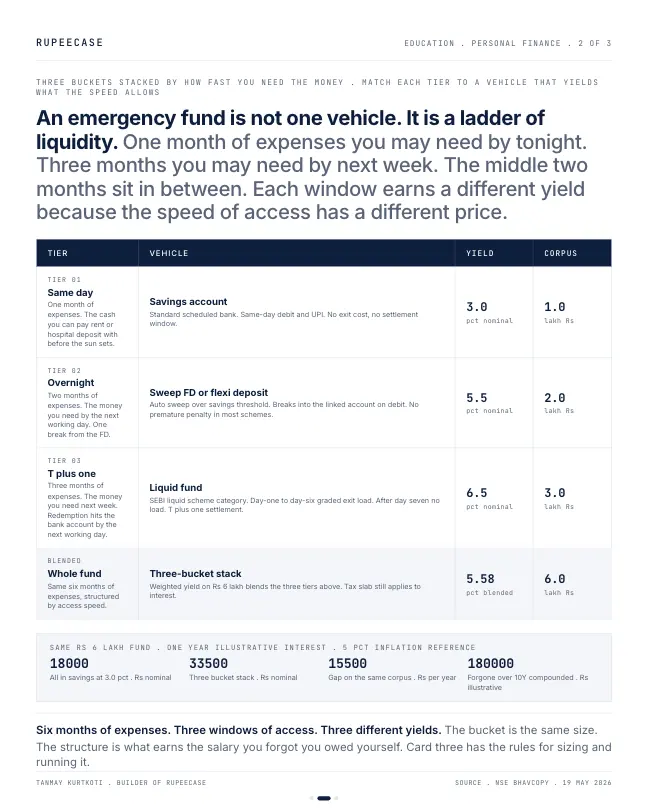
Run it on Rs 6 lakh, which is roughly six months for an urban household with Rs 1 lakh monthly run-rate. Whole bucket in savings at 3 pct earns Rs 18,000 in a year. Split the same Rs 6 lakh across three tiers and the bucket earns Rs 33,500 in the same year on the same corpus. Tier one is one month of expenses in a regular savings account for same-day access at 3 pct. Tier two is two months in a sweep FD or flexi deposit at 5.5 pct, which auto-breaks into the savings account on debit. Tier three is three months in a liquid fund at 6.5 pct, redeemable on T plus one. The blended yield is 5.58 pct on the same bucket. Same liquidity in aggregate. No tier slower than the job it has to do.
The gap is Rs 15,500 a year on the floor. Over a decade compounded at roughly 6 pct it grows to about Rs 1.8 lakh. The amount that often pays for the emergency you actually had.
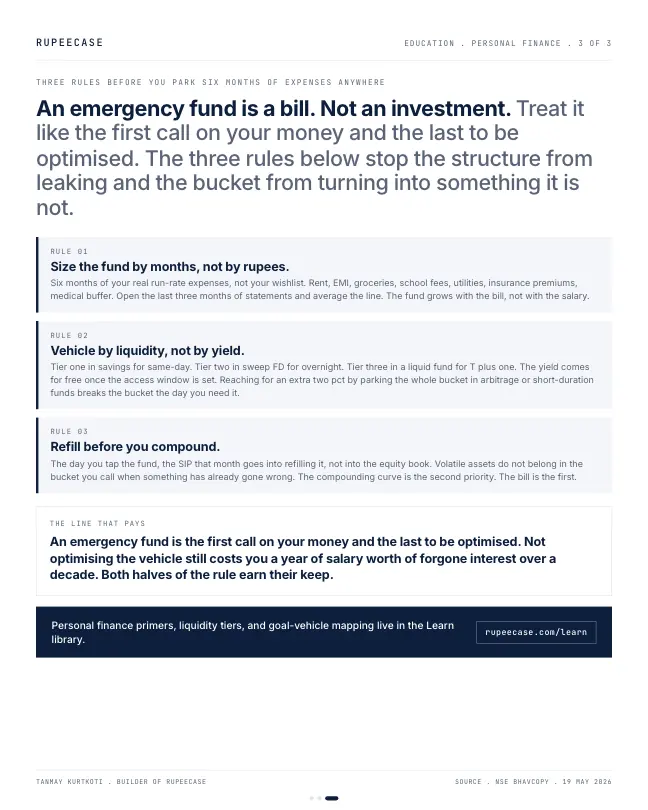
Three rules keep the bucket honest. Size it by months of real expenses, not by a target rupee number, and average the last three months of statements rather than the wishlist. Pick the vehicle by liquidity window first and let the yield come for free, because reaching for an extra two pct by parking the whole bucket in arbitrage or short-duration funds breaks the bucket the day you call it. And refill before you compound. The month you tap the fund, the SIP goes into rebuilding it before the equity book gets another rupee.
An emergency fund is the first call on your money and the last to be optimised. Not optimising the vehicle still costs you a year of salary worth of forgone interest over a decade. Both halves of the rule earn their keep.
The three tiers, as a picture
The opening's structure is easiest to see as one bucket cut by how fast each slice can reach your account.
- Savings, same day1 month
- Sweep deposit, same day2 months
- Liquid fund, next day3 months
Worked example from the opening: Rs 6 lakh, Rs 1 lakh a month of expenses.
The logic is about the order of withdrawals. Most emergencies are paid over days or weeks, not in one hour. The first month's bills come out of the savings account. By the time the bigger bills arrive, the sweep deposit has broken automatically and the liquid fund redemption has landed.
Today's rates, and the line the opening skipped
Rates have moved since this post was written, so here are the reference points as of Oct 2026. Inflation is a little under the opening's 5 percent. Short term government paper, which is what a liquid fund mostly holds alongside other money market instruments, yields about the repo rate.
all India CPI inflation, Aug 2026
MOSPI, 14 Sep 2026
RBI repo rate after the 7 Oct 2026 policy
RBI, 7 Oct 2026
91 day Treasury bill cut off yield
RBI auction, 7 Oct 2026
The line the opening skipped is tax. Savings interest, fixed deposit interest and gains on a liquid fund bought after 1 Apr 2023 are all taxed at your slab rate. For the liquid fund that is because section 50AA treats gains on a fund with more than 65 percent in debt as short term, however long you hold it. At the 30 percent slab with cess, a 6.5 percent yield keeps about 4.47 percent, which is below the 4.82 percent inflation figure. The tiers still beat a savings account. They do not beat inflation after tax at the top slab, and that is fine: the bucket's job is to be there, not to grow.
How fast each tier really is
The liquid fund's speed has rules behind it, set by SEBI. Redemptions are paid on the next business day. A liquid fund also carries a small graded exit load if units are redeemed within the first six days, and nothing from day seven. Many funds offer an instant access facility for a small amount a day, but the limit is low, so it cannot replace tier one.
- Day 0, the bill arrivesPay from savings. That is what tier one is for.
- Day 0, larger billThe sweep deposit breaks into savings on the debit.
- Day 0, requestRedeem from the liquid fund for anything bigger.
- Next business dayLiquid fund money lands, and the bucket has done its job.
- The month afterRefill the tiers before the next SIP rupee goes to equity.
The emergency fund calculator sizes the bucket from your real spending. The free Learn module on bonds and fixed income in India explains liquid and money market funds, what they hold and how they are taxed. The companion post, emergency fund first, risk profile second, shows what happens without the bucket when a bill meets a falling market.
Questions readers ask
Where should I keep my emergency fund in India?
One common structure splits it by speed: about a month of expenses in a savings account, more in a sweep or flexi deposit that breaks automatically, and the rest in a liquid fund that pays out the next business day. The split matters more for access than for return.
How are liquid funds taxed?
Gains on liquid funds and other funds with more than 65 percent in debt, bought on or after 1 Apr 2023, are treated as short term under section 50AA and taxed at your slab rate, whatever the holding period. There is no long term rate or exemption for them.
Does an emergency fund beat inflation?
Usually not after tax. With CPI inflation at 4.82 percent in Aug 2026 and a blended pre tax yield of 5.58 percent, a 30 percent slab leaves about 3.84 percent after tax. The fund's job is to be available, not to grow.
The cards
3 cards. Swipe, or tap to open.
Related
- Emergency fund first, risk profile secondTwo people with Rs 12 lakh hit by a Rs 2 lakh bill in a 30 percent fall end Rs 85,714 apart, because one sold equity at the trough and one paid from cash.Personal finance and tax . . 5 min
- Day 364 vs day 366: the two day tax cliffRedeeming a Rs 10 lakh lump sum two days after the year mark removes the exit load, drops STCG to LTCG and opens the exemption, worth Rs 40,225 on the same units.Personal finance and tax . . 5 min
- NPS, PPF, ELSS: the order matters more than the rateThe Rs 50,000 NPS slot under 80CCD(1B) sits on top of the 80C ceiling, so a rate led picker leaves Rs 15,600 a year of saved tax on the table at the 30 percent slab.Personal finance and tax . . 5 min
Educational content only. Figures are illustrative and computed on historical or representative data for teaching purposes, not investment advice. Past performance does not guarantee future returns. Sourced from NSE, BSE, SEBI, AMFI and RBI public data.