

Personal finance and tax..5 min read
The first crore is the slowest
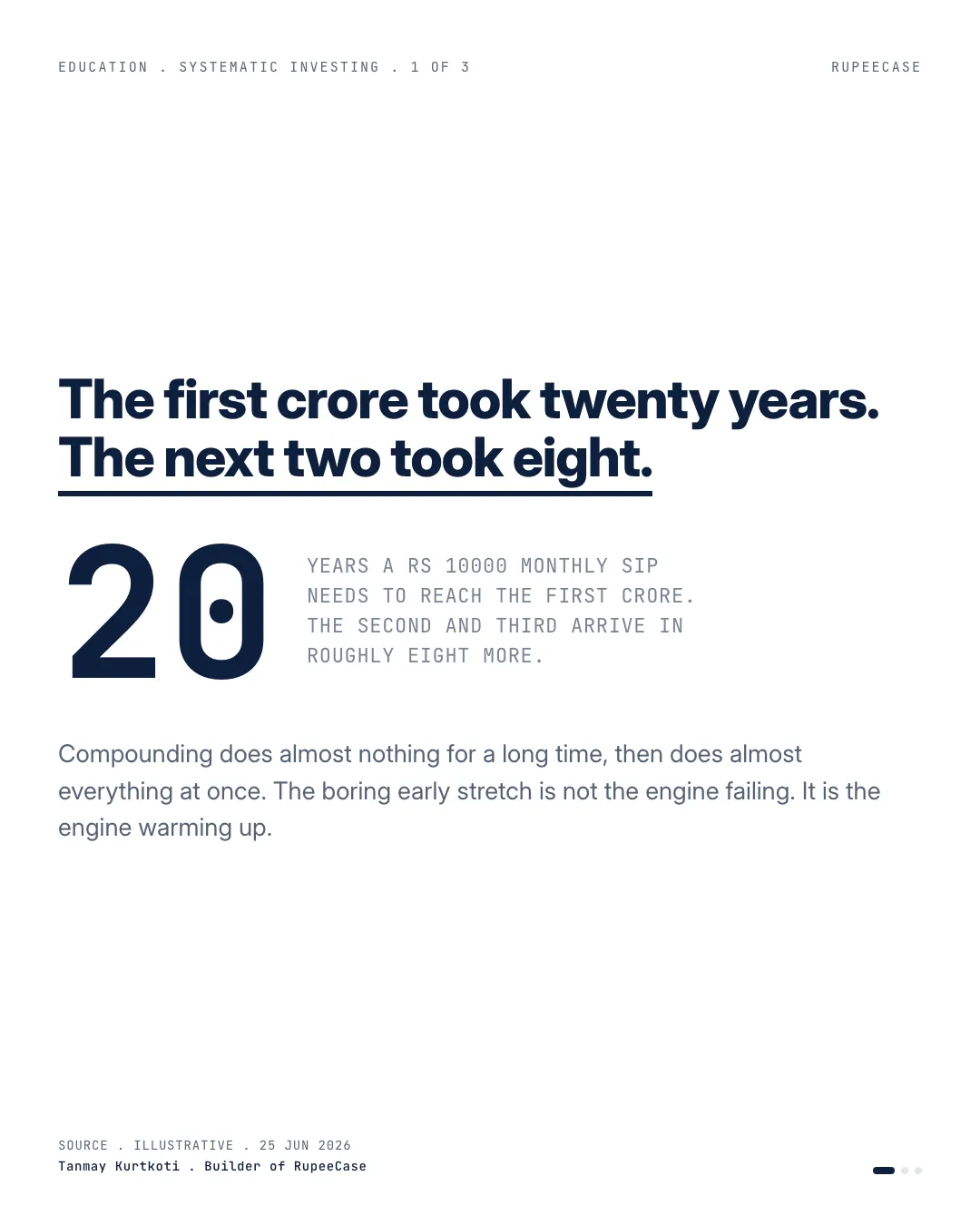
A flat Rs 10,000 SIP at 12 percent takes about 20 years to the first crore, 5 more to the second and 3 to the third, with 72 percent of the final pot arriving in the last decade.
By Tanmay Kurtkoti, founder of QC Alpha and builder of RupeeCase
A friend showed me his SIP statement last week. Eight years of steady investing, and he was deflated. "It barely feels like it moved. Maybe I picked the wrong thing."
He picked fine. He was just standing in the flat part of the curve, and nobody had told him the curve is a hockey stick, not a ramp.
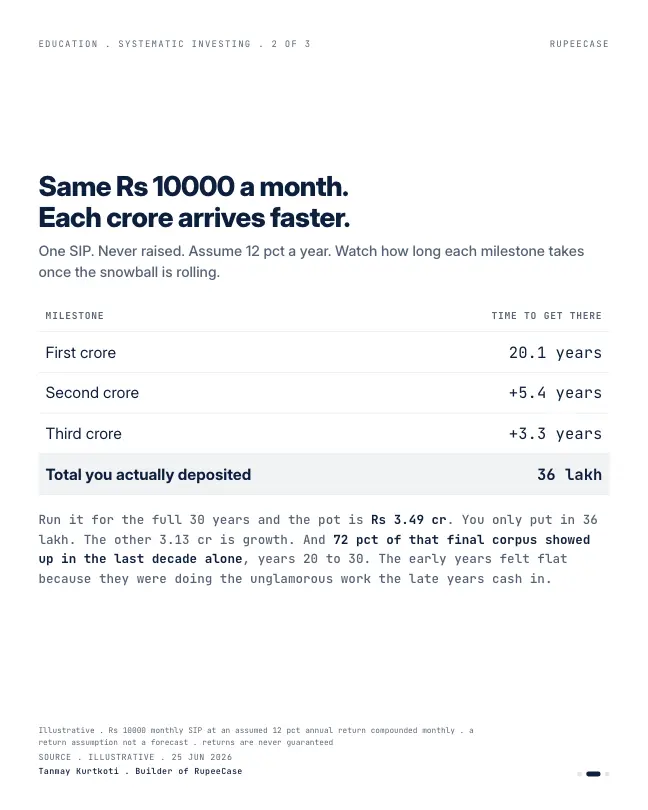
So I pulled the numbers on a plain Rs 10,000 monthly SIP. Never increased. Assume 12 pct a year. The first crore takes about 20 years. Feels glacial. But the second crore arrives in roughly 5 more years, and the third in about 3 after that. Same deposit every month. Each milestone lands faster than the one before, because by then the growth is doing more lifting than your contribution ever could.
Here is the line that lands for most people. Run that SIP for the full 30 years and it grows to around 3.49 cr. You only ever deposited 36 lakh of your own money. The other 3.13 cr is compounding. And roughly 72 pct of that final pot shows up in the last decade alone.
That is why the early years feel like nothing. The reward is back-loaded by design. The boring stretch is not the engine failing, it is the engine warming up.
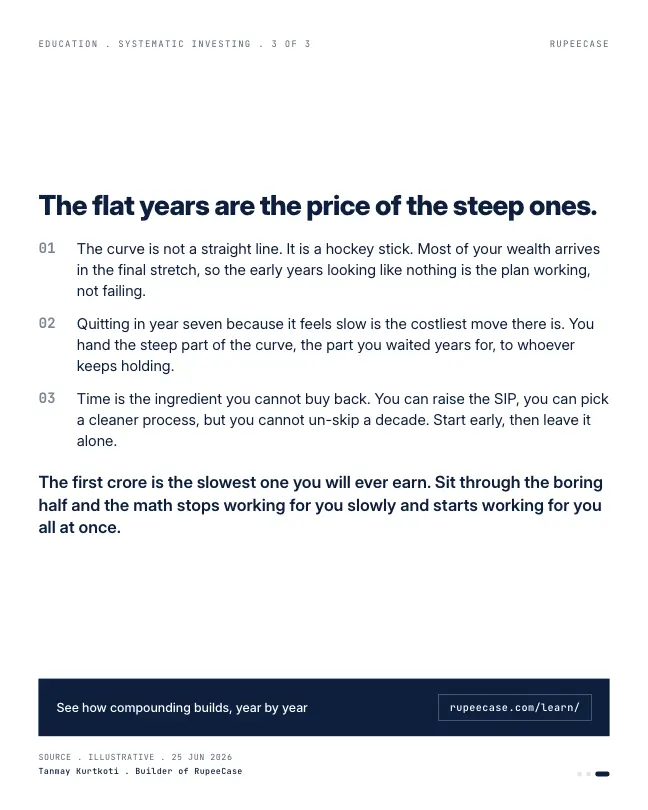
Which makes the most common mistake also the most expensive one. People quit around year seven because the screen looks flat. They put in the hard, unglamorous decade and then walk away right before the part they were waiting for. The steep bit goes to whoever stays in the chair.
You can raise your SIP. You can pick a cleaner process. The one thing you cannot do is un-skip a decade. Start early, then get out of the way.
The first crore is the slowest one you will ever earn. Sit through it:
The hockey stick, five years at a time
I checked the opening's figures with 1 percent a month and each Rs 10,000 paid at the end of the month. They hold: Rs 98.9 lakh at 20 years, the first crore a month later, the second crore at about 25.5 years, the third at about 28.8, and Rs 3.49 crore at 30. Here is the pot every five years, next to the money actually put in.
- Year 5, Rs 6 L inRs 8.2 L
- Year 10, Rs 12 L inRs 23.0 L
- Year 15, Rs 18 L inRs 50.0 L
- Year 20, Rs 24 L inRs 98.9 L
- Year 25, Rs 30 L inRs 187.9 L
- Year 30, Rs 36 L inRs 349.5 L
Worked example: Rs 10,000 a month, 12% a year as 1% a month, month end instalments. Before tax and costs.
At year 7, the stage where the opening says people quit, the pot is about Rs 13.1 lakh on Rs 8.4 lakh put in. Real money, but it looks small next to a monthly salary. The same SIP adds more than that every five months in its last few years.
Why each milestone comes faster
Compounding is growth on growth. The yearly gain is roughly the pot times the return. Early on the pot is small, so the contribution is most of each year's increase. Later the pot is large, and the return on it dwarfs the contribution. The doubling time at a fixed return stays the same, and the rule of 72 gives it: at 12 percent, money doubles in about six years.
A Rs 1 crore pot at 12 percent adds about a crore in the next six years without a single new rupee. A Rs 10 lakh pot adds Rs 10 lakh in the same six years. Same return, same time, a tenfold difference in rupees. That is the hockey stick.
The flat part can be truly flat
The friend's statement felt flat because of compounding's shape. Sometimes it is flat for a simpler reason: the market itself went nowhere. I ran a Rs 10,000 monthly SIP on the Nifty 50 using NSE's month end closes from Oct 2024 to Sep 2026, 24 instalments. Rs 2,40,000 went in. On 30 Sep 2026 the units were worth about Rs 2,23,900, price only, before dividends and costs. Two years of discipline, and the statement showed a loss.
put in over 24 months
Worked example
value on 30 Sep 2026, Nifty 50 price only
NSE month end closes, Oct 2024 to Sep 2026
on the money put in
NSE closes, worked example
That is normal for a two year window. The 12 percent in the worked example is an average over decades, and averages are made of stretches like this one. The units bought in a falling market are the ones that do the most work if the long run resembles the past. Quitting at a moment like this is quitting exactly where the opening says the expensive mistake happens.
MythIf my SIP has barely grown in seven years, the investment is not working.
FactIn the worked example, year 7 shows Rs 13.1 lakh on Rs 8.4 lakh in. Over 70 percent of the 30 year pot arrives in the last decade.
The free Learn module on loss aversion and prospect theory explains why a flat or red statement pulls so hard on the decision to stop. The rule of 72 tool shows doubling times at any return. Related: the cost of waiting and the step up SIP.
Questions readers ask
How long does a Rs 10,000 SIP take to reach Rs 1 crore?
At an illustrative 12 percent a year, about 20 years: the pot is Rs 98.9 lakh after 20 years and crosses Rs 1 crore a month later. The second crore takes about 5.4 more years and the third about 3.3 more.
Why does my SIP seem to grow so slowly?
In the early years most of the pot is your own contributions, so growth on it is small in rupees. At 12 percent, a 7 year old Rs 10,000 SIP is about Rs 13.1 lakh on Rs 8.4 lakh invested, while the same SIP adds more than that every five months near year 30.
What is the rule of 72?
It estimates how many years money takes to double: divide 72 by the yearly return in percent. At 12 percent that is about 6 years; the exact figure is 6.1.
The cards
3 cards. Swipe, or tap to open.
Explore next
Learn it properly, then see it applied.
Related
- The cost of waiting: start small, start nowA saver who invested Rs 10,000 a month from 25 to 35 and stopped ends with Rs 4.6 crore at 60, ahead of one who invested from 35 to 60, because time did the work.Personal finance and tax . . 5 min
- Rule of 72: count in doublingsRs 10 lakh for thirty years becomes about Rs 3 crore at 12 percent and Rs 1 crore at 8, because four points deletes close to two doublings.Returns and risk maths . . 4 min
- The lever you control beats the one you chaseTwo extra points of return over 25 years adds Rs 82 lakh to a Rs 10,000 SIP; stepping the same SIP up 10 percent a year adds Rs 2.35 crore.Personal finance and tax . . 4 min
Educational content only. Figures are illustrative and computed on historical or representative data for teaching purposes, not investment advice. Past performance does not guarantee future returns. Sourced from NSE, BSE, SEBI, AMFI and RBI public data.