

Portfolio construction..5 min read
Position sizing: what Kelly actually says
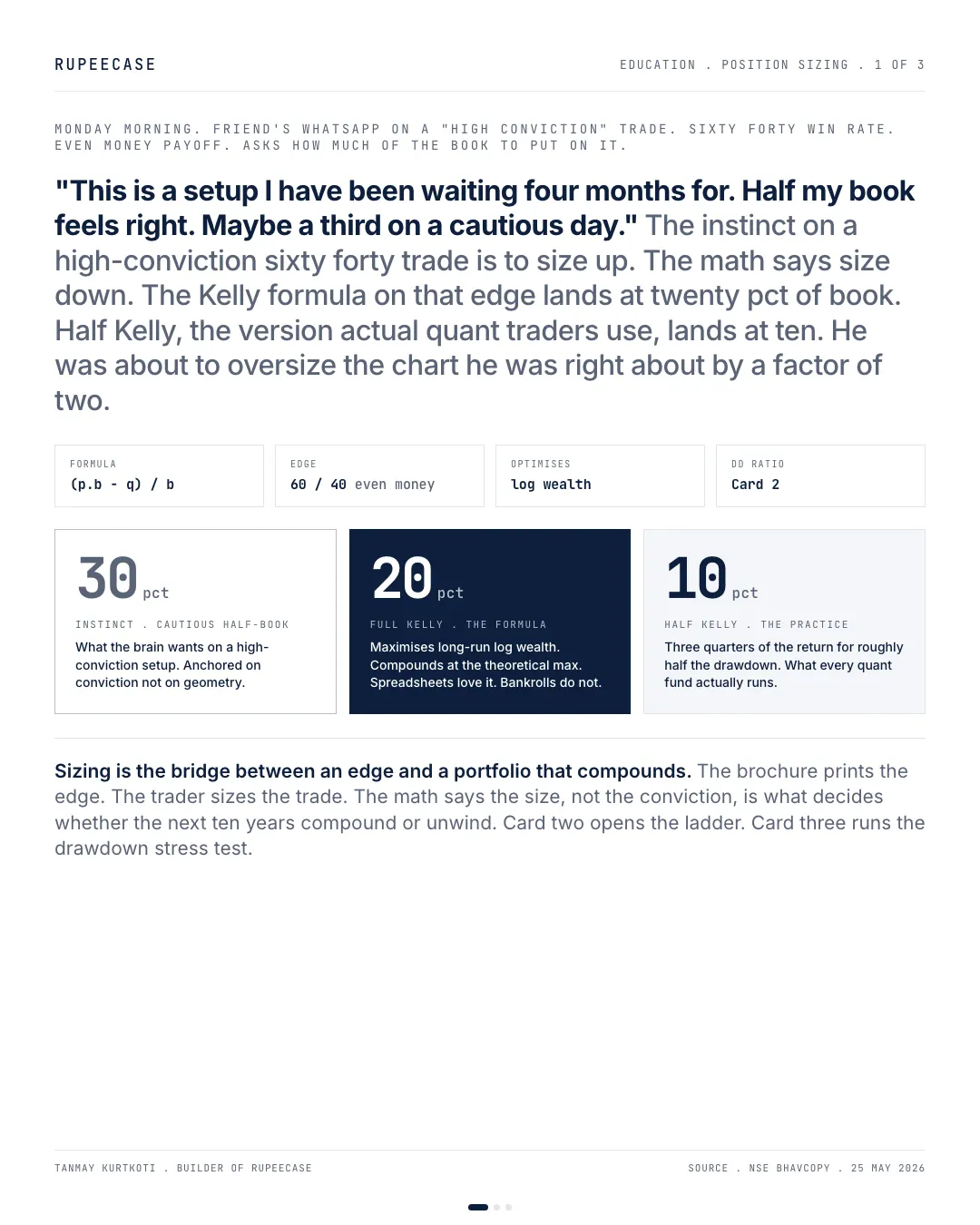
At a 60/40 win rate and even money, Kelly says 20 percent of the book and half Kelly says 10, because doubling the bet roughly quadruples the drawdown.
By Tanmay Kurtkoti, founder of QC Alpha and builder of RupeeCase
Monday morning. Friend forwards a message on a "high conviction" trade. Sixty forty win rate, even money payoff, the kind of setup he had been waiting four months for. He wanted to size it. His instinct said half his book. Maybe a third on a more cautious day. He asked the one question worth asking. How much.
Kelly says twenty pct. Half Kelly says ten. The math says he was about to over-size the trade by a factor of two on the chart he was right about.
The Kelly formula on a discrete payoff is fraction equals win probability times payoff minus loss probability, divided by payoff. At sixty forty even money that reads zero point six times one minus zero point four over one, which lands at zero point two. Twenty pct of the book on the highest conviction trade of the quarter. The number reads small because Kelly is not optimising for the bet. It is optimising for the long-run geometric growth of the bankroll across thousands of bets like this one. Optimising for log wealth.
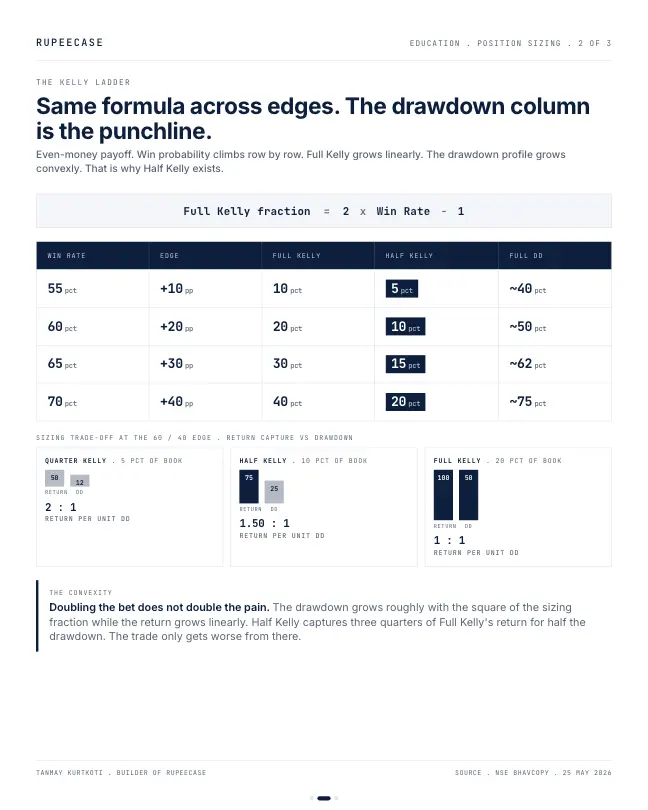
The reveal is in the next column. Full Kelly compounds at the theoretical maximum, but the expected long-run drawdown on the way to that maximum is roughly half the bankroll. Half Kelly captures about three quarters of the geometric return for roughly half the drawdown. Quarter Kelly takes about half the return for one quarter of the drawdown. The relationship between size and drawdown is convex. Doubling the bet does not double the pain. It roughly quadruples it.
That is why every quant fund that knows the formula does not use the formula. They use Half Kelly. Or quarter. The drawdown profile of Full Kelly survives in a spreadsheet. It does not survive in a fund that has investor mark-to-market windows.
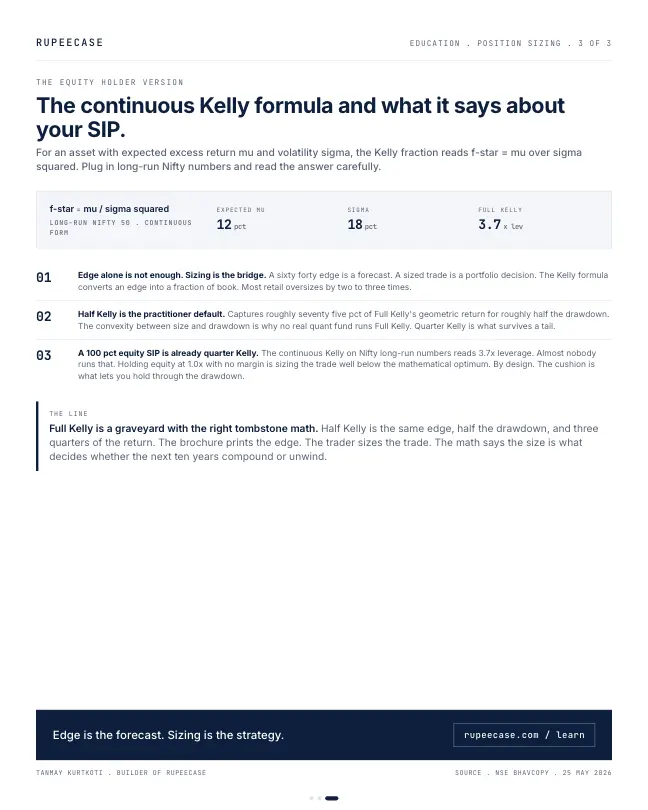
For equity holders the continuous version reads f-star equals mu over sigma squared. Plug in long-run Nifty 50 numbers, mu around twelve pct, sigma around eighteen pct, and the formula hands you three point seven times leverage. Almost nobody actually runs three point seven times. A 100 pct equity SIP, no margin, no leverage, is already running at roughly quarter Kelly on that math.
That is by design, not accident.
The size is the strategy
Size the bet yourself
The calculator takes the friend's trade and shows three things: the full Kelly fraction, what a fraction of it puts on the table in rupees, and how much of the maximum growth rate that fraction keeps.
Set the fraction of Kelly to 1 and the growth share is 100 percent. Set it to 2, the friend's instinct of "a third or half the book" is in that region, and the growth share drops to zero. Betting twice the Kelly amount, over many bets, grows the bankroll no faster than not betting at all, while it swings far harder.
Over betting is worse than under betting
That last point is the one I wish every trader saw early. The curve of growth against bet size is a hill. It is gentle on the left and steep on the right.
- Quarter Kelly43.75%
- Half Kelly75%
- Full Kelly100%
- 1.5 times Kelly75%
- Twice Kelly0%
Share of the maximum long run growth rate, approximation 2k minus k squared for a fraction k of the Kelly bet. Illustration.
Half Kelly and 1.5 times Kelly keep the same growth. The difference is the ride. The smaller bet gets there with a fraction of the swings, and it is also forgiving when your estimate of the edge is wrong. The 60 percent win rate is a guess. If the true rate is 55 percent, full Kelly drops to 10 percent, and a 20 percent bet becomes twice Kelly without anyone noticing.
The continuous version, on Indian inputs
The opening's equity example uses round numbers. Two of the inputs can be checked against public data today. The Nifty 50 had a five year standard deviation of 13.82 percent in the NSE factsheet of 30 Sep 2026. The 91 day treasury bill cut off at an implied yield of 5.5747 percent in the RBI auction of 7 Oct 2026. The return is the one input nobody can look up.
Nifty 50, five year standard deviation
NSE Indices factsheet, 30 Sep 2026
91 day T-bill implied yield
RBI auction result, 7 Oct 2026
The continuous Kelly fraction uses the excess return over the risk free rate: (mu minus r) divided by sigma squared. With an assumed 12 percent return, the excess is about 6.4 points, and 0.064 divided by 0.1382 squared is about 3.4. Kelly would again call for more than three times leverage. Cut the assumed return to 9 percent and it falls to about 1.8. A three point change in a number nobody knows moves the answer by half. That fragility, not the formula, is the reason sensible investors size well below it.
A sizing rule that survives being wrong
- Estimate the edge, then shrink itAssume your win rate or return estimate is too high. It usually is.
- Compute Kelly on the shrunk edgeFor the friend's trade at a 55% win rate, full Kelly is 10%.
- Take half or a quarterHalf of 10% is 5% of capital, Rs 50,000 on Rs 10 lakh.
- Cap any single nameA hard ceiling per position, set before the trade, overrides conviction.
The free Learn module on position sizing covers Kelly, fixed fraction and volatility based sizing with quizzes and a certificate. The position size calculator turns a risk budget and a stop into a share count. For how a cap per name protects a stock book, read the single stock skew.
Questions readers ask
What is the Kelly criterion in simple terms?
It is a formula for the share of capital to put on a bet with a known edge so that wealth grows fastest over many bets. For a 60 percent win rate at even money it gives 20 percent. Because real edges are uncertain, most practitioners use half or a quarter of it.
Why is half Kelly better than full Kelly?
Half Kelly keeps about 75 percent of the maximum growth rate with much smaller swings, and it stays safe if the edge was overestimated. Betting twice the Kelly amount grows wealth no faster than not betting at all.
How much of my portfolio should I put in one trade?
There is no single right number; it depends on your edge, your stop and how much loss you can absorb. A common method is to cap the loss on any one position at a small share of capital, such as 1 percent, and size the position from the stop distance.
The cards
3 cards. Swipe, or tap to open.
Explore next
Learn it properly, then see it applied.
- Free module 4.1Modern Portfolio Theory, What Actually Matters11 min read
- StrategyAllcap strategyNifty Total Market, 50 stocks, every 2 weeks
- Free module 4.2Position Sizing8 min read
- CalculatorPosition size calculatorFree, with the formula and a worked example
- Blog topicPortfolio construction notes33 notes
Related
- Size decides more than selectionHolding research constant and moving the top three weights from 5 to 20 percent each quadruples a 40 percent shock's damage from 6 to 24 percent of the book.Portfolio construction . . 12 min
- The conservative starter is a drawdown number, not a nameMost investors tick the box for a 40 percent drawdown and panic at 15 to 20, which is why the first SIP should be sized to the worst window you would keep adding into.Portfolio construction . . 5 min
- Rebalance cadence: the latency nobody readsThe same thirty names rebalanced quarterly and fortnightly landed at 30.2 and 33.8 percent CAGR over five years, because drift is a silent overweight.Portfolio construction . . 6 min
Educational content only. Figures are illustrative and computed on historical or representative data for teaching purposes, not investment advice. Past performance does not guarantee future returns. Sourced from NSE, BSE, SEBI, AMFI and RBI public data.