

Portfolio construction..5 min read
The repo number is not the number that moves your money
A 25 basis point cut lifts a liquid fund 0.03 percent and a long gilt 2.25 percent, and the yield curve usually priced the move weeks before the MPC met.
By Tanmay Kurtkoti, founder of QC Alpha and builder of RupeeCase
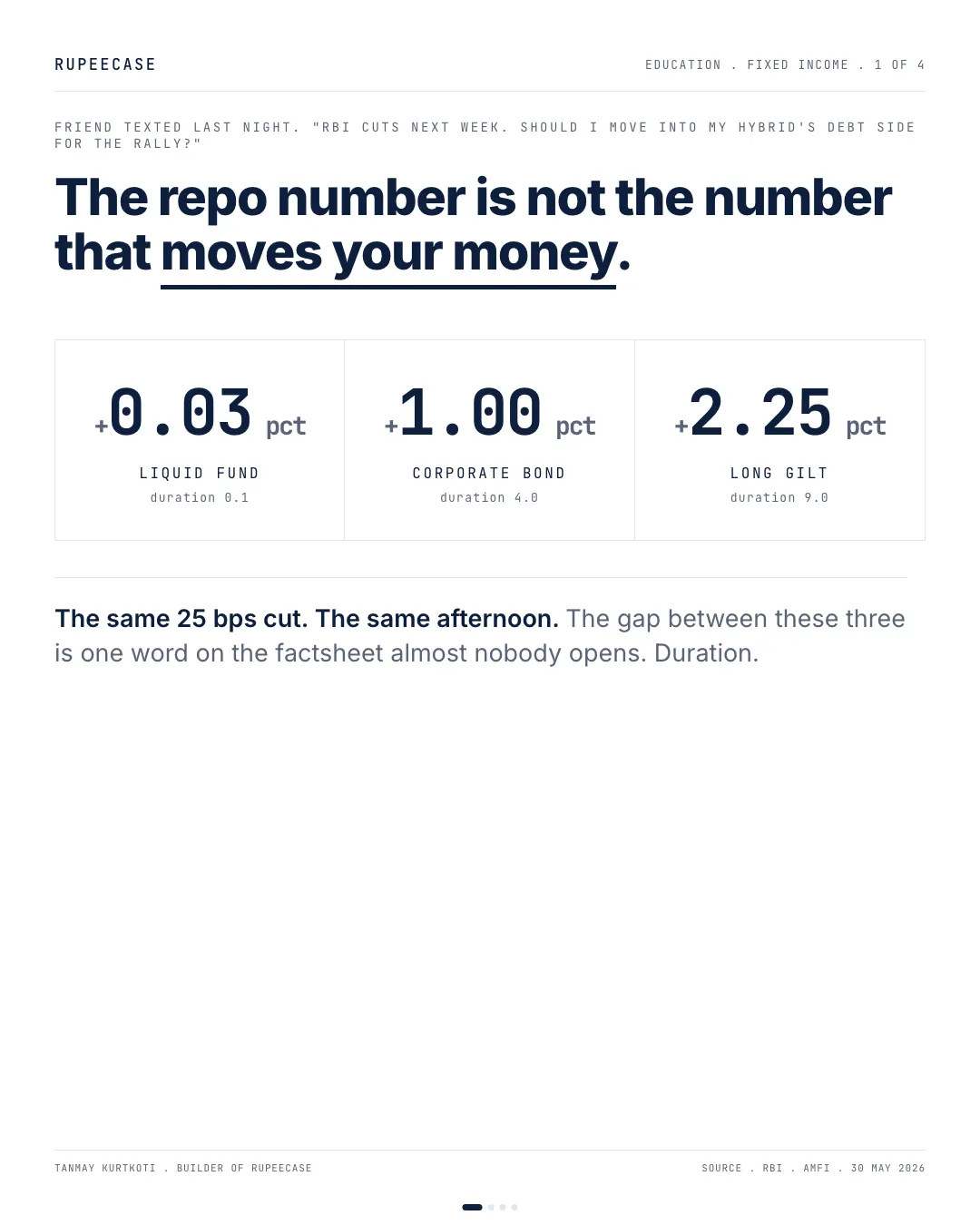
A friend texted me last night. RBI meets the first week of June, the whole timeline says a cut is coming, and he wanted to know whether to move money into the debt side of his hybrid fund to catch the rally.
Reasonable question. Wrong starting point.
The first thing worth saying out loud: a repo cut does not reach your money directly. It reaches it through the bonds your fund holds, and how much it moves them depends almost entirely on one number on the factsheet that almost nobody opens. Duration.
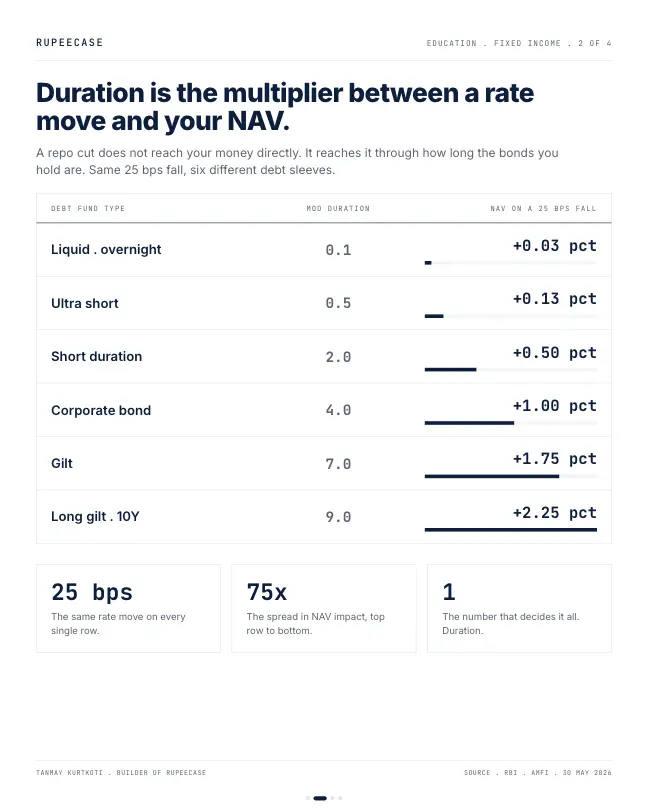
Take the same 25 basis point cut and run it across the shelf. A liquid fund, duration near zero, gains about 0.03 pct. A corporate bond fund at duration 4 gains about 1 pct. A long gilt at duration 9 gains about 2.25 pct. Same rate move. Roughly 75 times the spread between the top and the bottom. The repo number was identical for all three. Duration did the rest.
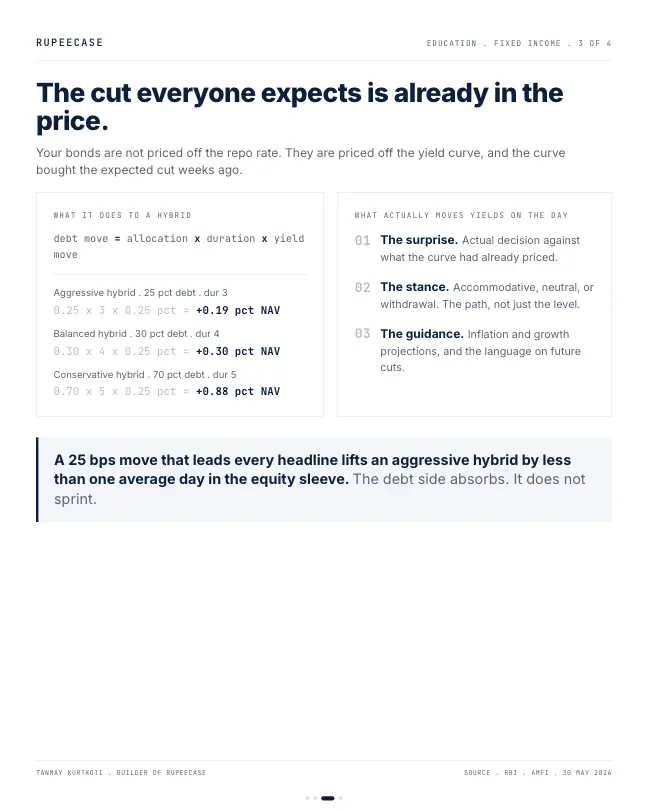
Then the part most people miss. Your bonds are not priced off the repo rate, they are priced off the yield curve, and the curve already bought the expected cut weeks ago. If the MPC delivers exactly what everyone expects, prices barely move. Decision day only pays you for three things. The surprise versus what was priced, the stance, and the guidance on what comes next.
And inside a hybrid, the debt sleeve is the shock absorber, not the engine. A 25 pct debt sleeve at duration 3 lifts the whole NAV by about 0.19 pct on that move. Less than one average day in the equity side. If you moved in for the rate rally, you bought the wrong sleeve for the job.
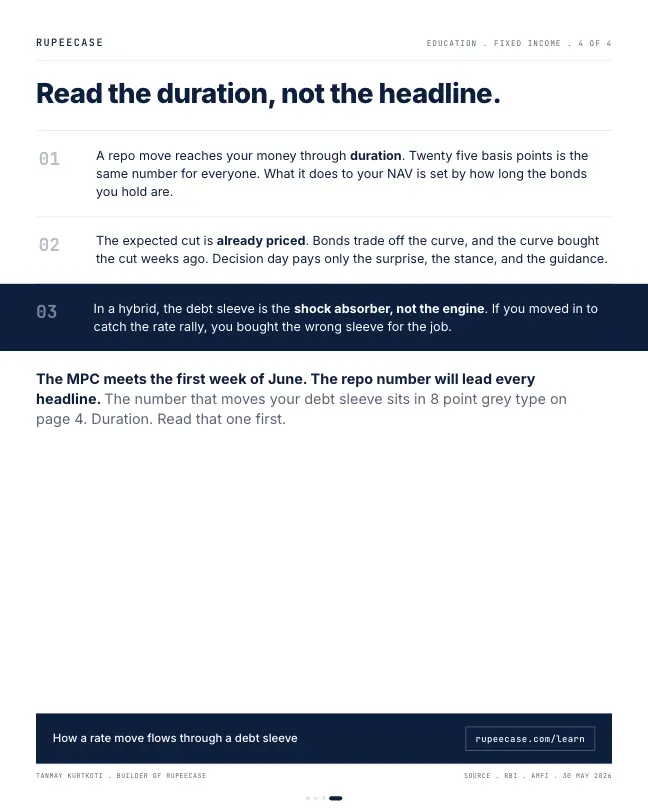
So the honest version. The repo number will lead every headline next week. The number that actually moves your debt sleeve sits in 8 point grey type on page 4. Read that one first.
How a rate move flows through a debt sleeve:
- The MPC sets the repo rateThe rate at which the RBI lends overnight to banks. It anchors the shortest end of the curve.
- The yield curve repricesT-bill and bond yields move on what the market expects, often weeks before the meeting.
- Bond prices move against yieldsPrice change is roughly minus duration times the change in yield.
- The fund NAV follows its bondsA liquid fund barely moves; a long gilt fund moves the most.
- The hybrid NAV follows its sleevesThe debt move is scaled down by the debt weight, then swamped by equity.
The rule of thumb, in one line
A bond's price changes by about minus its duration times the change in yield. Duration 9 and a 0.25 point fall in yield: 9 x 0.25 = 2.25 percent up. Duration 4: 1 percent. A liquid fund at a duration of about 0.1 years: 0.025 percent, which rounds to the 0.03 in the opening.
The rule works in both directions, and that matters now. The cut the friend was waiting for in May was not the last word on rates. On 7 Oct 2026 the RBI raised the policy repo rate by 25 basis points to 5.50 percent. The same arithmetic now runs the other way.
- Liquid fund, duration 0.1-0.03%
- Bond fund, duration 4-1.00%
- Long gilt, duration 9-2.25%
Price change = minus duration x change in yield, for a 0.25 point rise in yield. Rule of thumb; real moves depend on how much of the change was already priced.
Two caveats sit inside that chart. The yield your fund's bonds reprice to is not the repo rate, and a move that was fully expected may already be in the price before the announcement.
The curve is not the repo rate
You can see the gap in a single week of RBI data. On the day of the hike the repo rate was 5.50 percent. In the RBI treasury bill auction the same day, the 91 day bill cut off at an implied yield of 5.5747 percent and the 364 day bill at 6.2869 percent.
Policy repo rate after the hike
RBI, MPC resolution, 7 Oct 2026
91 day T-bill implied yield
RBI auction result, 7 Oct 2026
364 day T-bill implied yield
RBI auction result, 7 Oct 2026
The one year bill already sat about 0.79 points above the repo rate. Longer bonds price the whole expected path of rates, inflation and government borrowing, not one meeting. That is why a bond fund can fall in a quarter with no rate change at all. The Nifty Composite G-sec Index closed at 3,052.91 on 31 Dec 2025 and 3,009.05 on 30 Mar 2026, a fall of 1.4 percent, by NSE closing data.
What the move does to a hybrid
Put your own fund into the arithmetic. The default is the opening's hybrid: a 25 percent debt sleeve at duration 3.
On Rs 10 lakh, the whole rate rally the friend wanted to catch is worth about Rs 1,875. Flip the sign for the October hike and the cost is the same size. Either way the equity sleeve moves more than that on an ordinary day.
The free Learn module on RBI and monetary policy explains the MPC, the policy corridor, and how a decision travels through the curve, with a quiz at the end. For the case that the split matters more than the pick, read the split decides more than the pick.
Questions readers ask
How does a repo rate cut affect debt mutual funds?
A cut usually lowers bond yields, which raises bond prices. The size of the gain depends on the fund's duration: about 2.25 percent for duration 9 and about 0.03 percent for a liquid fund, for a 0.25 point fall in yield. If the cut was fully expected, much of the move may have happened before the announcement.
What is modified duration in a debt fund?
It is the approximate percentage change in a bond fund's price for a 1 point change in yields. A fund with a modified duration of 4 falls about 4 percent if yields rise by 1 point, and rises about 4 percent if they fall by 1 point.
Did the RBI raise the repo rate in October 2026?
Yes. At its 7 Oct 2026 meeting the RBI's Monetary Policy Committee raised the policy repo rate by 25 basis points to 5.50 percent.
The cards
4 cards. Swipe, or tap to open.
Related
- The split decides more than the pickBrinson's finding is about variability, not return, and holding the same index at 100/0/0 versus 40/40/20 trades two points of return for 34 points of drawdown.Portfolio construction . . 5 min
- Position sizing: what Kelly actually saysAt a 60/40 win rate and even money, Kelly says 20 percent of the book and half Kelly says 10, because doubling the bet roughly quadruples the drawdown.Portfolio construction . . 5 min
- The conservative starter is a drawdown number, not a nameMost investors tick the box for a 40 percent drawdown and panic at 15 to 20, which is why the first SIP should be sized to the worst window you would keep adding into.Portfolio construction . . 5 min
Educational content only. Figures are illustrative and computed on historical or representative data for teaching purposes, not investment advice. Past performance does not guarantee future returns. Sourced from NSE, BSE, SEBI, AMFI and RBI public data.