

Portfolio construction..6 min read
Rebalancing harvests volatility
An equal weight five fund SIP drifted to 38/17/16/15/14 in two years, and a two asset napkin shows how rebalancing at the swing turns a flat round trip into a 10 percent gain.
By Tanmay Kurtkoti, founder of QC Alpha and builder of RupeeCase
Friend pulled his CAS out over coffee on Saturday. He had been upset about his five-fund SIP underperforming the index by a margin he could not explain. Buy and hold, he said. Equal weight, five funds, started in 2021. Should have been the boring sensible thing.
I made him add the columns up.
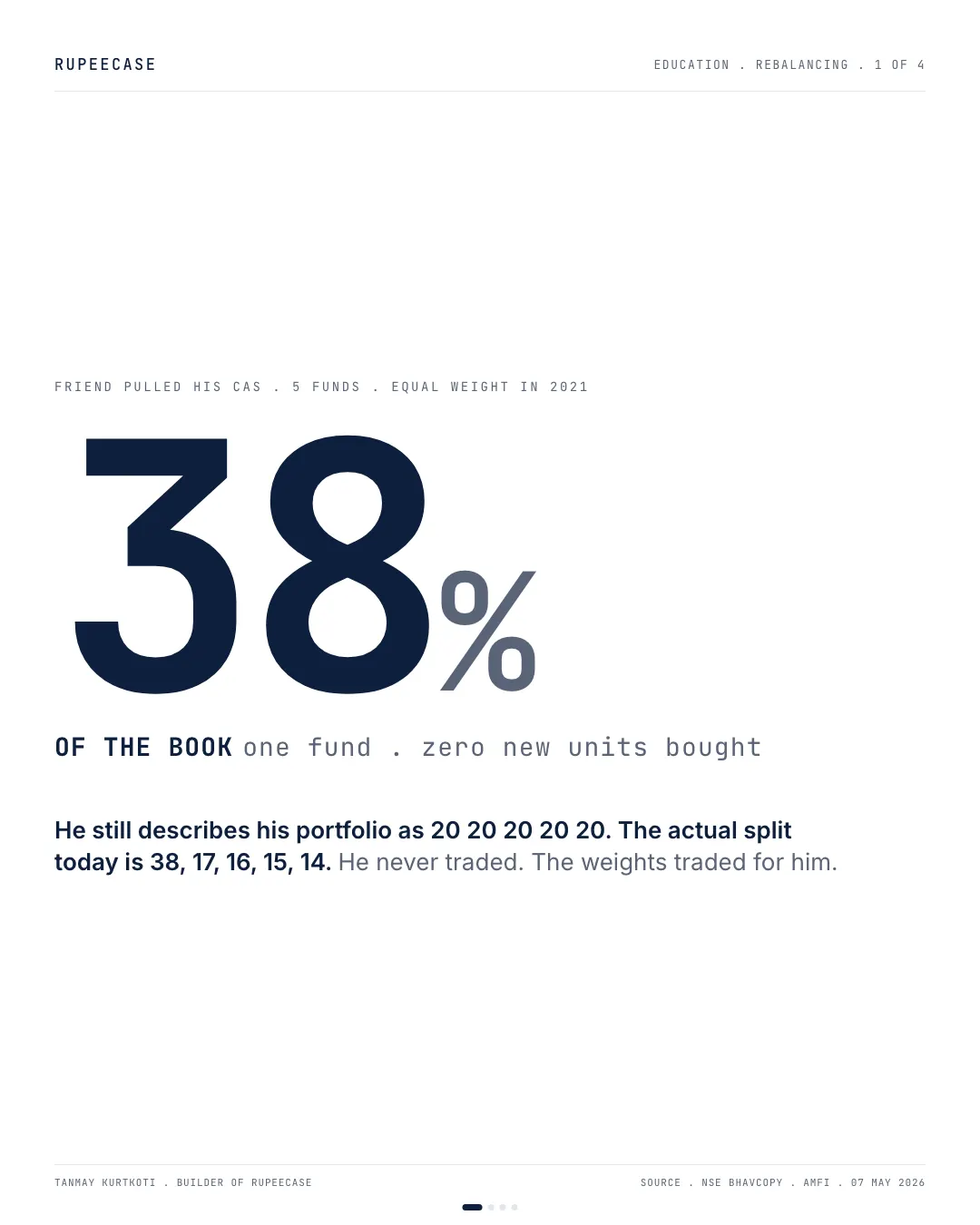
The actual split today is 38, 17, 16, 15, 14. One fund had quietly become more than a third of the book on its own. Two years without a trade. The weights traded for him.
This is the part of buy and hold nobody puts in the brochure. You can pick a perfect equal-weight portfolio on day one and the market will resize it on you while you are not looking. The diversification is on the start statement. Not the current one.
So I drew him the napkin version.
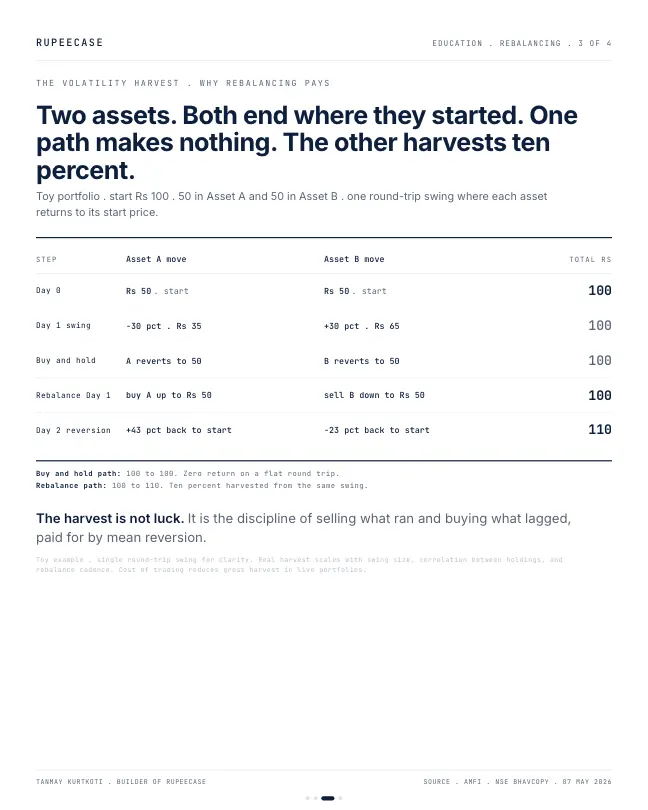
Two assets, fifty fifty, total one hundred rupees. Asset A drops thirty percent, Asset B rises thirty percent. Total still one hundred. Both assets then revert to where they started. Buy and hold path ends at one hundred. Flat round trip, zero return.
Now run the same swing with a rebalance at the high. Sell fifteen rupees of B at the peak, buy fifteen rupees of A at the trough. When both prices revert, the portfolio ends at one hundred and ten. Same start prices. Same end prices. Ten percent harvested by the act of rebalancing.
The textbook name for this is a volatility harvest. The bigger the swings between holdings and the more they mean-revert, the bigger the harvest. The math is not opinion. It falls out of the geometry of compounding.
Cadence decides how much of it you actually capture. Short cadence catches mean reversion before drift sets. Long cadence lets it ferment. Annual is buy and hope. Trade off is small turnover cost in exchange for the harvest plus a portfolio that still looks like the rule sheet you bought.
Three rules I left him with over the second coffee.
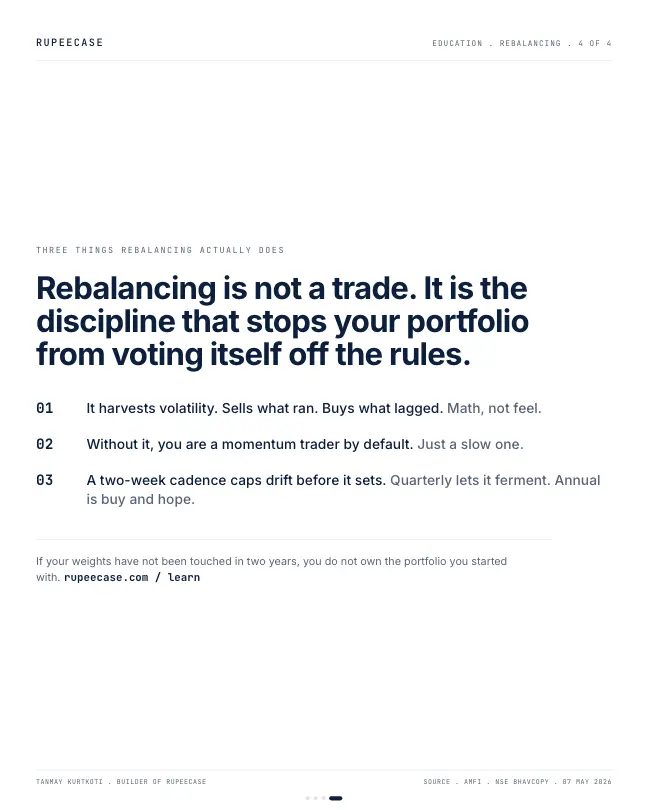
One. Rebalancing is not churn. It is the discipline that keeps the portfolio you bought from being eaten by the portfolio you accidentally became.
Two. Without it you are a momentum trader by default. Just a slow one.
Three. If your weights have not been touched in two years, you do not own the portfolio you started with.
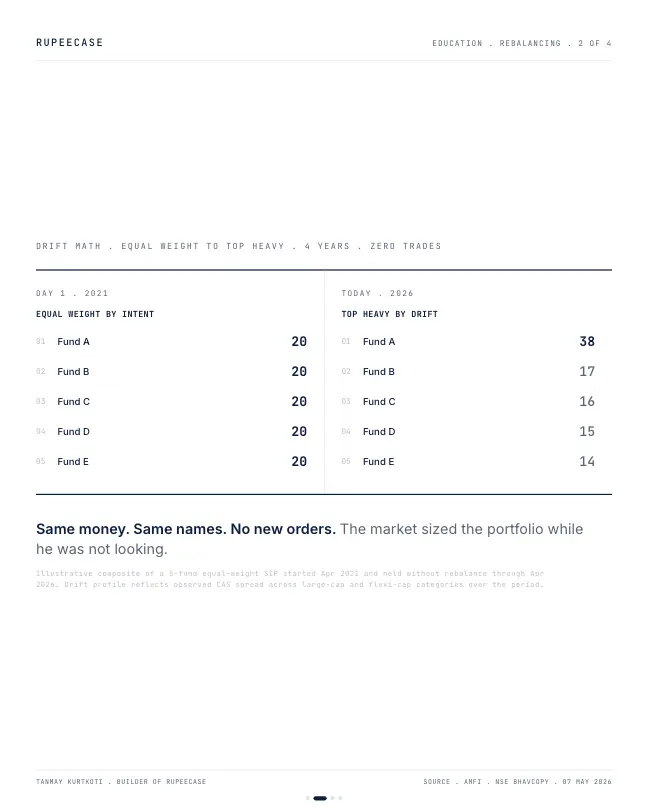
What the drift looks like on one page
Five funds at 20 percent each is the plan. The statement two years later is the portfolio. One fund at 38 percent means almost twice the planned exposure to whatever that fund holds, and the other four have each shrunk below their target.
- Fund 138%
- Fund 217%
- Fund 316%
- Fund 415%
- Fund 514%
- Target for each20%
Weights from the worked example in the opening, two years after an equal weight start.
The napkin, with your own swing
The ten rupees in the opening come from one formula. Start 50/50. Asset A falls by some percentage, asset B rises by the same. You rebalance back to 50/50 at that point. Then both return to their starting prices. The untouched portfolio ends at 100. The rebalanced one ends at 50 divided by (1 minus the swing) plus 50 divided by (1 plus the swing).
Try 10 percent and the harvest is about 1 percent. Try 50 and it is about 33. The harvest grows with the square of the swing, which is why it is real for volatile assets that take turns and close to nothing for calm ones.
The same test on real Indian data
The napkin is a best case. So I ran the plain version on actual NSE closes. Put Rs 10,00,000 into a 50/50 mix on 14 Oct 2024: Rs 5,00,000 tracking the Nifty 50 and Rs 5,00,000 tracking the Nifty Composite G-sec Index. One copy is left alone. The other is put back to 50/50 at every quarter end. Both are measured on 30 Sep 2026.
Left alone, ending at 45 percent equity
NSE closes, 14 Oct 2024 to 30 Sep 2026
Rebalanced every quarter, held at 50 percent
NSE closes, 14 Oct 2024 to 30 Sep 2026
A gap of Rs 343 on Rs 10 lakh. No harvest worth the name. The Nifty 50 fell about 10 percent over the window and the G-sec index rose about 9.6 percent, so the move was mostly one way, not a swing that reversed. Government bonds also move far less than stocks, so the swings between the two were small.
What rebalancing did deliver here was the other job. The untouched copy ended with 45 percent in equity, not 50. The rebalanced one carried the risk that was chosen, every quarter. That is the honest summary: the harvest is a bonus that shows up when holdings swing hard and take turns. Holding the risk you picked is the part you get every time.
When the harvest is worth chasing
It needs three things together: holdings that swing a lot, swings that partly reverse, and costs low enough not to eat the gain. Equity funds in the same category fail the second test, because they rise and fall together. A stock basket rebalanced to equal weight passes more often, because individual stocks take turns leading. That is one reason equal weight books are rebalanced on a short, fixed cadence.
MythRebalancing always earns a harvest.
FactIt needs swings that reverse. On a Nifty 50 and G-sec mix from Oct 2024 to Sep 2026 the quarterly rebalance ended Rs 343 behind on Rs 10 lakh.
MythLeaving a portfolio alone is the neutral choice.
FactLeaving it alone lets the market pick the weights. The untouched 50/50 ended at 45/55 without a single decision.
Costs are the brake. Every rebalance that sells equity can create short term gains, taxed at 20 percent for listed equity sold within 12 months, for transfers from 23 Jul 2024. The cheapest rebalance is usually new money pointed at the sleeve that is under target. The rebalance cost calculator prices a trade before you make it, and allocation drift shows the same drift on a 60/40.
The free Learn module on rebalancing strategies compares calendar, band and signal rules on a rupee portfolio, with the tax side of each trade.
Questions readers ask
Does rebalancing increase returns?
Sometimes. It adds return when holdings swing a lot and the swings reverse, as in the toy example where a 30 percent swing pays about 9.9 percent. On a Nifty 50 and G-sec mix from Oct 2024 to Sep 2026, quarterly rebalancing ended within Rs 343 of leaving it alone on Rs 10 lakh. Its reliable job is keeping the risk level you chose.
How often should I rebalance my mutual fund portfolio?
Common rules are a fixed date, such as once a year, or a band, such as acting when any holding drifts more than 5 points from target. Shorter cadences catch more swings but trade more and can create short term tax.
What is a volatility harvest?
It is the extra return from repeatedly selling the holding that has risen and buying the one that has fallen, when their prices later move back. It comes from compounding geometry and depends on large swings that reverse.
The cards
4 cards. Swipe, or tap to open.
Explore next
Learn it properly, then see it applied.
- Free module 4.1Modern Portfolio Theory, What Actually Matters11 min read
- StrategyAllcap strategyNifty Total Market, 50 stocks, every 2 weeks
- Free module 4.3Rebalancing Strategies9 min read
- CalculatorRebalance cost at 0.2%Free, with the formula and a worked example
- Blog topicPortfolio construction notes33 notes
Related
- Rebalance cadence: the latency nobody readsThe same thirty names rebalanced quarterly and fortnightly landed at 30.2 and 33.8 percent CAGR over five years, because drift is a silent overweight.Portfolio construction . . 6 min
- Allocation drift: the risk you didn't chooseAn untouched 60/40 drifts to about 71/29 in ten years at 12 and 6.5 percent, and falls 27.8 instead of 23.2 percent when equity drops 40.Portfolio construction . . 6 min
- Rebalancing is not free. And it is not always money.Two 10 percent sleeves at 25 percent volatility earn a 1.88 point bonus at minus 0.20 correlation and 0.16 at plus 0.90, while a trending decade charges 1.39 points a year.Portfolio construction . . 11 min
Educational content only. Figures are illustrative and computed on historical or representative data for teaching purposes, not investment advice. Past performance does not guarantee future returns. Sourced from NSE, BSE, SEBI, AMFI and RBI public data.