

Here is a conversation I have had more times than I can count. Someone shows me a backtest at 28% a year. They go live. Twelve months later the account shows something far smaller, and the first question is "did the signal break?" Usually it did not. The gap sits in two places the backtest never saw: the costs printed on the contract note, and the costs that never get printed at all.
SEBI measured this for intraday traders in the equity cash segment. In FY23, traders who lost money spent an extra 57% of their trading losses on trading costs, and those who made money gave up 19% of their profits to costs. Costs are not a footnote. For an active strategy they are often the single largest line.
STT on equity delivery, on the buy and again on the sell
Unchanged by Finance Act 2026
STT on futures sales from 1 April 2026, up from 0.02%
Finance Act 2026
STT on option premium sold from 1 April 2026, up from 0.1%
Finance Act 2026
Extra spent on costs by loss making intraday traders, as a share of their losses
SEBI study, FY23
The complete Indian cost stack
Take the simplest trade there is. You buy ₹1,00,000 of a stock for delivery on NSE and sell it a few weeks later for the same ₹1,00,000. Here is every rupee that leaves, at rates in force in October 2026.
| Component | Rate | Zero brokerage account | ₹20 per order account |
|---|---|---|---|
| STT | 0.1% buy + 0.1% sell | ₹200.00 | ₹200.00 |
| NSE transaction charge | ₹3.07 per lakh, each side, IPFT included | ₹6.14 | ₹6.14 |
| SEBI turnover fee | ₹10 per crore, each side | ₹0.20 | ₹0.20 |
| Stamp duty | 0.015% on the buy only | ₹15.00 | ₹15.00 |
| Depository charge on the sell | Flat per stock per day, varies by broker | about ₹20 | about ₹20 |
| Brokerage | Depends on the account | ₹0 | ₹40 |
| GST | 18% on brokerage, exchange, SEBI and depository charges | ₹4.74 | ₹11.94 |
| Total round trip | about ₹246 (0.25%) | about ₹293 (0.29%) |
Rates: STT and stamp duty from the Finance Acts and the Indian Stamp Act as applied by exchanges; NSE transaction charge from its 1 March 2026 revision, ₹307 per crore (IPFT included); SEBI turnover fee ₹10 per crore. Depository charge is illustrative. Check your own contract note.
Read that table again. STT is 81% of the bill in the zero brokerage column. The brokerage war that brokers advertise moves the total by a few tens of rupees. The tax you cannot negotiate moves it by hundreds. A full service account charging 0.3% a side changes the picture completely: about ₹954 on the same trade, almost four times the discount number.
- STT₹200.00
- Depository charge₹20.00
- Stamp duty₹15.00
- Exchange and SEBI fees₹6.34
- GST₹4.74
₹1 lakh delivery buy and ₹1 lakh sell on NSE, zero brokerage account, October 2026 rates. Depository charge illustrative.
STT, the big one
Securities Transaction Tax is collected by the exchange on every trade. The rates that matter in 2026:
- Equity delivery: 0.1% on the buy and 0.1% on the sell. So 0.2% round trip, whatever your broker.
- Equity intraday: 0.025% on the sell only.
- Futures: 0.05% on the sell side from 1 April 2026, up from 0.02%.
- Options: 0.15% of the premium on the sell side from 1 April 2026, up from 0.1%; 0.15% of the intrinsic value when an option is exercised, up from 0.125%.
- Equity mutual fund units redeemed with the fund: 0.001%.
The Finance Act 2026 raised only the derivative rates. Delivery equity stayed where it was. That is a policy signal worth hearing: the state wants turnover in long term holdings, not in leveraged bets.
MythA zero brokerage account means trading is almost free.
FactOn a ₹1 lakh delivery round trip, statutory charges alone come to about ₹246. Brokerage is the smallest part of the bill for most investors.
Stamp duty, exchange and SEBI fees
Stamp duty is collected centrally since July 2020 and paid only by the buyer: 0.015% on delivery, 0.003% on intraday, 0.002% on futures and 0.003% on options. The NSE transaction charge on the cash market, including the IPFT contribution, is ₹3.07 per lakh of turnover on each side (as of March 2026). SEBI takes ₹10 per crore. These three together are small, about ₹21 on our ₹1 lakh round trip.
Brokerage, GST and the depository charge
Brokerage on delivery ranges from zero at many discount brokers to 0.3% to 0.5% a side at full service houses. GST at 18% sits on top of brokerage, exchange charges, the SEBI fee and the depository charge, not on STT or stamp duty. The depository charge is the one people forget. It is a flat amount for every stock you sell on a given day, so a rebalance that sells 15 small positions pays it 15 times.
Slippage: the hidden tax
Everything above is printed on your contract note. Slippage is not. It is the gap between the price your model assumed and the price you got, and it never appears as a line item. It shows up only as a lower return.
Why backtests show higher returns than live trading
A daily backtest fills at the close. Live, you cannot always trade at the close, and when you can, your own order moves it. Three kinds of slippage do the damage:
- Spread cost. A market order pays half the spread versus the mid price. On a liquid largecap that is a few hundredths of a percent. On a thin smallcap it can be 0.2% to 0.5%.
- Impact cost. Your size eats through the best levels of the book. This grows faster than your order size, which is why Module 10.6 is about capacity.
- Delay cost. The signal fires at the close, you trade the next morning, the stock has already gapped. Momentum strategies feel this most, because they buy what is already rising.
Quantifying slippage
Worked example. A ₹500 smallcap shows ₹499.80 bid and ₹500.20 ask, 4,000 shares at the ask, 5,000 at ₹500.40 and 6,000 at ₹500.60. You market buy 10,000 shares, ₹50 lakh. You take 4,000 at ₹500.20, 5,000 at ₹500.40 and 1,000 at ₹500.60. Average ₹500.34. The mid was ₹500.00. Slippage is 0.068%, or ₹3,400 on one order, before any fee.
Do that across 20 names on a rebalance day and twice a month, and an invisible 0.07% per trade turns into a visible percentage point a year.
The honest way to measure your own slippage is to log the model price and the fill price of every order and average the gap for a quarter. Most people who do this for the first time are surprised in both directions: liquid largecaps cost less than they feared, and the last five names in a smallcap list cost far more.
Impact cost: NSE's own transparency
NSE computes impact cost for index eligibility. A stock in the Nifty 50 must show impact cost of 0.50% or less on a ₹10 crore basket for 90% of observations over six months. That tells you something useful: for the largest 50 companies, even a ₹10 crore basket barely moves the price. Outside that set, the same order can cost ten times more. Rule of thumb, from my own desk years: below 2% of a stock's daily value, impact is a rounding error; from 5% upward it is a cost line you must model.
Backtest vs live: the complete waterfall
Here is an illustration, not a real track record, of how a 28% backtest can become a much smaller live number for a smallcap rotation that trades heavily. The numbers are round on purpose so you can redo them.
| Step | Annual drag | Running total |
|---|---|---|
| Backtest at closing prices, no costs | 28.0% | |
| STT: 0.2% round trip on 10 times the portfolio traded in a year | 2.0% | 26.0% |
| Stamp, exchange, depository charges, GST | 0.4% | 25.6% |
| Spread cost at 0.15% a trade | 1.5% | 24.1% |
| Impact cost in the thinnest names | 2.5% | 21.6% |
| Delay cost: trading the morning after the signal | 1.6% | 20.0% |
Illustration only. Not a RupeeCase figure and not a track record.
Notice what dominates. STT is fixed per rupee traded, so it scales with turnover. Spread, impact and delay scale with turnover and with illiquidity at the same time. That is why a smallcap rotation and a largecap index with the same backtest can end up years apart.
Annual drag in percentage points, illustration
- STT2.0
- Other statutory charges0.4
- Spread cost1.5
- Impact cost2.5
- Delay cost1.6
Illustration for a heavily traded smallcap rotation. Not a RupeeCase figure and not a track record.
Reducing transaction costs systematically
You cannot negotiate STT. You can design around it.
1. Rebalance frequency
Cost is turnover times cost per rupee traded. Halve the turnover and you halve STT. The question is never "is weekly better than monthly" in the abstract. It is "does the extra signal from trading more often beat the extra cost?" For a slow factor like quality, monthly or slower is usually enough. For momentum, a two to three week cycle is common because the signal decays fast.
2. Limit orders vs market orders
A limit order at or near the mid saves the spread on every fill that comes through, and costs you the trades that never fill. For liquid names, a marketable limit, priced a tick or two through the best price, gets most of both.
3. Time of day
Spreads are widest in the first 15 minutes after the open. For F&O stocks the Closing Auction Session, live since 3 August 2026, now offers a single price that matches the official close, which suits strategies that are backtested on closes. For other stocks, the last 30 minutes set the close as an average, so trading through that window keeps you near the close.
4. Netting trades
If one index you follow sells a stock and another buys it on the same day, netting the two saves both sides of STT and both spreads. Within one portfolio, trimming a 6% weight back to 5% only trades the 1%, not a full sell and rebuy.
5. Count every fee, including the platform fee
Whatever you pay a platform, a fund or an adviser belongs in the same table. A mutual fund's expense ratio is charged every day on all your money. A PMS adds fixed and profit share fees. A per trade fee is charged only when something trades. Compare them on the same ₹ amount over the same year, not on the headline percentage.
Common mistakes
- Comparing brokers on brokerage alone. STT is 80% of a discount broker round trip. Pick for reliability and API quality.
- Forgetting the depository charge. It is per stock per day, so it hurts a portfolio of many small positions most.
- Using the 2025 F&O STT rates in a hedge cost model. Futures STT is 0.05% and option premium STT 0.15% since 1 April 2026.
- Modelling one slippage number for every stock. Slippage in the 50th most liquid stock and the 450th differ by an order of magnitude.
- Ignoring tax as a cost. Short term gains at 20% are the largest cost of all for a high turnover strategy. Module 11.1 covers it.
How this shows up in RupeeCase
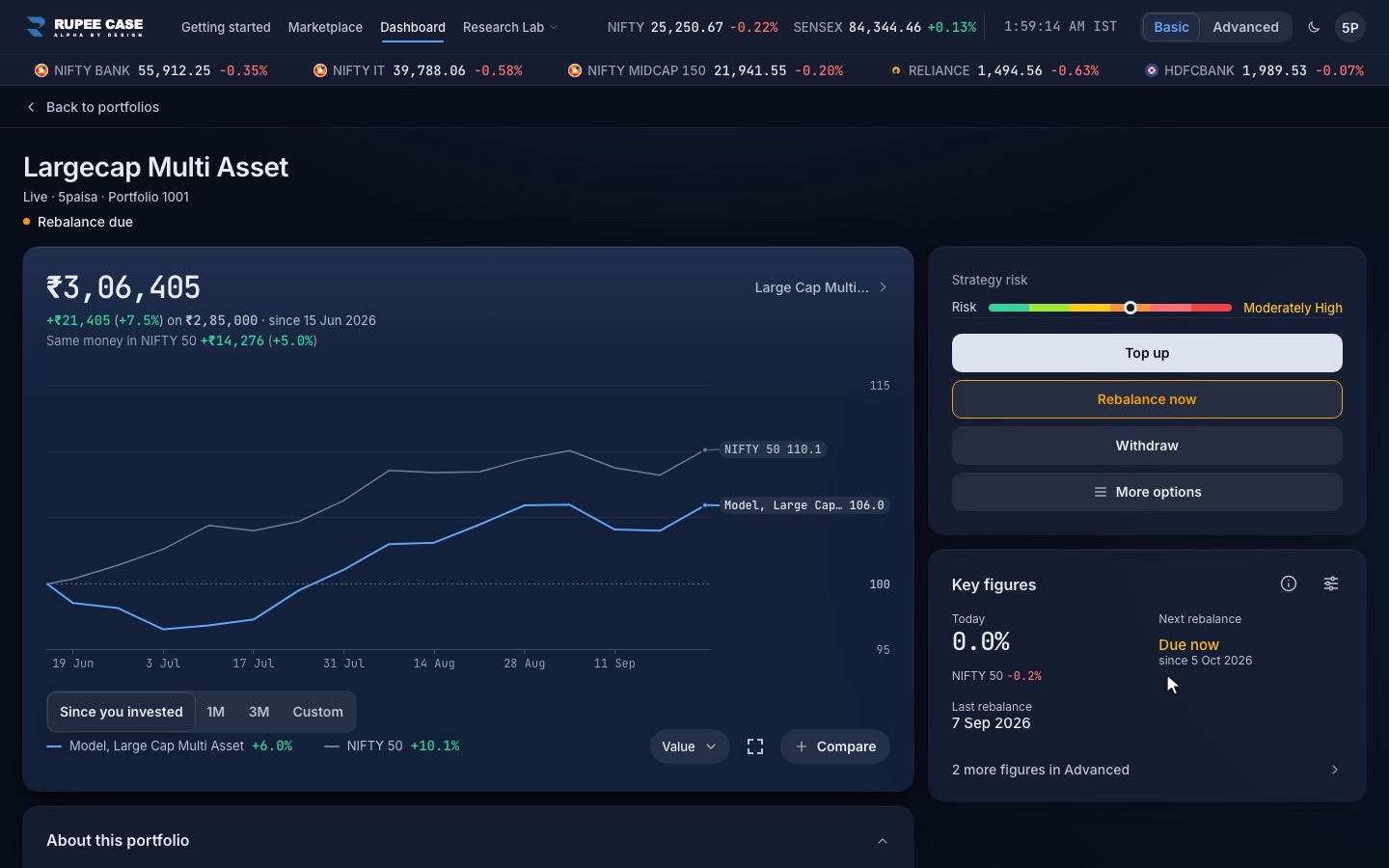
RupeeCase charges one fee per rebalance and nothing else: 0.2% of the value that trades, only when a rebalance actually trades. The pricing page works it through: ₹1,00,000 deployed, 30% trades on a rebalance, that is ₹30,000 times 0.2%, so ₹60. Thirteen rebalances in a year is ₹780, or 0.78% of the amount deployed. Brokerage, STT, stamp duty and the other statutory charges go through your own broker exactly as in the table above. Run your own numbers in the fee calculator or read the full breakdown on the pricing page.
Questions people ask me
Is STT charged on both buy and sell for delivery shares?
Yes. 0.1% on the buy value and 0.1% on the sell value, so 0.2% of the traded amount over a round trip. Intraday equity pays 0.025% on the sell only.
What changed in transaction costs in 2026?
From 1 April 2026 the Finance Act 2026 raised STT on futures to 0.05% of the sale value and on options to 0.15% of the premium sold, and 0.15% of intrinsic value on exercise. Equity delivery and intraday rates did not change.
Can I claim STT as a deduction?
Not against capital gains. If your trading is taxed as business income, as F&O trading is, STT is an allowable business expense. For delivery investors taxed under capital gains, STT is neither part of cost nor a deduction.
What to remember
- A ₹1 lakh delivery round trip costs about ₹246 to ₹293 at a discount broker, and STT is about ₹200 of it.
- F&O STT rose on 1 April 2026: futures 0.05%, options 0.15% of premium.
- Slippage never appears on a contract note. Log model price against fill price to see it.
- Cost equals turnover times cost per rupee. Turnover is the lever you control.
- Put every fee on the same rupee basis before you compare products.