

Every portfolio drifts. You set it up at 50% equity and 50% debt, the market moves, and a year later you own something you never chose. The past year shows it in the other direction from the textbook: the Nifty 50 fell 10.9% between 10 October 2025 and 9 October 2026. A 50:50 portfolio that started on that date, with debt earning an illustrative 7%, now sits at about 45:55. Nobody decided that. The market did.
Rebalancing is how a systematic portfolio stays the portfolio its rules describe. The hard part is not the rule. It is doing it on schedule, at a sensible cost, and then leaving it alone in between.
Why rebalancing matters as much as stock selection
A model says hold 5% each in 20 stocks. Six weeks later the winners are at 6.5%, the laggards at 3.8%, and one stock that broke down has fallen out of the model's top list entirely. Until you rebalance, you are not running the model. You are running last month's model with a momentum tilt you did not choose. In a factor strategy the rebalance is the moment the signal turns into a position. Skip it and the backtest stops describing your portfolio.
The other reason is risk. Drift concentrates you in whatever went up most. That feels great until the trend turns, and it is exactly what equal weight and capped weight rules exist to prevent.
Three ways to decide when
- Calendar. Rebalance on a fixed cycle: weekly, every two weeks, monthly, quarterly. Predictable, easy to audit, easy to backtest honestly.
- Threshold. Rebalance only when a weight drifts beyond a band, say 5% target outside 4% to 6%. Responds to actual drift, but timing and cost are unpredictable.
- Hybrid. Check on a calendar date, trade only the positions outside their band. Cheaper than full calendar rebalancing, more disciplined than pure threshold.
Calendar vs threshold vs hybrid: which works best?
It depends on what the signal is. For an allocation portfolio, like equity against debt, drift is slow and a quarterly or threshold rule is plenty. For a factor index, the composition itself changes: stocks enter and leave because their scores change. There the calendar is set by how fast the signal decays. Momentum decays in weeks, quality in quarters.
Here is what that looks like in the RupeeCase lineup. These are the model, back tested rebalance records published on each index page, with records running to dates between April and July 2026.
| Index | Cadence | Typical holdings | Median share of names new at each rebalance |
|---|---|---|---|
| Nifty 50 Equal Weight | 4 weeks | about 43 to 50 | 0%: weights reset, names rarely change |
| Focused Largecap 20 | 4 weeks | about 26 | 20% |
| Large Midcap | 2 weeks | about 48 | 16% |
| Allcap | 2 weeks | about 61 | 19% |
| Midcap Smallcap | 2 weeks | about 52 | 21% |
| Dynamic Asset Allocator | 3 weeks | about 61 | 24% |
| Energy Basket | 1 week | about 11 | 9% |
Model, back tested rebalance records from RupeeCase published data, first record 14 May 2021 for most indices. Not actual client trades. Tickers in the records are not recommendations.
Median share of names new at each rebalance
- Dynamic Asset Allocator, 3 wk24%
- Midcap Smallcap, 2 wk21%
- Focused Largecap 20, 4 wk20%
- Large Midcap, 2 wk16%
- Energy Basket, 1 wk9%
- Nifty 50 Equal Weight, 4 wk0%
Model, back tested rebalance records from RupeeCase published data, records to Apr to Jul 2026. Not actual client trades.
Two things jump out. A weekly sector basket changes fewer names per rebalance than a two week multicap index, because its universe is narrow. And an equal weight index of the Nifty 50 almost never changes names; its rebalance is mostly about resetting weights. Frequency alone tells you very little about cost. Frequency times the share that changes tells you a lot.
Four numbers to keep in view
- Drift: how far the actual weights are from target.
- Turnover per rebalance: the value traded as a share of the portfolio.
- Cost per rebalance: statutory charges, fees and slippage on that turnover.
- Tax per rebalance: capital gains realised by the sells.
The rebalancing cost budget
Every rebalance spends money in three ways.
- Transaction costs. From Module 10.2: about 0.25% to 0.29% on a delivery round trip at a discount broker, mostly STT, plus any platform or adviser fee.
- Slippage and impact. Small for the 100 largest stocks, material for the thinnest names in a smallcap list.
- Tax. Sell a winner held less than 12 months and you pay 20% short term capital gains tax on the gain. Held 12 months or more, 12.5% above the ₹1.25 lakh yearly exemption. For a high turnover strategy, tax is often the biggest of the three.
Worked example. A ₹10 lakh portfolio rebalances every two weeks. Each time it sells ₹1 lakh of stocks and buys ₹1 lakh of new ones, so ₹2 lakh trades. STT at 0.1% on each side is ₹200 per rebalance before other charges. Over 26 rebalances that is about ₹5,200, or 0.52% of the portfolio, in STT alone. If the stocks sold had ₹25,000 of short term gains on a rebalance, the tax on those is ₹5,000, about the same as a whole year of STT. Turnover and holding period drive the bill, not the broker.
Tax aware rebalancing
Three habits help without changing the model. Sell positions in loss first, because the realised loss offsets other gains. Look at holdings that are a few weeks from the 12 month mark before you sell them. And when a rule says trim a winner from 6% to 5%, trim only that 1%. Module 11.3 goes deeper on harvesting losses around a rebalance.
What to monitor between rebalances
This is where most people do too much. A systematic portfolio does not need daily attention. It needs a short list of exception checks.
- Daily: nothing. Seriously.
- Weekly: any single position above its cap, for example 10% in a 20 stock equal weight portfolio.
- Monthly: sector weights against your limits, and whether the portfolio still matches the intended style.
- Immediately: corporate actions that change share counts (splits, bonuses, mergers, buybacks), a stock moved to a trade for trade or surveillance segment, or a suspension.
Set three alerts and stop looking at prices: any position down 20% from its entry, a portfolio drawdown deeper than the back tested maximum, and any sector above 30% of the portfolio. The second one is the important one. If live drawdown goes beyond what the back test ever saw, something has changed and it is worth a proper look.
Execution mechanics on rebalance day
- Generate the trade list before the openFrom the model's targets and your actual holdings, read from the broker.
- Handle corporate actions firstA stock that went ex for a 1:1 bonus yesterday has double the shares at half the price; your weights are fine, your quantity file is not.
- Sells first, then buysMost brokers let you use today's sale proceeds for today's buys, so one session is enough.
- Price your ordersLimit orders a tick or two through the best price for liquid names, wider for thin ones. Avoid the first 15 minutes after the open, when spreads are widest.
- Unfilled orders waitDo not chase with market orders. Carry them to the next session, and if a name repeatedly will not fill, it is too illiquid for your size.
- Log the resultModel price, fill price, cost, and any order that did not go through.
Tracking performance: the right metrics
- XIRR for your own money, because it accounts for the timing of every rupee you added or withdrew.
- Time weighted return to compare the strategy with a benchmark, because it strips out your cash flows.
- Maximum drawdown against the back tested maximum.
- Turnover per year, and the cost and tax it generated.
- Tracking error against the benchmark you chose, so you know how different from the index you really are.
Write these on one page after every rebalance. Over a year, that page tells you whether the strategy is earning its costs.
Common mistakes
- Checking daily, acting weekly, rebalancing never. Activity is not discipline.
- Rebalancing more often after a bad patch. More trading rarely fixes a factor that is out of favour; it just adds cost.
- Ignoring tax in the trade list. Two equal sells can have very different tax bills.
- Using a stale quantity file after a bonus or split.
- Judging the strategy on absolute return when you added money in the middle. Use XIRR for yourself and time weighted return for the strategy.
How this shows up in RupeeCase
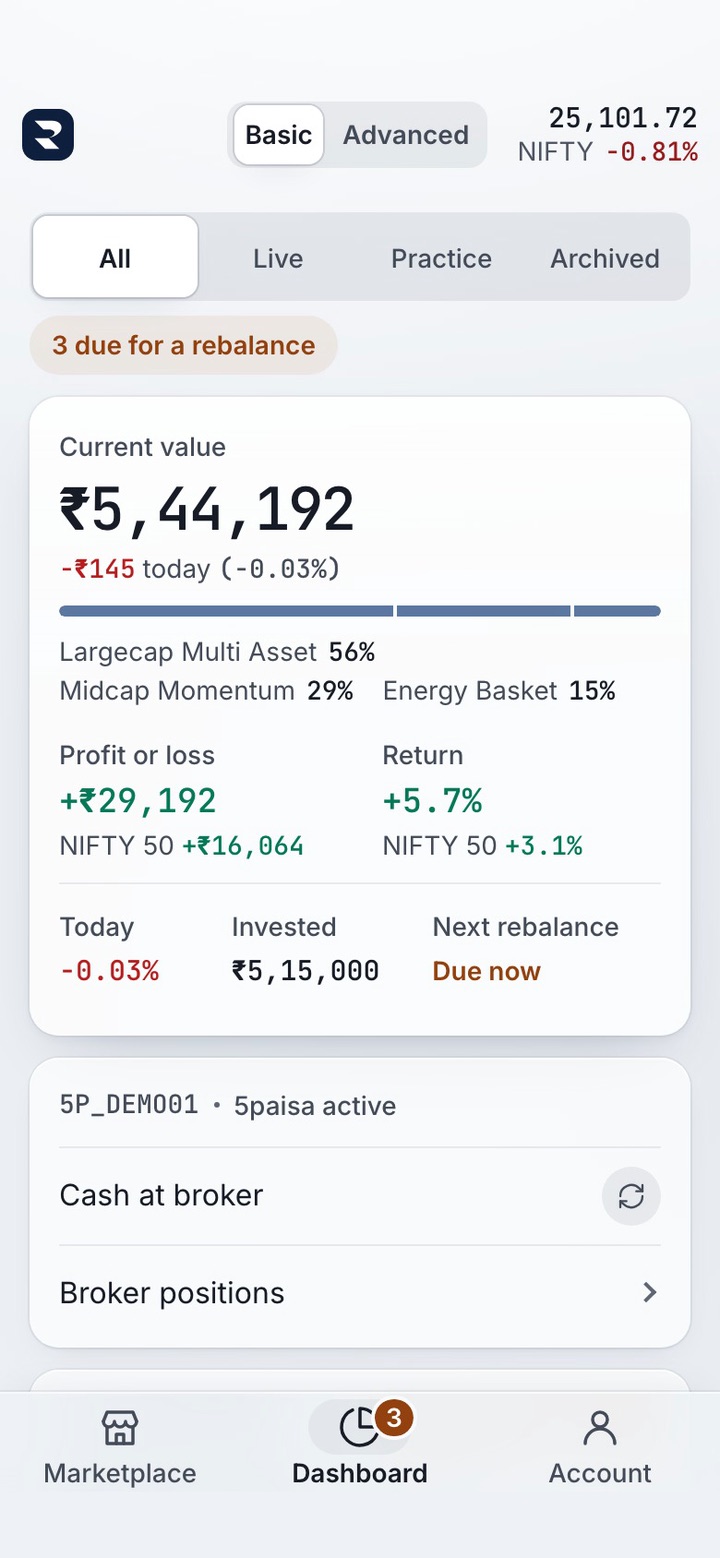
Every RupeeCase index rebalances on a fixed calendar cadence written into its rules, from one week for the sector baskets to four weeks for the largecap ones. On rebalance day the terminal shows what changes; you review it, tick that you accept, and confirm. Orders go to your own broker for your own demat. The fee is 0.2% of the value that actually trades. You can read every past rebalance of every index on its page, for example Midcap Smallcap, and see the cadence and churn for yourself before you invest.
Questions people ask me
How often should a systematic portfolio be rebalanced?
As often as the signal decays, and no more. Momentum style rules often use two to three weeks, quality and low volatility rules a month or a quarter, simple allocation portfolios a quarter or a threshold. What matters is that the cadence is fixed in advance and tested with costs and tax included.
Is threshold rebalancing better than calendar rebalancing?
For an allocation between asset classes it is often cheaper, because nothing trades until drift is meaningful. For a factor index whose names change, a calendar is cleaner, because the composition itself is updated on each date and the back test can be reproduced exactly.
What should I do if a stock in my portfolio is suspended?
Nothing can trade until it resumes, so the rebalance skips it and the weight stays frozen. Keep it in your records, follow exchange announcements, and let the next rebalance handle it once trading resumes.
What to remember
- Without rebalancing you run last month's model with an accidental tilt.
- Cost is frequency times the share that trades times cost per rupee. Tax often outweighs all of it.
- Monitor exceptions, not prices: caps, drawdown, sectors, corporate actions.
- Sells first, priced orders, no chasing, log everything.
- XIRR for your money, time weighted return for the strategy.