


Costs: MF, PMS, RupeeCase..5 min read
The cost of switching funds
Hopping out of a fund inside a year on a Rs 11.5 lakh pot costs about Rs 41,500 in tax and exit load, so the new fund must out earn the old by 3.6 percent before it earns a rupee.
By Tanmay Kurtkoti, founder of QC Alpha and builder of RupeeCase
A friend runs the same play every March. He sells whatever fund lagged last year and buys whatever sits at the top of the one year chart. It feels like good housekeeping. Prune the laggard, back the winner.
I asked him one question. What does the move itself cost, before the new fund has done anything at all.
He had never counted it. So we did.
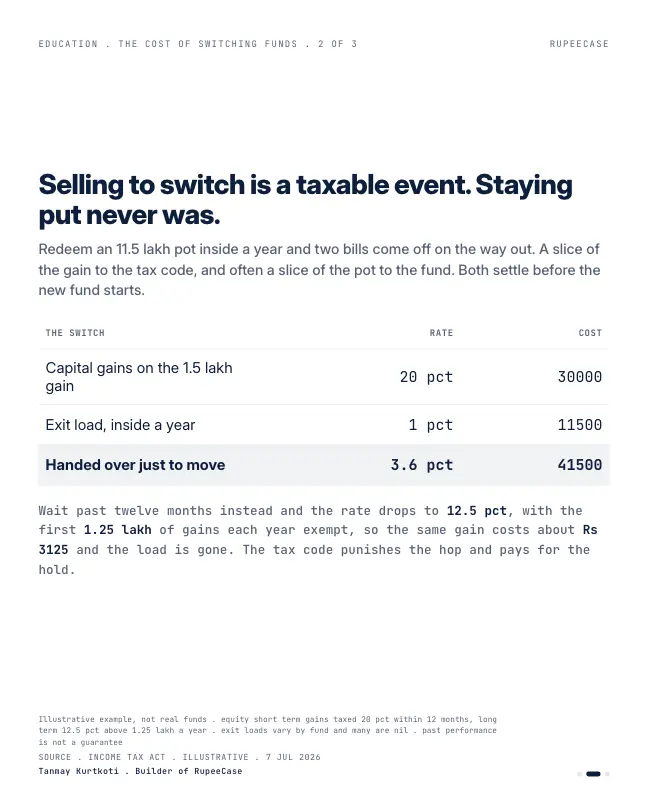
Say the pot is 11.5 lakh, up from 10 lakh over the year. Redeem inside twelve months and two bills come off on the way out. Capital gains on the 1.5 lakh gain, at 20 percent, is 30,000. The exit load many equity funds charge inside a year, about 1 percent, is another 11,500. That is 41,500 gone. Roughly 3.6 percent of the pot, handed over before the new fund earns a single rupee.
Here is the part that flips the whole thing. Hold the same fund past twelve months and the rate drops to 12.5 percent, and the first 1.25 lakh of gains each year is exempt. The same gain now costs about 3125, and the load has disappeared. The tax code quietly punishes the hop and pays for the hold.
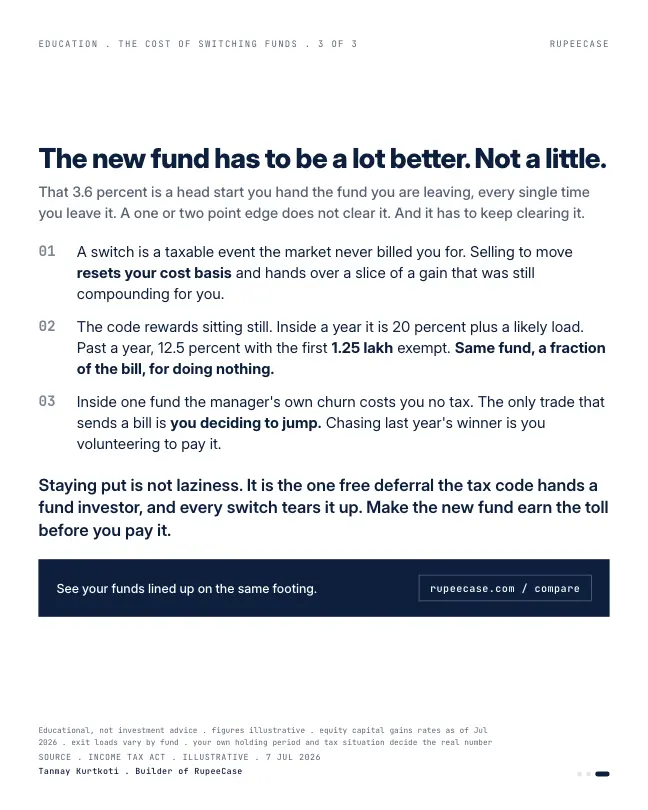
Which resets the question. The new fund cannot be a little better. It has to out-earn the old one by more than the 3.6 percent it just cost you to move, and then keep out-earning it. A one or two point edge does not clear the toll.
The detail most people miss. Inside a fund, the manager's own buying and selling costs you no tax at all. The only trade that ever sends you a bill is the one where you decide to jump. Chasing last year's winner is you volunteering to pay it.
Staying put is not laziness. It is the one free deferral the code hands a fund investor. Make the new fund earn the toll before you pay it.
The toll, on your own numbers
The friend's March habit costs Rs 41,500 on an Rs 11.5 lakh pot. Change the inputs below to your own holding. The months box decides which side of the 12 month line you are on, and that one number changes almost everything.
Set the months to 13 and the toll falls to Rs 3,125, about 0.27 percent. The fund, the gain and the market are the same. Only the calendar moved.
Spreading the toll over the years
The opening says the new fund has to out earn the old one by more than 3.6 percent. Over how long? The longer you plan to hold the new fund, the smaller the yearly edge it needs, but the edge has to show up every year.
- Recover in 1 year3.74% a year
- Recover in 2 years1.85% a year
- Recover in 3 years1.23% a year
- Recover in 5 years0.74% a year
Extra yearly return the new fund needs over the old one to recover a 3.61% toll. Worked example.
Now put that next to what you know about last year's winner. A fund at the top of the one year chart is there because of one year. The star rating post shows how rarely last year's leader leads again. Asking it to beat the old fund by 1.85 points a year for two years straight is asking a lot of a one year record.
The calendar of an equity fund unit
The rules that decide the toll are all dates. Here they are on one line, for a unit bought on 15 Mar 2025.
- Bought
The 12 month clock starts for these units. Each SIP instalment has its own clock.
- Short term zone
Gain taxed at 20 percent. An exit load, often 1 percent, may apply.
- Long term zone
Held more than 12 months: 12.5 percent above Rs 1.25 lakh of long term gains in the year.
- New financial year
A fresh Rs 1.25 lakh of exempt long term gains.
Two details trip people up. First, a SIP is not one holding. Every monthly instalment has its own purchase date, so selling a whole SIP fund at once can mix units that are long term with units that are a few weeks old. Units are redeemed first in, first out, so the oldest go first. Second, the yearly exemption covers all your long term gains from listed equity and equity funds together, not each fund separately.
Where the exit load goes
The exit load is not a fee to the fund house. Under SEBI's 2012 rules it is credited back to the scheme, so it compensates the investors who stay for the cost of your leaving. SEBI also used to allow schemes with exit loads to charge an extra 0.05 percent a year in expenses; its board removed that allowance on 17 Dec 2025.
The free Learn module on equity taxation after July 2024 covers holding periods, the exemption and worked sale examples, with a quiz. The capital gains tax calculator runs any redemption. Related: the base rate of beating the market.
Questions readers ask
How much tax do I pay when I switch mutual funds within a year?
A switch is a redemption, so the gain is taxed. Equity fund units held 12 months or less are taxed at 20 percent on the gain, and many equity funds also charge an exit load of about 1 percent inside a year. On an Rs 11.5 lakh holding with a Rs 1.5 lakh gain, that is Rs 30,000 of tax plus Rs 11,500 of load.
Is switching between funds of the same fund house tax free?
No. Moving money from one scheme to another, even within the same fund house, is treated as selling the first and buying the second. Capital gains tax and any exit load apply as if you had redeemed.
When does a mutual fund holding become long term?
For equity oriented funds, when the units have been held for more than 12 months. Each SIP instalment counts from its own purchase date, so a SIP fund usually holds a mix of long term and short term units.
The cards
3 cards. Swipe, or tap to open.
Explore next
Learn it properly, then see it applied.
- Free module 6.3Mutual Funds, Structure, Types and Hidden Costs8 min read
- StrategyAllcap strategyNifty Total Market, 50 stocks, every 2 weeks
- Free module 11.1Equity Taxation After July 2024: The New Rules10 min read
- CalculatorLTCG and STCG on equityFree, with the formula and a worked example
- Blog topicCosts: MF, PMS, RupeeCase notes25 notes
Related
- The base rate of beating the marketSPIVA India shows 73 of 100 active large cap funds and 82 of 100 mid and small cap funds trailed their benchmark over the ten years to June 2025.Costs: MF, PMS, RupeeCase . . 5 min
- Funds that vanishedAbout one in four Indian large cap funds disappeared over ten years, and the category average you see is the average of the survivors.Costs: MF, PMS, RupeeCase . . 5 min
- SEBI's overlap cap and the overlap you ownSEBI's February rule treats two schemes as duplicates above 50 percent overlap but carves out large caps, which is exactly where two plain funds share 60 to 80 percent.Costs: MF, PMS, RupeeCase . . 5 min
Educational content only. Figures are illustrative and computed on historical or representative data for teaching purposes, not investment advice. Past performance does not guarantee future returns. Sourced from NSE, BSE, SEBI, AMFI and RBI public data.