

Strategy notes..6 min read
TotalMarket Hybrid: the gold free twin
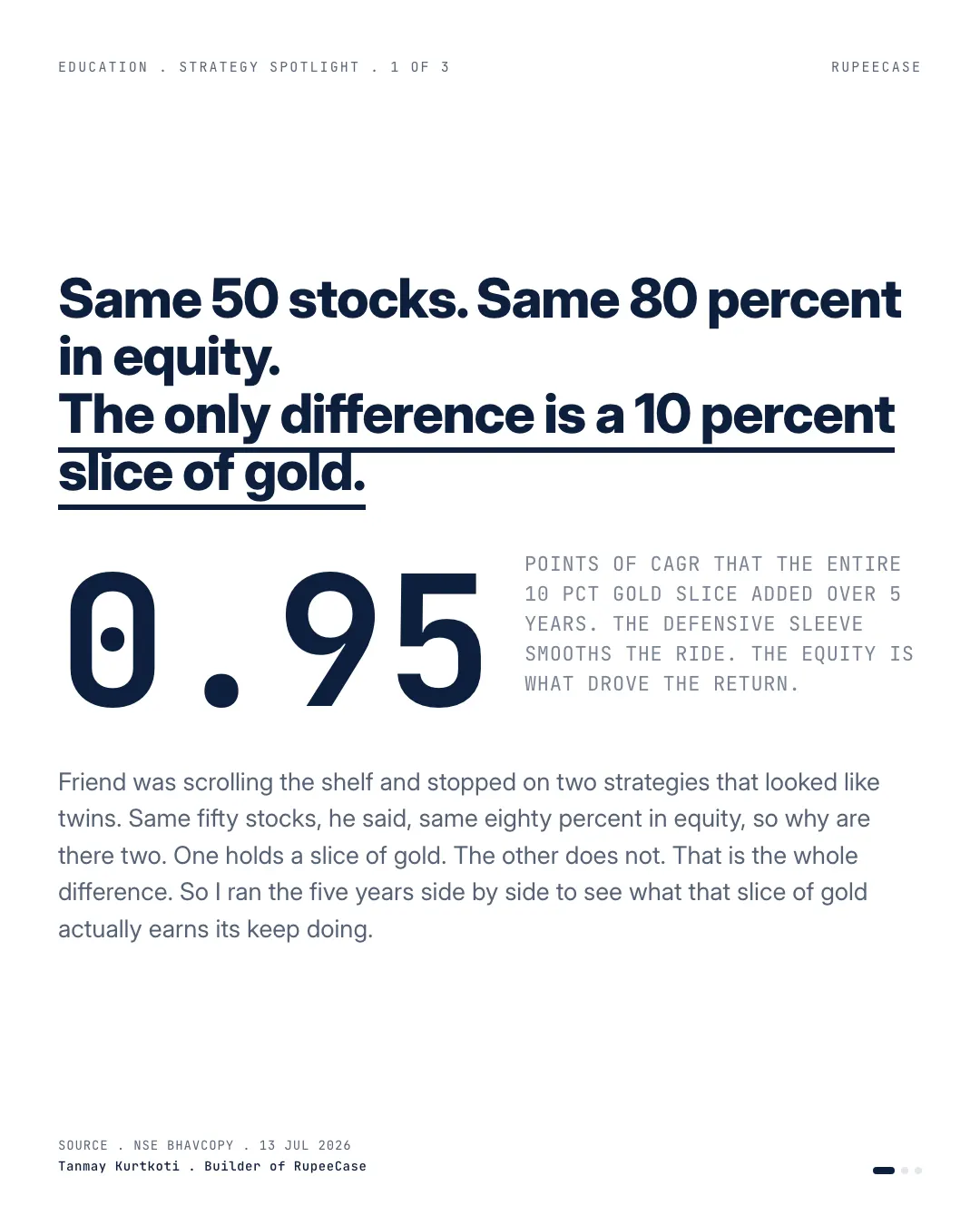
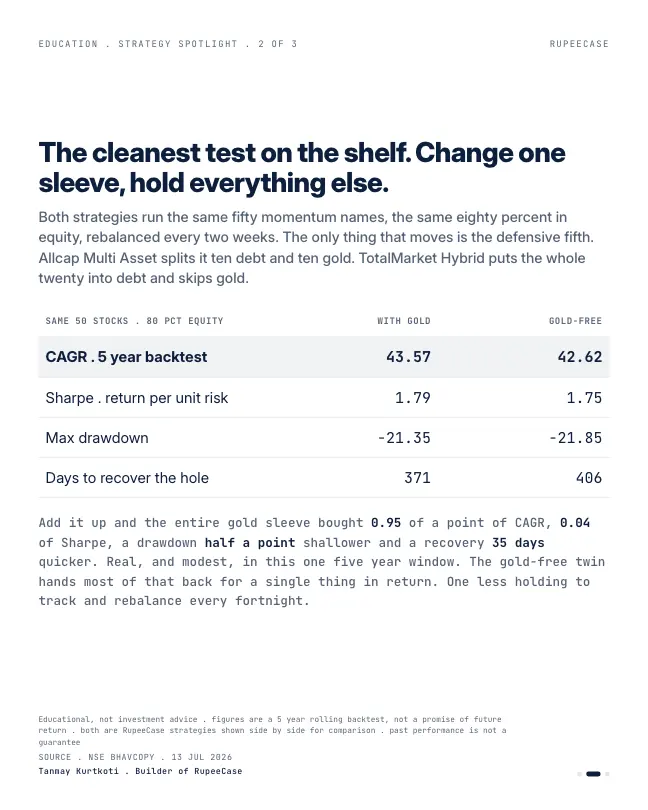
Swapping the 10 percent gold sleeve for debt gave back just under a point of CAGR, 43.57 against 42.62, half a point of drawdown and 35 days of recovery.
Model, back tested, as of 27 Apr 2026, as published then; the strategy page shows the current figure.
By Tanmay Kurtkoti, founder of QC Alpha and builder of RupeeCase
A friend was scrolling the RupeeCase shelf the other day and stopped on two strategies that looked like identical twins. Same fifty stocks, he said, same eighty percent sitting in equity, rebalanced the same way. So why are there two of them?
One holds a small slice of gold in its defensive sleeve. The other skips gold and holds debt instead. That is the whole difference.
Which makes it about the cleanest test you can run on a portfolio. Hold everything else constant, change one sleeve, and you get to see exactly what that sleeve is worth. So I lined up the five year backtests side by side.
Here is what the gold slice bought. Just under a point of extra CAGR, 43.57 against 42.62. A drawdown half a point shallower. A recovery about thirty five days quicker. A touch more return per unit of risk. Real contributions, all of them, and all of them small.
The version without gold keeps almost the entire result. What it hands you back in return is simplicity. One less holding to own, watch, and rebalance every two weeks.
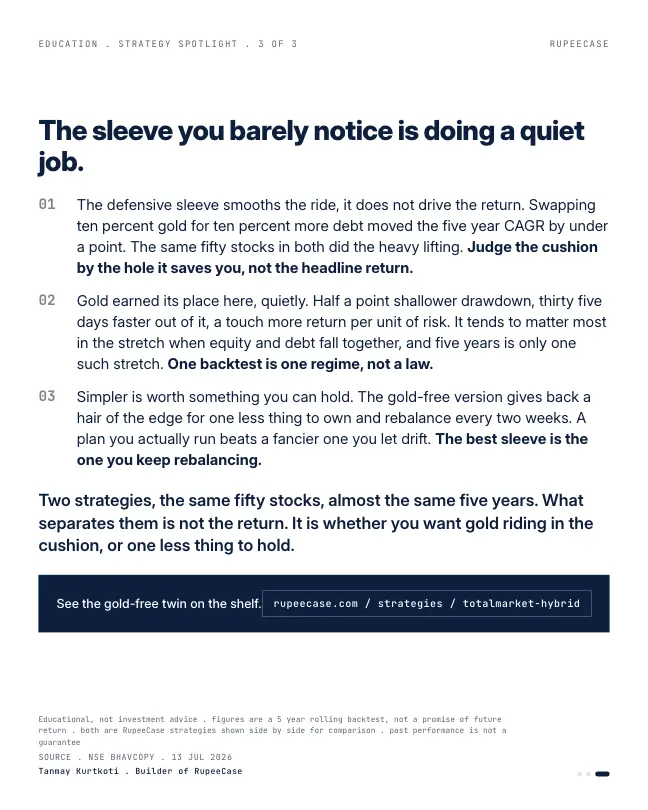
Two things I keep coming back to. The defensive sleeve smooths the ride, it does not drive the return. The same fifty stocks did the heavy lifting in both versions, so judge a cushion by the hole it saves you, not the headline number on top.
And gold did earn its place here, but five years is one market regime, not a permanent law. Gold tends to matter most in the rare stretch when equity and debt fall together, and this window never really tested that.
So pick the cushion you will actually keep rebalancing. The best sleeve is the one you hold onto
The twins on the current figures
The figures above are the ones I had when I wrote this in July. The lineup now carries a backtest window to 27 April 2026, and the gap between the twins has barely moved. Allcap Multi Asset, the one with 10 percent gold and 10 percent debt, shows 40.47 percent CAGR. TotalMarket Hybrid, 20 percent debt and no gold, shows 39.53. Model, back tested, as of 27 Apr 2026. Still just under a point.
CAGR with 10% gold and 10% debt
Allcap Multi Asset. Model, back tested, as of 27 Apr 2026
CAGR with 20% debt, no gold
TotalMarket Hybrid. Model, back tested, as of 27 Apr 2026
Worst fall, gold version
Model, back tested, as of 27 Apr 2026
Worst fall, gold free version
Model, back tested, as of 27 Apr 2026
Half a point of drawdown and a Sharpe of 1.81 against 1.77. Small, and in the same direction as before. The interesting question is not whether gold helped. It is why the help was so small, and when it could be large.
What a gold sleeve is actually for
Gold is not a quiet asset. People picture it as the safe corner of a portfolio, but on its own it swings hard. I pulled the closing prices of an NSE listed gold ETF for the twelve months to 30 Sep 2026. Its monthly returns, annualised, ran at about 26.6 percent volatility. The Nifty 50 over the same twelve months ran at about 16.9 percent. Gold was the more volatile of the two.
So why hold it as a cushion? Because what matters is not how much gold moves. It is whether it moves at the same time as your stocks. Over those twelve months the correlation of monthly returns between the two was about 0.20. Low. Most months, gold was doing its own thing.
| Month | Oct | Nov | Dec | Jan | Feb | Mar | Apr | May | Jun | Jul | Aug | Sep |
|---|---|---|---|---|---|---|---|---|---|---|---|---|
| Nifty 50 | 4.5 | 1.9 | -0.3 | -3.1 | -0.6 | -11.3 | 7.5 | -1.9 | 1.4 | 2.2 | -1.2 | -6.1 |
| Gold ETF | 4.4 | 4.6 | 5.2 | 19.1 | 0.4 | -7.9 | 1.8 | 4.2 | -9.9 | 1.0 | 8.7 | -4.5 |
Month end closes, Oct 2025 to Sep 2026, price change in percent. NSE bhavcopy via the NSE data tools: Nifty 50 index and an NSE listed gold ETF.
From 30 Sep 2025 to 30 Sep 2026 the Nifty 50 fell 8.1 percent. The gold ETF rose 26.9 percent. In January 2026 the index lost 3.1 percent while gold gained 19.1. That month is the brochure case for a gold sleeve.
Then look at March. The Nifty 50 fell 11.3 percent and gold fell 7.9 percent with it. The cushion fell with the thing it was meant to cushion. September did the same on a smaller scale.
MythGold always goes up when stocks fall.
FactIn March 2026 the Nifty 50 fell 11.3 percent and an NSE listed gold ETF fell 7.9 percent. Low correlation means often, not always.
Work it through on Rs 10,00,000
Take Rs 10,00,000 and build both twins with the index standing in for the stock sleeve. Gold version: Rs 8,00,000 equity, Rs 1,00,000 gold, Rs 1,00,000 debt. Gold free version: Rs 8,00,000 equity, Rs 2,00,000 debt. Give the debt about 0.45 percent a month, roughly what a 5.5 percent yield pays.
January 2026. Equity loses 3.1 percent, which is Rs 24,800. In the gold version, gold adds 19.1 percent on Rs 1,00,000, which is Rs 19,100, and debt adds Rs 450. Net loss Rs 5,250. In the gold free version, debt adds Rs 900 on Rs 2,00,000. Net loss Rs 23,900. Same stocks, Rs 18,650 apart.
March 2026. Equity loses 11.3 percent, Rs 90,400. Gold loses Rs 7,900. Debt adds Rs 450. Net loss Rs 97,850 for the gold version. The gold free version loses Rs 90,400 and gets Rs 900 back, net Rs 89,500. In March the twin without gold did better by Rs 8,350.
Add months like these up over five years and you get what the backtest shows: a small edge for gold, with months where it costs you.
When the edge could be large
Here is the case the five year window never really tested. Equity falls and debt falls at the same time, which happens when rates rise fast. The RBI raised the repo rate by 25 basis points to 5.50 percent on 7 Oct 2026. A liquid sleeve barely notices a hike, because its paper matures in weeks. Longer bonds feel it more. Gold answers to different things: the rupee, global demand, fear. In a stretch where both stocks and longer bonds are falling, gold is the one sleeve not tied to Indian interest rates.
That is the honest case for the gold slice. Not the extra point of CAGR. The rare year when everything else in the book moves together. The free Learn module on gold, commodities and international investing covers how gold is held in India, what each route costs, and how it is taxed, with a quiz at the end.
My own test is the one I wrote in July. If you will rebalance the gold sleeve every two weeks without thinking about it, it earns its small place. If you will be tempted to sell it after a month like June 2026, when the gold ETF fell 9.9 percent, the gold free twin keeps almost all of the result with one less thing to second guess. The debt sleeve post covers what the other half of the cushion does.
Questions readers ask
Does gold always rise when the stock market falls?
No. Over the twelve months to 30 Sep 2026 the correlation between monthly returns of the Nifty 50 and an NSE listed gold ETF was about 0.20, which is low but not negative. In January 2026 gold rose 19.1 percent while the index fell 3.1 percent. In March 2026 both fell, the index by 11.3 percent and gold by 7.9 percent.
How much gold do multi asset portfolios usually hold?
There is no fixed rule. The RupeeCase multi asset strategies use a 10 percent gold sleeve next to 10 percent debt and 80 percent equity. The model gap between that and a 20 percent debt, no gold version was just under one point of CAGR and half a point of drawdown (Model, back tested, as of 27 Apr 2026).
How is a gold ETF taxed in India?
Listed gold ETF units held for more than 12 months are taxed at 12.5 percent long term capital gains without indexation; units held for 12 months or less are taxed at your slab rate. This follows the Finance (No. 2) Act 2024 changes, with gold ETFs outside the debt fund rule from 1 Apr 2025.
The cards
3 cards. Swipe, or tap to open.
Explore next
Learn it properly, then see it applied.
- Free module 3.1The Momentum Factor11 min read
- StrategyAllcap Multi Asset strategyNifty Total Market, 52 stocks, every 2 weeks
- Free module 6.9Gold, Commodities, and International Investing for Indian Investors8 min read
- CalculatorAsset allocation by risk profileFree, with the formula and a worked example
- StrategyTotalMarket Hybrid strategyNifty Total Market, 51 stocks, every 2 weeks
- Blog topicStrategy notes notes22 notes
Related
- Large Mid Hybrid: the debt sleeve that did two jobsThe 20 percent liquid sleeve softened the worst fall to 18.30 percent and, because it is never traded fortnightly, cut the five year friction bill from 67 to 54 points.Strategy notes . . 6 min
- Largecap Hybrid: a buffer is a shock absorber, not a shieldOne of only two cards whose worst week was softer than the Nifty's own still closed 2025 down 2.9 percent, because the 80 percent equity sleeve decides the year.Strategy notes . . 5 min
- Large Mid Multi Asset: the card that finished 2025 greenIt closed 2025 up 10.1 percent while the broad cards fell, giving up 6.45 points of CAGR for a 17.61 percent worst hole and the highest win rate.Strategy notes . . 5 min
Educational content only. Figures are illustrative and computed on historical or representative data for teaching purposes, not investment advice. Past performance does not guarantee future returns. Sourced from NSE, BSE, SEBI, AMFI and RBI public data.