

Strategy notes..5 min read
Largecap Hybrid: a buffer is a shock absorber, not a shield
One of only two cards whose worst week was softer than the Nifty's own still closed 2025 down 2.9 percent, because the 80 percent equity sleeve decides the year.
Model, back tested, as of 27 Apr 2026, as published then; the strategy page shows the current figure.
By Tanmay Kurtkoti, founder of QC Alpha and builder of RupeeCase
A friend was sorting my marketplace for the calm end on Saturday, the low volatility cards. He stopped on the conservative largecap one, noticed it had closed last year in the red, minus 2.9 percent on the factsheet as refreshed by Oct 2026, and asked the fair question. Wasn't the 20 percent debt sleeve supposed to protect it.
It did protect something. Just not the thing he was looking at.
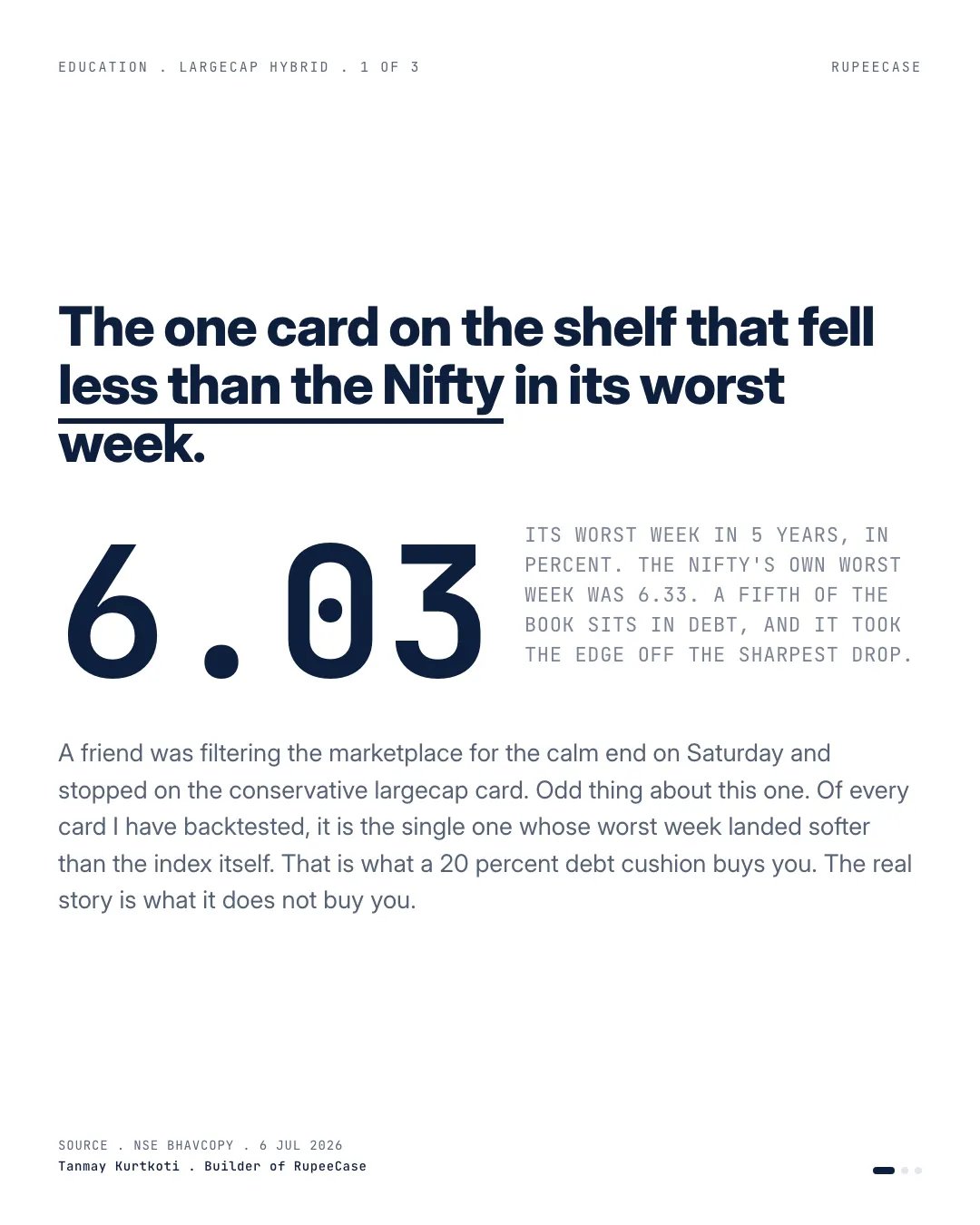
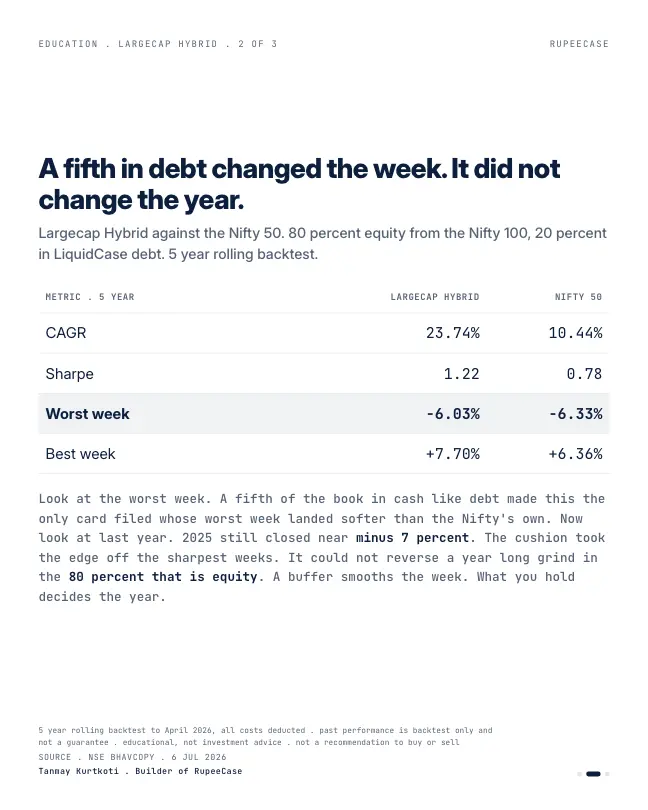
Here is the part that surprised me the first time I ran the numbers. Of every card I have backtested, it is one of only two whose worst single week landed softer than the Nifty's own, the other being its multi asset sibling. Its worst week was 6.20 percent on the current factsheet. The index at its worst was 6.33. A fifth of the book sitting in cash like debt genuinely takes the edge off the sharpest drops. That cushion is real.
And yet the same card still closed 2025 down 2.9 percent.
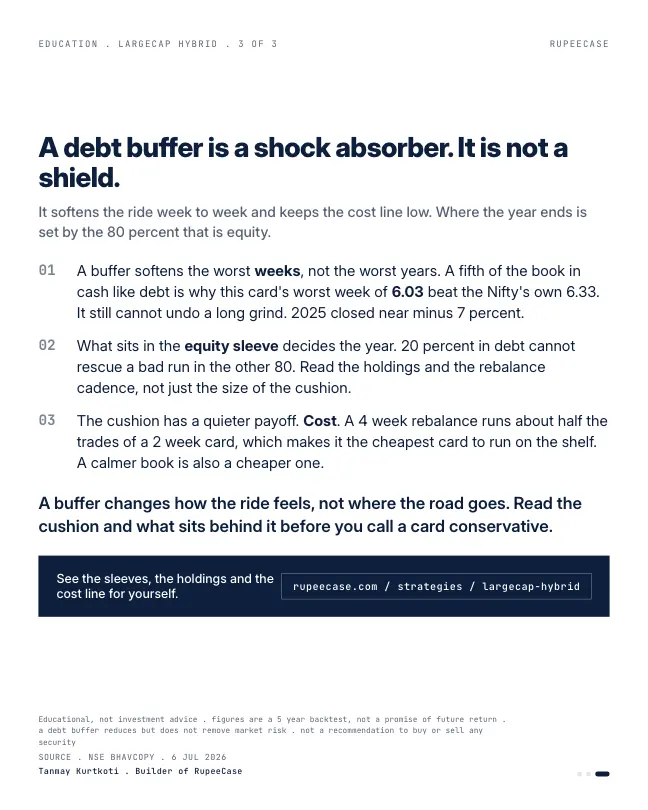
Both of those are true at once, and the gap between them is the whole lesson. A debt buffer is a shock absorber, not a shield. It softens how a bad week feels, because a chunk of the book is not falling with the market. It cannot reverse a year long grind in the other 80 percent, because that 80 percent is equity, and equity is what decides the year. The buffer changes how the ride feels. What you hold decides where it ends.
There is a quieter payoff to the same cushion, one nobody screenshots. Cost. This card rebalances every 4 weeks, roughly half the trades of the 2 week cards, and that makes it one of the cheapest active cards to run on the shelf, at about 1.8 percent a year of cost drag. Only its multi asset sibling and the plain Nifty 50 Equal Weight card cost less. A calmer book turns out to be a cheaper one too.
So before you call any card conservative, read two things, not one. The size of the cushion, and what is sitting behind it.
The card on today's factsheet
Both cushioned large cap cards beat the index on their worst week, and the pure equity sibling did not (Model, back tested, risk metrics as of 27 Apr 2026).
- Large Cap Multi Asset-6.12%
- Largecap Hybrid-6.20%
- Nifty 50, factsheet column-6.33%
- Focused Largecap 20-6.75%
Worst single week. Model, back tested, RupeeCase factsheets; risk metrics as of 27 Apr 2026, Focused Largecap 20 as of 13 Jul 2026.
The lineup file puts Largecap Hybrid at 22.74 percent CAGR, Sharpe 1.25 and a maximum drawdown of 22.04 percent; its pure equity sibling Focused Largecap 20 at 26.29, 1.20 and 23.56 (Model, back tested, as of 27 Apr 2026). A softer worst week, a hole only about one and a half points shallower. That gap between the week and the hole is the whole post.
The buffer, as arithmetic
A 20 percent debt sleeve does one thing: it stops a fifth of the book from moving with equity. So in any period, the book's move is 80 percent of the equity move plus 20 percent of the debt return. That is all, and it explains both halves of the opening.
A week where the twenty stocks fall 7.5 percent becomes a 5.98 percent week for the book. That is the shock absorber. Now change the equity move to minus 6 percent and the debt return to 6.5 percent, a rough year rather than a rough week. The book still ends near minus 3.5 percent. The cushion took about 2.5 points off; it could not turn the year positive, because 80 percent of the book is still the equity that decided it.
A debt sleeve earns roughly a money market return, a few percent a year. Against an equity fall of 20 or 30 percent, a fifth of the book earning a few percent cannot do much. Against a single week, when the debt earns almost nothing but also loses nothing, it takes a clean fifth off the fall. That is why the same card can have a softer week than the index and a deeper hole.
- Bad weekEquity falls, debt flat: the book falls about four fifths as much.
- Bad yearEquity grinds down, debt earns a little: the book still follows equity.
- RebalanceEvery four weeks, back to 80 and 20, buying equity after it fell.
- RecoveryThe extra equity bought at lower prices helps the climb back.
The cost line, ranked
The opening's quieter point was cost. The factsheets' cost decompositions let you turn each card's estimated cost into a yearly drag over its roughly five year back test. Here are a few, from the busiest cadence to the slowest.
- Energy Basket, weekly3.32%
- Allcap, 2 weeks2.78%
- Large Midcap, 2 weeks2.34%
- Focused Largecap 20, 4 wks1.94%
- Largecap Hybrid, 4 weeks1.81%
- Large Cap Multi Asset1.71%
Approximate yearly cost drag over about five years, from each factsheet's gross and net return. Model, back tested; cost decompositions as of 27 Apr 2026 (Allcap, Focused Largecap 20: 13 Jul 2026).
Nifty 50 Equal Weight, which simply holds all fifty index names, is far cheaper again at about 0.3 percent (same source). The pattern holds: a four week cadence and a 20 percent sleeve that rarely trades bring the bill down.
The free Learn module on bonds and fixed income in India explains what a debt sleeve earns and how it behaves next to equity, with a quiz, and the rebalance cost calculator estimates the bill for your own cadence. Related: Focused Largecap 20 and Large Mid Multi Asset.
Questions readers ask
Does a debt allocation protect a portfolio in a crash?
It softens the fall but does not prevent it. With 20 percent in debt, the book falls about 80 percent as much as the equity part in a sharp week. Over a long fall the equity part still decides the result, so an 80 20 portfolio can still lose 20 percent or more.
What is the difference between a hybrid and a multi asset portfolio?
A hybrid here means equity plus debt, such as 80 percent stocks and 20 percent debt. A multi asset portfolio adds a third asset, such as 80 percent stocks, 10 percent debt and 10 percent gold. On RupeeCase's large cap cards the multi asset version shows a shallower worst fall, 20.96 percent against 22.04 (Model, back tested, as of 27 Apr 2026).
Why does a slower rebalance cost less?
Each rebalance sells and buys part of the book and pays charges on what it trades. Rebalancing every four weeks instead of every two roughly halves the number of trading days, and a debt sleeve that rarely changes adds little to the bill.
The cards
3 cards. Swipe, or tap to open.
Explore next
Learn it properly, then see it applied.
- Free module 3.1The Momentum Factor11 min read
- CalculatorDrawdown and recoveryFree, with the formula and a worked example
- Free module 6.7Bonds and Fixed Income in India8 min read
- CalculatorRebalance cost at 0.2%Free, with the formula and a worked example
- StrategyLargecap Hybrid strategyNifty 100, 21 stocks, every 4 weeks
- Blog topicStrategy notes notes22 notes
Related
- Large Mid Hybrid: the debt sleeve that did two jobsThe 20 percent liquid sleeve softened the worst fall to 18.30 percent and, because it is never traded fortnightly, cut the five year friction bill from 67 to 54 points.Strategy notes . . 6 min
- TotalMarket Hybrid: the gold free twinSwapping the 10 percent gold sleeve for debt gave back just under a point of CAGR, 43.57 against 42.62, half a point of drawdown and 35 days of recovery.Strategy notes . . 6 min
- Large Mid Multi Asset: the card that finished 2025 greenIt closed 2025 up 10.1 percent while the broad cards fell, giving up 6.45 points of CAGR for a 17.61 percent worst hole and the highest win rate.Strategy notes . . 5 min
Educational content only. Figures are illustrative and computed on historical or representative data for teaching purposes, not investment advice. Past performance does not guarantee future returns. Sourced from NSE, BSE, SEBI, AMFI and RBI public data.