

Strategy notes..6 min read
Large Mid Hybrid: the debt sleeve that did two jobs
The 20 percent liquid sleeve softened the worst fall to 18.30 percent and, because it is never traded fortnightly, cut the five year friction bill from 67 to 54 points.
Model, back tested, as of 27 Apr 2026, as published then; the strategy page shows the current figure.
By Tanmay Kurtkoti, founder of QC Alpha and builder of RupeeCase
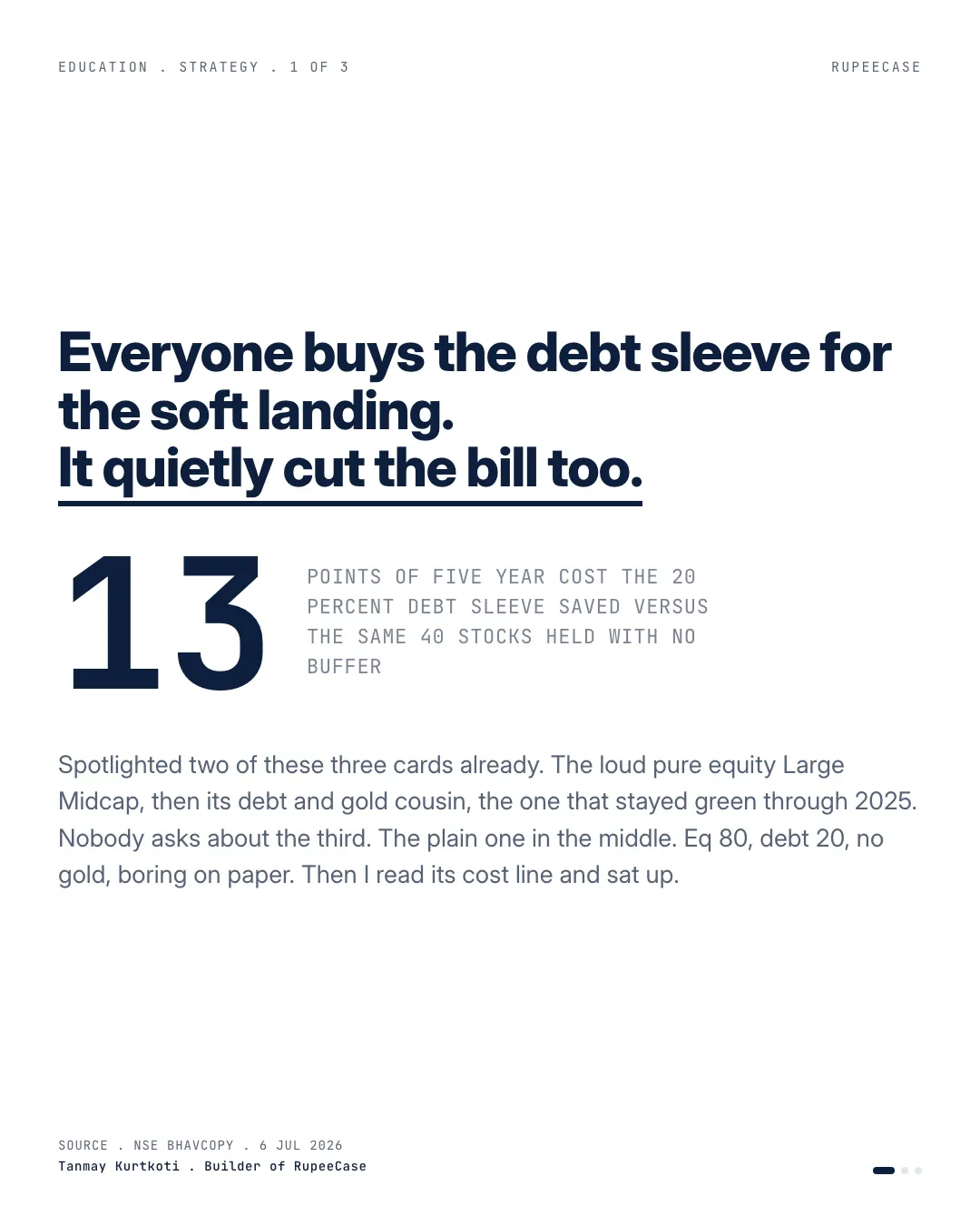
I have spotlighted two of these three cards already, so this one closes the set.
A couple weeks back it was Large Midcap, the pure equity card, 40 momentum names from the LargeMidCap 250, rebalanced every fortnight. Then its cousin, the debt and gold multi asset version, the one that finished 2025 in the green while most of the shelf was red. Nobody ever asks about the third sibling. Same 40 stocks, same manager, same cadence. The only difference is that a fifth of the book sits in a Liquidcase debt sleeve instead of in equity. Eq 80, debt 20, no gold. Boring on paper.
Then I read the cost line.
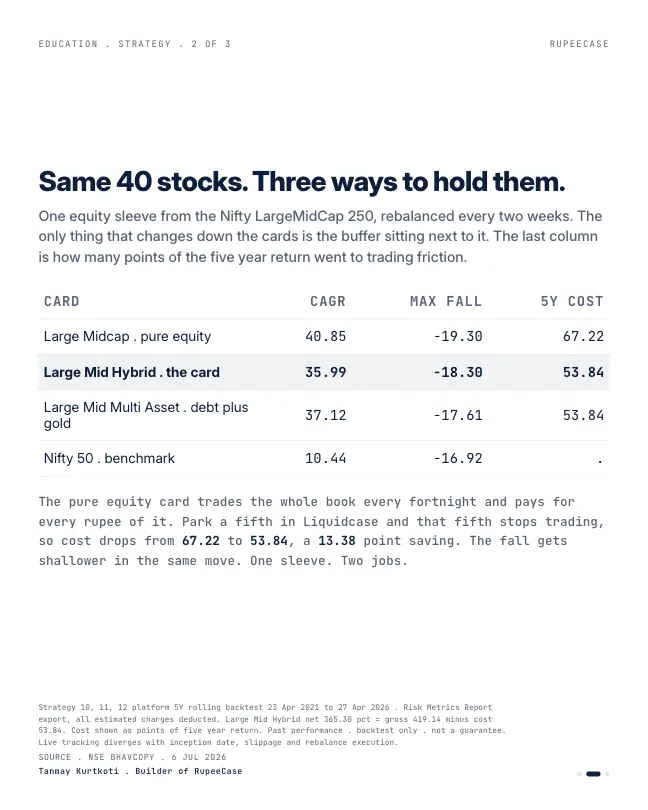
Everybody buys a debt sleeve for the soft landing, and it delivers one. The plain hybrid fell 18.30 percent at its worst against the pure equity twin's 19.30. Shallower ride, about the same Sharpe on the 27 Apr 2026 lineup, 1.67 against 1.69, calmer nights. Fine. Expected.
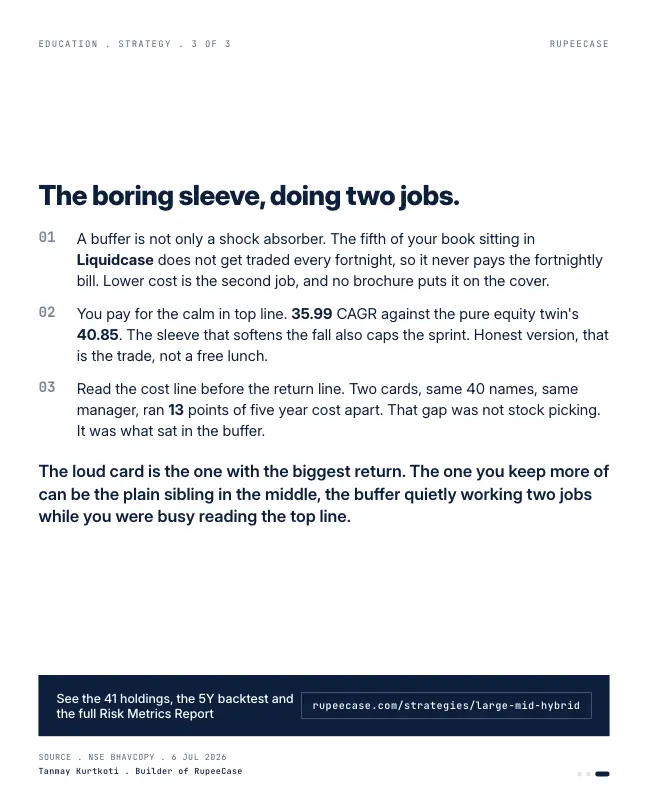
Here is the part that does not make the brochure. That 20 percent parked in Liquidcase does not get traded every fortnight. So it never pays the fortnightly trading bill. Over the five year backtest the pure equity card handed 67 points of its return to friction. The hybrid handed 54. A 13 point gap, and not one rupee of it came from stock picking. It came from what sat in the buffer.
The honest part. You pay for the calm in top line, 35.99 CAGR against 40.85, nearly five points given up. This is not the card that wins the leaderboard. But a bigger slice of what is left actually reaches you, and it does it with a softer fall.
The loud card wins the headline. The plain sibling in the middle can be the one you keep more of. Read the cost line before the return line
What actually sits in a liquid sleeve
A liquid sleeve is not a bond portfolio in the way most people picture one. Under the SEBI scheme categories of October 2017, a liquid fund holds debt and money market paper that matures within 91 days. Treasury bills, commercial paper, certificates of deposit. Paper that rolls over every few weeks and earns roughly the short term rate in the economy.
That short term rate is set, in the end, by the RBI. On 7 Oct 2026 the Monetary Policy Committee raised the repo rate by 25 basis points to 5.50 percent. In the Treasury bill auction result the RBI released the same day, the 91 day bill cleared at an implied yield of 5.5747 percent and the 364 day bill at 6.2869 percent.
Repo rate after the 7 Oct 2026 policy
RBI, MPC resolution, 7 Oct 2026
91 day Treasury bill yield
RBI, T-bill auction cut-off, 7 Oct 2026
364 day Treasury bill yield
RBI, T-bill auction cut-off, 7 Oct 2026
Two things follow from that short maturity. When rates rise, a liquid sleeve barely loses value, because its paper is replaced within weeks at the new, higher rate. And it pays a low, steady return, roughly the 91 day number, month after month. It is not there to make money. It is there to be the part of the book that does not move.
Job one: the softer fall
The original figures above were the ones I had in July. The lineup now runs to 27 April 2026, and the order of the three siblings has not changed.
- Large Midcap, pure equity-19.31%
- Large Mid Hybrid, 20% debt-18.27%
- Large Mid Multi Asset-17.60%
Maximum drawdown. Model, back tested, as of 27 Apr 2026. RupeeCase lineup.json.
On these figures the hybrid shows 33.21 percent CAGR against 37.83 for pure equity, and a Sharpe of 1.67 against 1.69. Model, back tested, as of 27 Apr 2026. So on the current window the Sharpe is a draw. The softer fall is still there. The extra return per unit of risk is not.
Job two: the trading bill it never pays
The second job is the one this post was about, and it is pure arithmetic. A fortnightly momentum strategy sells some stocks and buys others 26 times a year. Every rupee that changes hands pays statutory costs. On a delivery trade, STT is 0.1 percent on the buy and 0.1 percent on the sell. Stamp duty is 0.015 percent on the buy. The NSE transaction charge, since 1 Mar 2026, is Rs 307 per crore on each side. That is about 0.22 percent for a round trip before brokerage, GST and the cost of moving the price.
A debt sleeve that is reset only to its target weight barely touches that bill. The trading happens inside the equity sleeve, and the equity sleeve is 80 percent of the book, not 100.
All of the book is in the churn
- Rs 10,00,000 in 40 stocks
- Every fortnight some names are swapped
- Costs land on the whole Rs 10,00,000
A fifth of the book sits out
- Rs 8,00,000 in the same 40 stocks
- Rs 2,00,000 in liquid paper, reset only to weight
- Costs land on Rs 8,00,000
Put numbers on it. Take Rs 10,00,000, assume each fortnight replaces 20 percent of the equity sleeve, and assume a round trip costs 0.25 percent once a little brokerage and slippage sit on top of the statutory 0.22. Pure equity: Rs 10,00,000 times 20 percent times 0.25 percent is Rs 500 a fortnight, Rs 13,000 a year. The hybrid: Rs 8,00,000 in the churn, Rs 400 a fortnight, Rs 10,400 a year. Rs 2,600 a year stays in the book, about 0.26 percent of it, before any compounding.
Small each year. Compound it over five years, with real turnover higher in some fortnights than others, and this is the mechanism behind the 13 point friction gap in the July note. Raise the turnover or the cost in the calculator and watch the gap widen.
The free Learn module on bonds and fixed income in India covers how T-bills, liquid funds and longer bonds behave when rates move, with a quiz at the end. For the other cushion, the gold free twin shows what a 10 percent gold slice added on top of debt.
Questions readers ask
What does a liquid fund actually invest in?
Debt and money market paper with a maturity of up to 91 days, under the SEBI scheme categories of October 2017: Treasury bills, commercial paper and certificates of deposit. Its return tracks the short term rate; the 91 day Treasury bill cleared at 5.5747 percent in the RBI auction result of 7 Oct 2026.
Does a rate hike hurt a liquid fund?
Very little. Because the paper matures within weeks, it is replaced at the new, higher yield almost at once, so the price effect of a hike is small. Longer bonds feel a hike much more. The RBI raised the repo rate to 5.50 percent on 7 Oct 2026.
How are gains on a liquid or debt fund taxed?
Units of a fund with more than 65 percent in debt bought on or after 1 Apr 2023 are taxed at your slab rate, however long they are held, under section 50AA. Units bought before 1 Apr 2023 and held for more than 24 months are taxed at 12.5 percent without indexation.
The cards
3 cards. Swipe, or tap to open.
Explore next
Learn it properly, then see it applied.
Related
- Largecap Hybrid: a buffer is a shock absorber, not a shieldOne of only two cards whose worst week was softer than the Nifty's own still closed 2025 down 2.9 percent, because the 80 percent equity sleeve decides the year.Strategy notes . . 5 min
- TotalMarket Hybrid: the gold free twinSwapping the 10 percent gold sleeve for debt gave back just under a point of CAGR, 43.57 against 42.62, half a point of drawdown and 35 days of recovery.Strategy notes . . 6 min
- Large Mid Multi Asset: the card that finished 2025 greenIt closed 2025 up 10.1 percent while the broad cards fell, giving up 6.45 points of CAGR for a 17.61 percent worst hole and the highest win rate.Strategy notes . . 5 min
Educational content only. Figures are illustrative and computed on historical or representative data for teaching purposes, not investment advice. Past performance does not guarantee future returns. Sourced from NSE, BSE, SEBI, AMFI and RBI public data.