

Behaviour..6 min read
The settlement cycle
India moved to next day settlement in January 2023, sixteen months before the US, and optional same day settlement now covers the 500 largest stocks.
By Tanmay Kurtkoti, founder of QC Alpha and builder of RupeeCase
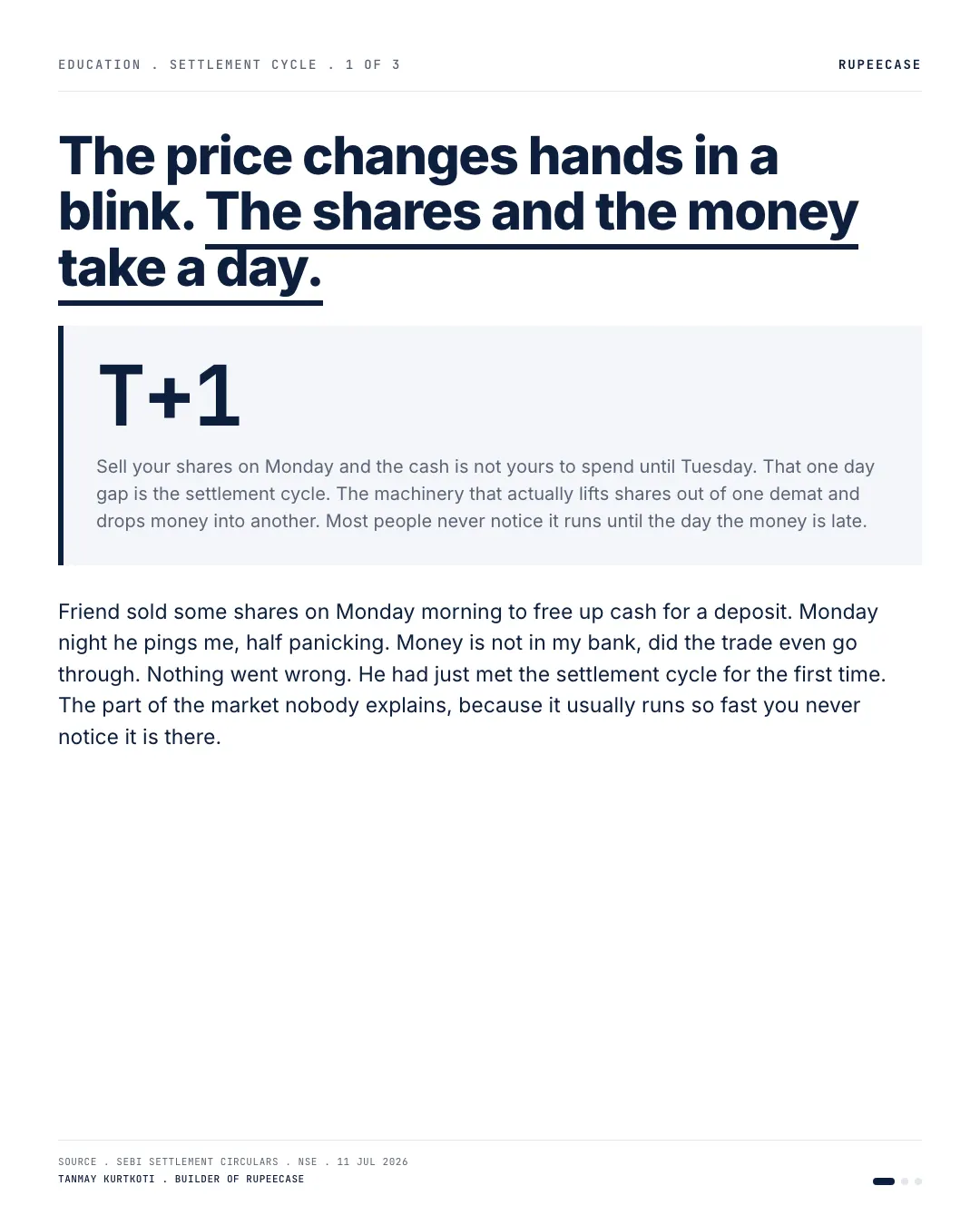
A friend sold some shares on Monday morning to free up cash for a deposit.
By Monday night he was half panicking. The money wasn't in his bank account. Did the trade even go through, he asked.
Nothing had gone wrong. He'd just run into the settlement cycle for the first time. It's the part of the market almost nobody explains, because it usually runs so fast you never notice it's there.
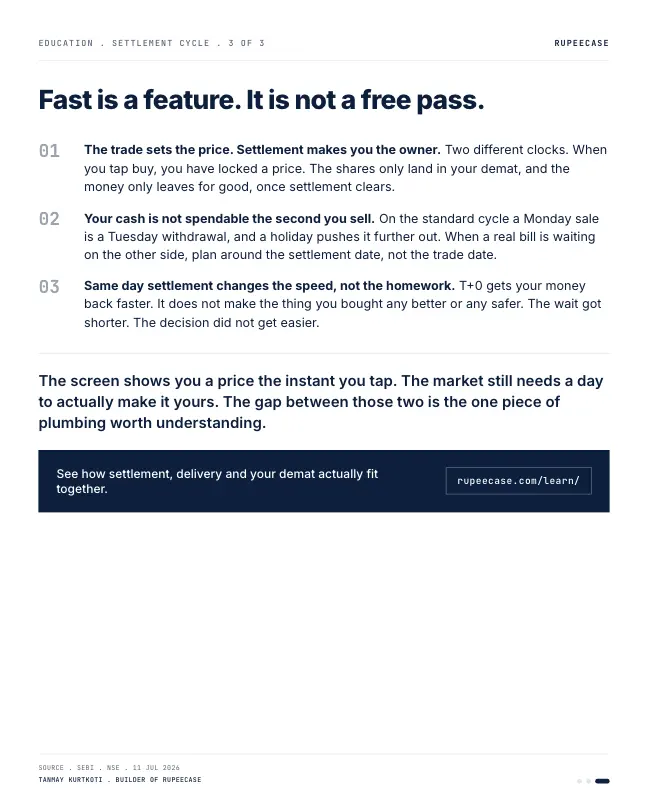
Here's the bit that surprised him. When you hit buy, you lock in a price instantly. But the shares only move into your demat, and the money only truly leaves the buyer's account, when the trade settles. Usually the next working day. The trade and the transfer are two separate events, running on two different clocks.
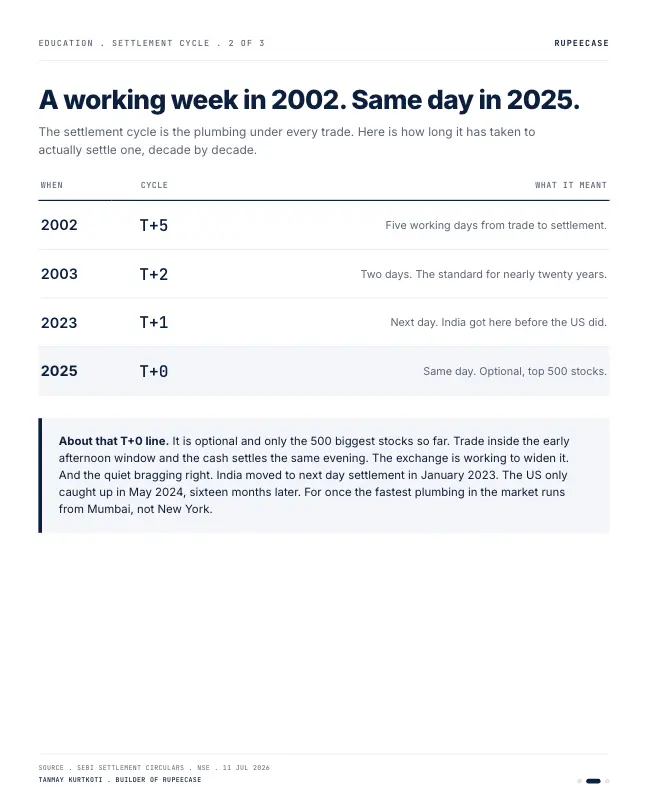
What actually impresses me is how far that gap has closed. Back in 2003 a trade took two full working days to settle, and that held for close to twenty years. In January 2023 India moved the whole market to next day settlement. The US didn't get there until May 2024, sixteen months later. And for the 500 largest stocks, we now have optional same day settlement. Sell in the morning, cash by evening.
Two things worth holding onto.
Your money isn't spendable the instant you sell. A Monday sale becomes a Tuesday withdrawal, and a market holiday pushes it further out. If a real bill is waiting on the other side, plan around the settlement date, not the trade date.
And faster settlement shortens the wait, not the thinking. T+0 gets your cash back sooner. It doesn't make what you bought any better.
What happens between the click and the cash
When your sell order matches, you have a contract, not cash. Nobody hands money across the table. The trade goes to a clearing corporation, which stands in the middle of every trade on the exchange, so you never carry the risk of the particular buyer failing to pay.
- Trade day (T)Your order matches at a price. The deal is fixed, nothing has moved yet.
- ClearingThe clearing corporation nets every broker's buys and sells into one obligation each.
- Pay in (T+1)Sellers' shares leave their demat accounts; buyers' brokers pay in the funds.
- Pay out (T+1)Shares go straight to the buyer's demat; the seller's money goes to the seller's broker.
- Your bankThe broker pays your ledger balance to your bank when you ask for a withdrawal.
That last step is the one my friend was staring at. Settlement finishes at the clearing corporation. Your bank account sees the money only after your broker processes the withdrawal, which is why a Monday sale often shows up in the bank on Tuesday evening or Wednesday.
One change in the middle is worth knowing. Since 11 November 2024, under a SEBI circular, shares you buy are paid out by the clearing corporation directly into your own demat account, instead of passing through your broker's pool account first. Less of your property sits in someone else's name, even for a night.
Twenty years in five steps
- T+5 becomes T+3
SEBI shortens the rolling settlement cycle.
- T+2 from 1 April
Two working days becomes the standard for close to twenty years.
- T+1 for every stock
The phased move started in February 2022 and finished on 27 January 2023.
- Optional T+0 beta
Same day settlement for 25 stocks and a few brokers, from 28 March.
- T+0 widens to the top 500
Added 100 stocks a month from 31 January; every broker allowed to offer it.
The faster lane almost nobody used
Here is a number I did not expect. SEBI's own board paper of November 2024 counted every T+0 trade in the beta, on both NSE and BSE, from 28 March to 6 September 2024. In more than five months, there were 126 trades with a total value of Rs 8,73,762. For several weeks there were none at all.
T+0 trades in the first five months of the beta
SEBI board memo, Nov 2024
their total value, NSE and BSE together
SEBI board memo, Nov 2024
stocks in the beta, Mar 2024
SEBI circular, Mar 2024
stocks eligible after the phase in from Jan 2025
SEBI circular, 10 Dec 2024
That tells you something useful. For most investors, next day settlement is already fast enough. T+0 is a tool for the rare day when timing the cash genuinely matters, and even then the trade must be placed in the shorter T+0 session, which ends at 1:30 pm.
A worked example: selling for a bill
Say you sell 100 shares of Company A at Rs 1,500 on a Monday to pay a deposit due on Wednesday. The sale is worth Rs 1,50,000. Here is what reaches your ledger, using 2026 rates:
- STT on the sell side, 0.1 percent: Rs 150.
- NSE transaction charge, Rs 3.07 per lakh: about Rs 4.61.
- SEBI turnover fee, Rs 10 per crore: Rs 0.15.
- Brokerage, assume Rs 20 for the order: Rs 20.
- GST at 18 percent on brokerage and exchange charges: about Rs 4.46.
Net proceeds are about Rs 1,49,821. Your broker may also charge a small depository fee when shares leave your demat. Settlement is Tuesday. Ask for the withdrawal on Tuesday and the money usually lands by Tuesday night or Wednesday. If Tuesday is a market holiday, every step slides by a day and Wednesday gets tight.
What would you do?
A Rs 1,50,000 payment is due on Wednesday morning. Tuesday is a trading holiday. When do you sell?
- Monday afternoon, the normal T+1 way
Monday's trade settles on the next working day, Wednesday. The money reaches your broker that day and your bank later, after the payment was due.
- The Friday before
Friday's trade settles on Monday. You can request the withdrawal on Monday and the cash is in the bank before Wednesday.
- Monday before 1:30 pm in the T+0 session
This can work if the stock is in the eligible list and your broker offers T+0, and the trade settles the same evening. If either is missing, you are back to the first answer.
Settlement on the next working day under T+1; T+0 eligibility and session timing per SEBI circulars of Mar 2024 and 10 Dec 2024.
The trade cost calculator will break your own sale down line by line. The free Learn module on how orders actually work walks through the order book, the trading day and T+1 settlement, with a quiz at the end. For the story of the switch itself, read T+1 settlement.
Questions readers ask
When will I get money after selling shares in India?
Equity trades settle on the next working day (T+1), so a Monday sale settles on Tuesday. The money then reaches your bank after your broker processes the withdrawal, often the same evening or the next day. Holidays push every step out by a day.
What is T+0 settlement and which stocks can use it?
T+0 is optional same day settlement. Since a SEBI circular of 10 December 2024 it covers up to the top 500 stocks by market value, phased in from 31 January 2025, for trades placed in a session that closes at 1:30 pm.
Why are shares not in my demat on the day I buy them?
The trade fixes the price on T day, but shares move only at settlement on T+1. Since 11 November 2024 the clearing corporation credits them directly to your own demat account.
The cards
3 cards. Swipe, or tap to open.
Explore next
Learn it properly, then see it applied.
- Free module 8.1Why Investors Lose, Introduction to Behavioural Finance11 min read
- StrategyAllcap strategyNifty Total Market, 50 stocks, every 2 weeks
- Free module 10.1How Orders Actually Work: Market Microstructure India12 min read
- CalculatorTrade cost calculatorFree, with the formula and a worked example
- Blog topicBehaviour notes27 notes
Related
- Impact cost: zero brokerage was never zero costA Rs 1 lakh round trip costs about Rs 100 of spread on a liquid Nifty name and about Rs 4,000 on a thin small cap, and neither appears on the contract note.Behaviour . . 5 min
- Why your sell is not cash yetIndia settles at T plus one trading day, so a Friday sale lands on Monday and a sale before a long weekend can take five calendar days to become spendable.Behaviour . . 5 min
- The IPO pop is not the businessIn 2025, 65 of 100 mainboard listings opened above issue price and 59 of 100 traded below their listing by December, because the grey market prices the first hour, not the first year.Behaviour . . 6 min
Educational content only. Figures are illustrative and computed on historical or representative data for teaching purposes, not investment advice. Past performance does not guarantee future returns. Sourced from NSE, BSE, SEBI, AMFI and RBI public data.