

Behaviour..5 min read
Doing nothing is the skill
Keepers who stay in the centre save about a third of penalties and dive anyway; the investor who sold a 30 percent fall and bought back higher ended with 3,000 fewer units.
By Tanmay Kurtkoti, founder of QC Alpha and builder of RupeeCase
Watched a penalty shootout with a friend who runs money for a living. Keeper guessed left, the ball rolled straight down the middle, net rippling in the exact spot he had just left. My friend groaned like it was his own capital.
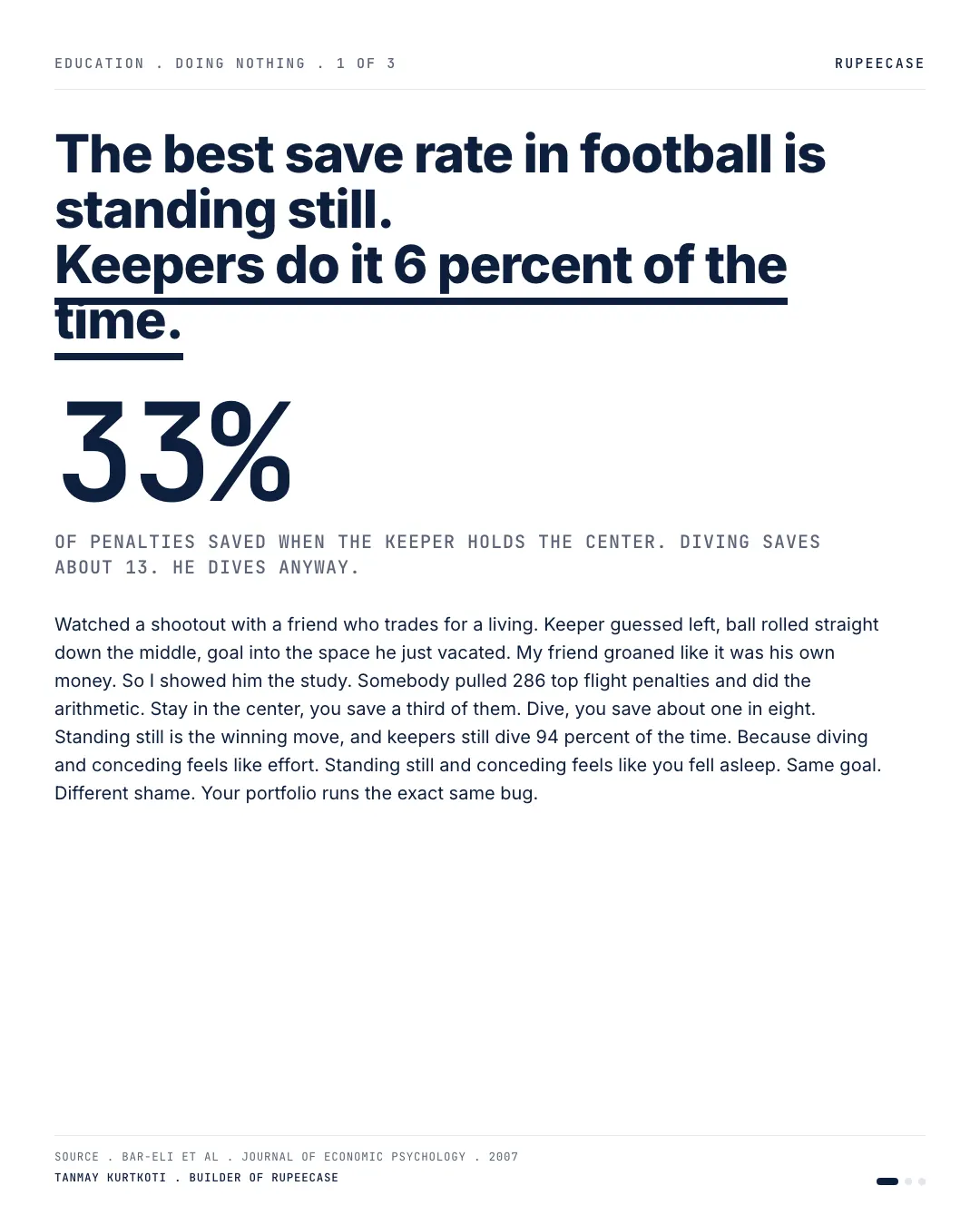
So I showed him the study. Someone sat down with 286 top flight penalties and worked out where keepers should actually stand. The best move is to not move. Hold the center and you save about a third of them. Dive left or right and you save roughly one in eight. Standing still wins by a mile.
Keepers dive 94 percent of the time anyway.
Here is the reason. A goal you concede while planted in the center feels like you fell asleep on the job. A goal you concede mid dive feels like you at least tried. Same goal, same scoreline, completely different shame. And the brain will pay real money to avoid looking like it did nothing.
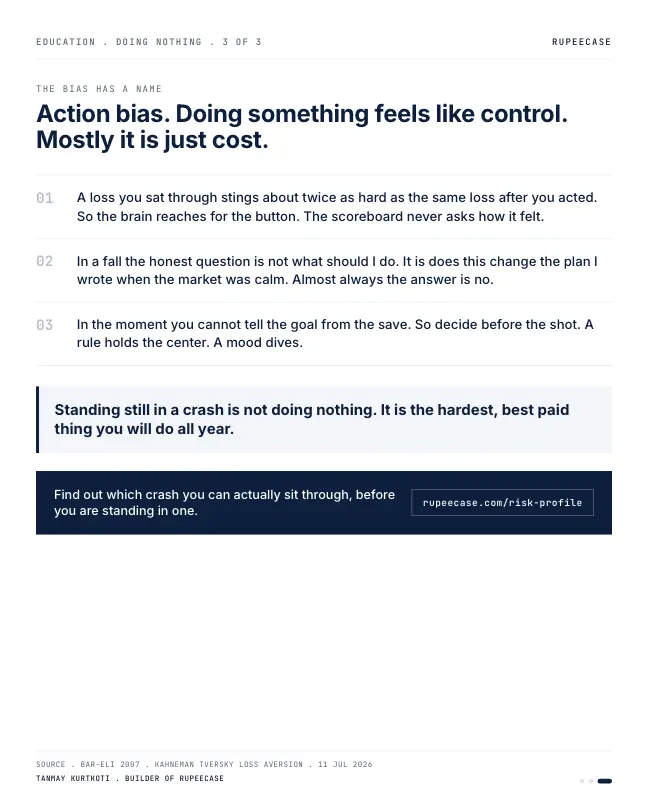
That is action bias. Your portfolio runs it in a crash.
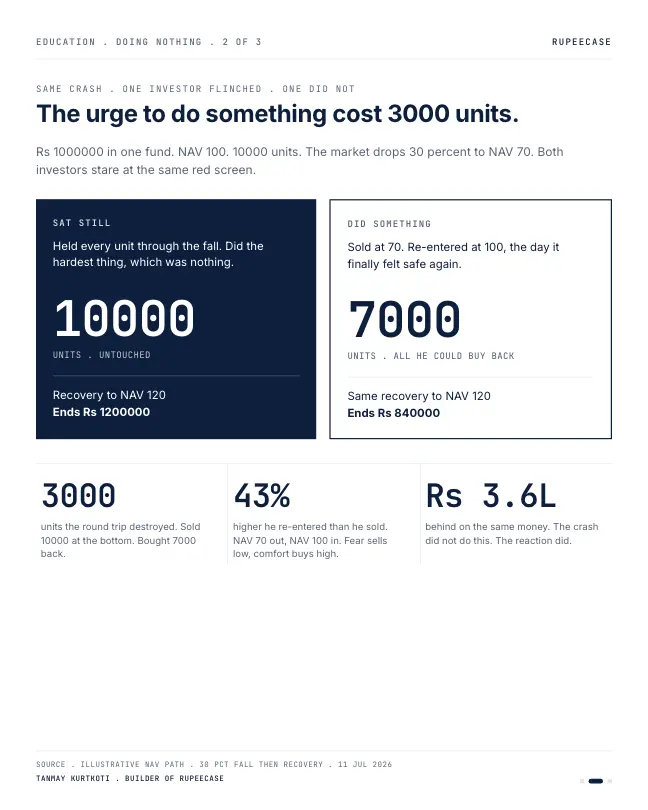
Put it in rupees. Ten lakh in a fund, ten thousand units, market falls 30 percent. The investor who sat still kept all ten thousand units and rode the recovery back to twelve lakh. The one who could not just watch sold near the bottom, waited until it felt safe, and bought back in higher. The same money now buys seven thousand units. He ends at eight lakh forty thousand.
The three thousand units he lost were not taken by the crash. They were the fee for needing to do something.
In a fall the only honest question is not what should I do. It is whether anything actually changed the plan you wrote when the market was calm. Usually nothing did.
The catch is you can only sit still through a drawdown you were built for. Worth knowing that number before you are standing in one:
Units are the score that matters
The opening's example works because it counts units, not rupees. The rupees on the screen go up and down with the price. The units only change when you act. Every sale at a low price and purchase at a higher one swaps units for comfort.
units kept by the investor who sat still
Worked example
units after selling at 70 and buying back at 100
Worked example
gap at a price of 120
Worked example
Here is the arithmetic as a tool. Change the price you sell at, the price at which it "feels safe" again, and where the price ends up.
The same move on the 2026 index
The opening uses round numbers. Here is the same move on NSE's closes for the Nifty 50 this year. The index fell from 26,328.55 on 2 Jan 2026 to 22,331.40 on 30 Mar 2026. Suppose someone sold at that March close and waited until the index had recovered for a few months, buying back at the 31 Jul 2026 close of 24,383.60.
The ratio is 22,331.40 divided by 24,383.60, or 0.916. They come back with about 8.4 percent fewer units than they sold. On a Rs 10 lakh holding that is about Rs 84,000 of index exposure gone, for the comfort of being out during April, May and June. And by 9 Oct 2026, with the index at 22,520.45, the person who bought back in July was sitting on a loss on the new units as well.
Acting also sends you a bill
Action has costs that sitting still does not. Each round trip pays STT of 0.1 percent on the sell and the buy, stamp duty on the buy, exchange charges and brokerage. If the units were in profit and held under 12 months, the sale also triggers short term capital gains tax at 20 percent on listed equity and equity funds, under the rates in force since 23 Jul 2024 and carried into the Income-tax Act 2025. Held over 12 months, gains above Rs 1.25 lakh a year are taxed at 12.5 percent. Sitting still pays none of these.
MythSelling in a crash is the cautious move. At least I did something.
FactSelling low and buying back higher shrinks your units, pays STT and charges twice and may trigger tax. In the worked example it turned 10,000 units into 7,000.
Write the plan before the penalty
The keeper's problem is that he decides in the moment, under shame. The fix in investing is to decide earlier, when nothing is happening, and to write down what will and will not count as a reason to act.
- On a calm dayWrite the mix, the rebalance date and the fall you are sized for.
- In the fallAsk one question: did my goal, income or time horizon change?
- If notDo the scheduled thing: rebalance by rule, keep the SIP date.
- If yesChange the plan deliberately, after the panic, in writing.
The catch from the opening still holds: you can only sit still through a fall you were built for. Our risk profile asks the question in rupees, and the post on risk tolerance as a mood explains why the answer changes on red days. The free Learn module on building systems that protect you from yourself covers pre commitment, checklists and rule design.
Questions readers ask
What is action bias in investing?
It is the urge to do something, usually sell, when markets fall, because acting feels more responsible than waiting even when it leads to a worse result. Selling low and buying back higher leaves you with fewer units than if you had held.
What happens if I sell in a market crash and buy back later?
If you buy back at a higher price, the same money buys fewer units. Selling at 70 and buying back at 100 turns 10,000 units into 7,000. You also pay transaction charges twice and may owe capital gains tax on the sale.
Is it better to hold or sell during a market fall?
That depends on whether your goal, income or time horizon has changed, not on the fall itself. A plan written in advance, with a mix sized for falls of 25 to 30 percent, makes the decision before the market forces it.
The cards
3 cards. Swipe, or tap to open.
Related
- Risk tolerance is a moodGuiso, Sapienza and Zingales found risk aversion rose sharply after 2008 on fear rather than wealth, so ask the drawdown question in rupees, not percentages.Behaviour . . 5 min
- The disposition effectOdean found investors 1.5 times more likely to sell a winner than a loser, and the winners they sold beat the losers they kept by 3.4 points over the next year.Behaviour . . 10 min
- Confirmation bias: research or hopeLord, Ross and Lepper's 1979 study showed mixed evidence hardens both sides, and cutting at minus 15 instead of holding through minus 40 ends Rs 3.51 lakh ahead on Rs 10 lakh.Behaviour . . 9 min
Educational content only. Figures are illustrative and computed on historical or representative data for teaching purposes, not investment advice. Past performance does not guarantee future returns. Sourced from NSE, BSE, SEBI, AMFI and RBI public data.