

Behaviour..6 min read
The IPO pop is not the business
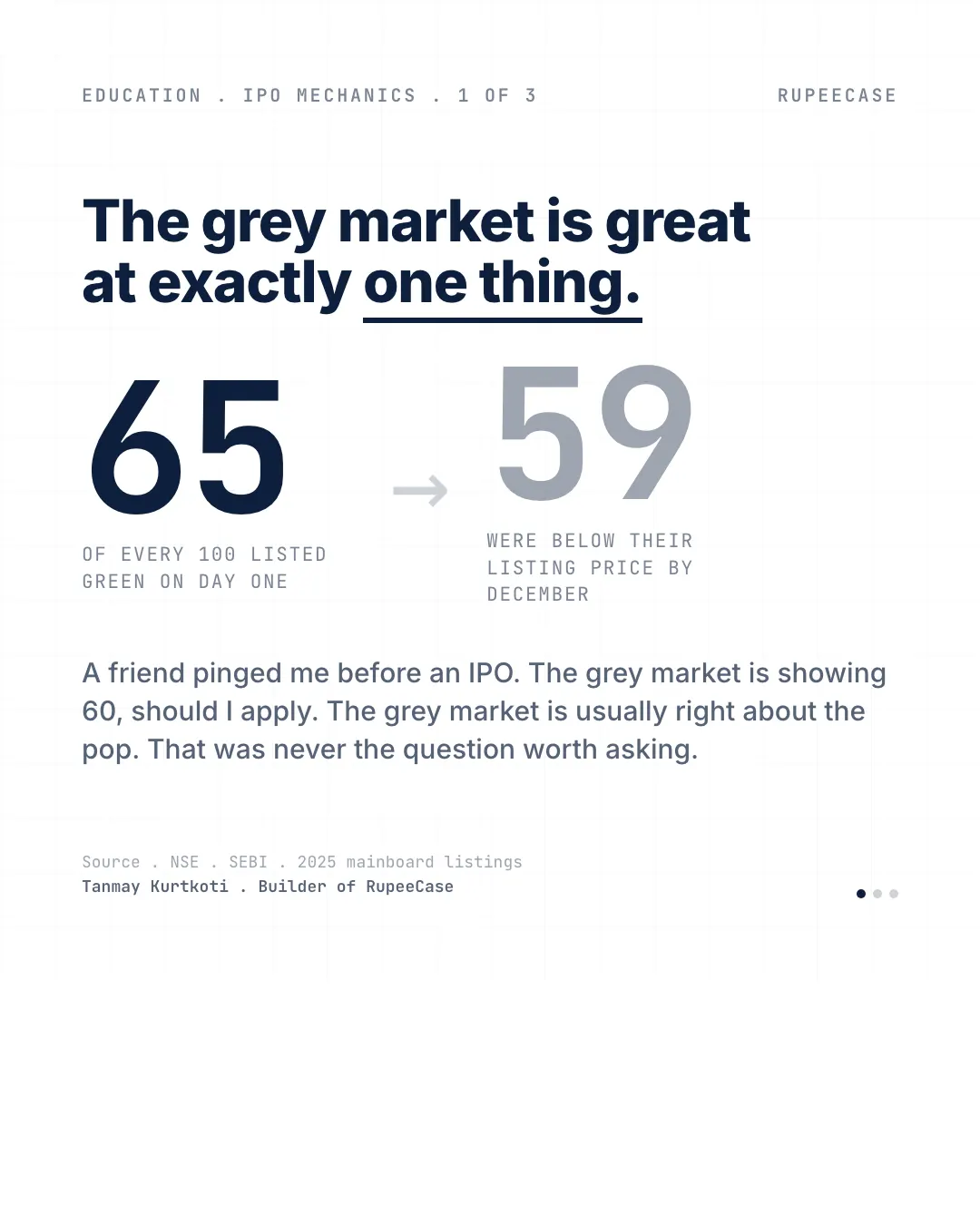
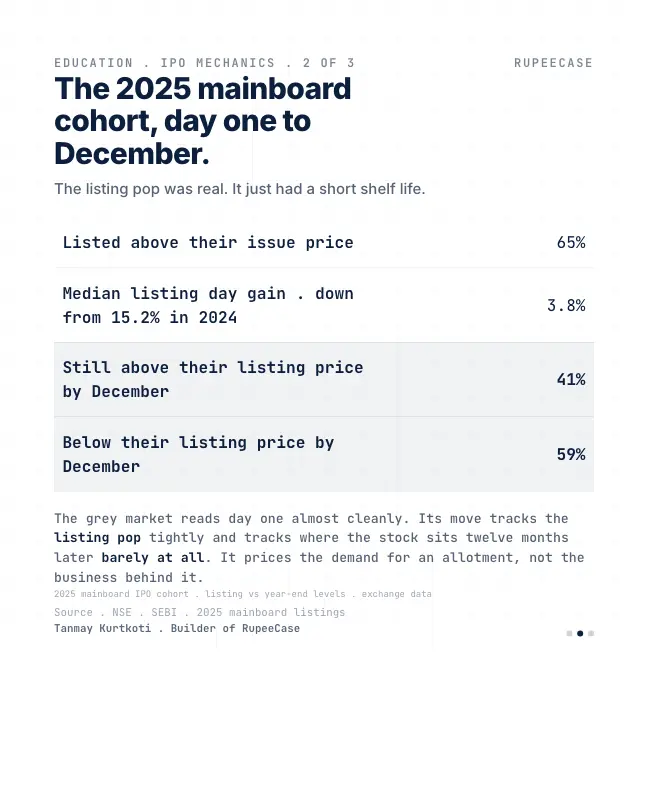
In 2025, 65 of 100 mainboard listings opened above issue price and 59 of 100 traded below their listing by December, because the grey market prices the first hour, not the first year.
By Tanmay Kurtkoti, founder of QC Alpha and builder of RupeeCase
A friend pinged me before an IPO last week. "Grey market is showing 60, should I apply?"
Fair question. And the honest answer is that the grey market is usually right about the thing he was actually asking. It just was not the thing worth asking.
I pulled the 2025 mainboard listings to make the point. 65 of every 100 listed above their issue price. The median listing-day gain was 3.8%, down from 15.2% the year before, but still green. On day one it looked like a perfectly good year to be applying.
Then look at the same names in December. 59 of every 100 were trading below where they listed. The pop was real. It just had a short shelf life.
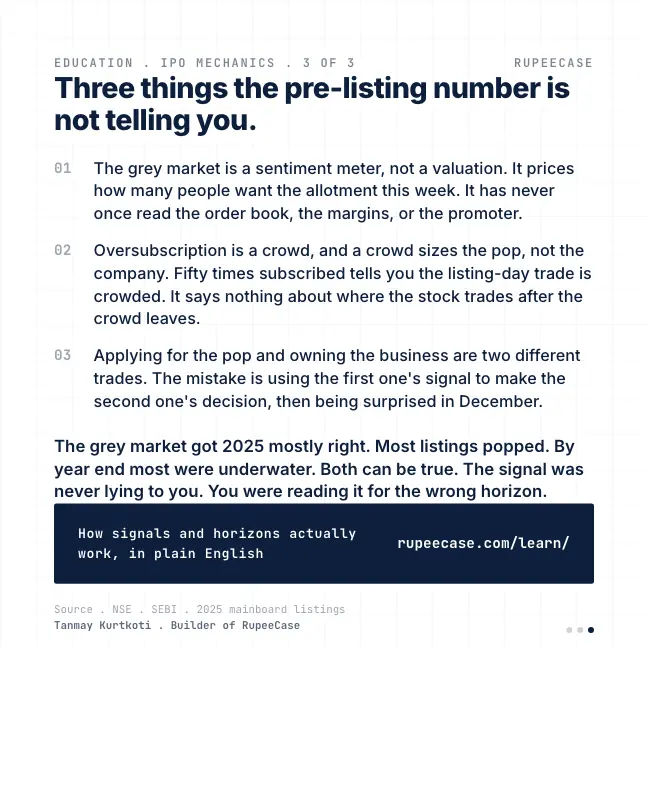
Here is the part that gets skipped. The grey market premium tracks the listing-day move tightly, somewhere around a 0.8 correlation in the studies I have seen. As a sentiment meter for the first hour of trading, it works. But its relationship with where the stock sits twelve months later is close to nothing. Same with oversubscription. Fifty times subscribed tells you the listing-day trade is crowded. It does not read the order book, the margins, or the promoter.
None of that makes the signal a liar. It makes it a signal for one specific horizon.
Applying for the pop and owning the business are two different trades. One is a sentiment bet that closes by lunch on listing day. The other is a five-year decision about cash flows. The expensive mistake is using the first one's number to make the second one's call, then being surprised in December.
First, what the grey market actually is
The grey market is not a market in any official sense. It is informal, off exchange dealing in IPO shares or allotment rights before they list. There is no exchange, no clearing corporation, no SEBI oversight and no recourse if the other side does not pay. The "premium" you see quoted is whatever someone in that chain says it is. That is why I do not quote grey market numbers here, and why nobody can audit them.
What you can audit is the official record. SEBI looked at exactly this question in a study published in September 2024: 144 mainboard IPOs listed between April 2021 and December 2023, with every allottee's holdings traced through the depositories.
Hot demand prices the first day
The cleanest table in that study sorts the 144 issues by how many times they were subscribed and shows the median listing day return for each group.
- Over 100x (17 IPOs)82%
- 10x to 100x (75 IPOs)22%
- 5x to 10x (10 IPOs)10%
- 1x to 5x (40 IPOs)-2%
- Undersubscribed (2 IPOs)2%
Median listing day return by level of subscription, 144 mainboard IPOs, Apr 2021 to Dec 2023. SEBI, Analysis of Investor Behavior in IPOs, Sep 2024, Table 4.
So the crowd is right about day one. Demand that heavy has to clear somewhere, and it clears in the opening auction. That is the one horizon the signal was built for.
And most allottees treat it as a day one trade
The same study then followed the shares. Excluding anchor investors, 54 percent of allotted shares by value were sold within a week of listing, and 72.6 percent within a year. Individuals sold 67.6 percent within a week when the listing return was above 20 percent, but only 23.3 percent when the return was negative.
of allotted shares sold within a week of listing
SEBI IPO study, Sep 2024
sold within a year
SEBI IPO study, Sep 2024
sold in a week by individuals when the pop was over 20%
SEBI IPO study, Sep 2024
sold in a week when the listing was negative
SEBI IPO study, Sep 2024
Read those last two together. People bank the winners fast and sit on the losers. SEBI names it in the study: the disposition effect. So the investor who "applied for the long term" often ends up holding exactly the listings that disappointed, which is how a year of green listing days turns into a red December.
What applying is worth, in rupees
Here is the part the premium hides. A hot issue is also a hard one to get. When the retail book is oversubscribed, allotment is by lottery, one minimum lot per winning applicant. If most people apply for one lot, your chance of getting anything is roughly one divided by the times subscribed.
Take a minimum lot worth Rs 15,000, a retail book subscribed 50 times, and a 20 percent listing pop:
- The gain if you are allotted: 20 percent of Rs 15,000, so Rs 3,000.
- Your chance of allotment: about 1 in 50, so 2 percent.
- What one application is worth before you know the result: 2 percent of Rs 3,000, so about Rs 60.
The pop is real. Your expected share of it is tiny, and it shrinks as the subscription number that excited you grows.
The timeline you are actually trading
Since 1 December 2023, SEBI requires every public issue to list within three working days of the issue closing. That compresses the whole pop trade into less than a week.
- Issue closes
Bids and UPI mandates accepted up to 5 pm.
- Basis of allotment
Rejections finalised and the lottery basis approved by the evening.
- Shares credited, money unblocked
Allotted shares reach demat accounts; unsuccessful bids are unblocked.
- Listing day
A special pre-open call auction sets the opening price; normal trading starts at 10 am.
The 10 am open matters more than it looks. The listing price is found in a call auction where every buyer and seller meets at one price. By the time you can trade continuously, the crowd's view, the one the grey market was guessing at, is already in the price.
The free Learn module on IPOs and new listings covers book building, the investor quotas and lock ins, with a quiz and a certificate. And if you have ever been unable to sell on a wild morning, the day the market did not let you sell explains why.
Questions readers ask
Is the IPO grey market premium legal or regulated?
The grey market is informal, off exchange dealing before listing. It has no exchange, clearing corporation or SEBI oversight, so the quoted premium cannot be verified and there is no recourse if a deal is not honoured.
Does high IPO subscription mean good returns?
It points to a bigger listing day move. In SEBI's study of 144 IPOs from 2021 to 2023, issues subscribed over 100 times had a median listing day return of 82 percent, against minus 2 percent for those subscribed 1 to 5 times. The study says nothing about the business after that first day.
How many days after an IPO closes do shares list?
Three working days. Since 1 December 2023 SEBI requires listing on T+3, where T is the issue closing date, with allotment fixed on T+1 and shares credited on T+2.
The cards
3 cards. Swipe, or tap to open.
Related
- The day the market did not let you sellA 10 percent index move halts the whole market, and a lower circuit means the bids have vanished, which is why position size and not the exit plan is the real protection.Behaviour . . 5 min
- Why your sell is not cash yetIndia settles at T plus one trading day, so a Friday sale lands on Monday and a sale before a long weekend can take five calendar days to become spendable.Behaviour . . 5 min
- Impact cost: zero brokerage was never zero costA Rs 1 lakh round trip costs about Rs 100 of spread on a liquid Nifty name and about Rs 4,000 on a thin small cap, and neither appears on the contract note.Behaviour . . 5 min
Educational content only. Figures are illustrative and computed on historical or representative data for teaching purposes, not investment advice. Past performance does not guarantee future returns. Sourced from NSE, BSE, SEBI, AMFI and RBI public data.