

Behaviour..5 min read
Why your sell is not cash yet
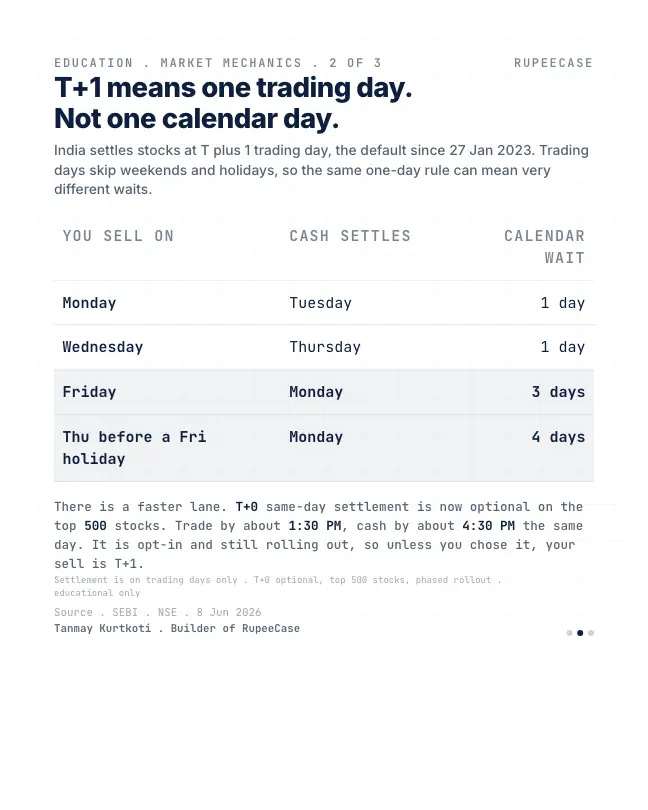
India settles at T plus one trading day, so a Friday sale lands on Monday and a sale before a long weekend can take five calendar days to become spendable.
By Tanmay Kurtkoti, founder of QC Alpha and builder of RupeeCase
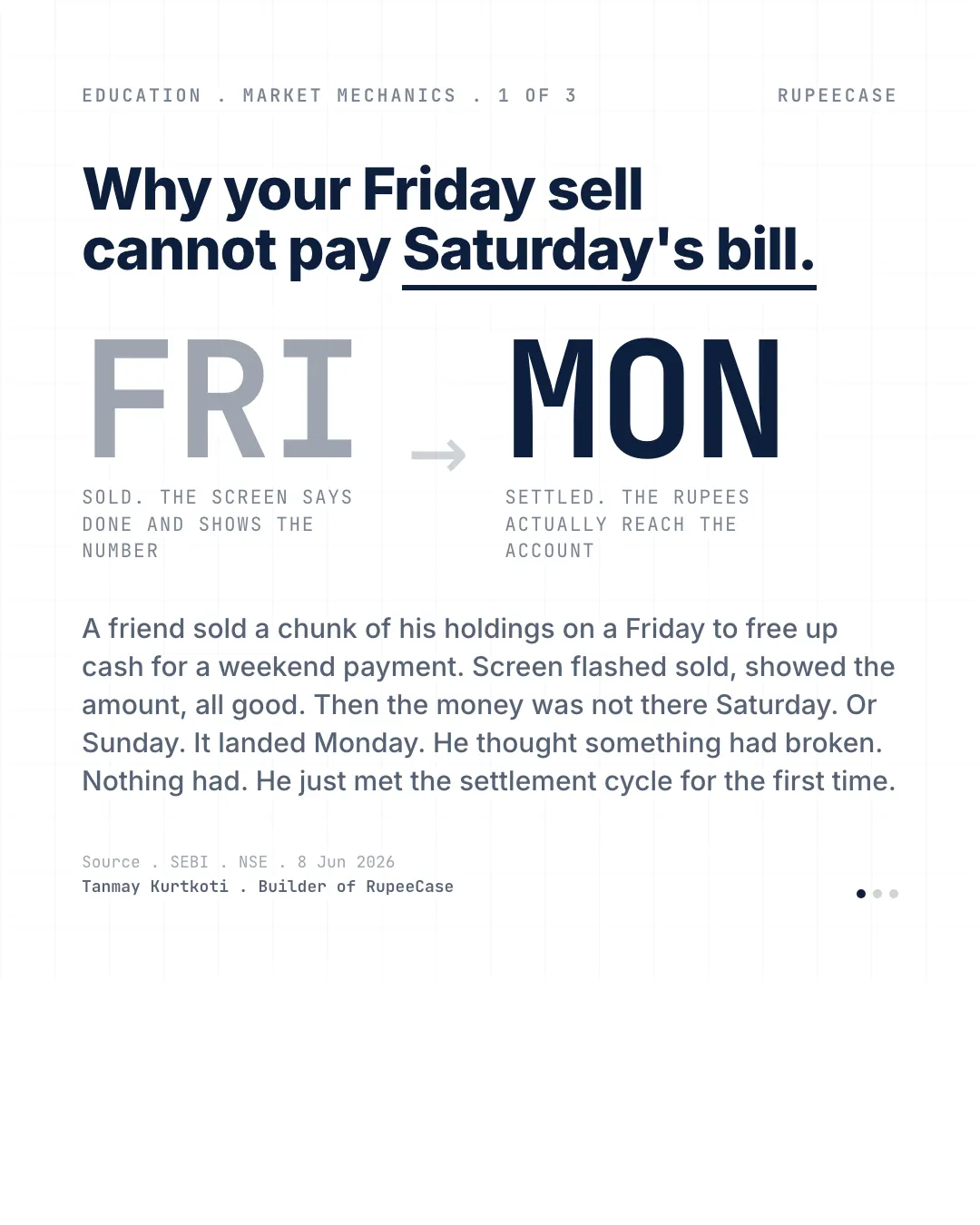
A friend sold a chunk of his portfolio on a Friday. He needed cash for a weekend payment, and selling felt like the fast way to get it.
The screen flashed sold and showed the amount. Saturday came, no money. Sunday, still nothing. It finally landed Monday. He was convinced something had broken.
Nothing had. He had just met the settlement cycle for the first time, worth understanding before you ever sell to pay a bill.
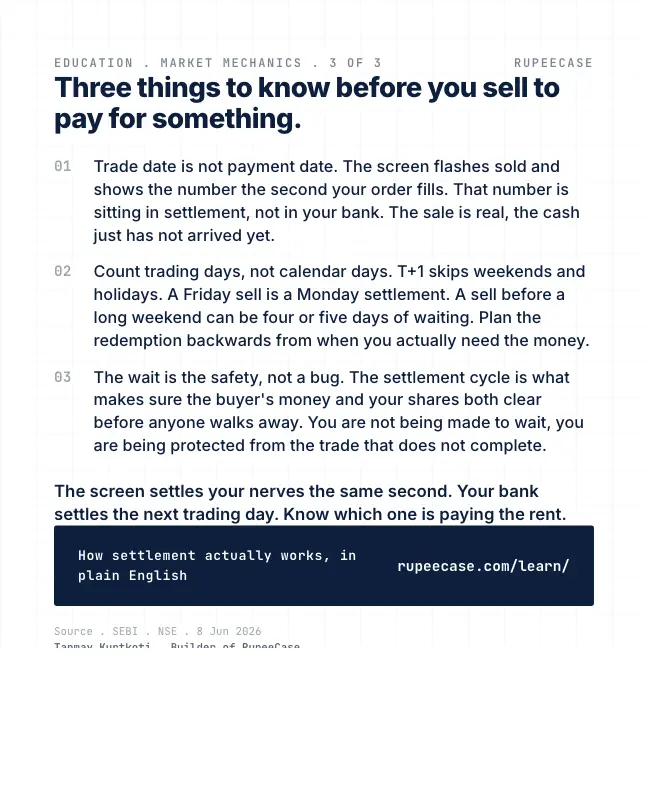
Here is what actually happens. The second your sell order fills, the screen shows the number. That number is real, but it is sitting in settlement, not in your bank account. India settles stocks at T plus one trading day, the default since January 2023. The sale completed. The rupees are simply in transit.
The trap is the word day. T+1 means one trading day, not one calendar day, and trading days skip weekends and holidays. Sell on a Monday and the cash settles Tuesday, one day. Sell on a Friday and it settles the following Monday, three calendar days. Sell the day before a long weekend and you can be waiting four or five. The one-day rule never changed. The calendar did.
There is now a faster lane. Same-day T+0 settlement is optional on the top 500 stocks, cash in by about 4:30 the same afternoon. But it is opt-in and still rolling out, so unless you chose it, your sell is still T+1.
The instinct is to treat the delay as friction. It is the opposite. The cycle guarantees the buyer's money and your shares both clear before either side walks away. You are not being made to wait. You are being protected from the trade that quietly does not complete.
So if you ever sell to fund a real bill, count backwards from the day you need the money, in trading days, not calendar days.
The screen settles your nerves the same second. Your bank settles the next trading day. Know which one is paying the rent.
The 2026 calendar, counted
The opening's long weekend is not rare. NSE had no trading session on 12 weekdays between 1 Jan and 9 Oct 2026. You can see every one of them as a missing day in NSE's daily data: 15 Jan, 26 Jan, 3 Mar, 26 Mar, 31 Mar, 3 Apr, 14 Apr, 1 May, 28 May, 26 Jun, 14 Sep and 2 Oct. Four more are on NSE's 2026 list before the year ends: 20 Oct, 10 Nov, 24 Nov and 25 Dec.
weekdays with no NSE session, 1 Jan to 9 Oct 2026
NSE daily data, 2026
of them on a Monday or a Friday
NSE daily data, 2026
more weekday holidays on the 2026 list after 9 Oct
NSE holiday list, 2026
A Monday or Friday holiday glues itself to a weekend. That is where the four calendar day wait in the opening comes from.
Four sales, four waits
Here is the same T+1 rule on four real sale days from the 2026 calendar. Each bar is the number of calendar days from the sale to the settlement day.
- Mon 6 Apr, settles Tue1
- Fri 9 Oct, settles Mon3
- Thu 1 Oct, settles Mon4
- Thu 2 Apr, settles Mon4
Calendar days from trade to settlement under T+1, using NSE's 2026 trading days (no session on Fri 3 Apr and Fri 2 Oct). Settlement can also skip clearing holidays; check the exchange calendar.
Thursday 2 Apr 2026 is the clean case. Friday 3 Apr was a market holiday, so the next trading day was Monday 6 Apr. A sale on Thursday afternoon settled four calendar days later. The same happened around Gandhi Jayanti: sell Thursday 1 Oct, settle Monday 5 Oct.
Selling enough, not just early enough
The second thing people miss when they sell for a bill is that the sale value is not the cash that arrives. The sell side of a delivery trade pays STT of 0.1 percent, NSE's transaction charge of Rs 3.07 per lakh and the SEBI fee, before brokerage, GST and the depository charge. And if the shares are in profit, tax is due on the gain later in the year, even though it is not deducted from the payout.
The buffer is there because you usually decide the amount before the order fills. A 2 percent buffer on a Rs 1,50,000 bill is about Rs 3,000 of extra shares sold, which is cheap next to finding out on Monday that the payout fell short.
MythT+1 means I get the money tomorrow.
FactT+1 means the next trading day. In 2026, a Thursday sale before a Friday holiday settled on Monday, four calendar days later, and the bank credit can come later still.
The free Learn module on how Indian stock markets work explains the exchange, the clearing corporation and the depository, and who holds what between the trade and the settlement. The companion post on the settlement cycle covers the history from T+5 to T+1 and how little the optional T+0 lane has been used so far.
Questions readers ask
When will I get money after selling shares in India?
Shares sold in the normal market settle on T+1, the next trading day after the sale. The broker then credits the payout, and the transfer to your bank follows. A sale on a Friday, or before a market holiday, settles after the weekend or holiday.
Does T+1 include Saturday, Sunday and holidays?
No. T+1 counts trading days only. A sale on Thursday 2 Apr 2026 settled on Monday 6 Apr because Friday 3 Apr was a market holiday and the next two days were the weekend.
How many market holidays does NSE have in 2026?
NSE's daily data shows no session on 12 weekdays between 1 Jan and 9 Oct 2026, and the 2026 list has four more after that: 20 Oct, 10 Nov, 24 Nov and 25 Dec. Weekend holidays do not affect settlement.
The cards
3 cards. Swipe, or tap to open.
Explore next
Learn it properly, then see it applied.
- GuideAre your shares safe in a demat account?Where the shares and the money actually sit, what SEBI changed, and five checks to run.
- Free module 8.1Why Investors Lose, Introduction to Behavioural Finance11 min read
- StrategyAllcap strategyNifty Total Market, 50 stocks, every 2 weeks
- CalculatorRule of 72Free, with the formula and a worked example
Related
- The IPO pop is not the businessIn 2025, 65 of 100 mainboard listings opened above issue price and 59 of 100 traded below their listing by December, because the grey market prices the first hour, not the first year.Behaviour . . 6 min
- The day the market did not let you sellA 10 percent index move halts the whole market, and a lower circuit means the bids have vanished, which is why position size and not the exit plan is the real protection.Behaviour . . 5 min
- Impact cost: zero brokerage was never zero costA Rs 1 lakh round trip costs about Rs 100 of spread on a liquid Nifty name and about Rs 4,000 on a thin small cap, and neither appears on the contract note.Behaviour . . 5 min
Educational content only. Figures are illustrative and computed on historical or representative data for teaching purposes, not investment advice. Past performance does not guarantee future returns. Sourced from NSE, BSE, SEBI, AMFI and RBI public data.