

Costs: MF, PMS, RupeeCase..5 min read
The Rs 50 lakh door
The PMS minimum is a SEBI rule about the investor, raised from Rs 25 lakh in 2019, and the ladder from a Rs 500 SIP to a Rs 1 crore AIF opens onto mostly the same listed market.
By Tanmay Kurtkoti, founder of QC Alpha and builder of RupeeCase
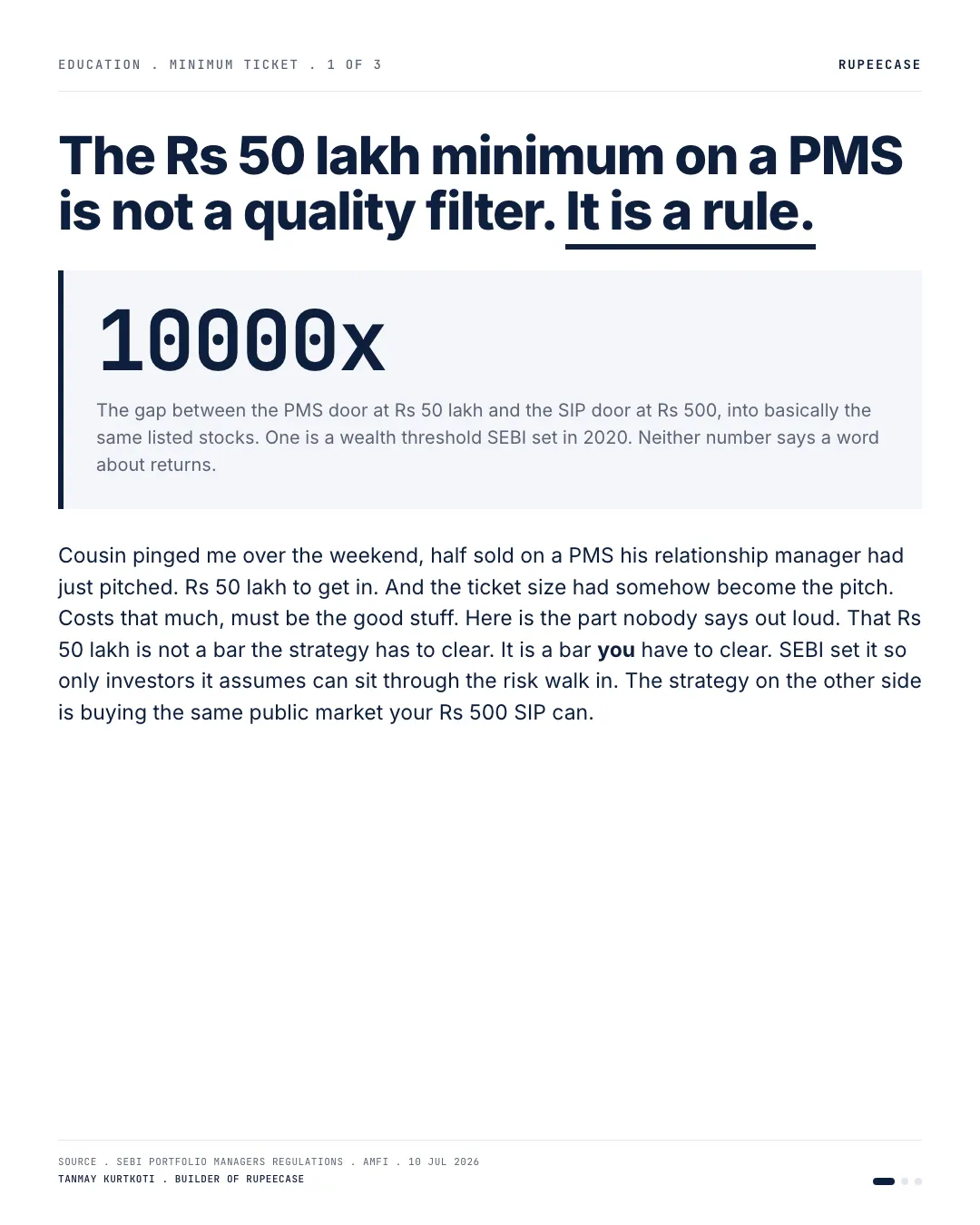
Cousin pinged me over the weekend, half sold on a PMS his relationship manager had just pitched. Rs 50 lakh to get in. And somewhere on that call, the ticket size had quietly become the pitch. Costs that much, must be the good stuff.
Asked him one question. Who set that number, the manager or the regulator?
He did not know. Most people do not. So here it is. The Rs 50 lakh PMS minimum is a SEBI rule about the investor, not a grade on the strategy. It was Rs 25 lakh until 2019. The regulator raised it because it wanted fewer small investors sitting inside concentrated risk. The strategies did not improve overnight. The door just got taller.
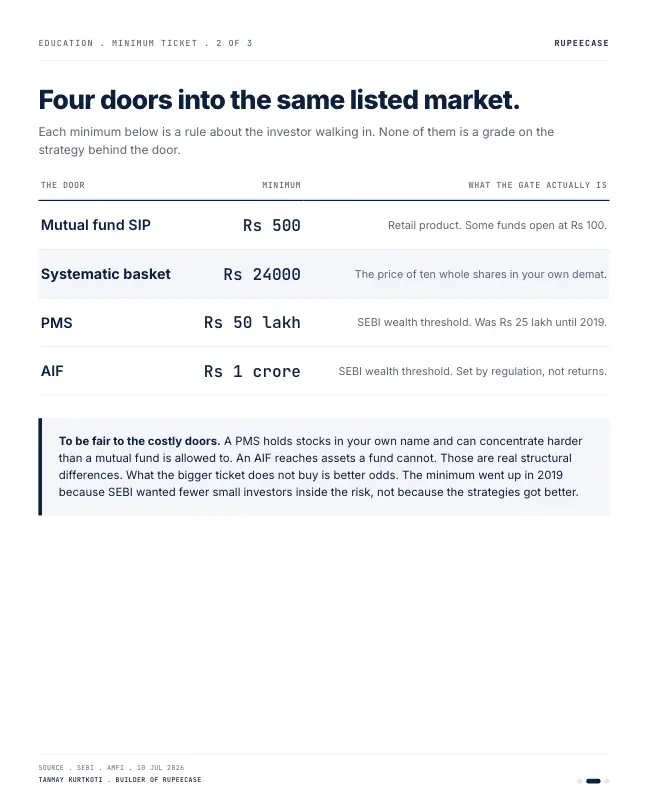
Walk the ladder once. A mutual fund SIP opens at Rs 500, some at Rs 100. A systematic basket in your own demat opens at the minimum its factsheet prints, from about Rs 65,000 for a ten stock basket to about Rs 2.9 lakh for a fifty name one on the 2026 factsheets. A PMS opens at Rs 50 lakh. An AIF opens at Rs 1 crore. Four doors, and behind all four sits mostly the same listed market.
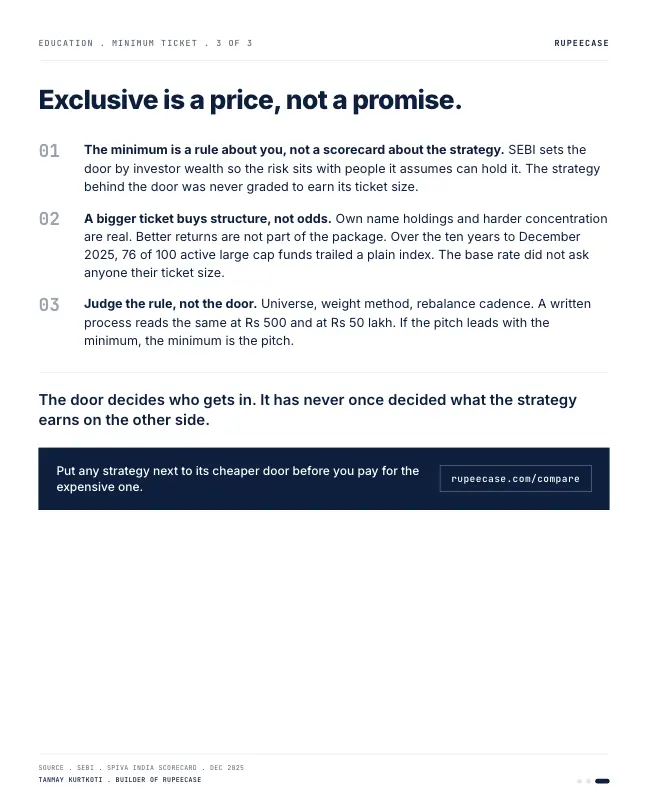
To be fair to the costly doors. A PMS holds stocks in your own name and can concentrate harder than a mutual fund is allowed to. An AIF reaches assets a fund cannot. Real differences. But the one thing the bigger ticket does not buy is better odds. Over the ten years to December 2025, 76 of 100 active large cap funds trailed a plain index. The base rate never asked anyone their ticket size.
So judge the rule, not the door. Universe, weight method, rebalance cadence. A written process reads the same at Rs 500 and at Rs 50 lakh. If the pitch leads with the minimum, the minimum is the pitch.
Exclusive is a price, not a promise.
The doors, with the regulator's numbers
Every minimum on that ladder is set by someone, and the large ones are set by SEBI. Here they are with their sources.
- Smallest RupeeCase basketRs 64,836
- Specialised investment fundRs 10 lakh
- PMSRs 50 lakh
- AIFRs 1 crore
SIF: SEBI circular, 27 Feb 2025. PMS: SEBI PMS Regulations, 16 Jan 2020. AIF: SEBI AIF Regulations, reg. 10(c), per SEBI FAQ. Basket: minimum capital on the RupeeCase Energy Basket factsheet, 13 May 2026 (model portfolio).
A mutual fund SIP sits so far left of this chart that its bar would not show. Each of the other doors also has a carve out: accredited investors, who meet SEBI's income or net worth tests, may enter a PMS or an AIF below the minimum.
The specialised investment fund is the newest door. SEBI created it on 27 Feb 2025 as a middle step between a mutual fund and a PMS, run by fund houses, with a Rs 10 lakh minimum counted across all of a fund's strategies at your PAN. It shows how the regulator thinks about minimums: the ticket rises with the freedom the manager gets, because more freedom means more ways to lose.
How the PMS door got taller
- Rs 5 lakh
The original PMS minimum, per SEBI's 2019 working group report.
- Rs 25 lakh
Raised by amendment.
- Rs 50 lakh
New PMS Regulations. The working group's stated aim: keep small savers out of concentrated, illiquid risk.
- Rs 10 lakh SIF
A regulated middle door below the PMS.
Read the reason SEBI gave. Not that PMS strategies are better, but that they carry concentration and illiquidity risks small savers should not carry. The minimum is a warning label written in rupees.
Why small doors are possible now
Part of what a big ticket used to buy was simple arithmetic: you need enough money to hold whole shares in the right proportions. Take an equal weight basket of 20 stocks. With Rs 1,00,000, each stock gets Rs 5,000. A share priced at Rs 4,800 fits once, and Rs 200 sits idle. A share priced at Rs 6,000 does not fit at all.
That is why a systematic basket sets a price cap and publishes a minimum. Allcap screens out shares priced above Rs 5,000, and its factsheet prints a minimum capital of Rs 2,29,500 for 50 names. Across the lineup, the printed minimums run from Rs 64,836 for the 10 stock Energy Basket to Rs 2,91,975 for Allcap Multi Asset (RupeeCase factsheets, Apr and May 2026, model portfolios).
What the bigger ticket really buys
The opening is fair to the expensive doors, and it is worth listing exactly what each one adds, because none of it is a better hit rate.
- Mutual fundPooled trust, daily NAV, SEBI categories, tax only on your redemptions.
- SIFA fund house product with more room, such as long short strategies.
- PMSShares in your name with a custodian, more concentration, every trade taxed to you.
- AIFUnlisted and illiquid assets a fund cannot hold.
Those are differences in structure, access and freedom. None of them is a promise about returns. The same listed market sits behind the first three doors, and the base rate of beating it does not change with the size of the cheque.
The free Learn module on the SEBI regulatory framework explains what each regulated product protects and where the risks sit, with a quiz. Related: PMS 2 and 20, the rupee math and recipe against paragraph.
Questions readers ask
Why is the minimum investment for PMS Rs 50 lakh?
SEBI set it in the Portfolio Managers Regulations notified on 16 Jan 2020, up from Rs 25 lakh. Its working group said the aim was to keep small savers away from the concentration and illiquidity risks a PMS can carry. It is a rule about who may invest, not a rating of the strategy.
What is the minimum investment in a specialised investment fund?
Rs 10 lakh, counted across all of a fund's strategies at your PAN, under SEBI's framework of 27 Feb 2025. Accredited investors can invest less.
Does a higher minimum investment mean better returns?
No. A higher minimum buys structure and freedom, such as shares in your own name, more concentration or access to unlisted assets. It does not change the base rate of beating the market, which applies to the strategy, not to the ticket size.
The cards
3 cards. Swipe, or tap to open.
Explore next
Learn it properly, then see it applied.
Related
- The tax you pay for someone else's tradesA PMS realises gains in your name every year while a fund defers to exit, and on the same 14 percent gross over ten years the structure alone keeps five to twelve lakh more invested.Costs: MF, PMS, RupeeCase . . 6 min
- Recipe versus paragraph: reading a methodology pageUniverse, entry rule, weight method and cadence decide whether a strategy is a process or a paragraph, and a conviction weighted PMS brochure answers none of them.Costs: MF, PMS, RupeeCase . . 6 min
- PMS 2 and 20: the rupee mathOn a Rs 25 lakh book earning 18 percent gross, a 2 and 20 PMS fee stack with GST and trading drag takes 4.08 points, and the ten year compounding gap is Rs 38 lakh.Costs: MF, PMS, RupeeCase . . 6 min
Educational content only. Figures are illustrative and computed on historical or representative data for teaching purposes, not investment advice. Past performance does not guarantee future returns. Sourced from NSE, BSE, SEBI, AMFI and RBI public data.