

Costs: MF, PMS, RupeeCase..6 min read
PMS 2 and 20: the rupee math
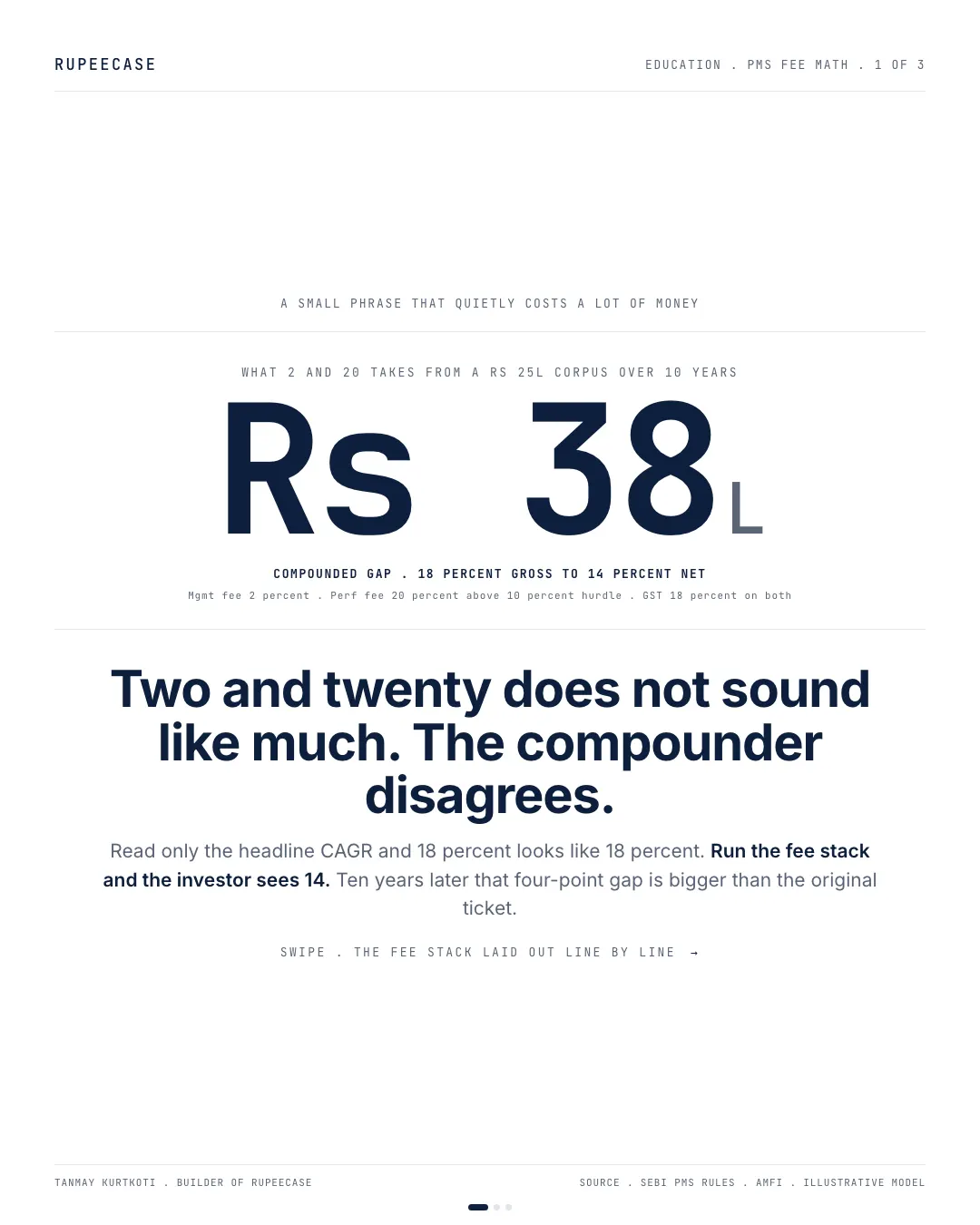
On a Rs 25 lakh book earning 18 percent gross, a 2 and 20 PMS fee stack with GST and trading drag takes 4.08 points, and the ten year compounding gap is Rs 38 lakh.
By Tanmay Kurtkoti, founder of QC Alpha and builder of RupeeCase
Pulled the fee math on a 2-and-20 PMS structure last week. Not the abstract version. The rupee version. The one where you look at the brochure CAGR and the statement CAGR sitting on the same page and ask the compounder to settle the argument.
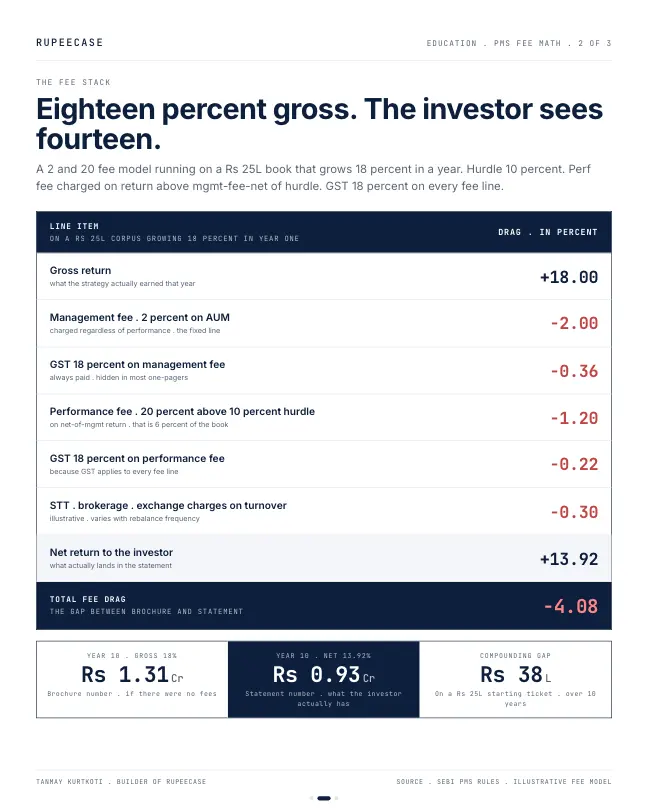
Here is the line by line on a Rs 25L book that grows 18 percent in year one.
Management fee of 2 percent on AUM is 2.0 percent gone. GST at 18 percent on that fee is another 0.36. Performance fee at 20 percent above a 10 percent hurdle, calculated on the return net of management fee, is 1.20. GST on that is 0.22. Trading drag from STT, brokerage and exchange charges is roughly 0.30. The stack is 4.08 percent. The net return to the investor is 13.92 percent. The brochure said 18.
A four-point gap looks small in basis points. Compound it for ten years. Rs 25L at 18 percent gross lands at Rs 1.31 Cr. Rs 25L at 13.92 percent net lands at Rs 0.93 Cr. The compounding gap is Rs 38 lakh. Bigger than the original ticket. The fee stack across structures laid side by side is at rupeecase.com/compare and what compounding actually does to small drags over long horizons is at rupeecase.com/learn/
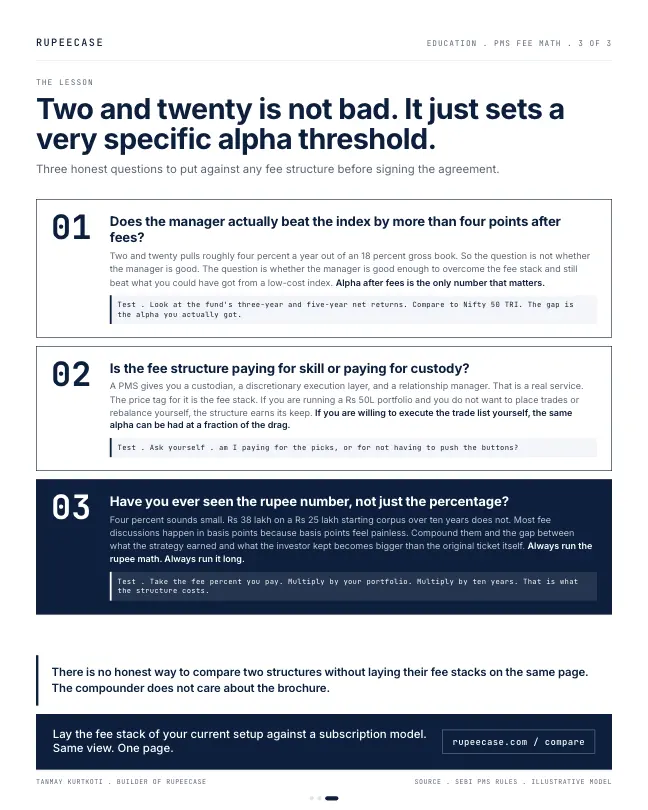
The point is not that 2 and 20 is a bad structure. PMS gives you a custodian, a discretionary execution layer, and a relationship manager. That is a real service and the price tag for it is the fee stack. If you have a Rs 50L plus portfolio and you genuinely do not want to place trades or rebalance yourself, the structure earns its keep. The fee math is not the issue. The math is just the math.
The issue is the comparison most investors never run. After the four-point fee stack, can the manager still beat what a low-cost index, or a transparent rule-based system, would have given you? That is the only number that matters. Alpha after fees. Not gross. Not before. After.
If you are willing to push the buttons yourself, the same picks at a fraction of the drag sit at rupeecase.com/strategies/ and the behavioural-fit test that tells you whether you can actually run them yourself is at rupeecase.com/risk-profile
The compounder does not care about brochures. Always run the rupee math. Always run it long.
Run the 2 and 20 on your own numbers
The line by line above is easy to redo. Here it is as a calculator, with the same rules: a 2 percent management fee on assets, a 20 percent share of the return above a 10 percent hurdle measured after the management fee, 18 percent GST on both fees, and about 0.30 percent of trading drag. Change the gross return and watch which lines move.
Try a flat year. At a 10 percent gross return the performance fee is zero, but the management fee and its GST still take 2.36 percent, and trading another 0.30. You keep 7.34 percent. The fixed part of the stack never takes a year off.
What SEBI fixes in a PMS fee, and what it leaves to the contract
A portfolio management service is regulated by SEBI, and some of the fee rules are not negotiable. SEBI's circular of 13 Feb 2020, issued with the Portfolio Managers Regulations notified on 16 Jan 2020, set out these:
minimum investment per client
SEBI PMS Regulations, notified 16 Jan 2020
cap on yearly operating expenses, before brokerage
SEBI circular, 13 Feb 2020
most exit load in year one, then 2%, 1%, nil after three years
SEBI circular, 13 Feb 2020
The same circular bars upfront fees, charged directly or indirectly. It makes every portfolio manager offer direct onboarding, without a distributor, with no charges at onboarding except statutory ones. That is the PMS version of a direct plan, and it is worth asking for by name.
The management fee rate, the hurdle and the performance share are set in your agreement. SEBI does set how a performance fee works over time: it is charged only on gains above the high water mark, the highest value the account has reached. SEBI's FAQ on portfolio managers, updated 20 Sep 2024, carries a worked illustration of it.
The high water mark on Rs 50 lakh
Here is why the high water mark matters, on the minimum ticket. Same fees as above.
- Year one, gross 18 percent. Rs 50 lakh becomes about Rs 56.96 lakh after the full stack, the 13.92 percent from the opening. That is the new high water mark.
- Year two, gross minus 10 percent. No performance fee, but the management fee, its GST and trading still apply. The account ends near Rs 49.75 lakh.
- Year three, gross plus 20 percent. After the management fee the account is about Rs 58.71 lakh.
Without a high water mark, the 20 percent share would apply to the whole return above the 10 percent hurdle in year three: about Rs 3.98 lakh of excess, a fee of about Rs 79,600 before GST. That is the case the rule exists to stop. With the mark, the fee applies only above Rs 56.96 lakh, the old peak. The excess is about Rs 1.74 lakh and the fee about Rs 34,900. You do not pay twice for climbing back to where you already were.
- Minimum raised to Rs 25 lakh
It had been Rs 5 lakh before, per SEBI's 2019 working group report.
- New PMS Regulations notified
Minimum ticket Rs 50 lakh per client.
- Fee guidelines
No upfront fees, exit load caps, 0.50 percent cap on operating expenses, direct onboarding.
- FAQ updated
Worked illustrations of the high water mark and time weighted returns.
Alpha after fees is the only comparison
The opening asks whether the manager can beat a low cost alternative after a four point stack. Put numbers on it. Say the alternative costs 0.5 percent a year. To hand you the same 12 percent net, the PMS above needs about 14.8 percent gross. To match 18 percent net, it needs about 22.7 percent gross, because the fee stack grows as the return grows. At an 18 percent gross return the stack is 4.08 percent; at 25 percent it is 5.73 percent.
The cost of the alternative is not zero either, and I would rather say that plainly. A rules based basket you run in your own demat pays STT, stamp duty, exchange charges and its own fee on every rebalance. What changes is that every line is visible and none of them takes a share of your gains. The free Learn module on the SEBI regulatory framework covers what PMS, AIF and mutual fund rules protect, with a quiz, and the fee drag calculator runs any fee over any horizon. Two related posts: the Rs 50 lakh door and the tax you pay for someone else's trades.
Questions readers ask
What is the minimum investment for a PMS in India?
Rs 50 lakh per client, in cash or securities, under the SEBI (Portfolio Managers) Regulations notified on 16 Jan 2020. Accredited investors are exempt. Before that the floor was Rs 25 lakh, and before Feb 2012 it was Rs 5 lakh.
What is a high water mark in PMS fees?
It is the highest value your account has reached. A performance fee is charged only on gains above that mark, so after a losing year you do not pay a performance fee again for recovering the same ground. SEBI's FAQ of 20 Sep 2024 shows a worked example.
Can a PMS charge an exit load?
Yes, within limits set by SEBI on 13 Feb 2020: at most 3 percent of the amount redeemed in the first year, 2 percent in the second, 1 percent in the third, and nothing after three years. Upfront fees are not allowed at all.
The cards
3 cards. Swipe, or tap to open.
Explore next
Learn it properly, then see it applied.
- GuideHow to evaluate a PMS: the rules, the fees in rupees and the questions to askSEBI's fee caps, the benchmark rule, a profit share in rupees, and the checklist.
- Free module 6.3Mutual Funds, Structure, Types and Hidden Costs8 min read
- StrategyAllcap strategyNifty Total Market, 50 stocks, every 2 weeks
- CalculatorSIP calculatorFree, with the formula and a worked example
Reading path
Stop 5 of 8 on The cost stack
Related
- Recipe versus paragraph: reading a methodology pageUniverse, entry rule, weight method and cadence decide whether a strategy is a process or a paragraph, and a conviction weighted PMS brochure answers none of them.Costs: MF, PMS, RupeeCase . . 6 min
- The tax you pay for someone else's tradesA PMS realises gains in your name every year while a fund defers to exit, and on the same 14 percent gross over ten years the structure alone keeps five to twelve lakh more invested.Costs: MF, PMS, RupeeCase . . 6 min
- The Rs 50 lakh doorThe PMS minimum is a SEBI rule about the investor, raised from Rs 25 lakh in 2019, and the ladder from a Rs 500 SIP to a Rs 1 crore AIF opens onto mostly the same listed market.Costs: MF, PMS, RupeeCase . . 5 min
Educational content only. Figures are illustrative and computed on historical or representative data for teaching purposes, not investment advice. Past performance does not guarantee future returns. Sourced from NSE, BSE, SEBI, AMFI and RBI public data.