

Costs: MF, PMS, RupeeCase..6 min read
The tax you pay for someone else's trades
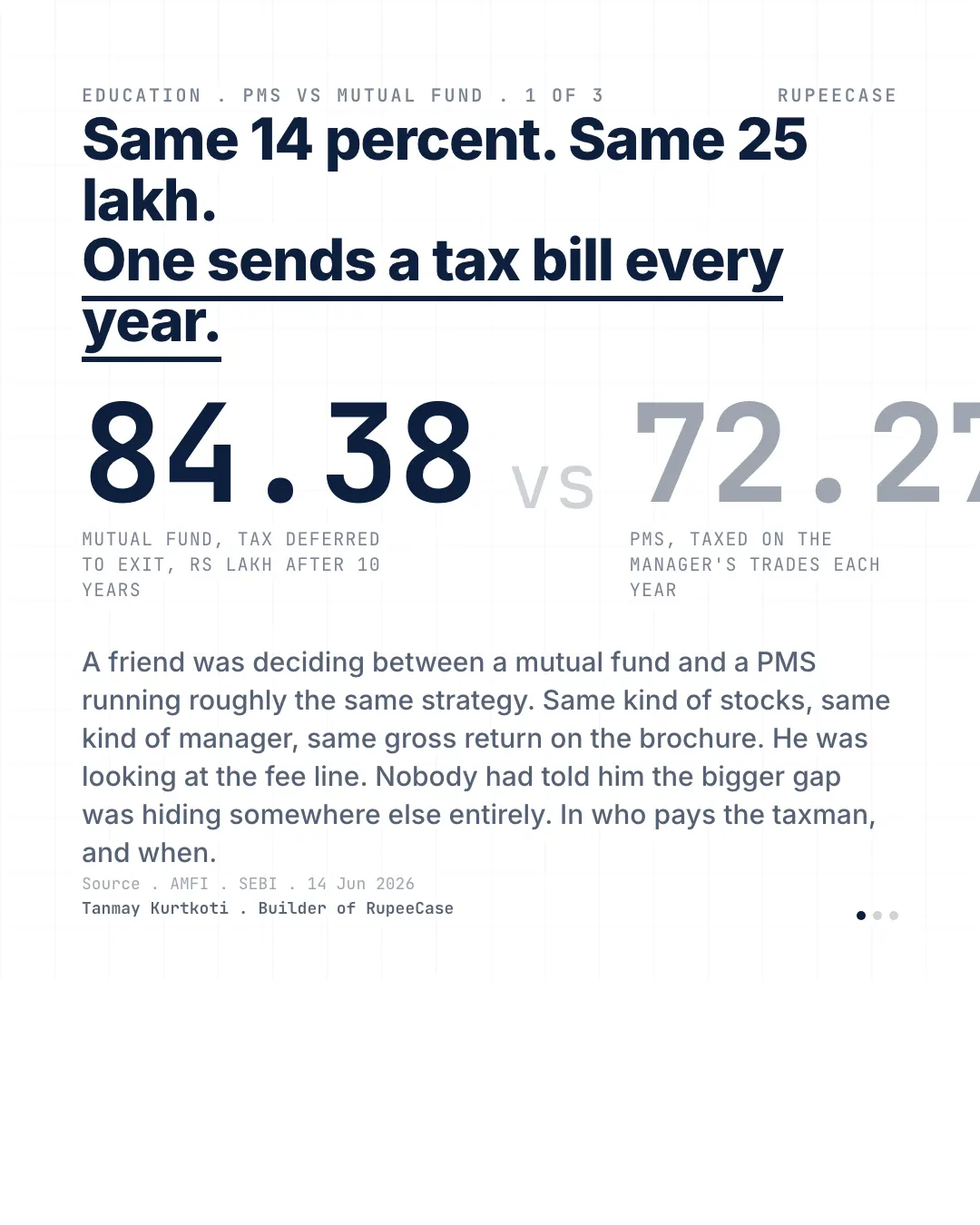
A PMS realises gains in your name every year while a fund defers to exit, and on the same 14 percent gross over ten years the structure alone keeps five to twelve lakh more invested.
By Tanmay Kurtkoti, founder of QC Alpha and builder of RupeeCase
A friend was deciding between a mutual fund and a PMS running roughly the same strategy. Same kind of stocks, same kind of manager, the same gross return printed on both brochures. He was comparing the fee lines, line by line, trying to find the catch.
The catch was not in the fee. It was in the tax, and almost nobody points at it.
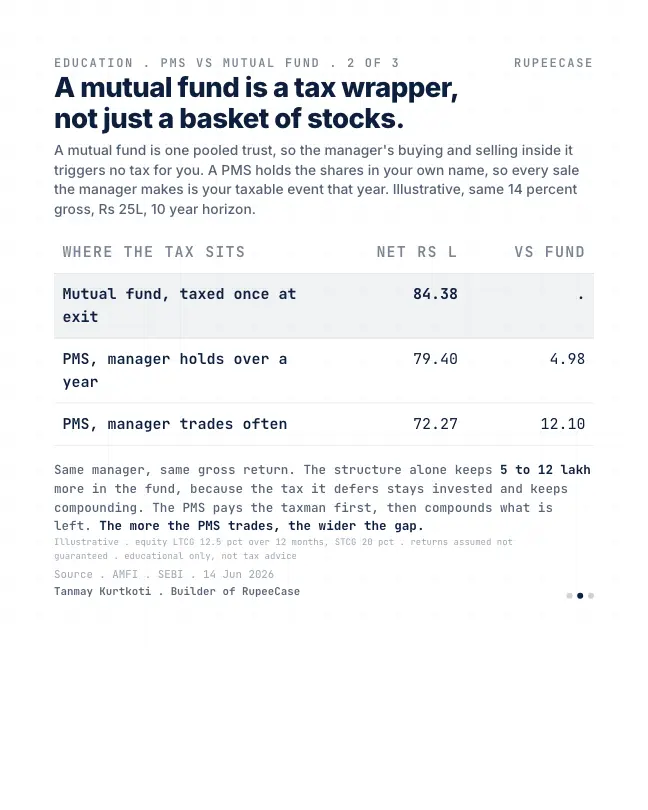
Here is the mechanic. A mutual fund is a single pooled trust. When the fund manager trades inside it, churning the portfolio all year, none of that touches your tax return. You owe capital gains only the day you redeem your own units. A PMS is built the other way. The shares sit in your own name, so every sale the manager makes is your taxable event in that financial year, whether you withdrew a single rupee or not.
Put numbers on it. Same 14 percent gross return, Rs 25 lakh, ten years. The mutual fund defers tax to the exit and ends at about Rs 84.38 lakh after one capital gains event. A PMS realising those same gains every year ends near Rs 79.40 lakh if the manager mostly holds for over a year, and around Rs 72.27 lakh if the manager trades often. Same strategy, same gross return. The structure alone keeps five to twelve lakh more in the fund.
The reason is simple once you see it. The tax a mutual fund defers does not vanish, but it stays invested and keeps compounding until you leave. The PMS pays the taxman first and compounds what is left. The more the PMS trades, the wider that gap grows.
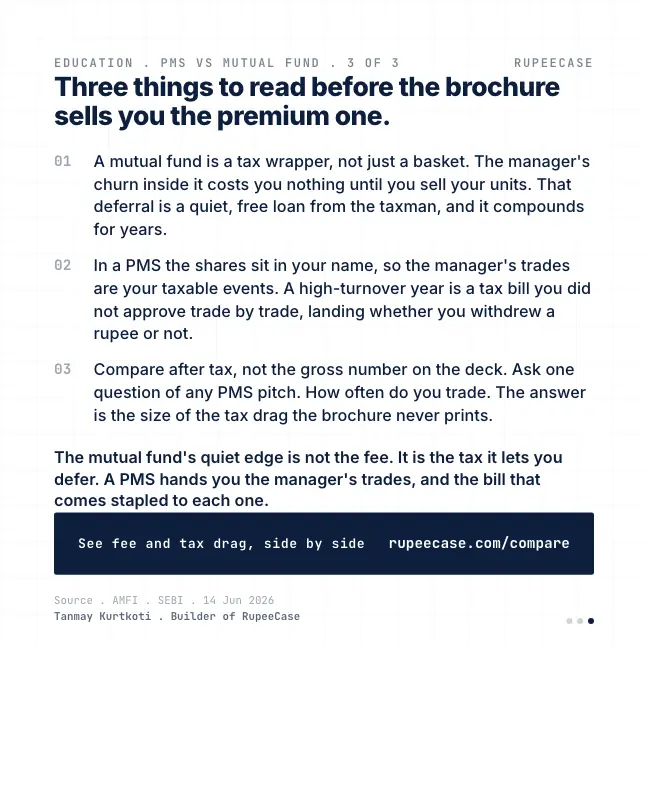
None of this makes a PMS wrong. It makes the gross number on the deck the wrong thing to compare. Read the after-tax outcome, and ask one question of any pitch: how often do you trade.
Two wrappers, two tax clocks
The mechanic in the opening comes down to who owns the shares. In a mutual fund the trust owns them, and you own units of the trust. In a PMS the shares sit in your own demat account, and the manager trades them for you.
The trust trades, you hold units
- Manager's sales are not your tax events
- You pay capital gains only when you redeem units
- One holding period: your own units
The shares are yours, every sale counts
- Each sale by the manager is your capital gain that year
- Each lot has its own holding period
- Every trade lands in your own tax return
The rates are the same for both. Since 23 Jul 2024, a listed share or an equity fund unit sold within 12 months is taxed at 20 percent on the gain. Held longer, the gain is taxed at 12.5 percent, with the first Rs 1.25 lakh of long term gains in a year exempt. What differs is how often the bill arrives.
The three endings, rebuilt
Here are the opening's numbers so you can redo them. Rs 25 lakh, 14 percent a year before tax, ten years.
- Mutual fund. Rs 25 lakh grows untouched to about Rs 92.68 lakh. At exit the gain is Rs 67.68 lakh; after the Rs 1.25 lakh exemption, 12.5 percent tax is about Rs 8.30 lakh. You keep about Rs 84.38 lakh.
- PMS that holds past a year and realises the year's gains. Each year 12.5 percent of the gain goes, so the book compounds at 12.25 percent instead of 14. It ends near Rs 79.40 lakh.
- PMS that trades often. Each year 20 percent of the gain goes, so the book compounds at 11.2 percent. It ends near Rs 72.27 lakh.
- Mutual fund, tax at exitRs 84.38 L
- PMS, long term, exemptionRs 82.17 L
- PMS, long term, no reliefRs 79.40 L
- PMS, short term every yearRs 72.27 L
Rs 25 lakh, 14% a year gross, 10 years. Tax rates for transfers from 23 Jul 2024, before surcharge and cess. Worked example.
The second bar is the honest counterpoint the opening left out. The Rs 1.25 lakh exemption is yearly, per person. A PMS that realises long term gains every year can use it every year, while the fund holder uses it once, at exit. If the PMS is your only source of long term gains, that narrows the gap to about Rs 2.2 lakh. If you already use the exemption on other investments, it does not help, and the gap is closer to Rs 5 lakh.
Run it on your own numbers
Set the yearly tax rate to 12.5 and the gap shrinks to about Rs 5 lakh. Set the return to 20 percent and it widens, because deferral is worth more when there is more growth to defer.
What the yearly bill does to your paperwork
There is a second cost, and it is not money. Every sale in a PMS is your sale. Each one shows up in your Annual Information Statement and has to be reported, lot by lot, in the capital gains schedule of your return. A manager who turns the book over once a year can generate hundreds of lines. A mutual fund holder reports only the units he sold.
- Manager sellsInside a fund: nothing for you. In a PMS: a capital gain in your name.
- Year endThe PMS statement lists every realised gain and loss.
- Tax returnShort term at 20 percent, long term at 12.5 above Rs 1.25 lakh.
- Next yearSmaller base compounds. The deferred tax in a fund keeps working.
The PMS has one tax tool a fund holder lacks: losses realised by the manager are your losses, and can be set off against your gains that year. That can matter in a falling year. It does not change the base case above, where the gains are the norm.
So the question in the opening stands: how often do you trade. A slow PMS with a long holding period gets close to the fund. A fast one pays the taxman first, every year. The free Learn module on tax efficient portfolio construction works through asset location, holding periods and harvesting with a quiz, and the capital gains tax calculator runs any sale. Related: PMS 2 and 20, the rupee math and the Rs 50 lakh door.
Questions readers ask
Is PMS taxed differently from mutual funds?
The tax rates are the same, but the timing differs. In a PMS the shares are in your name, so every sale by the manager is your capital gain in that year. In a mutual fund the trust's trading is not taxed in your hands; you pay only when you redeem units.
How much does yearly taxation cost over ten years?
On Rs 25 lakh at 14 percent a year, paying 20 percent tax on gains every year ends near Rs 72.27 lakh after ten years, against about Rs 84.38 lakh when 12.5 percent is paid once at exit. Paying 12.5 percent every year ends near Rs 79.40 lakh.
Can I use the Rs 1.25 lakh LTCG exemption every year?
Yes. The exemption applies to long term gains on listed equity and equity funds each financial year, per person. A portfolio that realises long term gains every year can use it each year, if you have no other long term gains to set it against.
The cards
3 cards. Swipe, or tap to open.
Reading path
Stop 6 of 8 on The cost stack
Related
- Recipe versus paragraph: reading a methodology pageUniverse, entry rule, weight method and cadence decide whether a strategy is a process or a paragraph, and a conviction weighted PMS brochure answers none of them.Costs: MF, PMS, RupeeCase . . 6 min
- The Rs 50 lakh doorThe PMS minimum is a SEBI rule about the investor, raised from Rs 25 lakh in 2019, and the ladder from a Rs 500 SIP to a Rs 1 crore AIF opens onto mostly the same listed market.Costs: MF, PMS, RupeeCase . . 5 min
- PMS 2 and 20: the rupee mathOn a Rs 25 lakh book earning 18 percent gross, a 2 and 20 PMS fee stack with GST and trading drag takes 4.08 points, and the ten year compounding gap is Rs 38 lakh.Costs: MF, PMS, RupeeCase . . 6 min
Educational content only. Figures are illustrative and computed on historical or representative data for teaching purposes, not investment advice. Past performance does not guarantee future returns. Sourced from NSE, BSE, SEBI, AMFI and RBI public data.