

Costs: MF, PMS, RupeeCase..5 min read
Multicap vs flexicap: the same shelf, opposite mandates
A multicap must keep at least 25 percent each in large, mid and small caps while a flexicap can hold no small caps at all, which is why fund houses converted in 2020.
By Tanmay Kurtkoti, founder of QC Alpha and builder of RupeeCase
A cousin forwarded me two funds last week and asked which one to buy.
Both were sitting under the same tab on his app. Diversified equity. Go anywhere. He was about to pick whichever one had the bigger return on the screen, which is what most people do.
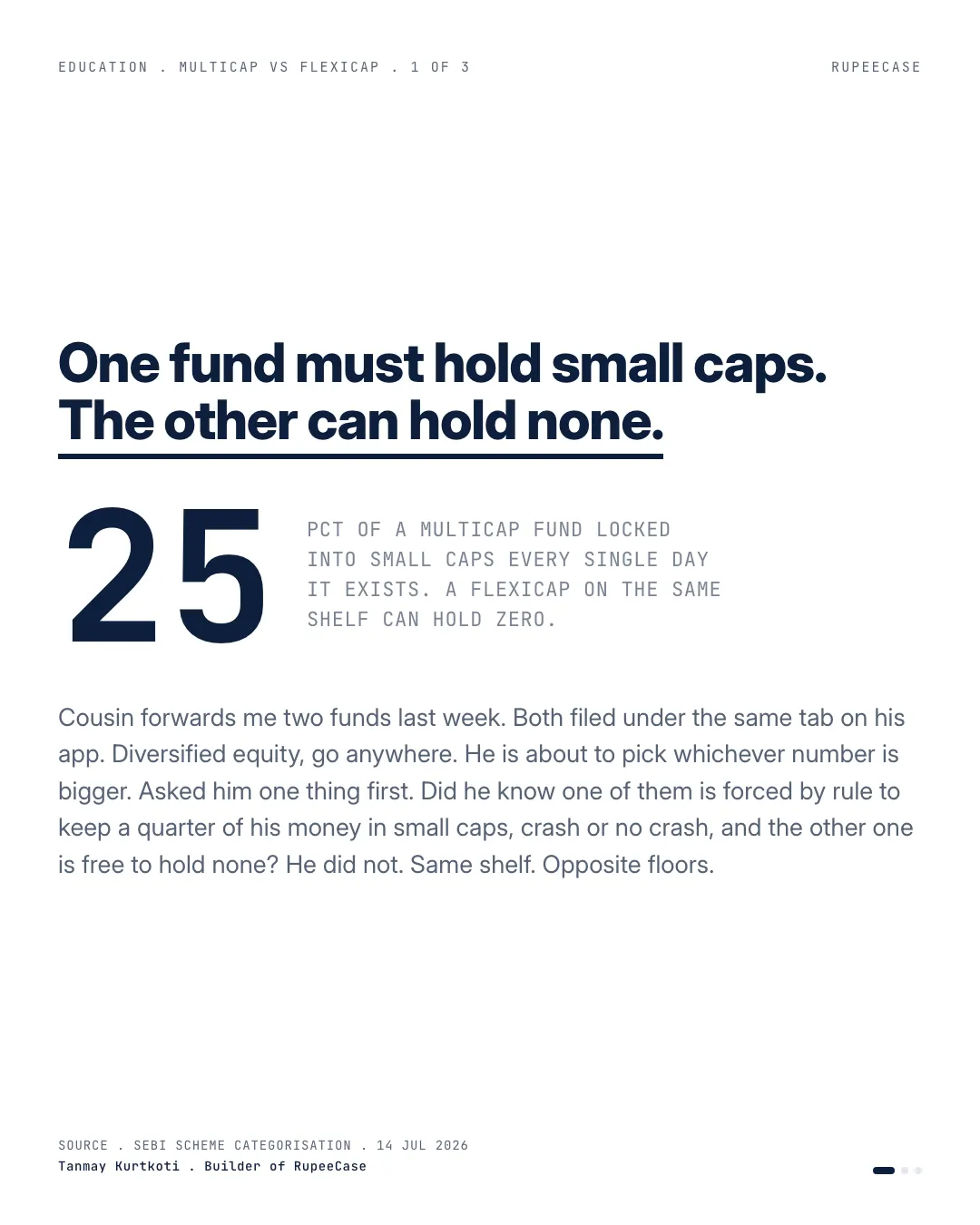
I asked him one thing first. Did he know that one of those funds is required, by rule, to keep a quarter of his money in small caps every single day it exists, crash or no crash. And that the other one, on the same shelf, is free to hold none.
He did not. Most people do not.
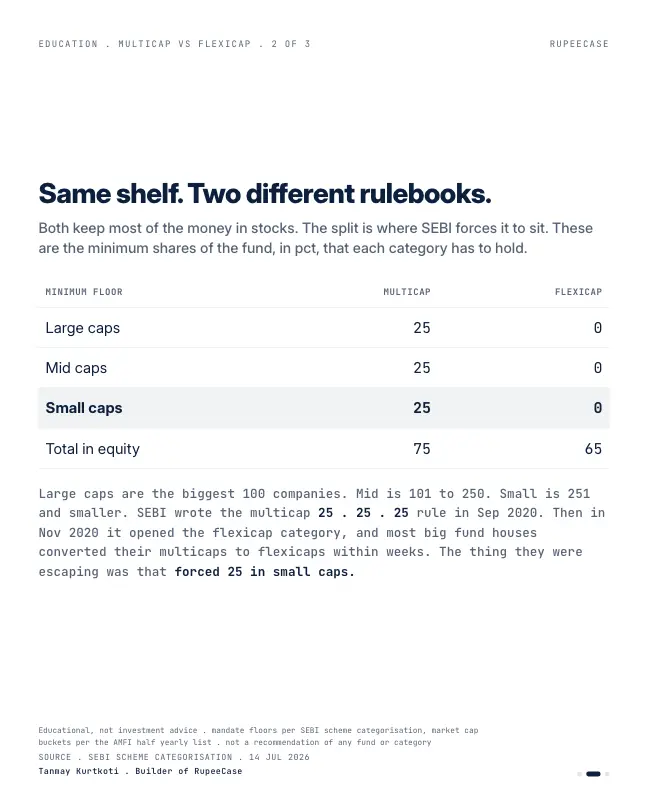
Here is the part nobody reads. A multicap fund is boxed in by SEBI. At least 25 percent in large caps, 25 in mid, 25 in small. Three quarters of the book locked into a fixed shape. A flexicap has exactly one constraint. Keep 65 percent in stocks. After that the manager roams wherever he likes, and the floor under small caps is zero.
Now the detail that gives the whole thing away. Flexicap did not always exist. SEBI wrote the 25 in small caps rule in September 2020. Eight weeks later it opened the flexicap category, and most of the big fund houses converted their multicaps into flexicaps almost immediately. The thing they were escaping was that forced small cap sleeve.
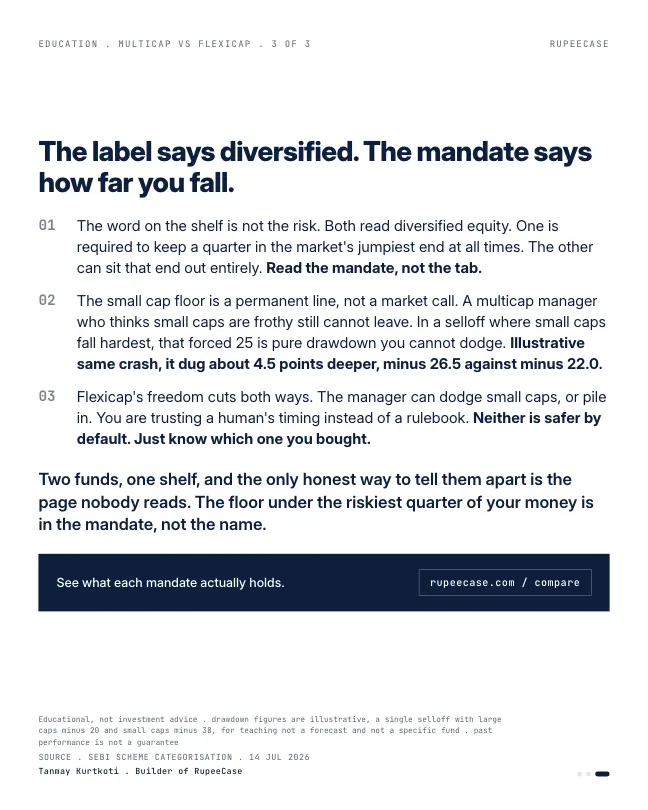
So when a fund is labelled diversified, that word is doing almost no work. One version has to sit through every small cap drawdown with a quarter of your money. The other can dodge it, or double down, depending on one human's read of the market. Neither is automatically safer. But they are not the same fund, and the shelf will never tell you which one you are holding.
Read the mandate, not the tab.
Two mandates, as SEBI writes them
The current wording sits in SEBI's categorisation circular of 26 Feb 2026, which carries the 2020 rules forward. Side by side, the two categories are almost opposites.
A fixed shape
- At least 75 percent in equity
- At least 25 percent each in large, mid and small caps
- Only the last quarter is the manager's call
One rule
- At least 65 percent in equity
- No minimum in any size band
- Small caps can be zero, or most of the book
Those size bands are the same ones NSE uses for its indices. The Nifty Midcap 150 holds the companies ranked 101 to 250, and the Nifty Smallcap 250 the next 250. So "a quarter in small caps" means a quarter of your money in companies ranked 251 and below.
The eight weeks that made the shelf
- SEBI standardises fund categories
A multi cap fund had to be at least 65 percent in equity, with no size rule.
- Multi cap gets a fixed shape
Circular on asset allocation of multi cap funds: 25 percent minimum in each size band.
- Flexi cap created
A new equity category with only a 65 percent equity floor.
- Categories restated
Both mandates carried into the updated framework.
The old multi cap rule from 2017 is, almost word for word, today's flexi cap rule. When the 2020 circular forced a small cap floor onto multi caps, the fund houses that did not want it had a new category to move into within eight weeks.
What a quarter in small caps does in a bad year
Size bands do not fall together by the same amount. NSE's own factsheets show the difference in day to day risk.
Nifty 50 volatility, five years
NSE Indices factsheet, 30 Sep 2026
Nifty Midcap 150 volatility, five years
NSE Indices factsheet, 30 Sep 2026
Nifty Smallcap 250 volatility, five years
NSE Indices factsheet, 30 Sep 2026
Now a worked example. Say in a bad year large caps fall 10 percent, mid caps 20 and small caps 30. These are round numbers, not a forecast, but the order is typical of a risk off year.
- Multi cap at its floor, with the free quarter in large caps: 50 percent large, 25 mid, 25 small. The fall is 5 plus 5 plus 7.5: about 17.5 percent.
- Flexi cap leaning large: 80 large, 20 mid, nothing small. The fall is 8 plus 4: about 12 percent.
- Flexi cap leaning small: 40 large, 20 mid, 40 small. The fall is 4 plus 4 plus 12: about 20 percent.
Same "diversified equity" tab, a range from a 12 percent fall to a 20 percent fall, decided by one weight the label never shows. A 20 percent fall needs a 25 percent climb to get back. That is the number to know before the bad year, not during it.
Why neither is automatically safer
The multi cap's floor cuts both ways. It forces the fund to hold small caps through a crash, but it also forces it to hold them before a small cap rally, when a cautious flexi cap manager might have sat out. Over the five years to 30 Sep 2026, NSE's factsheets show 14.51 percent a year for the small cap total return index, the Nifty Smallcap 250, against 6.38 for the Nifty 50. A fixed quarter in small caps was paid for that ride.
The flexi cap's freedom also cuts both ways. Its size mix is one person's market view, and it can change between factsheets. If you hold one, the monthly portfolio is the only place to see which fund you own this month.
The free Learn module on the size factor explains why small companies behave differently and what the Indian evidence shows, with a quiz. The drawdown recovery calculator works out the climb back from any fall. Related: hybrid, one word and three products and funds that vanished.
Questions readers ask
What is the difference between a multi cap and a flexi cap fund?
A multi cap fund must keep at least 25 percent each in large, mid and small caps, with at least 75 percent in equity. A flexi cap fund only has to keep 65 percent in equity and can hold any mix of sizes, including no small caps at all. Both rules are in SEBI's circular of 26 Feb 2026.
Why did multi cap funds convert to flexi cap in 2020?
SEBI's circular of 11 Sep 2020 required multi cap funds to hold at least 25 percent in small caps. On 6 Nov 2020 SEBI created the flexi cap category without that floor, and many fund houses moved their multi cap schemes into it rather than build a forced small cap sleeve.
Is a flexi cap fund less risky than a multi cap fund?
Not by rule. A flexi cap fund can hold fewer small caps than a multi cap, or more. Its risk depends on the manager's current mix, which you can read in the monthly portfolio. A multi cap's risk is pinned by its 25 percent small cap floor.
The cards
3 cards. Swipe, or tap to open.
Explore next
Learn it properly, then see it applied.
Related
- The diversifier that concentratesFinancial services is 37.7 percent of the Nifty 50, so a sector fund that must hold 80 percent financials pushes a 30 percent sleeve past half the book in one sector.Costs: MF, PMS, RupeeCase . . 10 min
- Hybrid: one word, three productsUniverse hybrid, SEBI asset class hybrid and multi asset hybrid carry worst windows from 5 to 27 percent under the same label, so read the asset mix, not the adjective.Costs: MF, PMS, RupeeCase . . 5 min
- Funds that vanishedAbout one in four Indian large cap funds disappeared over ten years, and the category average you see is the average of the survivors.Costs: MF, PMS, RupeeCase . . 5 min
Educational content only. Figures are illustrative and computed on historical or representative data for teaching purposes, not investment advice. Past performance does not guarantee future returns. Sourced from NSE, BSE, SEBI, AMFI and RBI public data.