

Behaviour..5 min read
Pausing a SIP in a downturn is the most expensive instinct
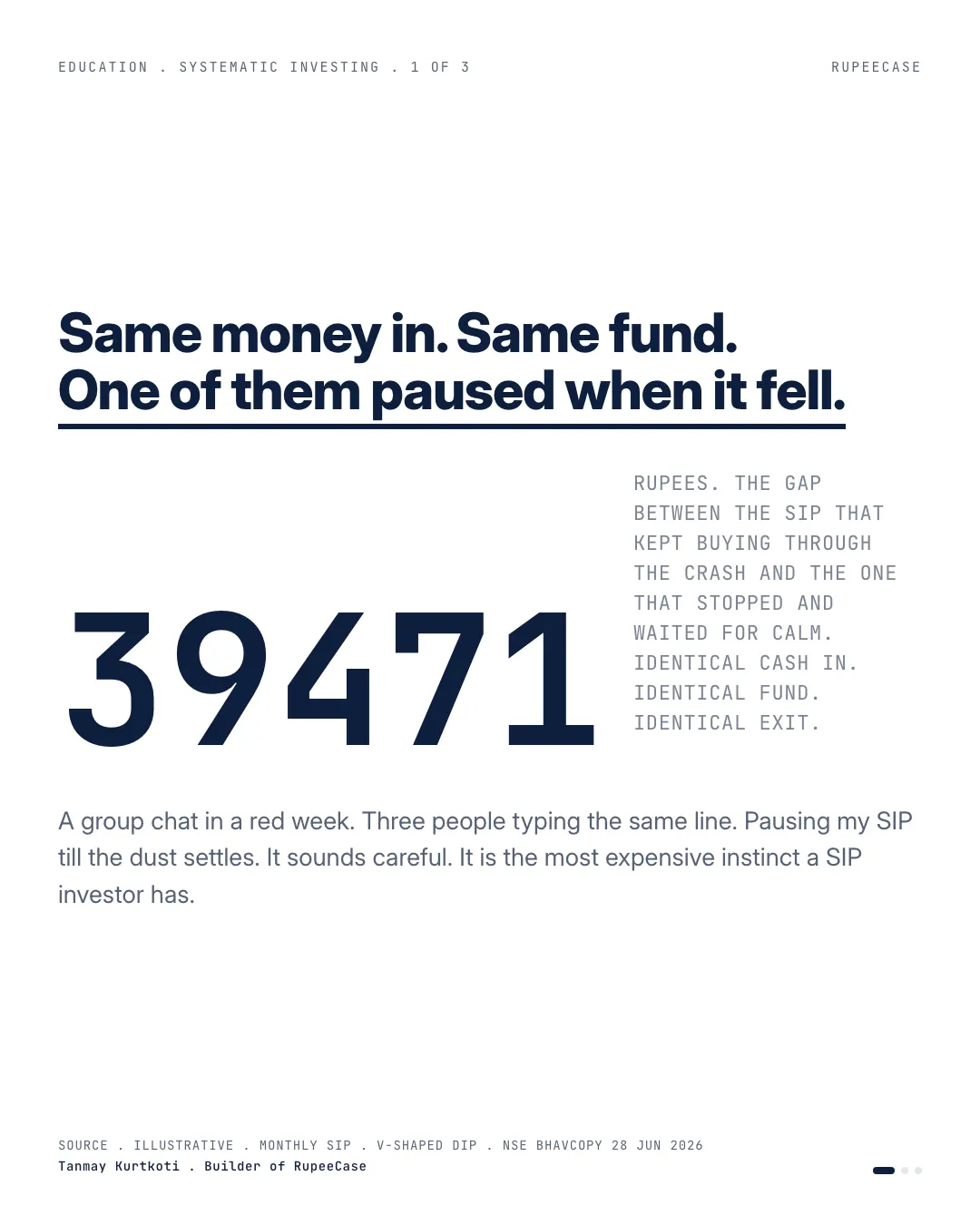
On identical money and the same exit, the investor who kept buying through a 40 percent fall ended with 329 more units and Rs 39,471 more than the one who paused.
By Tanmay Kurtkoti, founder of QC Alpha and builder of RupeeCase
A friend pinged the group the morning the index dropped four percent. "Pausing my SIP till the dust settles." Two others agreed inside a minute. It sounds like the responsible call. It is usually the costliest one.
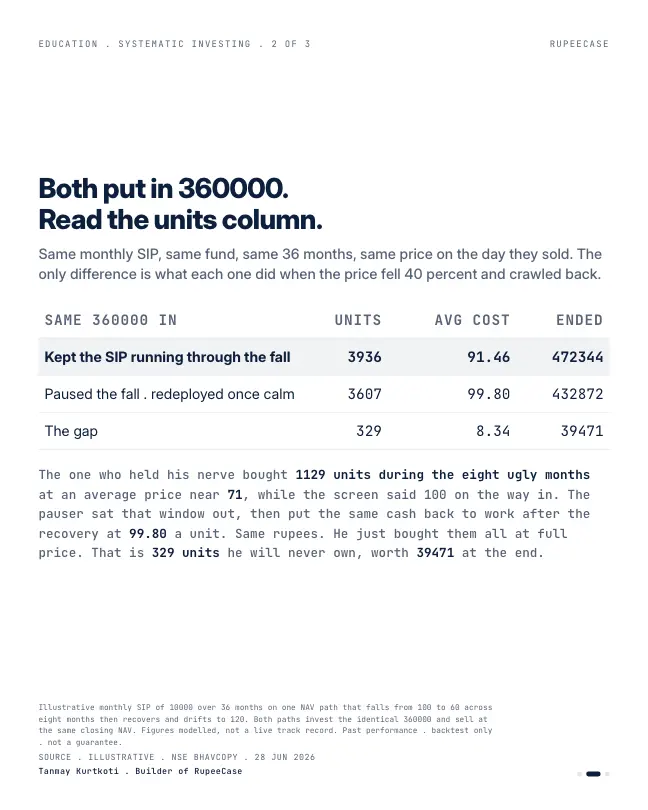
So I ran the two paths side by side. Two investors, the exact same 3,60,000 going in, the same fund, the same 36 months, and the same price on the day they each sold. The only difference is what they did when the price fell 40 percent and slowly climbed back.
The first one kept his SIP running the whole way down. The second paused during the fall, held the cash, and put the same money back to work once the market "felt safe again." Equal rupees in. Pure behaviour as the variable.
The one who kept buying picked up 1129 units during the eight ugly months at an average price near 71, while the screen had read 100 on the way in. The pauser bought those same rupees back later at 99.80 a unit. Sticker price. He ended with 329 fewer units and 39,471 less, on identical money in and the same exit.
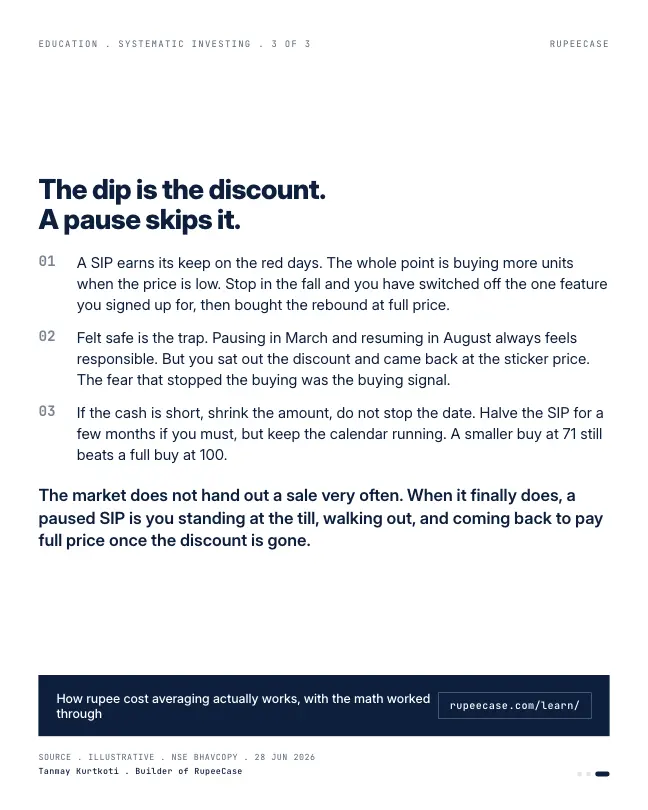
That is the part the careful instinct misses. A SIP is built to buy more when the price is low. The fall is not the thing to hide from. The fall is the discount the whole machine was designed to collect. Pause it and you have walked out of the shop during the sale and come back to pay full price once it ended.
Honest version: if the cash genuinely gets tight, halve the SIP for a few months. Just keep the date alive. A smaller buy at 71 still beats a full buy at 100.
The same test on real prices
The example above uses a clean, made up 40 percent fall. Real markets are messier, so I ran the two paths on the Nifty 50 itself, using NSE month end closes from October 2024 to September 2026. To keep the arithmetic readable, treat one unit as the index level divided by 100, a costless index fund. At the end of October 2024 a unit cost 242.05.
The Nifty 50 closed at 24,205 in October 2024, fell to 22,125 in February 2025, rose to 26,203 in November 2025, fell to 22,331 in March 2026 and ended September 2026 at 22,620.
NSE, Nifty 50 month end closes, Oct 2024 to Sep 2026 (NSE bhavcopy).
Both investors put Rs 10,000 in at every month end, 24 instalments, Rs 2,40,000 in all. The first never stops. The second sees the slide from December 2024, pauses for six months, and restarts in June 2025 when the index is back above 25,000, putting the Rs 60,000 of skipped instalments in alongside that month's Rs 10,000.
Here is how the six paused months play out:
- The investor who kept going bought at 236.45, 235.08, 221.25, 235.19, 243.34 and 247.51. Rs 60,000 bought 254.04 units, an average of 236.18.
- The pauser put the same Rs 60,000 in at 255.17 in June 2025 and got 235.14 units.
- Gap: 18.90 units. At the September 2026 close of 226.20 a unit, that is about Rs 4,277.
Every other month is identical. At the end, the steady investor holds 990.02 units worth Rs 2,23,947 and the pauser holds 971.11 units worth Rs 2,19,670. Average cost: 242.42 against 247.14.
Notice the honest part. Both are below the Rs 2,40,000 they put in, because September 2026 was itself a low month. The steady SIP did not avoid the fall. It just bought more of the cheap units, and that is the whole difference when the price recovers.
Smaller than the made up example, because the real dip was about 9 percent, not 40. The rule is the same at any size: the deeper the fall you skip, the more the pause costs.
Why the pause feels right
This is loss aversion doing its job. A loss hurts more than an equal gain pleases, so when the statement turns red, stopping the next instalment feels like stopping the pain. It is a feeling about the money already in, applied to the money not yet spent. The next Rs 10,000 has not lost anything. It is about to buy at a lower price than the last one.
MythPausing the SIP in a fall protects my money until things are safe.
FactThe paused cash is safe, but it buys later at a higher price. In the Nifty test it bought 18.90 fewer units for the same Rs 60,000.
How many people actually stop
AMFI publishes how many SIPs start and stop every month. In FY 2025 to 26, 719.22 lakh new SIPs were registered and 679.75 lakh were discontinued or reached the end of their tenure. In August 2026 alone, 53.82 lakh stopped or matured against 66.40 lakh new ones, while total SIP contributions that month were Rs 32,297 crore. Under SEBI rules, a monthly SIP counts as discontinued after three missed instalments in a row.
collected through SIPs in August 2026
AMFI, Aug 2026
new SIPs registered in August 2026
AMFI, Aug 2026
SIPs discontinued or matured in August 2026
AMFI, Aug 2026
discontinued or matured in FY 2025 to 26
AMFI, FY 2025 to 26
AMFI's count mixes SIPs that ended on schedule with those people stopped, so it does not tell you how many paused out of fear. It does tell you stopping is common, which is why the default you set matters more than the resolve you feel. The free Learn module on loss aversion and prospect theory covers the reference point trap and two field tested defences, with a quiz at the end. Model your own instalments in the SIP calculator, and read missing the best days for what moving to cash does to a lump sum.
Questions readers ask
Should I stop my SIP when the market falls?
That choice is yours, but know what it does. A paused instalment buys later at whatever price the market has by then. On Nifty 50 month end prices, pausing from December 2024 to May 2025 and restarting in June 2025 bought 18.90 fewer units for the same Rs 60,000.
What happens if I miss SIP payments?
Under the SEBI rule AMFI cites, a monthly SIP is treated as discontinued after three consecutive failed instalments. Units you already hold stay invested; only the future instalments stop.
How many SIPs are stopped every month in India?
AMFI reported 53.82 lakh SIPs discontinued or matured in August 2026, against 66.40 lakh new registrations. The figure includes SIPs that simply reached the end of their tenure.
The cards
3 cards. Swipe, or tap to open.
Related
- Missing the best daysSitting out the ten best days in twenty years cuts Rs 96 lakh to Rs 47 lakh on Rs 10 lakh at 12 percent, and those days cluster inside the worst weeks.Behaviour . . 5 min
- The behaviour gap: fund return vs investor returnIndian equity funds returned 19.1 percent a year from 2003 to 2022 while the rupees investors actually put in earned 13.8, and SIP investors earned 15.2.Behaviour . . 5 min
- Ten days that matteredRs 10 lakh in the Nifty 50 TRI from July 1999 grew to Rs 2.84 crore, or Rs 96 lakh without the 15 best days, seven of which sat within two weeks of the ten worst.Behaviour . . 10 min
Educational content only. Figures are illustrative and computed on historical or representative data for teaching purposes, not investment advice. Past performance does not guarantee future returns. Sourced from NSE, BSE, SEBI, AMFI and RBI public data.