

Personal finance and tax..5 min read
The cost of waiting: start small, start now
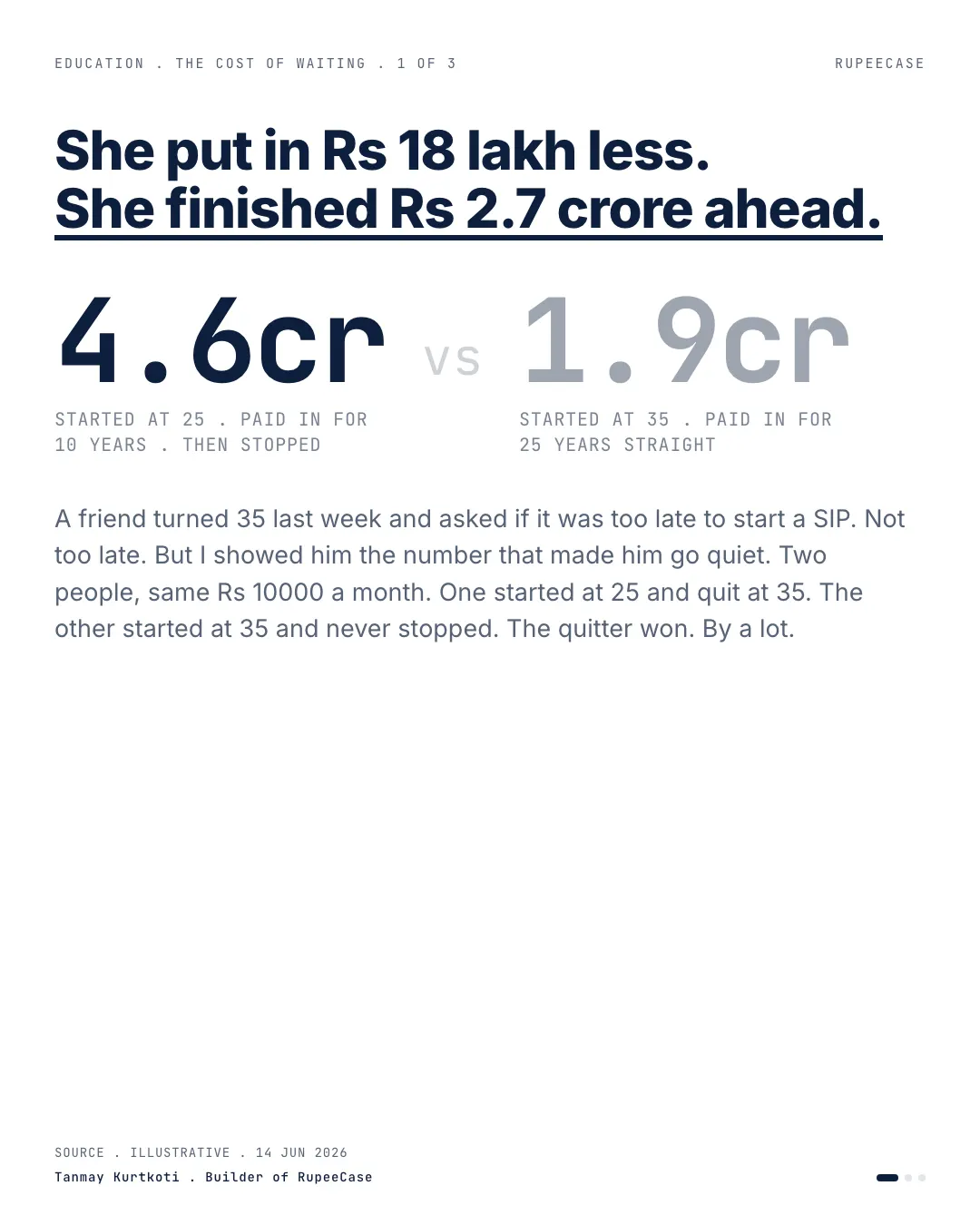
A saver who invested Rs 10,000 a month from 25 to 35 and stopped ends with Rs 4.6 crore at 60, ahead of one who invested from 35 to 60, because time did the work.
By Tanmay Kurtkoti, founder of QC Alpha and builder of RupeeCase
A friend turned 35 last week and asked, a little embarrassed, whether it was too late to start a SIP.
Not too late. But I pulled up a number that made him go quiet for a second.
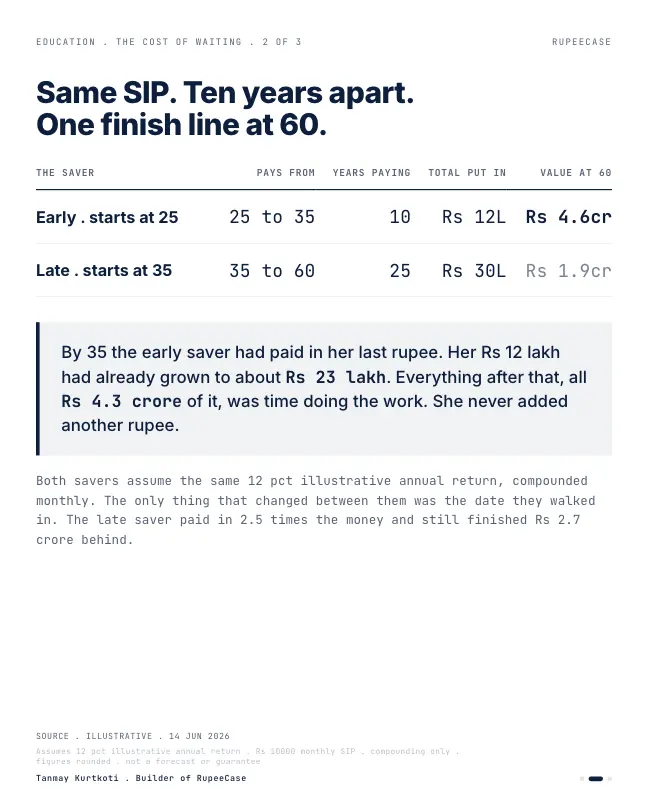
Picture two people, both putting away the same Rs 10,000 a month. The first one starts at 25 and pays in for exactly ten years. At 35 she stops cold and never invests another rupee. The second one starts at 35 and keeps going for twenty five years straight, all the way to 60.
The one who quit at 35 ends up with more. A lot more.
At a 12 pct illustrative return, the early saver's Rs 12 lakh grows to roughly Rs 4.6 crore by the time she is 60. The late saver puts in Rs 30 lakh over those twenty five years and lands at about Rs 1.9 crore. So the early saver invested Rs 18 lakh less, and finished Rs 2.7 crore ahead.
Here is the part that actually matters. By 35, the early saver had already paid in her last rupee. Her Rs 12 lakh had quietly become about Rs 23 lakh. Everything after that, the entire rest of the Rs 4.6 crore, was time doing the work. She was not saving anymore. She was just letting it sit.
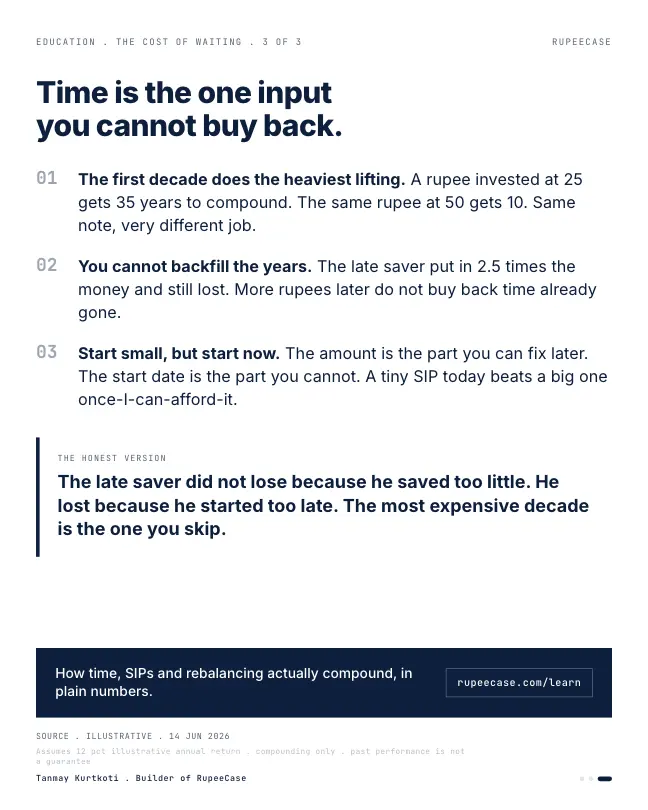
That is the whole lesson. The value of a rupee you invest is mostly the time it gets to compound, not the size of the cheque. A rupee invested at 25 gets thirty five years to work. The same rupee at 50 gets ten. Same note, completely different job.
And you cannot backfill the years. The late saver did everything right except the timing, doubled the money, and still came up short. More rupees later do not buy back time already gone.
So if you have been waiting to "start once I earn a bit more", remember: the amount is the part you can fix later. The start date is the part you cannot.
Start small. Start now.
Every five years of waiting halves the pot
I checked the opening's numbers with monthly compounding at 1 percent a month and each instalment paid at the start of the month. They hold: the early saver has about Rs 23.2 lakh at 35 and about Rs 4.60 crore at 60; the late saver about Rs 1.90 crore. Then I asked the friend's real question a different way. Same Rs 10,000 a month, kept going until 60. What does each five years of delay cost?
- Start at 25, Rs 42 L inRs 6.50 Cr
- Start at 30, Rs 36 L inRs 3.53 Cr
- Start at 35, Rs 30 L inRs 1.90 Cr
- Start at 40, Rs 24 L inRs 1.00 Cr
- Start at 45, Rs 18 L inRs 0.50 Cr
Worked example: 12% a year as 1% a month, paid at the start of each month, to age 60. Before tax and costs.
Starting at 30 instead of 25 means paying Rs 6 lakh less and ending with Rs 2.97 crore less. That is the price of five years, and it is paid in the last decade, long after the decision to wait was made.
Try your own start date
Rs 10,000 a month at 12% for 25 years: Rs 30 lakh in, about Rs 1.9 crore at the end.
Illustration with a fixed yearly rate, monthly instalments at the start of each month. Real returns vary every year.
Slide the years from 25 to 35 and watch the gap between the two lines. The money put in grows in a straight line. The value curves away from it, and most of that curve comes after year 20.
The same crore in today's rupees
There is an honest correction that belongs next to the big number. Rs 4.6 crore in 35 years will not buy what Rs 4.6 crore buys today. All India CPI inflation was 4.82 percent in Aug 2026, on MOSPI's figures. If prices rose at that rate for 35 years, they would be about 5.2 times today's level, so Rs 4.6 crore then is worth about Rs 89 lakh now.
the early saver at 60, in rupees of that year
Worked example
prices after 35 years at 4.82% a year
MOSPI CPI, Aug 2026, as a constant rate
the same pot in today's purchasing power
Worked example
This does not change the lesson. The late saver's Rs 1.9 crore shrinks by the same kind of factor. The early start still wins by about the same multiple. What it changes is the goal: a retirement number has to be set in future rupees, and the inflation figure decides how large that is. The free Learn module on inflation and its investment impact shows how to convert any goal into the rupees you will need.
What the early saver's ten years look like
- First Rs 10,000
Thirty five years of compounding ahead of this rupee.
- Last instalment
Rs 12 lakh in, about Rs 23.2 lakh in the account.
- No new money
About Rs 77 lakh, from compounding alone.
- Still none
About Rs 2.5 crore.
- The end of the example
About Rs 4.6 crore. About 97 percent of it is growth.
The SIP calculator runs any amount, rate and period. Two related posts carry the same idea further: the first crore is the slowest and SIP against lump sum.
Questions readers ask
Is it too late to start a SIP at 35?
No, but the start date matters a lot. Rs 10,000 a month at an illustrative 12 percent from 35 to 60 grows to about Rs 1.9 crore; the same SIP started at 30 grows to about Rs 3.5 crore. A later start can be offset partly with a larger amount or a yearly step up.
How much does delaying a SIP by five years cost?
In the worked example at 12 percent a year, a Rs 10,000 monthly SIP to age 60 ends near Rs 6.5 crore from 25, Rs 3.5 crore from 30 and Rs 1.9 crore from 35. Each five year delay roughly halves the result.
What is Rs 1 crore worth after 30 years of inflation?
At a constant 4.82 percent a year, the all India CPI rate for Aug 2026, prices would rise about 4.1 times in 30 years, so Rs 1 crore then would buy about what Rs 24 lakh buys today.
The cards
3 cards. Swipe, or tap to open.
Explore next
Learn it properly, then see it applied.
Related
- The first crore is the slowestA flat Rs 10,000 SIP at 12 percent takes about 20 years to the first crore, 5 more to the second and 3 to the third, with 72 percent of the final pot arriving in the last decade.Personal finance and tax . . 5 min
- Rule of 72: count in doublingsRs 10 lakh for thirty years becomes about Rs 3 crore at 12 percent and Rs 1 crore at 8, because four points deletes close to two doublings.Returns and risk maths . . 4 min
- SIP vs lump sum: time in the marketPutting Rs 12 lakh in at once beat dripping it over a year in about two of every three historical windows, because markets rise roughly two years in three.Personal finance and tax . . 5 min
Educational content only. Figures are illustrative and computed on historical or representative data for teaching purposes, not investment advice. Past performance does not guarantee future returns. Sourced from NSE, BSE, SEBI, AMFI and RBI public data.