

Behaviour..5 min read
The day the market did not let you sell
A 10 percent index move halts the whole market, and a lower circuit means the bids have vanished, which is why position size and not the exit plan is the real protection.
By Tanmay Kurtkoti, founder of QC Alpha and builder of RupeeCase
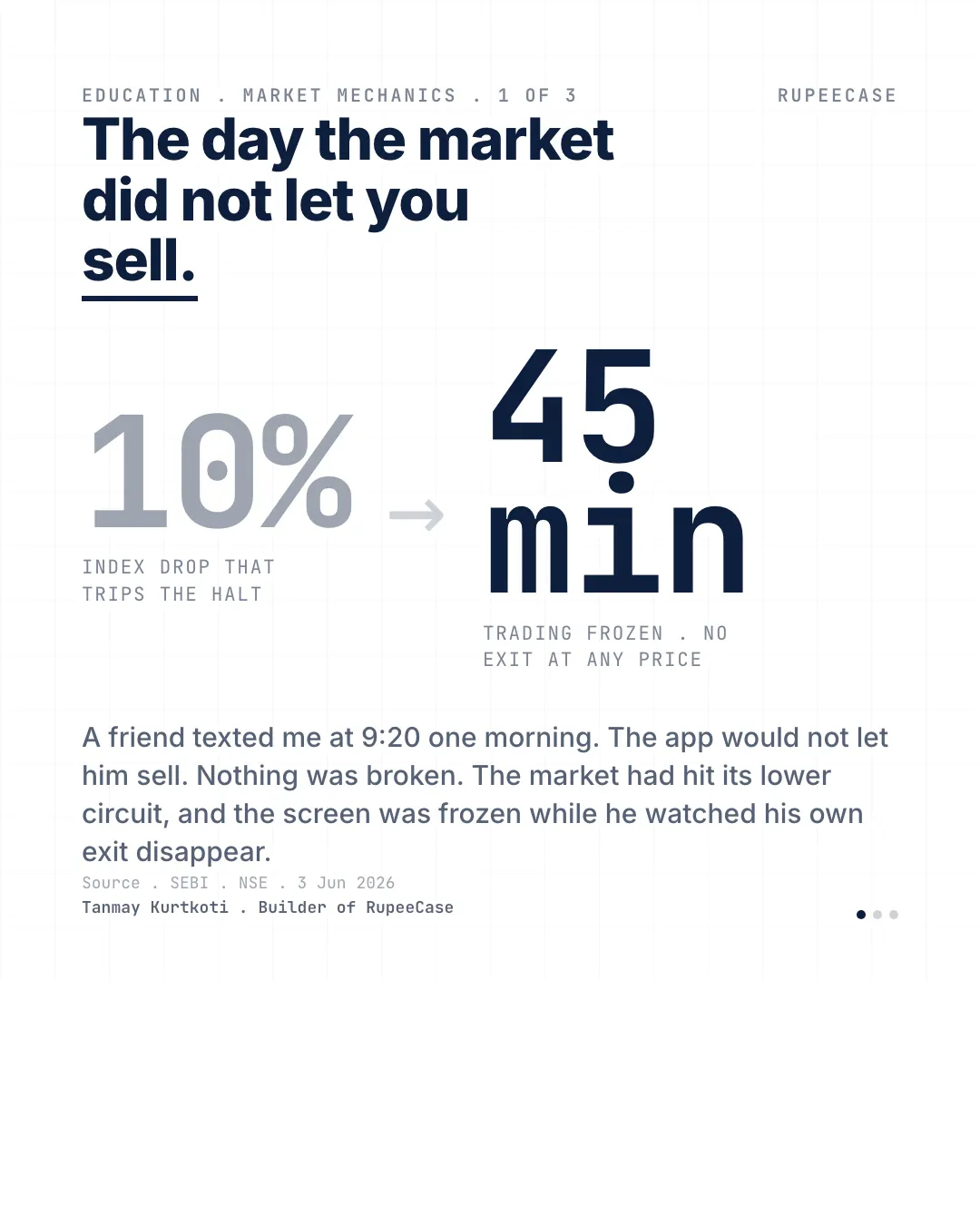
A friend texted me at 9:20 one morning a few years back. "The app won't let me sell."
He thought something was broken. Nothing was broken. The market had hit its lower circuit and trading was frozen. He spent the next 45 minutes watching an exit he could not take.
Most people find out how a circuit breaker works on the worst possible day to learn it. So here is the plain version, before you need it.
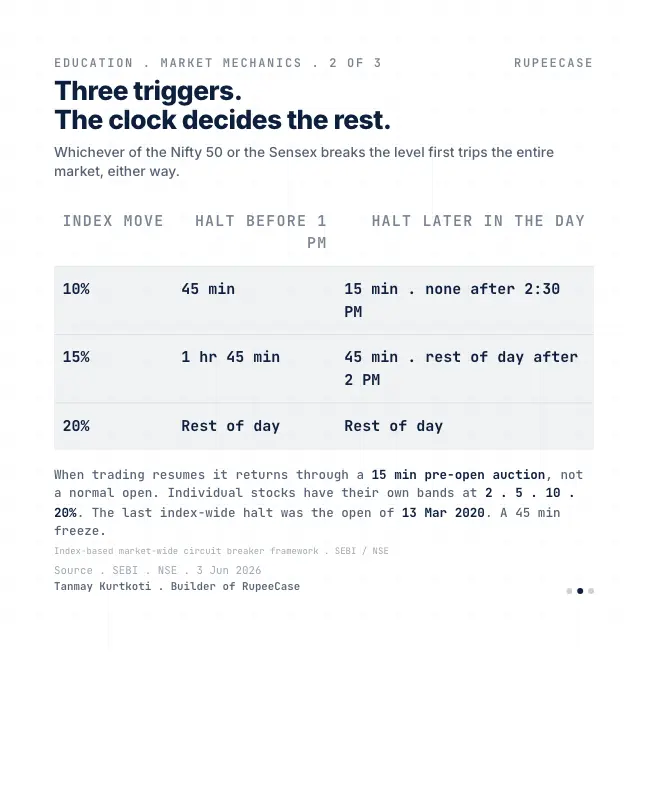
If the Nifty 50 or the Sensex moves 10% in either direction, the entire market halts. Whichever index breaks the level first trips the whole thing. Before 1 PM that halt is 45 minutes. Later in the day it shortens. At 15% the freeze gets longer. At 20%, they close the day. When trading resumes it comes back through a 15 minute pre-open auction, not a normal open.
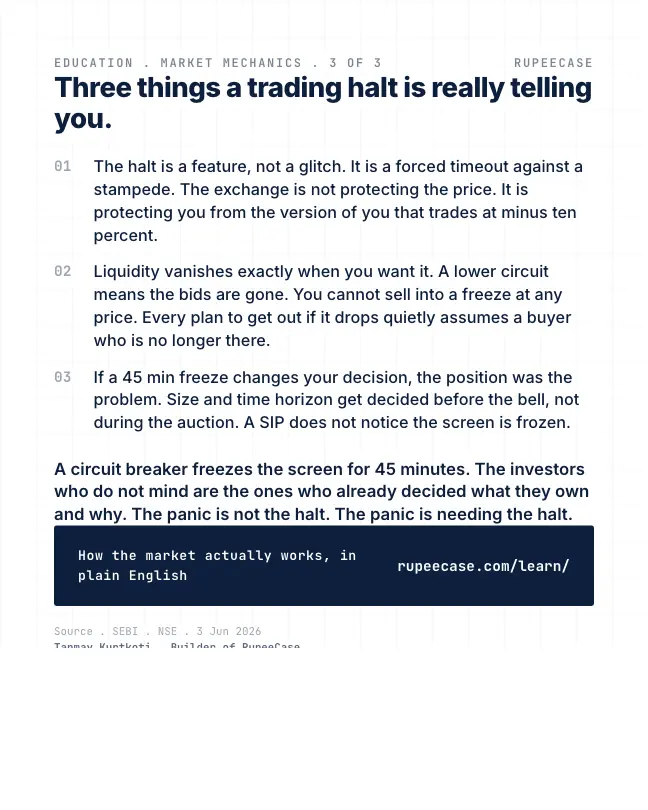
The detail that actually matters is the one nobody mentions. A lower circuit is not a pause you can trade around. It means the bids have vanished. There is no buyer to sell into at any price. Every "I'll just get out if it falls" plan quietly assumes someone is standing on the other side. At minus ten percent, nobody is.
Which is why I have stopped thinking of the halt as the problem. The halt is a feature. It is a forced timeout against a stampede, and mostly it protects you from the version of you that sells at the bottom.
The honest test is this. If a 45 minute freeze would change what you do with a holding, the position size was the problem, not the screen. A SIP does not notice the market is frozen. Neither should the rest of your plan.
The full rule table
The rules come from a SEBI circular of June 2001, refined by NSE in October 2013 so that a 15 minute pre-open call auction is carved out of every halt that does not end the day. Since 14 October 2013 the trigger levels are worked out fresh every morning from the previous day's Nifty 50 close, rounded to the tick size. All orders sitting in the system when the halt hits are cancelled.
| Move | Hits before 1 pm | Hits 1 pm to 2:30 pm | Hits later |
|---|---|---|---|
| 10% | 45 min halt, then 15 min pre-open | 15 min halt, then 15 min pre-open | No halt after 2:30 pm |
| 15% | 1 hr 45 min halt, then 15 min pre-open | 45 min halt if before 2 pm | Closed for the day from 2 pm |
| 20% | Closed for the day | Closed for the day | Closed for the day |
That cancellation line is the one people miss. If you had a stop loss order resting in the book, it is gone when trading resumes. You have to place it again, into an auction, at a price you did not choose.
Work out today's levels yourself
The Nifty 50 closed at 22,520.45 on 9 October 2026, according to NSE bhavcopy data. So for the next session the 10 percent lower trigger sits near 20,268, the 15 percent level near 19,142 and the 20 percent level near 18,016. Upward, the same steps are about 24,773, 25,899 and 27,025.
Put those numbers next to a normal year and you see how far away they are. Over the two years of NSE data I pulled, from October 2024 to October 2026, the single worst day for the Nifty 50 was a fall of 3.26 percent. Not one day came within a third of the way to a halt.
- 19 Mar 2026-3.26%
- 7 Apr 2025-3.24%
- 23 Mar 2026-2.60%
- 30 Mar 2026-2.14%
- 8 Jul 2026-2.12%
- First halt level-10.00%
Nifty 50 daily close to close change, five worst days, 14 Oct 2024 to 9 Oct 2026. NSE bhavcopy via NSE index history.
A market wide halt is rare. Single stocks are a different story, and that is where most people actually meet a frozen screen.
Stocks have their own, much tighter, circuits
NSE sets a daily price band on each stock. Bands of 2, 5, 10 and 20 percent either way apply depending on the stock, with 20 percent on the rest. Stocks that have futures and options trading carry no fixed band; NSE applies a 10 percent operating range to them instead. A smallcap on a 5 percent band can lock at its lower limit on a perfectly calm day for the index.
MythMy stop loss at minus 5 percent means I can never lose more than 5 percent on a stock.
FactA stop only fills if a buyer exists. At a lower band there are sellers and no bids, and a market halt cancels resting orders. The next trade can be far below your stop.
The day the circuit stopped people buying
Circuits work both ways. NSE's own press release of 18 May 2009 describes one such morning. In those years the triggers were fixed in points each quarter, and for the Nifty they stood at 300, 450 and 600 points.
- Up 531.65 points in seconds
The Nifty crosses the 15 percent level of 450 points almost as trading starts.
- Equity and derivatives markets shut
The halt for a 15 percent move, as the 2001 rules then prescribed.
- Trading reopens
The Nifty keeps rising after the auction.
- 651.50 points up, past the 20 percent level
Markets closed for the rest of the day.
Anyone who planned to buy "once it settles" that morning did not get the chance. The same freeze that traps a seller on the way down shuts out a buyer on the way up. That is why I think about circuits as a reason to size positions so I never need to act in the next hour. The free Learn module on how orders actually work covers circuit limits, the pre-open auction and the order book with a quiz at the end. For what a crowded opening auction does to a new listing, read the IPO pop is not the business.
Questions readers ask
What happens if the Nifty falls 10 percent in a day?
If it happens before 1 pm, trading in all stocks and equity derivatives halts for 45 minutes, followed by a 15 minute pre-open call auction. Between 1 pm and 2:30 pm the halt is 15 minutes, and after 2:30 pm there is no halt at the 10 percent level.
Can I sell a stock that is stuck at its lower circuit?
You can place a sell order, but it fills only if a buyer appears at the band price. When a stock is locked at its lower band there are usually far more sellers than buyers, so many orders stay unfilled until the next session.
Are the circuit breaker levels the same every day?
No. Since October 2013 NSE works them out each day from the previous day's Nifty 50 close, rounded to the tick size. On a close of 22,520.45, the 10 percent level is about 20,268 on the way down.
The cards
3 cards. Swipe, or tap to open.
Related
- The IPO pop is not the businessIn 2025, 65 of 100 mainboard listings opened above issue price and 59 of 100 traded below their listing by December, because the grey market prices the first hour, not the first year.Behaviour . . 6 min
- Why your sell is not cash yetIndia settles at T plus one trading day, so a Friday sale lands on Monday and a sale before a long weekend can take five calendar days to become spendable.Behaviour . . 5 min
- Impact cost: zero brokerage was never zero costA Rs 1 lakh round trip costs about Rs 100 of spread on a liquid Nifty name and about Rs 4,000 on a thin small cap, and neither appears on the contract note.Behaviour . . 5 min
Educational content only. Figures are illustrative and computed on historical or representative data for teaching purposes, not investment advice. Past performance does not guarantee future returns. Sourced from NSE, BSE, SEBI, AMFI and RBI public data.