


Personal finance and tax..5 min read
The Rs 1.25 lakh you forget every April
Booking about Rs 1.25 lakh of long term gains each year and rebuying cuts the exit tax on a Rs 96 lakh corpus from Rs 10.65 lakh to Rs 7.68 lakh.
By Tanmay Kurtkoti, founder of QC Alpha and builder of RupeeCase
A friend told me he has never sold a single unit of his index fund in seven years. He said it the way people say they floss every day. A small, quiet virtue.
On almost every count, he is right. Staying invested is the whole game.
On one line, though, it is costing him.
Every financial year, the tax code lets you book Rs 1,25,000 of long term equity gains completely tax free. Section 112A. It resets every April, and it does not carry forward. Use it or lose it.
If you never sell, you use exactly one year of that allowance in your entire investing life, on the day you finally cash out. Every other year's slice just expires, unnoticed.
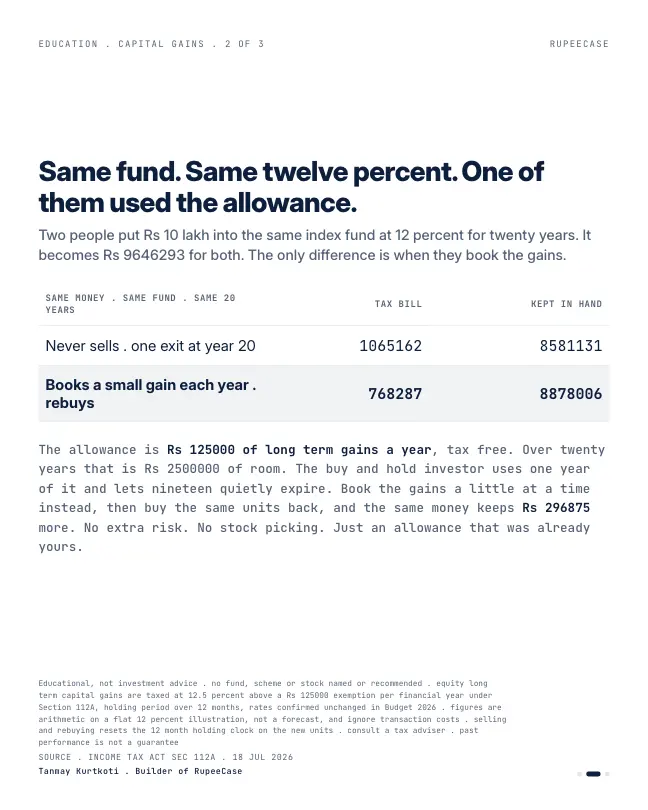
Here is the part that made him sit up. Put Rs 10 lakh in a fund at 12 percent for twenty years and it grows to about Rs 96 lakh either way. Sell it all at the end and the tax bill is Rs 10,65,162. Book roughly Rs 1,25,000 of gain each year instead, buy the same units straight back, and the bill drops to Rs 7,68,287. Same fund. Same return. About Rs 2,96,875 stays in your pocket, purely because you stopped letting a free allowance expire.
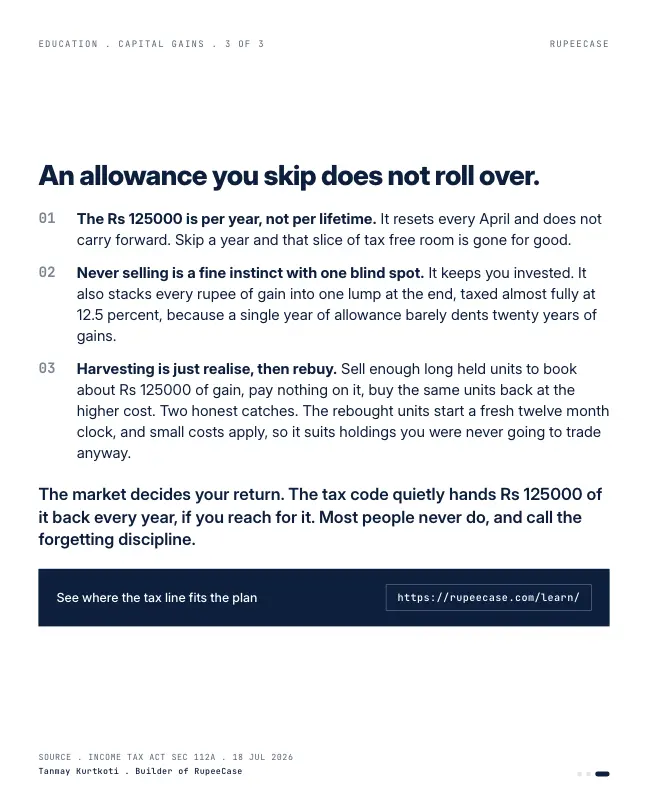
The mechanic is unglamorous. Realise a small long term gain, pay nothing on it because it sits under the exemption, buy the units back at the new higher cost. Two honest catches. The rebought units start a fresh twelve month clock, and small transaction costs apply, so this only makes sense for holdings you were never going to trade anyway.
I like it because it is the rare edge that has nothing to do with predicting anything. The market decides your return. This one line you actually control.
Most people forget it is there every single April, and call the forgetting discipline.
Where the rule lives now
The allowance survived the new law intact. From 1 Apr 2026 the Income-tax Act 2025 replaced the 1961 Act, and the long term rate on listed equity, equity oriented funds and business trust units moved from section 112A to section 198 of the new Act, with the same terms: 12.5 percent on long term gains above Rs 1.25 lakh in a tax year. The Finance Bill 2026 changed no capital gains rate. "Tax year" is the new Act's name for the financial year, so the allowance still resets every 1 April.
The opening's sum, checked
I reran it: Rs 10 lakh at 12 percent for 20 years is Rs 96,46,293. Selling all of it at the end, after the year's Rs 1.25 lakh exemption, leaves Rs 85,21,293 taxed at 12.5 percent: Rs 10,65,162. Harvesting Rs 1.25 lakh of gain in each of the first 19 years lifts the cost base by Rs 23.75 lakh, and the final bill falls to about Rs 7,68,900, within a few hundred rupees of the opening's figure.
- Never sell, tax at the endRs 10,65,162
- Harvest Rs 1.25 L a yearRs 7,68,912
Worked example: Rs 10 lakh, 12% a year, 20 years, LTCG 12.5% above Rs 1.25 lakh a year, before the 4% cess and transaction costs. Rates per section 198 of the Income-tax Act 2025 (same as section 112A).
Add the 4 percent health and education cess and both bills rise by 4 percent, so the saving grows to about Rs 3.09 lakh. And the cost base matters even if you never sell all of it: every rupee of gain booked tax free is a rupee that can never be taxed later.
One year of the habit
Rs 16,250 a year is small. Over twenty years, on a growing portfolio, it is the Rs 3 lakh in the chart. The habit only pays if it is done every year, which is why it belongs on a calendar.
The yearly routine
- Check what is already booked
Add up long term equity gains realised this tax year, including any from rebalancing.
- Book the gap
Sell units with long term gains up to the unused part of Rs 1.25 lakh, before 31 March.
- Buy back
Reinvest in the same fund. The new cost is today's price, and a new 12 month clock starts.
- The allowance resets
A fresh Rs 1.25 lakh for the new tax year.
Two cautions from the opening deserve a number. The rebought units are short term for 12 months, so selling them inside that window would be taxed at 20 percent. And the round trip is not free: on shares, STT of 0.1 percent applies on both the sale and the purchase, about Rs 250 on a Rs 1.25 lakh round trip, while fund units carry much smaller charges. Both are small against Rs 16,250, which is why the habit works for long term holdings.
MythIf I do not use the Rs 1.25 lakh exemption this year, it carries forward.
FactIt does not. It applies per tax year and lapses on 31 March if unused. Only capital losses can be carried forward.
The free Learn module on tax loss harvesting for systematic investors covers gain harvesting and loss harvesting together, with the set off rules. The tax loss harvesting calculator runs both on your numbers. Related: day 364 against day 366.
Questions readers ask
What is the LTCG exemption limit on shares and equity mutual funds?
Rs 1.25 lakh a year for long term gains on listed equity shares, equity oriented funds and business trust units together, for transfers from 23 Jul 2024. From 1 Apr 2026 it sits in section 198 of the Income-tax Act 2025, with the 12.5 percent rate above the limit unchanged.
What is tax gain harvesting?
It is selling holdings with long term gains up to the yearly exemption, paying no tax on them, and buying back so the cost base rises. In the worked example, doing it every year on Rs 10 lakh at 12 percent over 20 years cut the final tax from about Rs 10.65 lakh to about Rs 7.69 lakh.
Does the Rs 1.25 lakh LTCG exemption carry forward?
No. It applies to each tax year separately and is lost if not used by 31 March. Capital losses, by contrast, can be carried forward for eight years if the return is filed on time.
The cards
3 cards. Swipe, or tap to open.
Explore next
Learn it properly, then see it applied.
- Free module 11.1Equity Taxation After July 2024: The New Rules10 min read
- StrategyAllcap strategyNifty Total Market, 50 stocks, every 2 weeks
- Free module 11.3Tax-Loss Harvesting for Systematic Investors11 min read
- CalculatorTax loss harvestingFree, with the formula and a worked example
- Blog topicPersonal finance and tax notes24 notes
Related
- A loss you do not book is a rebate you do not claimBooking a Rs 60,000 short term loss against a Rs 1 lakh short term gain cuts the tax from Rs 20,000 to Rs 8,000, and unused losses carry eight years if you file on time.Personal finance and tax . . 10 min
- What the lock in costs youAcross ELSS, NPS and PPF the return argument is worth about Rs 54 lakh over twenty years and the NPS annuity clause moves Rs 40 lakh, decided by a paragraph nobody read.Personal finance and tax . . 13 min
- NPS, PPF, ELSS: the order matters more than the rateThe Rs 50,000 NPS slot under 80CCD(1B) sits on top of the 80C ceiling, so a rate led picker leaves Rs 15,600 a year of saved tax on the table at the 30 percent slab.Personal finance and tax . . 5 min
Educational content only. Figures are illustrative and computed on historical or representative data for teaching purposes, not investment advice. Past performance does not guarantee future returns. Sourced from NSE, BSE, SEBI, AMFI and RBI public data.