

Personal finance and tax..5 min read
NPS, PPF, ELSS: the order matters more than the rate
The Rs 50,000 NPS slot under 80CCD(1B) sits on top of the 80C ceiling, so a rate led picker leaves Rs 15,600 a year of saved tax on the table at the 30 percent slab.
By Tanmay Kurtkoti, founder of QC Alpha and builder of RupeeCase
Friend rang up on a chai call this evening. Fresh financial year just started. Old questionnaire from his CA in front of him.
"NPS or PPF or ELSS. Which one."
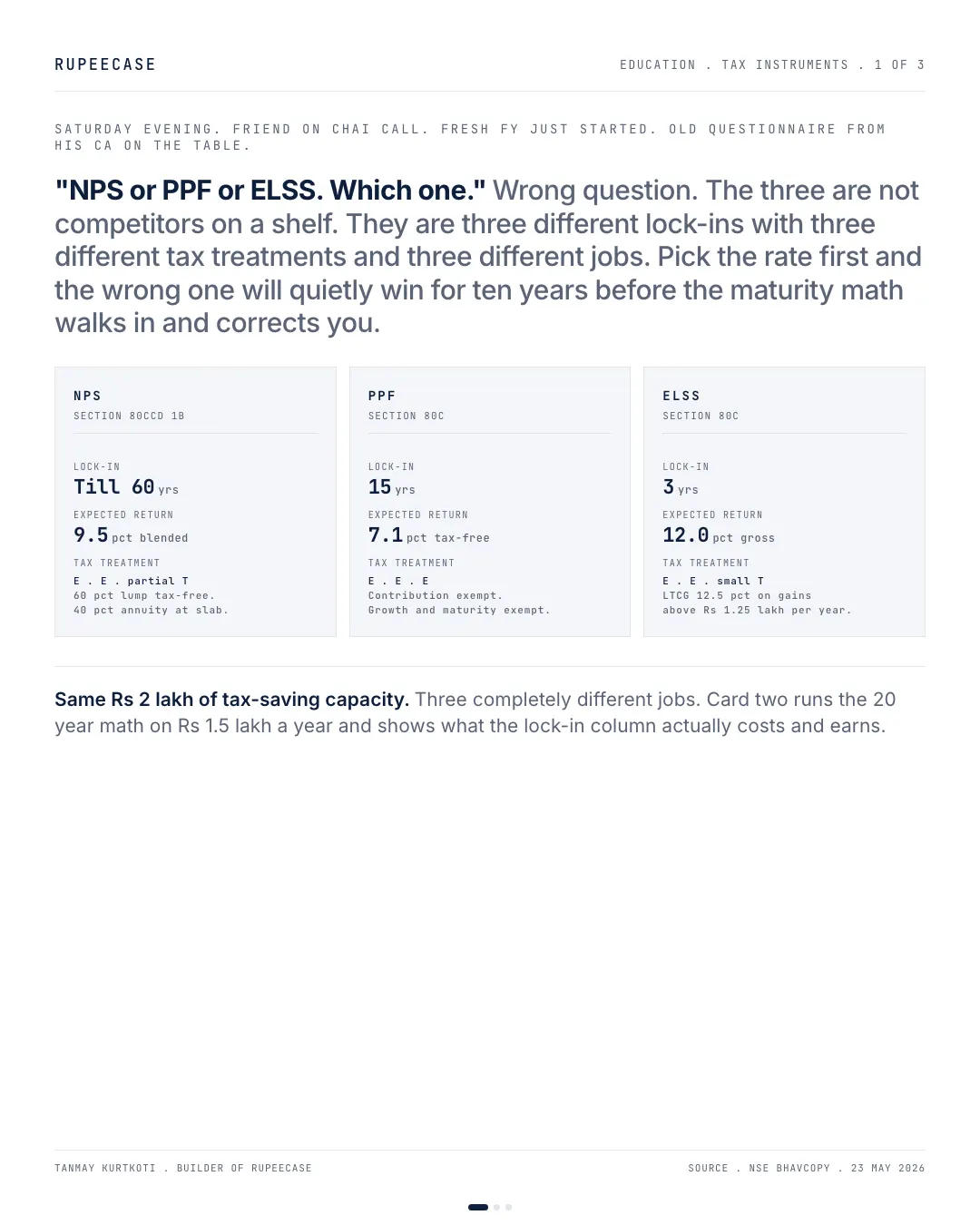
I told him that was the wrong question. The three are not competitors on a shelf. They are three different lock-ins doing three completely different jobs. NPS locks the money till age 60 and blends equity and debt at roughly 9.5 pct, but only 60 pct of the corpus comes out tax-free, the other 40 pct must annuitize at slab rates. PPF locks 15 years at 7.1 pct, but it is EEE end to end, every rupee at maturity is tax-free. ELSS locks just 3 years per SIP at 12 pct gross, but you pay 12.5 pct LTCG on gains above the Rs 1.25 lakh annual exemption.
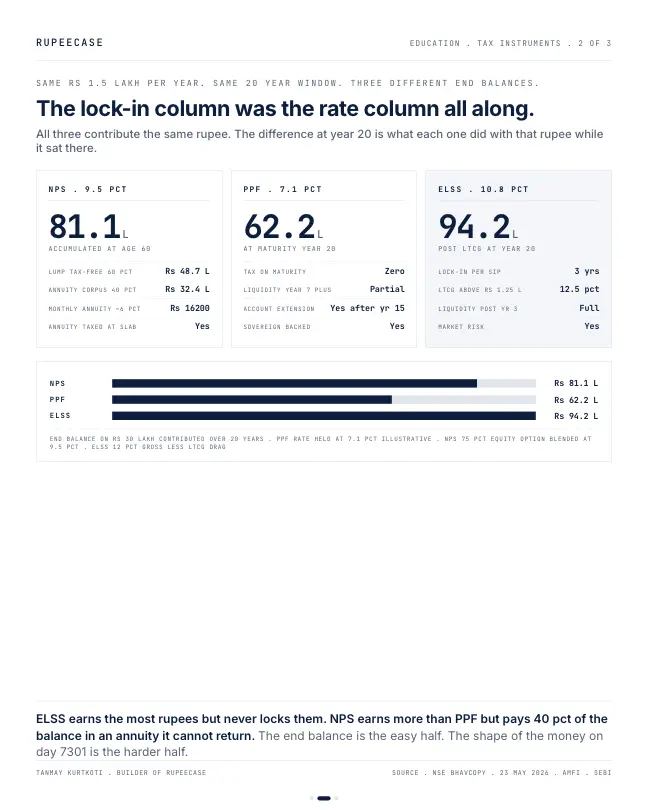
Run it on Rs 1.5 lakh a year for 20 years and the numbers land in a surprising order. NPS accumulates Rs 81.1 lakh, of which Rs 48.7 L is tax-free lump and Rs 32.4 L pays out as a roughly Rs 16,200 monthly annuity taxed at your slab. PPF lands at Rs 62.2 lakh, fully tax-free. ELSS lands at Rs 94.2 lakh post LTCG and stays liquid the whole way.
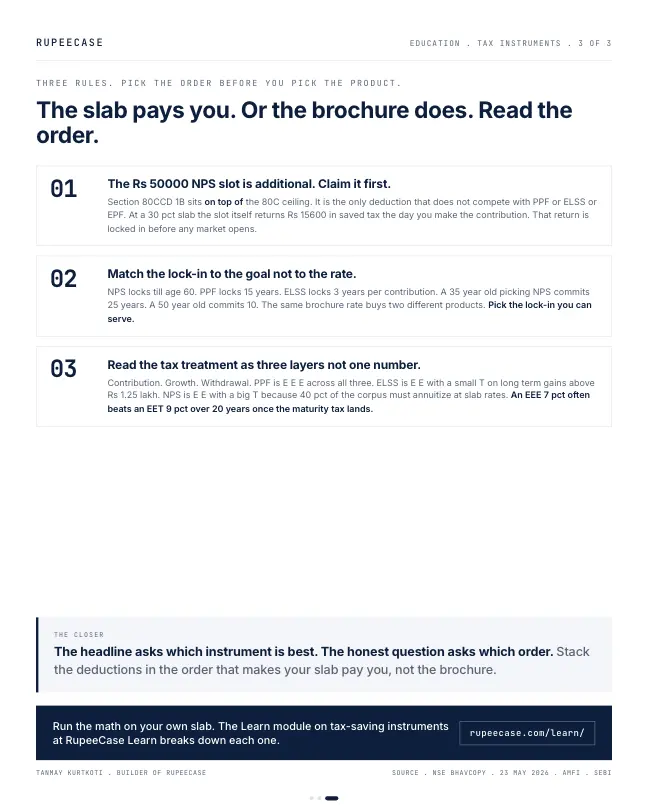
What the table actually teaches is that the Rs 50,000 NPS slot under Section 80CCD(1B) sits on top of the 80C ceiling. It does not compete with PPF or ELSS or EPF. At a 30 pct slab it pays Rs 15,600 in saved tax the day the SIP debits, which means a rate-led picker leaves Rs 15,600 a year on the table. After that, ELSS for growth and the shortest lock-in, PPF for tax-free fixed-income exposure, NPS for the retirement bucket your behaviour will not touch. The order is the product.
Honest version. Stack the deductions in the order that makes your slab pay you, not the brochure
The question before the order: which regime?
The order in the opening assumes something the post never said out loud. Every one of these deductions, the Rs 1.5 lakh basket that used to be section 80C and the extra Rs 50,000 for your own NPS contribution, is available only in the old tax regime. Since FY 2023-24 the new regime is the default, and the Income-tax Act 2025, in force from 1 Apr 2026, keeps it as the default in section 202. In the new regime, the e-filing portal's own FAQ is plain: Chapter VI-A deductions such as 80C and 80D cannot be claimed, with a few exceptions such as the employer's NPS contribution.
So the first decision is not NPS against PPF. It is whether your deductions are large enough for the old regime to beat the new one at all.
When the old regime wins
The new regime has lower slab rates, a Rs 75,000 standard deduction for salaried people, and no tax at all up to Rs 12 lakh of taxable income after the Rs 60,000 rebate. The old regime has higher rates but lets you subtract deductions. At Rs 20 lakh of salary, here is the gap with the full Rs 2 lakh of 80C and NPS deductions claimed.
- New regime, no deductionsRs 1,92,400
- Old regime, Rs 2 lakh claimedRs 3,51,000
Worked example, salary Rs 20 lakh, tax with 4% cess, no surcharge. New regime: s.202 slabs for tax year 2026-27, Rs 75,000 standard deduction. Old regime: slabs 5/20/30%, Rs 50,000 standard deduction.
The old regime needs about Rs 7.1 lakh of total deductions at a Rs 20 lakh salary just to draw level, and about Rs 5.4 lakh at Rs 15 lakh. That usually takes a large house rent allowance, home loan interest and the full investment basket together. Put your own figures into the calculator.
If the old minus new figure is positive, the deductions in the opening are saving tax inside a regime that costs more overall. The Rs 15,600 from the NPS slot is real only for someone already better off in the old regime.
MythThe extra Rs 50,000 NPS deduction saves Rs 15,600 for everyone in the 30 percent slab.
FactOnly in the old regime. In the default new regime your own NPS contribution is not deductible; the employer's contribution is.
The order, once the regime is settled
For someone who has worked out that the old regime wins, the opening's order holds, with one step added in front of it.
- Pick the regimeCompare both on your actual salary and deductions every year.
- Count what is already in the basketEmployee provident fund, life cover premium, home loan principal and school fees fill the Rs 1.5 lakh first.
- Add the NPS slotThe extra Rs 50,000 sits above the Rs 1.5 lakh ceiling, old regime only.
- Fill the gap by jobELSS for growth with a 3 year lock, PPF for tax free fixed income with a 15 year lock.
For someone in the new regime, the same three products are still useful, just for their jobs rather than their deductions. ELSS becomes an equity fund with a lock in. PPF stays tax free on interest and maturity. NPS is still a retirement account your behaviour cannot raid early. The tax label stops deciding the order.
The free Learn module on tax efficient portfolio construction puts regime choice, lock ins and the capital gains rules into one framework. The retirement calculator projects a corpus for any contribution and horizon. Related: day 364 against day 366 and the Rs 1.25 lakh you forget every April.
Questions readers ask
Can I claim 80C and 80CCD(1B) in the new tax regime?
No. The new regime, which is the default, does not allow the 80C basket or the extra Rs 50,000 for your own NPS contribution. The employer's contribution to NPS remains deductible in the new regime.
Which is better for me, the old or the new tax regime?
It depends on your total deductions. At a Rs 20 lakh salary, the old regime needs about Rs 7.1 lakh of deductions, including house rent allowance and home loan interest, before it matches the new regime; at Rs 15 lakh, about Rs 5.4 lakh. Below those levels the new regime costs less.
Is PPF still tax free under the new regime?
Yes for the interest and the maturity amount, which are exempt. What the new regime removes is the deduction for the deposit itself.
The cards
3 cards. Swipe, or tap to open.
Related
- Day 364 vs day 366: the two day tax cliffRedeeming a Rs 10 lakh lump sum two days after the year mark removes the exit load, drops STCG to LTCG and opens the exemption, worth Rs 40,225 on the same units.Personal finance and tax . . 5 min
- The Rs 1.25 lakh you forget every AprilBooking about Rs 1.25 lakh of long term gains each year and rebuying cuts the exit tax on a Rs 96 lakh corpus from Rs 10.65 lakh to Rs 7.68 lakh.Personal finance and tax . . 5 min
- A loss you do not book is a rebate you do not claimBooking a Rs 60,000 short term loss against a Rs 1 lakh short term gain cuts the tax from Rs 20,000 to Rs 8,000, and unused losses carry eight years if you file on time.Personal finance and tax . . 10 min
Educational content only. Figures are illustrative and computed on historical or representative data for teaching purposes, not investment advice. Past performance does not guarantee future returns. Sourced from NSE, BSE, SEBI, AMFI and RBI public data.