

Personal finance and tax..5 min read
A nominee is not an heir
The Supreme Court held in 1983 and 2023 that a nominee only receives; without a will, Rs 80 lakh to a sole nominee wife is owned one quarter each by four Class I heirs.
By Tanmay Kurtkoti, founder of QC Alpha and builder of RupeeCase
A friend sent me a screenshot on Sunday. Nomination updated across every folio, green ticks all the way down, captioned "estate planning done."
He had told his fund house who to hand the money to. He had not told anyone who owns it. Two different sentences. Only one of them was in his file.
The Supreme Court has settled this twice, in almost the same week of the year. December 1983, on a life insurance policy: the nominee is "only the hand which is authorised to receive." December 2023, on company shares: no absolute title, succession law supersedes the nomination. Forty years and eight days apart, same answer, and it keeps coming back because people keep assuming otherwise.
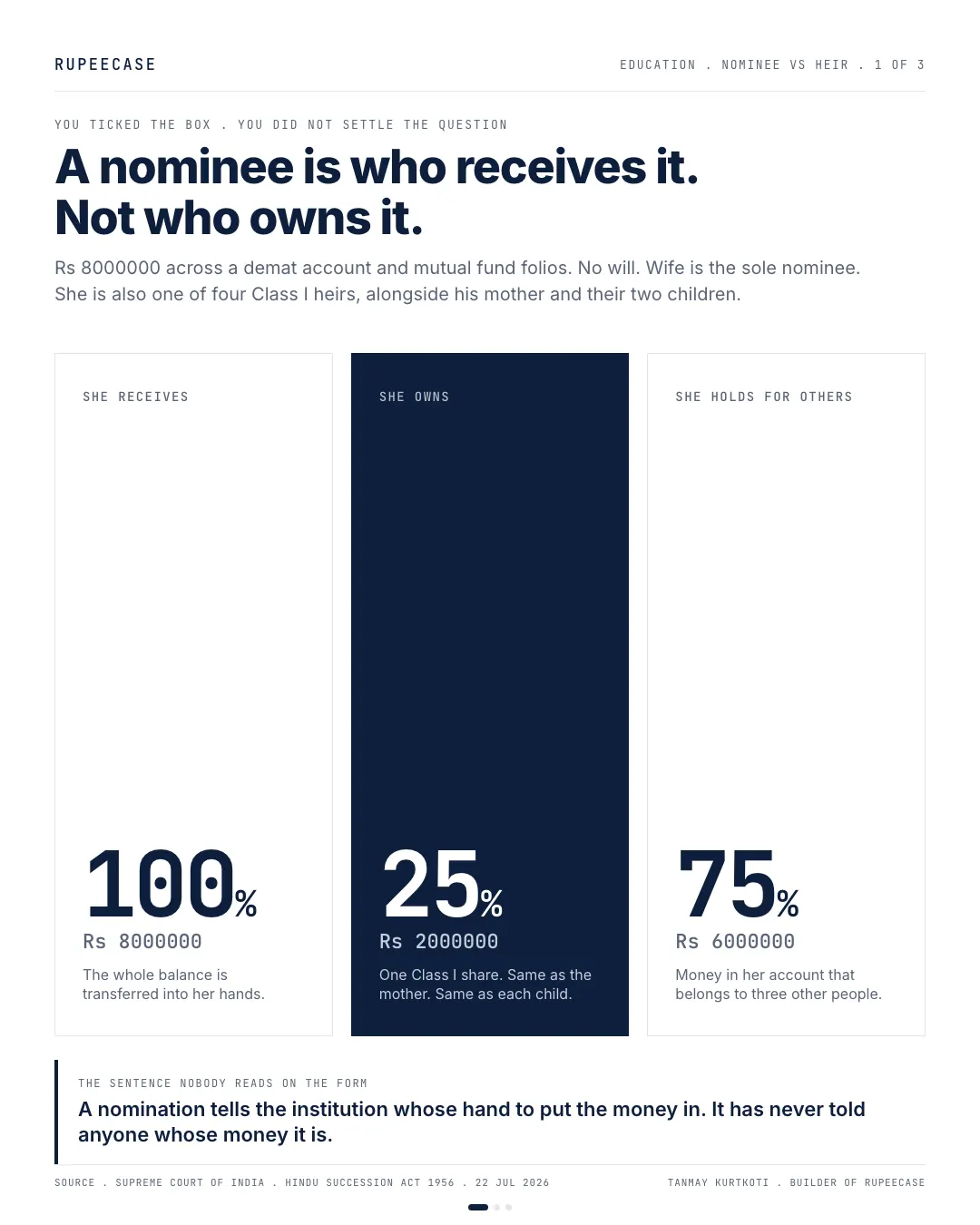
Put it in rupees. Say Rs 80,00,000 sits across a demat account and a few fund folios. No will. Wife is the sole nominee. Under the Hindu Succession Act the widow, the mother and each child are Class I heirs and take one share each.
She receives Rs 80,00,000. She owns Rs 20,00,000. The remaining Rs 60,00,000 is money sitting in her account that belongs to three other people, and she learns this in the worst month of her life.
Now the part that runs backwards from what people expect. Life insurance, the asset families actually fight over, got carved out in 2015. Name a spouse, parent or child and they are beneficially entitled. Done.
Bank deposits, demat holdings and fund folios, the ones everyone assumes are handled, are not. Since 1 Sep 2026, under SEBI's circular of 29 May 2026, you can name up to three nominees with percentage splits, and a new account carries a nomination unless you opt out. Three names, neat percentages, and not one of them decides who owns a rupee.
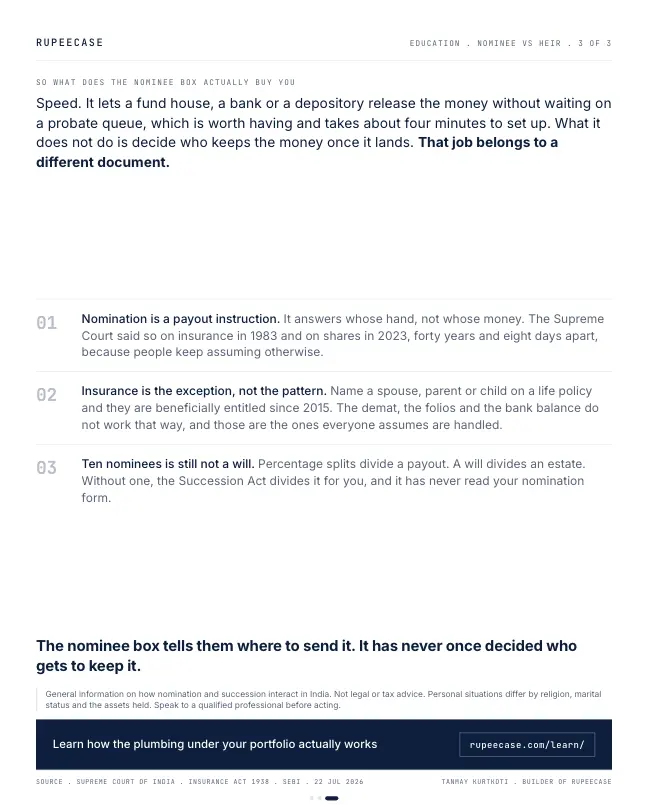
Honest version: nomination buys speed. It lets the money out without a probate queue, it takes four minutes, and it is worth doing. It is simply not the same job as deciding who keeps the money.
The nominee box tells them where to send it. It has never once decided who gets to keep it
Receiving and owning, in one picture
The opening's family has four Class I heirs: the widow, the mother and two children. Under the Act's rule of one share each, the Rs 80 lakh splits evenly, whatever the nomination form says about who receives it.
- Widow, also the nominee25%
- Mother25%
- First child25%
- Second child25%
Worked example from the opening: no will, Rs 80 lakh in demat and fund folios, four Class I heirs under the Hindu Succession Act 1956. Other personal laws divide differently.
The nominee holds Rs 60 lakh of that in trust for the other three. If the family agrees, the money moves without friction. If it does not, the nomination gives her no defence: succession law decides.
How the law got here
- Supreme Court, life insurance
A nominee is the hand authorised to receive, not the owner.
- Insurance law amended
A spouse, parent or child named as nominee on a life policy is beneficially entitled to the money.
- Supreme Court, company shares
Nomination under company law gives no absolute title; succession law prevails.
- SEBI revamps nomination
Up to ten nominees for a demat account or fund folio, with percentage shares.
- SEBI's modified norms apply
Up to three nominees, nomination by default on new single accounts unless you opt out.
The 29 May 2026 circular replaced the Jan 2025 framework, which had allowed up to ten nominees, from 1 Sep 2026. Beyond the limit of three and the default nomination on a new single holder account or folio, it adds one more rule: if no percentages are given, the holding is split equally, with any odd lot going to the first nominee. Existing accounts are covered too. None of these changes touches ownership. They make the money reach the people named faster. Who keeps it is still a question for a will or succession law.
Your own family's numbers
Two different jobs, two different documents
- NominationTells the depository or fund house whom to transmit to. Fast, no court process.
- TransmissionUnits or shares move to the nominee once the death is recorded with the depository or fund house.
- SuccessionA will, or the succession law that applies, decides who owns each rupee.
- SettlementThe nominee passes on each heir's share, or the heirs claim it.
MythUpdating nominees on every folio is estate planning.
FactNomination decides who receives. Ownership is decided by a will or by succession law. Without a will, a sole nominee among four Class I heirs owns a quarter.
None of this makes nomination less worth doing. It is the reason a family can get money out in weeks instead of months. The free Learn module on the SEBI regulatory framework covers how depositories, fund houses and SEBI's investor protection rules fit together, including nomination and transmission. Related: the Rs 1.25 lakh you forget every April.
Questions readers ask
Does a nominee become the owner of shares or mutual funds?
No. A nominee receives the shares or units on the holder's death, but ownership is decided by the will or by the succession law that applies. Without a will, a sole nominee among four Class I heirs under the Hindu Succession Act owns one quarter and holds the rest for the others.
How many nominees can I add to a demat account or mutual fund folio?
Up to three, under SEBI's circular of 29 May 2026, in effect from 1 Sep 2026. The earlier limit of ten, from the Jan 2025 circular, no longer applies. If no percentages are given, the holding is split equally among the nominees.
Is a life insurance nominee different from a demat nominee?
Yes. Since the 2015 amendment to insurance law, a spouse, parent or child named as nominee on a life policy is beneficially entitled to the money. A demat or fund nominee has no such status and holds the assets for the legal heirs.
The cards
3 cards. Swipe, or tap to open.

Related
- All in now, or drip it inVanguard's 1926 to 2022 data across seven markets shows a lump sum beat a three month drip about two times in three, and stretching the drip lowers the odds.Personal finance and tax . . 12 min
- The Rs 1.25 lakh you forget every AprilBooking about Rs 1.25 lakh of long term gains each year and rebuying cuts the exit tax on a Rs 96 lakh corpus from Rs 10.65 lakh to Rs 7.68 lakh.Personal finance and tax . . 5 min
- A loss you do not book is a rebate you do not claimBooking a Rs 60,000 short term loss against a Rs 1 lakh short term gain cuts the tax from Rs 20,000 to Rs 8,000, and unused losses carry eight years if you file on time.Personal finance and tax . . 10 min
Educational content only. Figures are illustrative and computed on historical or representative data for teaching purposes, not investment advice. Past performance does not guarantee future returns. Sourced from NSE, BSE, SEBI, AMFI and RBI public data.