

Personal finance and tax..5 min read
The clause that shrinks your health cover
A room at twice the policy's 1 percent daily cap settled the whole linked bill at half, turning a Rs 5 lakh cover into about Rs 2.5 lakh on the day it had to work.
By Tanmay Kurtkoti, founder of QC Alpha and builder of RupeeCase
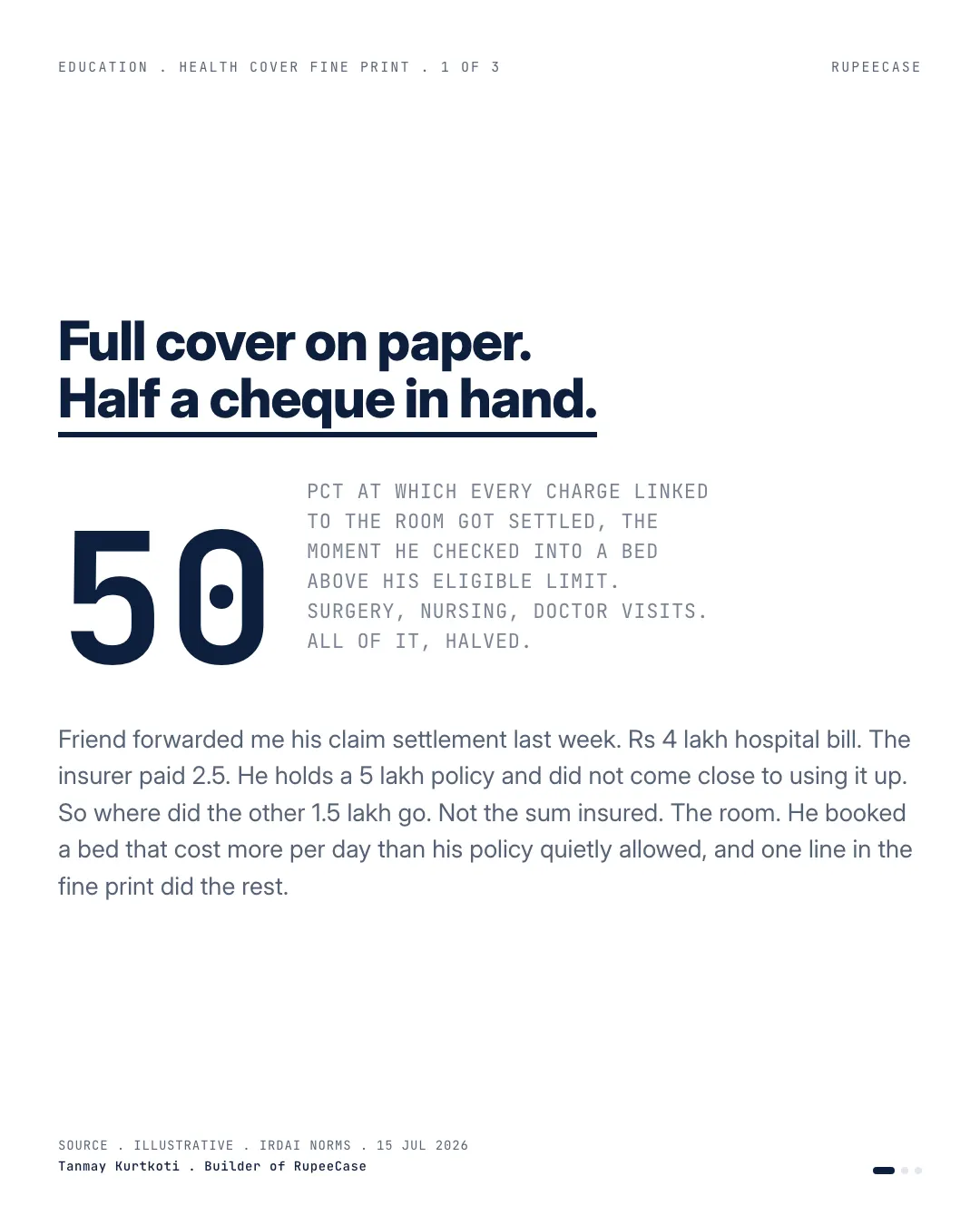
Friend forwarded me his health insurance claim settlement last week, half proud he was finally using the cover, half confused. Rs 4 lakh hospital bill. The insurer paid 2.5. He holds a 5 lakh policy. He did not come anywhere close to exhausting it. So he asked me the obvious thing. Where did the other 1.5 lakh go.
Not the sum insured. The room.
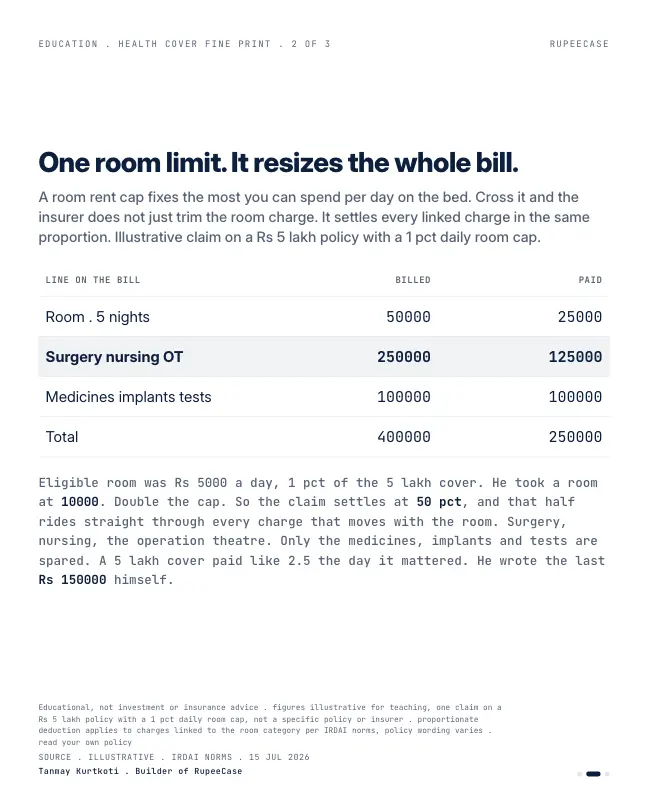
His policy caps room rent at 1 pct of the cover per day. On a 5 lakh policy that is Rs 5,000 a night. He checked into a room that cost 10,000. Twice the cap. Here is the part almost nobody reads until it is too late. When you cross the room limit, the insurer does not just trim the extra room charge. It settles the whole linked bill in the same proportion. His room was double the cap, so the claim paid at half.
That 50 pct rode straight through everything that moves with the room. The Rs 2.5 lakh of surgery and nursing came down to 1.25. The Rs 50,000 room bill came down to 25,000. Only the medicines, implants and tests sat outside the proportion and got paid in full. Add it up and a 5 lakh cover behaved like about 2.5 the one day it actually had to work. He wrote the last 1.5 lakh himself.
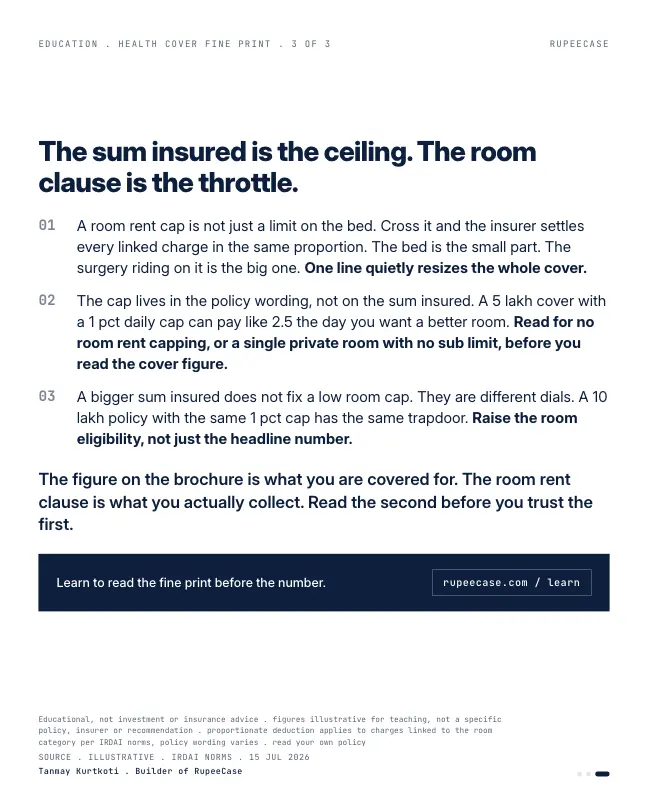
The lesson I keep repeating to anyone who will listen. The sum insured is the ceiling. The room rent clause is the throttle. And a bigger sum insured does not fix a low room cap, they are different dials, a 10 lakh policy with the same 1 pct cap has the same trapdoor.
So before you read the cover figure, read the room rent line. Look for no room rent capping, or a single private room with no sub limit. The number on the brochure is what you are covered for. The clause in the wording is what you actually collect.
The claim, line by line
Here is the friend's bill from the opening, split into the parts that moved with the room and the part that did not. The Rs 1 lakh of medicines, implants and tests is what is left of the Rs 4 lakh after surgery, nursing and room.
- Surgery and nursing, billedRs 2,50,000
- Surgery and nursing, paidRs 1,25,000
- Room, billedRs 50,000
- Room, paidRs 25,000
- Medicines, implants, testsRs 1,00,000
- Total paid on Rs 4 lakhRs 2,50,000
Worked example from the opening: Rs 5 lakh cover, room cap 1% a day (Rs 5,000), room taken Rs 10,000, so linked charges paid at 50%.
The arithmetic is a single ratio. Eligible room rent divided by actual room rent: 5,000 over 10,000, or 0.5. Every charge the policy treats as linked to the room is multiplied by that ratio. Which charges count as linked is set in each policy's wording, which is why the same hospital stay can settle differently under two policies with the same sum insured.
Run your own stay
Try doubling the sum insured to Rs 10 lakh with the same 1 percent cap. The cap rises to Rs 10,000 a night, so this room is now fully covered. Keep Rs 5 lakh and pick a Rs 5,000 room, and the claim pays in full too. Raise the room to Rs 20,000 on the Rs 10 lakh policy, and you are back at 50 percent. The opening's point holds: the ratio, not the cover, sets the payout.
The four lines to read before the sum insured
- Room rentIs there a cap per day, as a percent of cover or a rupee figure, or a room category?
- Proportionate deductionIf you exceed the cap, which charges are reduced in proportion?
- Sub limitsAre there separate caps for named surgeries or treatments?
- Co-payDo you pay a fixed share of every claim, for example at older ages?
MythA higher sum insured protects me from a big bill, whatever room I take.
FactA room cap scales the payout by eligible rent over actual rent. A Rs 20,000 room on a Rs 10 lakh policy with a 1 percent cap still pays linked charges at 50 percent.
Where cover sits in the plan
Health cover is the second line of the liquidity stack, after cash. A claim that pays half leaves the other half to the emergency fund, and if that is thin, to the portfolio at whatever price the market offers that week. The post on emergency fund first, risk profile second works out what a forced sale costs, and the emergency fund calculator sizes the cash. On tax: the deduction for health insurance premiums (80D in the old Act) is available only in the old regime; the e-filing portal's FAQ lists it among the Chapter VI-A deductions not allowed in the new regime. The free Learn module on risk management puts insurance, cash and position sizing in one frame. Related: term insurance and the sum assured.
Questions readers ask
What is a room rent limit in health insurance?
It is a cap on the room charge the policy will pay per day, often written as a percent of the sum insured, such as 1 percent, or as a room category. If you take a costlier room, many policies reduce other linked charges in the same proportion, not just the room charge.
What is proportionate deduction in a health insurance claim?
When the room exceeds the cap, the insurer pays linked charges at the ratio of the eligible rent to the actual rent. With a Rs 5,000 cap and a Rs 10,000 room, linked charges are paid at 50 percent, which turned a Rs 4 lakh bill into a Rs 2.5 lakh claim in the worked example.
Can I claim health insurance premium under the new tax regime?
No. The deduction for health insurance premiums is a Chapter VI-A deduction, which the e-filing portal's FAQ says cannot be claimed in the new regime. It remains available in the old regime.
The cards
3 cards. Swipe, or tap to open.
Related
- Term insurance: ten times income is the brochure ruleThe present value of a 35 year old's remaining earnings is about Rs 6.5 crore, not the Rs 2.5 crore a ten times income rule gives, and the extra cover costs about Rs 55 a day.Personal finance and tax . . 6 min
- The Rs 1.25 lakh you forget every AprilBooking about Rs 1.25 lakh of long term gains each year and rebuying cuts the exit tax on a Rs 96 lakh corpus from Rs 10.65 lakh to Rs 7.68 lakh.Personal finance and tax . . 5 min
- The minimum due trapPaying only the minimum on a Rs 1 lakh card balance takes 341 months and Rs 3,72,861 of interest, because 3.5 percent a month plus GST is 4.13 percent a month.Personal finance and tax . . 6 min
Educational content only. Figures are illustrative and computed on historical or representative data for teaching purposes, not investment advice. Past performance does not guarantee future returns. Sourced from NSE, BSE, SEBI, AMFI and RBI public data.