

Personal finance and tax..6 min read
The minimum due trap
Paying only the minimum on a Rs 1 lakh card balance takes 341 months and Rs 3,72,861 of interest, because 3.5 percent a month plus GST is 4.13 percent a month.
By Tanmay Kurtkoti, founder of QC Alpha and builder of RupeeCase
A friend told me over dinner that his credit card is under control.
Never missed a due date in his life. Pays the minimum due every month, on time, and feels responsible doing it. Most people at the table nodded. So I ran his numbers on a napkin.
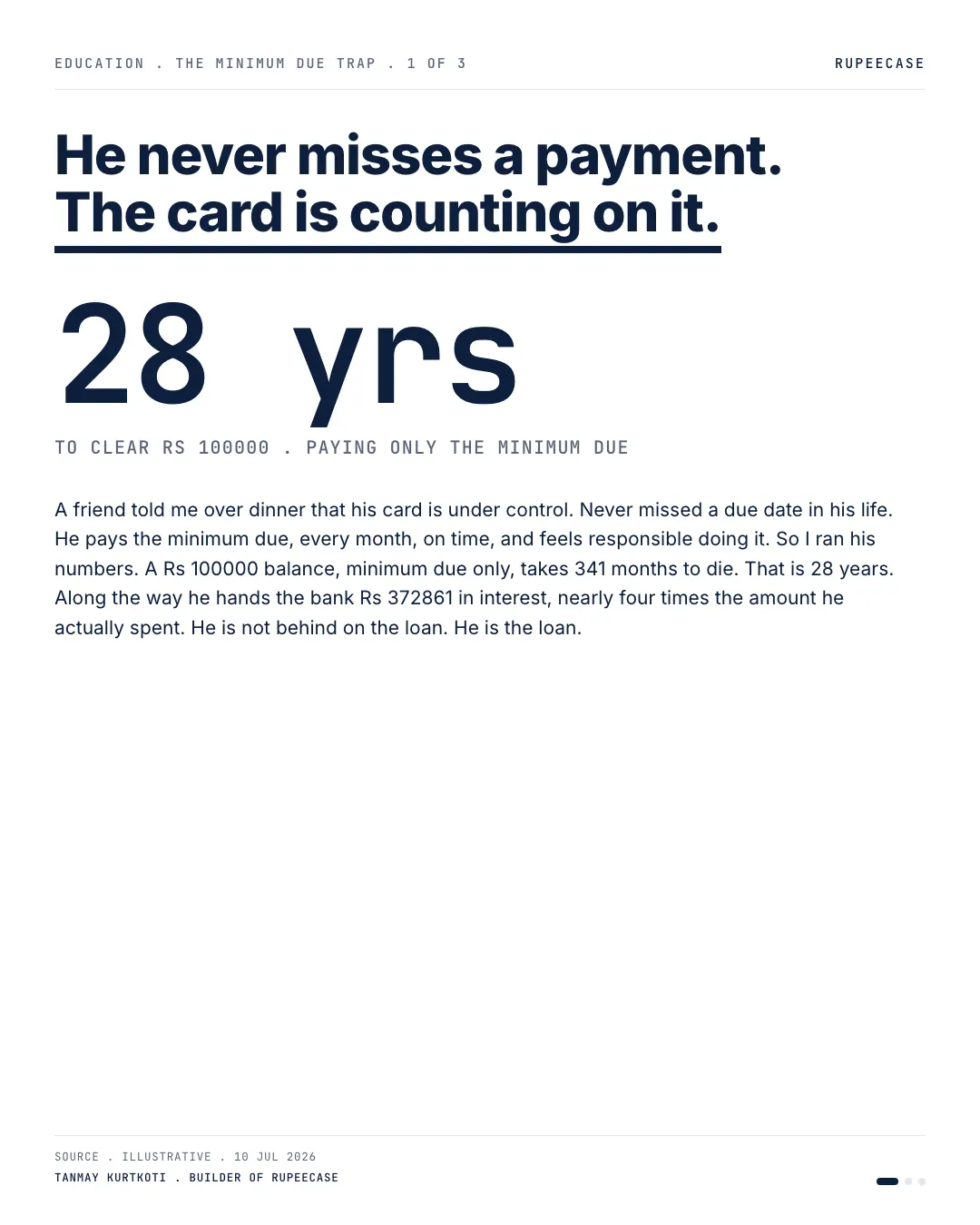
A Rs 1,00,000 balance, paying only the minimum due, takes 341 months to die. That is 28 years. Along the way he hands the bank Rs 3,72,861 in interest, nearly four times what he actually spent. He is not behind on the loan. He is the loan.
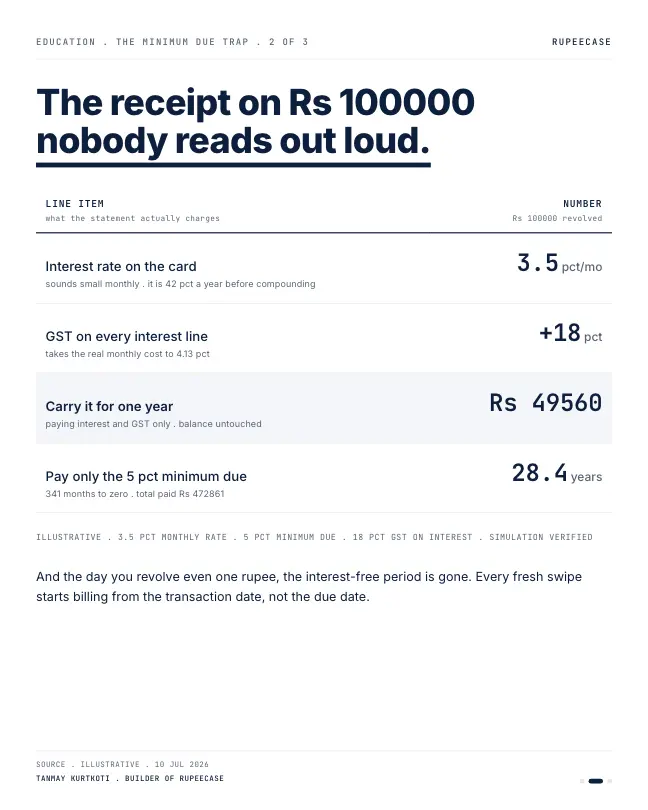
The arithmetic hides in plain sight. 3.5 percent a month sounds tiny. It is 42 percent a year before compounding. Then GST rides on every interest charge at 18 percent, which takes the real monthly cost to 4.13 percent. Just carrying that Rs 1,00,000 for one year, paying interest alone, costs Rs 49,560. Half the loan, paid as rent on the loan.
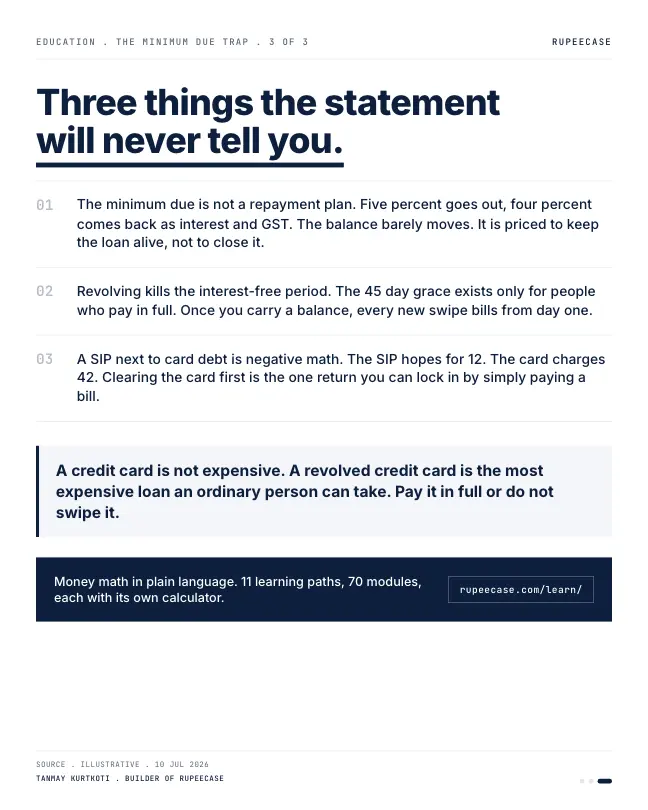
Two mechanics make it worse. The day you revolve even one rupee, the interest-free period stops existing. Every fresh swipe starts billing from the transaction date, not the due date. And the one I see most often: running a SIP next to card debt. The SIP hopes for 12. The card charges 42. That is borrowing at 42 to invest at 12, and the gap comes out of your pocket every month it runs.
Honest version: a credit card is not expensive. A revolved credit card is the most expensive loan an ordinary person can take. The minimum due is not a repayment plan. It is priced to keep the loan alive.
Pay it in full or do not swipe it.
How the 341 months were built
So you can redo it on paper, here are the assumptions behind the napkin. Interest and the GST on it together cost 4.13 percent of the balance each month. The minimum due is 5 percent of the statement amount, with a floor of Rs 200. No new spending.
Month one: interest of Rs 4,130 is added, the statement shows Rs 1,04,130, and the minimum due is Rs 5,206. He pays it. The balance drops to Rs 98,924. Of his Rs 5,206, only Rs 1,076 actually reduced the debt. The rest was the rent.
That ratio is the whole trap. Because the minimum is a percentage of a shrinking balance, the payment shrinks too. By year five he is paying about Rs 2,750 a month and still owes Rs 52,236. By year ten the payment is about Rs 1,440 and he owes Rs 27,286. The last years are spent at the Rs 200 floor, chipping at a tail.
Months to clear Rs 1 lakh at the minimum due
Worked example
Interest and GST paid along the way
Worked example
Of the first Rs 5,206 that cut the debt
Worked example
RBI saw this coming. Its Master Direction on credit and debit cards (21 Apr 2022, updated 7 Mar 2024) requires every billing statement to carry a warning that paying only the minimum stretches repayment over months or years with compounded interest. It also requires the minimum due to be set so the balance cannot grow on its own. So the minimum is designed to stop the debt from getting bigger. It is not designed to make it go away.
The same balance, three ways to pay it
Here is what changes when the payment is a fixed number instead of a percentage. Same Rs 1 lakh, same 4.13 percent a month.
Paying the minimum due clears Rs 1 lakh in 341 months; a fixed Rs 5,000 a month clears it in 44 months; a fixed Rs 10,000 in 14 months.
Balance at each year end. 4.13% a month including GST; minimum due 5% of the statement, floor Rs 200. Worked example.
The interest bill tells the same story. Minimum due only: Rs 3,72,861. A fixed Rs 5,000: about Rs 1,16,070 over 44 months. A fixed Rs 10,000: about Rs 31,660 over 14 months. The first Rs 5,000 payment is only Rs 206 smaller than the first minimum due. The difference is that it stays Rs 5,000.
Why the interest-free period disappears
The second mechanic in the post is the one people find hardest to believe, so here is the sequence. RBI's FAQ on the same Master Direction states it plainly: if the total amount due is not paid by the due date, the interest-free period is lost and interest may be charged from the date of each transaction.
- Statement, pay in fullEvery swipe rides free until the due date. This is the only state in which a card is free.
- Pay the minimum, or anything less than fullThe unpaid part starts charging interest, and the interest-free period is lost.
- New swipes while a balance revolvesInterest can run from the day of each transaction, not from the next due date.
- Clear the full outstandingThe step that ends the revolving state. Your card's terms say when the free period resumes.
So the Rs 2,000 dinner put on a revolving card is not free until the due date. It can start costing on the night of the dinner.
Put the rate next to every other rate
Numbers like 3.5 percent a month only look small because they are monthly. Put them on the same yearly scale as everything else in your financial life.
- Card, 4.13% a month compounded62.5%
- Card, 3.5% x 12, no GST42%
- SIP hope in the post12%
- RBI repo rate, Oct 20265.5%
Card and SIP rates: worked example. Repo rate 5.50% after the RBI policy of 7 Oct 2026.
The repo rate is what banks pay to borrow overnight from RBI; it was raised to 5.50 percent at the policy of 7 Oct 2026. A revolved card costs roughly eleven times that once the monthly compounding is counted.
Run the card's rate through the rule of 72 and you see the lender's side of the trade. Money compounding at 4.13 percent a month doubles in about 72 divided by 4.13, roughly 17 months. Here is the same check for any rate:
Card debt is leverage on the household
When I read a company's balance sheet, the question I ask is the one I ask of a household: what does the debt cost, and can the income carry it? A company borrowing at 62 percent to earn 12 percent on its assets would be gone in a few years. The free Learn module on leverage walks through how borrowing amplifies losses and why debt is the one risk that can end a plan outright. The same logic decides whether to prepay a loan or invest, and a quoted flat rate hides its true cost the same way a monthly card rate does.
Questions readers ask
How long does it take to clear a credit card balance paying only the minimum due?
On Rs 1 lakh at 3.5 percent a month plus GST, with a minimum due of 5 percent of the statement and a Rs 200 floor, it takes 341 months, about 28 years, and costs Rs 3,72,861 in interest and GST. A fixed Rs 5,000 a month clears the same balance in 44 months.
Do I lose the interest-free period if I pay only the minimum amount due?
Yes. RBI's FAQs on its credit card Master Direction say that if the total amount due is not paid by the due date, the interest-free period is lost and interest may be charged from the date of each transaction, including new purchases, until the full outstanding is cleared.
Is 3.5 percent a month really 42 percent a year?
It is 42 percent before compounding. With 18 percent GST on the interest the monthly cost becomes 4.13 percent, and compounded over 12 months that is about 62.5 percent a year.
The cards
3 cards. Swipe, or tap to open.
Related
- The flat rate trapA 10 percent flat car loan on Rs 6 lakh over five years costs Rs 1,35,000 more than a 10 percent reducing balance loan, a true rate near 17.3 percent.Personal finance and tax . . 4 min
- Rent vs buy: the two numbers the dead money line skipsMore than 80 paise of a first year EMI rupee is interest, rent runs about 3.5 percent of price against an 8.5 percent loan, and the down payment has an opportunity cost.Personal finance and tax . . 5 min
- Prepay or invest: the schedule decidesA Rs 5 lakh prepayment in month 12 of a Rs 50 lakh loan kills Rs 21.04 lakh of interest, and investing it still wins by about Rs 6 lakh at a post tax 9.36 percent.Personal finance and tax . . 13 min
Educational content only. Figures are illustrative and computed on historical or representative data for teaching purposes, not investment advice. Past performance does not guarantee future returns. Sourced from NSE, BSE, SEBI, AMFI and RBI public data.